Investors Leave Emerging Markets Behind

November 14, 2012 | Tom Salemy, CFA, CAIA, Partner

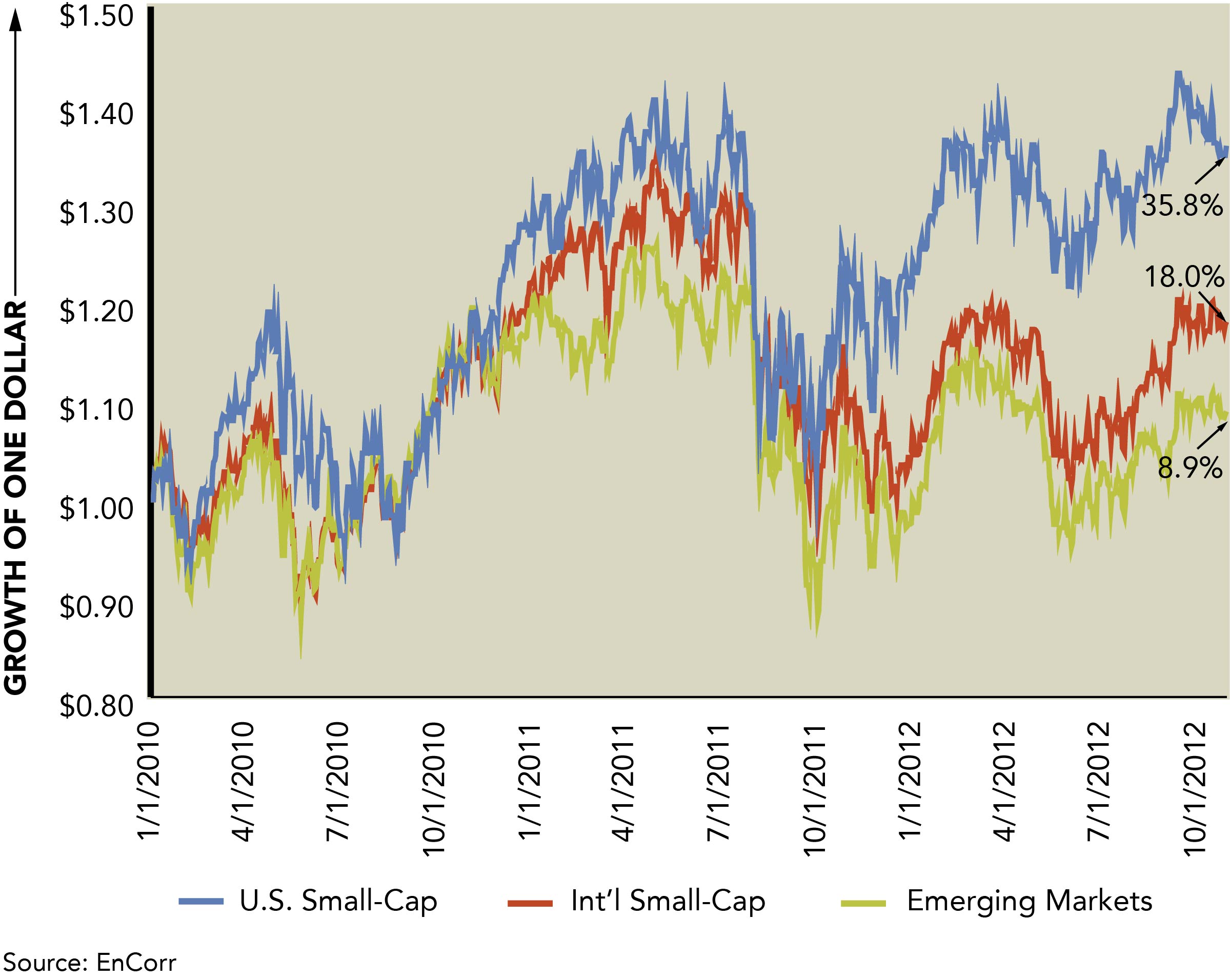
This week’s Chart of the Week highlights the relative underperformance of emerging market stocks compared to other “risky” asset classes. Since January 1, 2010, U.S. small-cap stocks1 have returned a cumulative 35.8% and international small-cap stocks2 have returned a cumulative 18% through October 2012. However, quite surprisingly, emerging market stocks3 are only up 8.9% over the same time-period.

Emerging market equities are still treated as a risk-on, risk-off investment. As the graph above illustrates, it appears that investors have returned to some of the riskier equity markets, but have left emerging markets behind. The underperformance of international small-cap and emerging market stocks compared to U.S. small-cap stocks is somewhat explained by investors’ continued concerns with Europe. However, when looking at one of the traditional valuation metrics, price-to-earnings (“P/E”) ratio, it appears that investors may be unfairly discounting emerging market stocks. As of 9/30/2012, U.S. small-cap, international small-cap, and emerging market stocks had P/E ratios of 33.7, 19.8, and 12.5, respectively.

Continued global economic and policy uncertainty suggests that this trend may persist. However, given their low P/E ratios, coupled with growth rates and fiscal health relative to developed countries, emerging market stocks should deliver long-term compelling returns, despite their recent struggles versus other risky equity indices.

1Represented by the Russell 2000 Index
2Represented by the S&P Developed ex. U.S. Small-Cap Index
3Represented by the MSCI Emerging Markets Index

Tom Salemy, CFA, CAIA
Partner

Get to Know Tom

The opinions expressed herein are those of Marquette Associates, Inc. (“Marquette”), and are subject to change without notice. This material is not financial advice or an offer to purchase or sell any product. Marquette reserves the right to modify its current investment strategies and techniques based on changing market dynamics or client needs.
Related Content

Combination column and line chart showing increase in non-renewables and renewables in net installed capacity (GW) in columns and share of new electricity generating capacity by renewables (line) annually since 2005. Renewables ave seen a marked increase in recent years (183.95GW in 2019 to 691.94GW in 2025). Renewable Share was at 86% for 2025. For full dataset, please contact marquettemarketing@marquetteassociates.com.

05.11.2026

A Renewed Focus on Renewables

In addition to the humanitarian toll of the conflict in Iran, the world is currently confronting the impact that trade…

Stacked column chart showing Weight in S&P 500 Index in 1985, 1995, 2005, 2015, and 2025 for top 10 companies at that time, with companies stacked for each year by weight. From 1985-2015, top 10 weight ranged from 17.6% to 21.1%, but 2025's weight was 40.6%. Company makeup changes over time, with no companies from 1985/1995 categories in 2025. For full dataset, please contact marquettemarketing@marquetteassociates.com.

05.04.2026

This Too Shall Reconstitute

Rooted in medieval Persian Sufi thought, the adage “this too shall pass” speaks to the fleeting and impermanent nature of…

Three-line chart comparing cumulative returns for MSCI EM Latin America Index, MSCI EAFE Index, and S&P 500 Index, Jan 1, 2026 through April 24, 2026. Dashed line at February 28 demarcates U.S. strikes on Iran. While all three indices dipped after war began, Latin America Index was higher to begin with and remains high. Most recent data point (4/24) for Latin America is 20.36%, EAFE is 5.7%, and S&P 500 is 5.06%. For full dataset, please email marquettemarketing@marquetteassociates.com.

04.27.2026

Let’s Hear It for Latin America

Latin American equity markets have shown remarkable strength in 2026. After a strong start to the year, the MSCI Emerging…

Two-line chart showing unemployment rate for All U.S. Workers and Recent College Graduates (Ages 22–27), 12/31/05 to 12/31/25. Up to 2020 period, Recent College Graduates generally had a lower unemployment rate than all U.S. workers category, but since then, the opposite has been true. Lines begin at ~3% to ~5% range in 2005, rose during Global Financial Crisis of '07-'09 to near 10% for All, ~7% for Grads, then both lines declined fairly steadily up to COVID. Peak for both series was 6/30/20, with All at 12.8% and Grads at 13.4%. Most recent data for 12/31/25 is ~4% for All and ~5.5% for Grads. For full dataset, please email marquettemarketing@marquetteassociates.com.

04.20.2026

The Sorrows of Young Workers

Entry-level jobs have traditionally served as the primary bridge between education and stable employment, offering young workers a foothold from…

Combination column and line chart showing Net Duties Received (columns, left-hand axis, ranging $0 to $35 billion) and Effective Tariff Rate (line, right-hand axis, ranging 0 to 12%) monthly, from April 2024 through February 2025. Up to March 2025, both data series held relatively steady, averaging around $7B for net duties received, and 2% for effective tariff rate, but both series have quadrupled since then. Most recent (Feb-26) is $26B and 8%. Please contact us for the full data set at marquettemarketing@marquetteassociates.com.

04.13.2026

Liberation Day: One Year Later

On April 2, 2025, President Donald Trump announced a sweeping set of tariffs on imports into the United States. Dubbed…

Line chart showing commercial & industrial loans as percent of total bank credit since 1980. Peak of line is September 1982 at 38%; since then there has been a steady decrease, with several peaks following global crises, with February 2026 datapoint at 21%. Basel I labeled at 1988, Basel II labeled at 2004, Basel III labeled at 2010. For full dataset, please contact marquettemarketing@marquetteassociates.com.

04.06.2026

Regulation Abdication?

The Basel capital framework was created to ensure that banks maintain sufficient capital to absorb losses and reduce the risk…

More articles

Subscribe to Research Email Alerts

Research Email Alert Subscription

Research alerts keep you updated on our latest research publications. Simply enter your contact information, choose the research alerts you would like to receive and click Subscribe. Alerts will be sent as research is published.

We respect your privacy. We will never share or sell your information.

Thank You

We appreciate your interest in Marquette Associates.

If you have questions or need further information, please contact us directly and we will respond to your inquiry within 24 hours.

Contact Us >