PE Tapping Public Market Strength

July 20, 2021 | Hayley McCollum, Senior Research Analyst

Two charts showing private equity exit activity. Chart subtitle: PE exits and exits via IPO have increased meaningfully YTD. First chart description: Left y-axis for columns shows PE exits by billions of dollars, ranging from $0-450. X-axis shows years 2011-H1 2021. Right y-axis for line shows exit count ranging from 0-1400. 2021 so far has had 676 exits at a value of $356 billion, on pace to beat the records of 1328 exits in 2015 and $421 billion in exit value in 2018. Second chart description: Stacked column chart showing percentage of exits by type from 2011 through H1 2021. At bottom of each column, corporate acquisition, middle category is public listing, and top of column is sponsor acquisition. 2021 has seen a significant increase in public listings so far. Note: Latest available 3Q20 Federal Debt as % of GDP used as proxy for 4Q20 Federal Debt as % of GDP. Chart source: PitchBook; U.S. data as of June 30, 2021.

Private equity exits are set to break record numbers in 2021. In 2020, there were 947 exits worth $367 billion, and in 2019 there were 1,111 for a total $323 billion. Already this year, in the first half of 2021, there have been 676 exits for $356 billion. At this pace, the year is on track to surpass both the previous highs of 1,328 exits in 2015 and $421 billion in exit value in 2018.

Along with the number of exits increasing overall, the percentage of exits via IPO has increased significantly this year. In 2019, the fear of a recession kept private companies from wanting to go public. Once a private company hits the market, PE sponsors keep their shares, now subject to public market dynamics, for an average of three years. Risk of a looming recession or lack of confidence in the public market can deter private company owners from pursuing this path. Alternatively, the increased use of public market exits year-to-date may represent private owners’ more bullish outlook on the market. We will continue to look to leading indicators like private market sentiment to help inform our own market expectations and client recommendations.

Print PDF > PE Tapping Public Market Strength


The opinions expressed herein are those of Marquette Associates, Inc. (“Marquette”), and are subject to change without notice. This material is not financial advice or an offer to purchase or sell any product. Marquette reserves the right to modify its current investment strategies and techniques based on changing market dynamics or client needs.

Hayley McCollum
Senior Research Analyst

Get to Know Hayley

The opinions expressed herein are those of Marquette Associates, Inc. (“Marquette”), and are subject to change without notice. This material is not financial advice or an offer to purchase or sell any product. Marquette reserves the right to modify its current investment strategies and techniques based on changing market dynamics or client needs.
Related Content

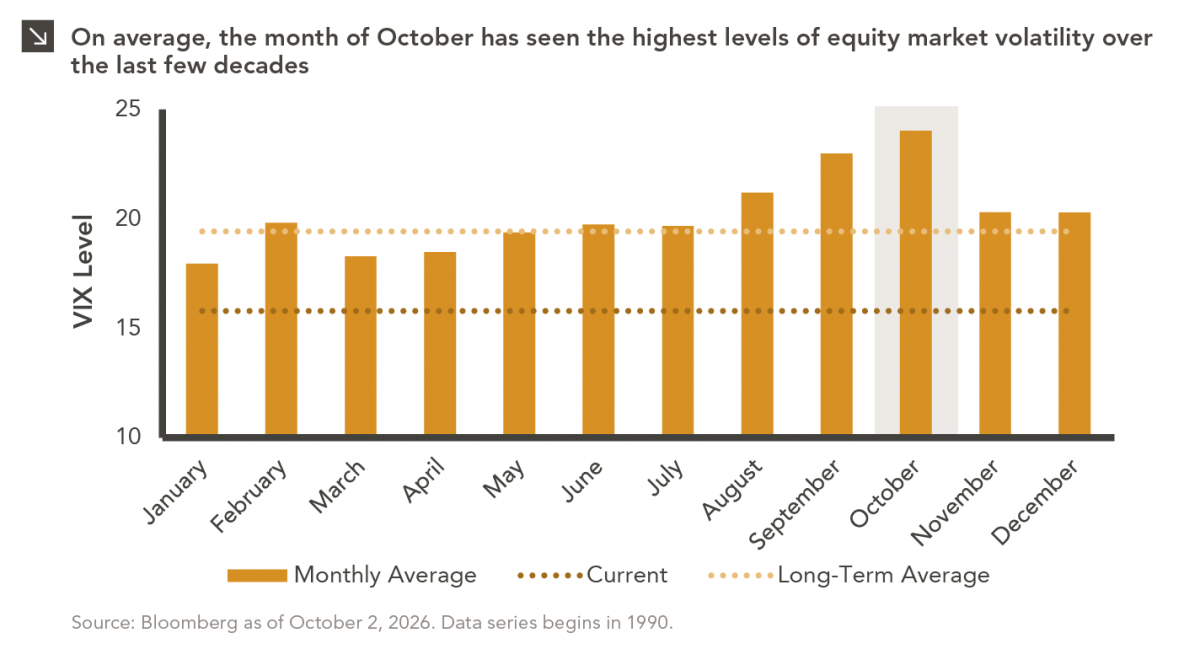
Bar chart showing average monthly VIX levels from 1990 through October 2026. The x-axis displays months of the year from January through December, and the y-axis displays VIX level. October has the highest average VIX level among all months, while April has the lowest. The chart also includes a current VIX level and a long-term average VIX level for comparison. Source: Bloomberg as of October 2, 2026. Data series begins in 1990. For full dataset, please contact marquettemarketing@marquetteassociates.com.

10.05.2026

Spooky Season

For investors, the spookiest thing about October might not be the ghosts and monsters that are bound to show up…
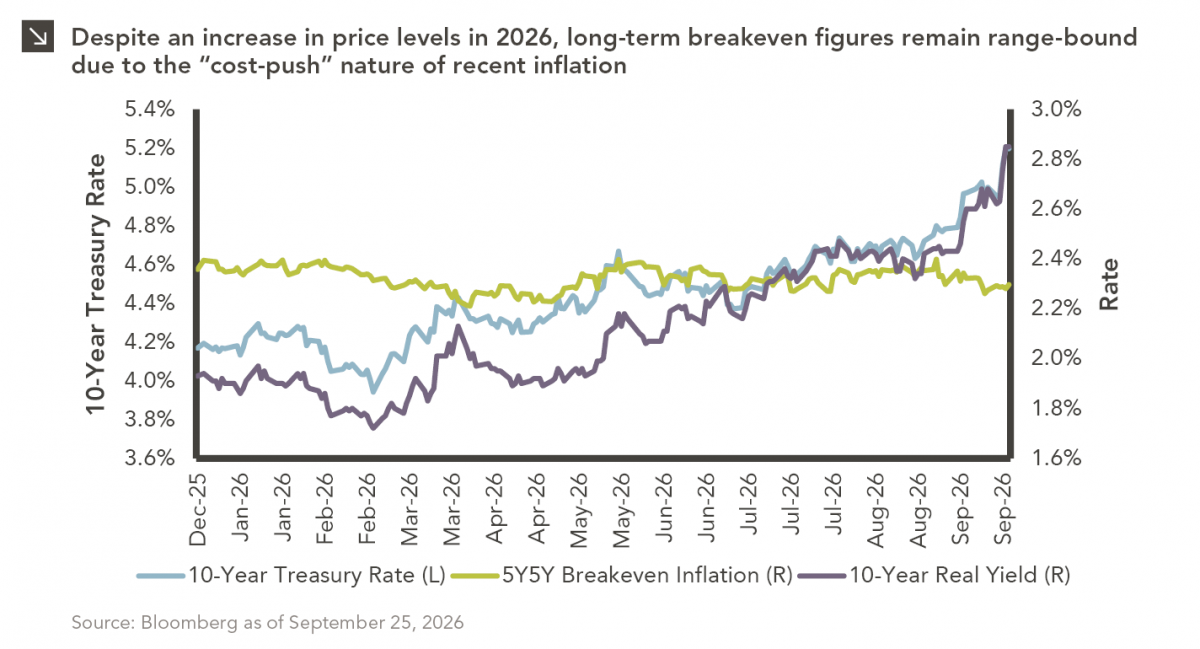
Line chart showing 10-year U.S. Treasury rate, 5-year/5-year breakeven inflation rate, and 10-year real yield from December 2025 through September 2026. The left axis shows rates from 3.6% to 5.4%, and the right axis from 1.6% to 3.0%. The Treasury rate and real yield rise notably in late 2026, while the breakeven inflation rate remains relatively range-bound around 2.3%–2.4%. For full dataset, please contact marquettemarketing@marquetteassociates.com.

09.28.2026

Getting Real on Inflation

The phrase “expectations of higher inflation” has become a staple in financial news to explain the increase in nominal U.S….
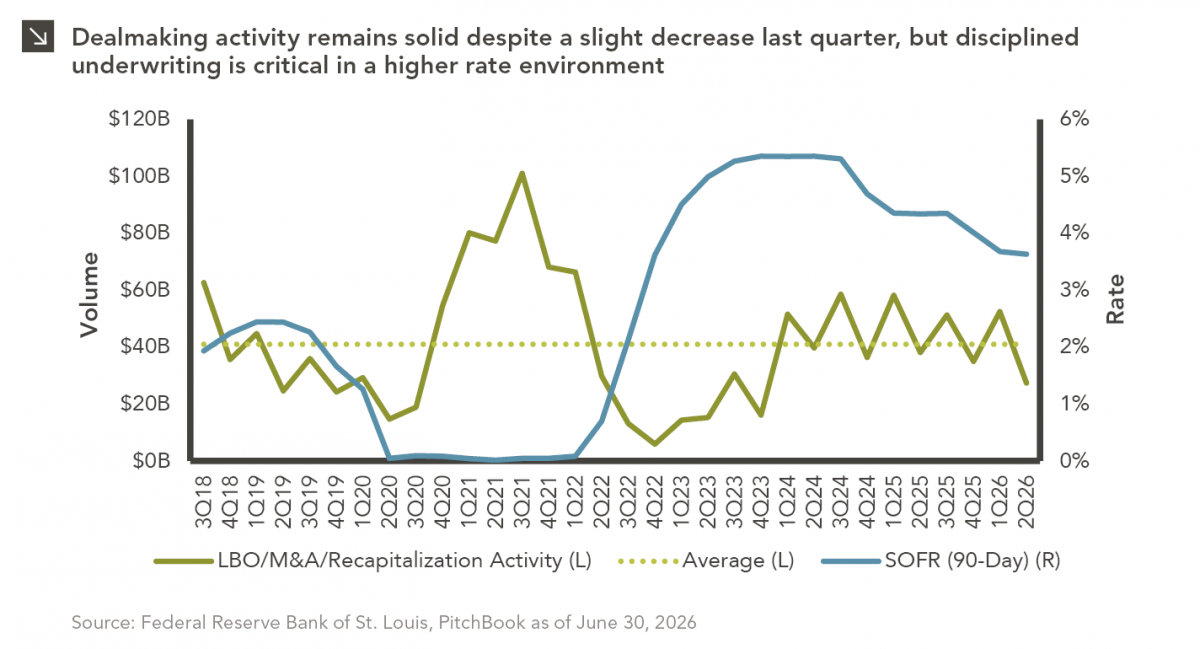
Dual-axis line chart comparing LBO/M&A/Recapitalization Activity, its average level, and the SOFR (90-Day) rate from 3Q18 through 2Q26. LBO/M&A/Recapitalization Activity ranges from approximately $0 billion to $100 billion, while SOFR ranges from 0% to approximately 5%. For full dataset, please contact marquettemarketing@marquetteassociates.com.

09.21.2026

Let’s Make a Deal

For much of the past several years, the conventional view has been that higher interest rates and stretched valuations would…

09.15.2026

Continuation Vehicles: Worth the Wait?

Over the past decade, continuation vehicles (“CV”) have become one of the fastest-growing trends in private equity. Private equity funds…
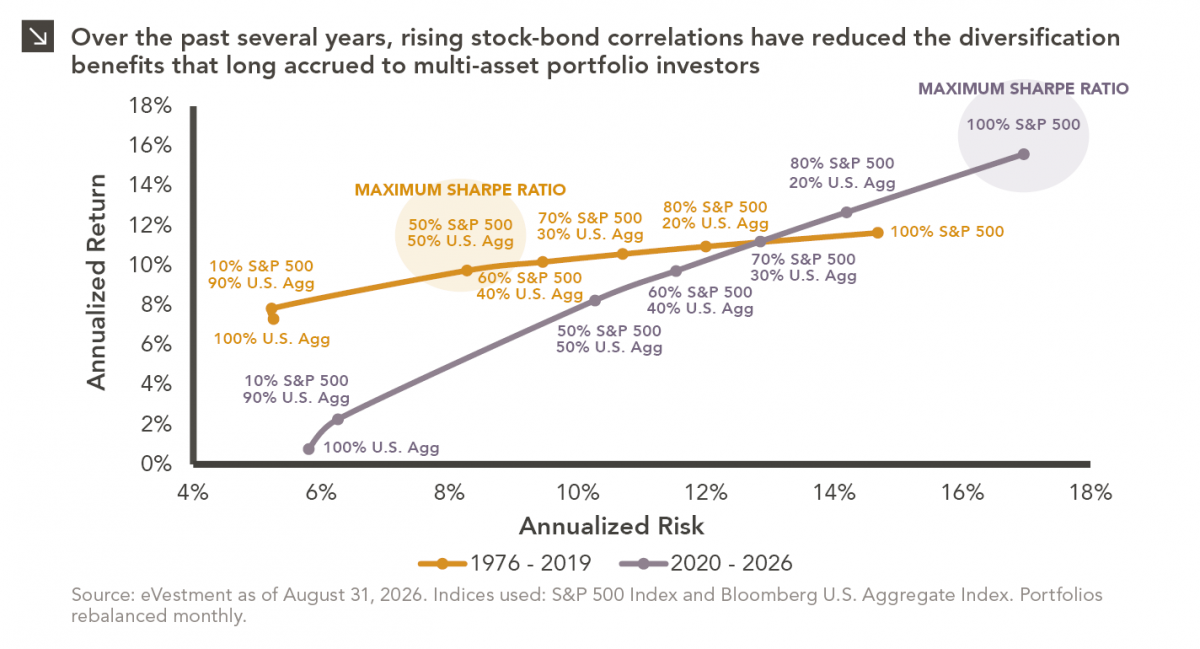
Line chart comparing annualized return and annualized risk for stock-bond portfolio combinations from 1976-2019 and 2020-2026. Two lines show the range of return and risk outcomes across portfolio allocations during each period. For full dataset, please contact marquettemarketing@marquetteassociates.com.

09.14.2026

No More Free Lunch?

There are many great things about working at Marquette Associates, but “Free Lunch Tuesday” is right at the top of…
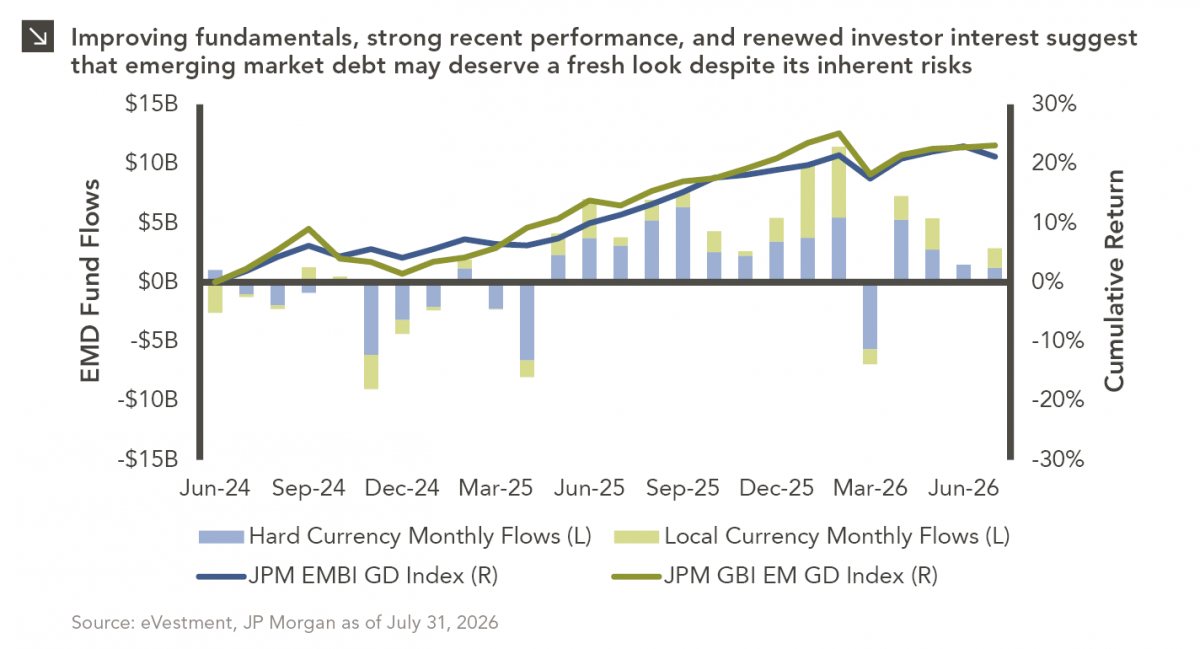
Combination stacked column and line chart comparing EMD fund flows (columns) and index cumulative returns (lines), June 2024 to present. Indices used: JPM EMBI GD Index and JPM GBI EM GD Index. Since May 2025, Monthly Flows have been positive, with the exception of March 2026. Most recent datapoint: July 31, 2026 Hard Currency Flows $1.2B, Local Currency $1.6B, JPM EMBI GD Index at 21.2%, JPM GBI EM GD Index at 23.1%. For full dataset, please contact marquettemarketing@marquetteassociates.com.

09.08.2026

EMD’s Second Chance?

Over the last several years, emerging market debt (EMD) has faced several headwinds, with rising yields across other fixed income…

More articles

Subscribe to Research Email Alerts

Research Email Alert Subscription

Research alerts keep you updated on our latest research publications. Simply enter your contact information, choose the research alerts you would like to receive and click Subscribe. Alerts will be sent as research is published.

We respect your privacy. We will never share or sell your information.

Thank You

We appreciate your interest in Marquette Associates.

If you have questions or need further information, please contact us directly and we will respond to your inquiry within 24 hours.

Contact Us >