EMD’s Second Chance?

Over the last several years, emerging market debt (EMD) has faced several headwinds, with rising yields across other fixed income sectors narrowing the traditional yield advantage of the space. While many investors have overlooked or even exited EMD funds as a result of these challenges, recent developments have driven some investors back to the asset class. For instance, many emerging market countries have implemented meaningful structural reforms, particularly following the economic challenges associated with the COVID-19 pandemic. These countries have made progress in reducing inflation, managing government spending, and strengthening monetary and fiscal policy frameworks. Additionally, the continued development of domestic investor bases for local-currency debt has improved countries’ ability to withstand external shocks and reduced their reliance on foreign capital flows. Sovereign credit fundamentals have also improved, with credit upgrades gradually outpacing downgrades across the emerging market universe.

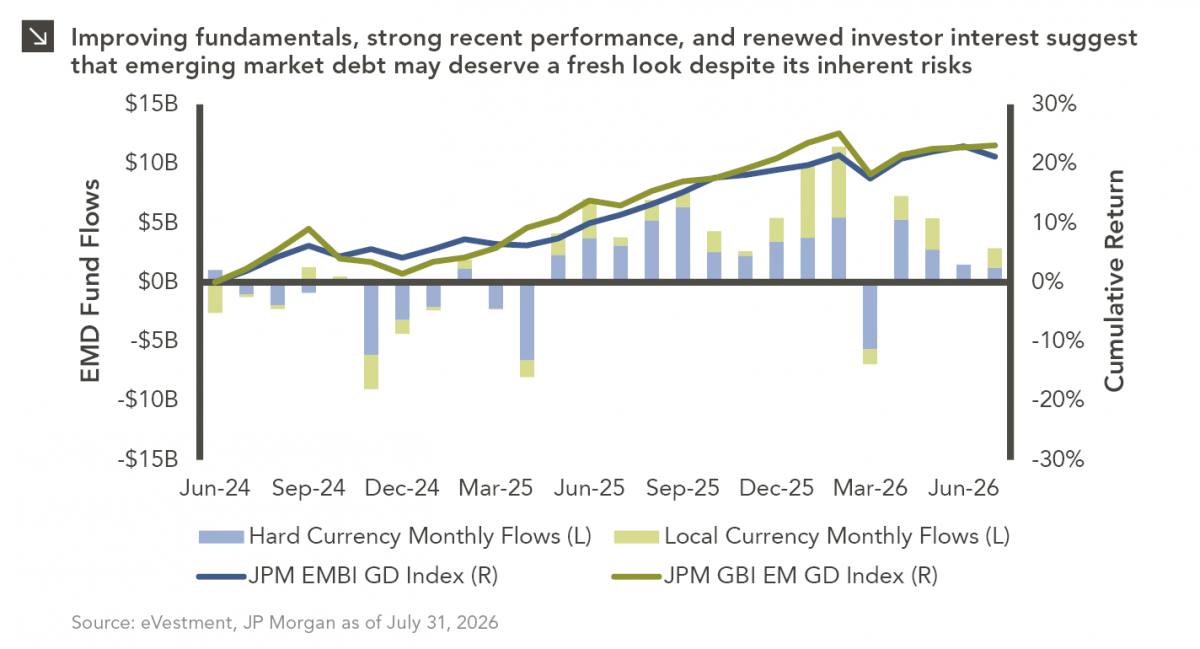
As some of the traditional risks associated with emerging market bond investing have moderated, performance has improved. To that point, EMD was the top-performing major fixed income asset class in 2025, and this momentum has continued so far this year. As of July 31, hard- and local-currency EMD indices have both returned roughly 1.8% on a year-to-date basis, respectively, outpacing high yield and core bonds over the same timeframe. Additionally, since the end of 2024, these indices have returned 10.1% and 13.1%, respectively. For context, the key difference between these indices is that local-currency debt exposes investors to both interest rate and currency movements, whereas hard-currency debt largely eliminates direct exposure to the issuing country’s currency.

Improving fundamentals have also supported renewed capital flows into the asset class. According to EPFR, cumulative EMD fund inflows for 2026 surpassed $31 billion as of the end of July. It is important to note that the composition of those flows is evolving. Historically, hard-currency debt has dominated investor allocations, but more than 50% of EMD fund flows have been directed toward local-currency strategies in 2026. Several factors could be contributing to this dynamic, including a weaker U.S. dollar, attractive local interest rates, improving macroeconomic fundamentals, and growing confidence in the stability of emerging market currencies.

All of this being said, EMD remains a complex asset class that poses risks related to interest rates, currencies, sovereign credit quality, and capital flows. Foreign investment flows can also introduce volatility during periods of market stress and risk-off environments. Nevertheless, the recent outperformance of EMD indices has clearly not gone unnoticed by investors, and the improving fundamentals and diversification benefits offered by the asset class suggest that it may deserve a second chance.


2026 Halftime Market Insights

This video is a recording of a live webinar held July 23 by Marquette’s research team analyzing the first half of 2026 across the economy and various asset classes as well as themes we’ll be monitoring in the coming months.


Our quarterly Market Insights series examines the primary asset classes we cover for clients including the U.S. economy, fixed income, U.S. and non-U.S. equities, hedge funds, real assets, and private markets, with commentary by our research analysts and directors.

Featuring:
Greg Leonberger, FSA, EA, MAAA, FCA, Partner, Director of Research
Frank Valle, CFA, CAIA, Associate Director of Fixed Income
James Torgerson, Senior Research Analyst
Fred Huang, Research Analyst
David Hernandez, CFA, Director of Traditional Manager Search
Evan Frazier, CFA, CAIA, Senior Research Analyst
Dennis Yu, Research Analyst
Amy Miller, Associate Director of Private Equity
Hayley McCollum, Senior Research Analyst

Sign up for research alerts to be invited to future webinars and notified when we publish new videos.

3Q 2025 Market Insights

This video is a recording of a live webinar held October 22 by Marquette’s research team analyzing the third quarter across the economy and various asset classes as well as themes we’ll be monitoring through the rest of 2025.

Our quarterly Market Insights series examines the primary asset classes we cover for clients including the U.S. economy, fixed income, U.S. and non-U.S. equities, hedge funds, real assets, and private markets, with commentary by our research analysts and directors.

Featuring:
Greg Leonberger, FSA, EA, MAAA, FCA, Partner, Director of Research
Frank Valle, CFA, CAIA, Associate Director of Fixed Income
James Torgerson, Senior Research Analyst
Catherine Hillier, Senior Research Analyst
David Hernandez, CFA, Director of Traditional Manager Search
Evan Frazier, CFA, CAIA, Senior Research Analyst
Dennis Yu, Research Analyst
Amy Miller, Associate Director of Private Equity

Sign up for research alerts to be invited to future webinars and notified when we publish new videos.

If you have any questions, please send our team an email.

2025 Halftime Market Insights

This video is a recording of a live webinar held July 17 by Marquette’s research team analyzing the first half of the year across the economy and various asset classes as well as themes we’ll be monitoring through the rest of 2025.


Our quarterly Market Insights series examines the primary asset classes we cover for clients including the U.S. economy, fixed income, U.S. and non-U.S. equities, hedge funds, real assets, and private markets, with commentary by our research analysts and directors.

Featuring:
Greg Leonberger, FSA, EA, MAAA, FCA, Partner, Director of Research
Frank Valle, CFA, CAIA, Associate Director of Fixed Income
James Torgerson, Senior Research Analyst
Catherine Hillier, Senior Research Analyst
David Hernandez, CFA, Director of Traditional Manager Search
Evan Frazier, CFA, CAIA, Senior Research Analyst
Dennis Yu, Research Analyst
Amy Miller, Associate Director of Private Equity
Chad Sheaffer, CFA, CAIA Senior Research Analyst

Sign up for research alerts to be invited to future webinars and notified when we publish new videos.

If you have any questions, please send our team an email.

Policy Uncertainty Blurs the Outlook

As we enter the second half of the year, Liberation Day-induced market volatility seems like a distant memory with the S&P hitting another all-time high on July 10th and non-U.S. stocks significantly outpacing their U.S. counterparts through June 30th. Meanwhile, the One Big Beautiful Bill was signed into law by President Trump on July 4th with varying expectations on its impact to growth but a consensus view that it will push the deficit higher.

In this edition:

  • Tariff and policy uncertainty
  • Risk factors and market indicators
  • Equity market drivers
  • Currency and regional trends
  • What to watch in the second half

1Q 2025 Market Insights

This video is a recording of a live webinar held April 16 by Marquette’s research team analyzing the first quarter of 2025 (and recent weeks) across the economy and various asset classes as well as themes we’ll be monitoring in the coming months.

Our Market Insights series examines the primary asset classes we cover for clients including the U.S. economy, fixed income, U.S. and non-U.S. equities, hedge funds, real estate, infrastructure, private equity, and private credit, with presentations by our research analysts and directors.

Featuring:
Greg Leonberger, FSA, EA, MAAA, FCA, Partner, Director of Research
Frank Valle, CFA, CAIA, Associate Director of Fixed Income
Catherine Hillier, Senior Research Analyst
David Hernandez, CFA, Director of Traditional Manager Search
Evan Frazier, CFA, CAIA, Senior Research Analyst
Dennis Yu, Research Analyst
Hayley McCollum, Senior Research Analyst
Chad Sheaffer, CFA, CAIA Senior Research Analyst

Sign up for research alerts to be invited to future webinars and notified when we publish new videos.

If you have any questions, please send our team an email.


2025 Market Preview Video

This video is a recording of a live webinar held January 16 by Marquette’s research team analyzing 2024 across the economy and various asset classes as well as themes we’ll be monitoring in 2025.

Our Market Insights series examines the primary asset classes we cover for clients including the U.S. economy, fixed income, U.S. and non-U.S. equities, hedge funds, real estate, infrastructure, private equity, and private credit, with presentations by our research analysts and directors.

Featuring:
Greg Leonberger, FSA, EA, MAAA, FCA, Partner, Director of Research
Frank Valle, CFA, CAIA, Associate Director of Fixed Income
James Torgerson, Research Analyst
Catherine Hillier, Senior Research Analyst
David Hernandez, CFA, Director of Traditional Manager Search
Evan Frazier, CFA, CAIA, Senior Research Analyst
Dennis Yu, Research Analyst
Michael Carlton, Research Analyst
Chad Sheaffer, CFA, CAIA Senior Research Analyst

Sign up for research alerts to be invited to future webinars and notified when we publish new videos.

If you have any questions, please send our team an email.

Multi-Asset Credit: Taking Offense From Good to Great

Before the football season began, we authored a white paper that detailed offensive and defensive elements of a fixed income portfolio. For most investors, an aggregate (core) mandate provides defense while strategic allocations to high yield, senior secured loans, and emerging market debt (EMD) are the primary sources of offense. Relative to an aggregate benchmark, this structure has outperformed over market cycles. However, just as championship teams adjust and innovate throughout a season, so too should an investor’s portfolio.

Multi-Asset Credit (MAC) strategies are single portfolios that dynamically allocate across a broad range of global credit markets to provide higher levels of income and a diversity of fixed income exposures. These mandates can serve as a single-solution credit allocation or as a credit alpha overlay in the context of a broader credit portfolio. There is no perfect definition of MAC, but what they do offer is diversification, flexibility, and ease of access and operations. While these markets are not new, investors may be unfamiliar with the mechanics of a MAC strategy and its potential benefits.

This newsletter provides an overview of MAC, including the opportunity set, allocation structure and considerations, diversification benefits, and sample MAC manager performance.

1Q 2024 Market Insights Video

This video is a recording of a live webinar held April 25 by Marquette’s research team analyzing the first quarter of 2024 across the economy and various asset classes and themes we’ll be monitoring in the coming months.

Our quarterly Market Insights series examines the primary asset classes we cover for clients including the U.S. economy, fixed income, U.S. and non-U.S. equities, hedge funds, real assets, and private markets, with commentary by our research analysts and directors.

Sign up for research alerts to be invited to future webinars and notified when we publish new videos. If you have any questions, please send us an email.

Emerging From the Depths: An Overview of the Emerging Market Debt Opportunity Set

Emerging market debt (EMD) has earned a checkered reputation at best from institutional investors. The asset class is large, complex, and comes with unique risks that can lead to “throwing the baby out with the bath water” when things go wrong. 2022 was a challenging year for investors across asset classes, and emerging markets headlines ranging from the meltdown in Chinese property developers to Russia’s invasion of Ukraine only complicated the investment case for EMD. That said, historically the asset class has tended to rebound strongly from drawdown events, and that has so far been the case this year.

This newsletter revisits the dynamics of emerging markets debt, reviews 2022 performance, and discusses the investment opportunity from here.

Read > Emerging From the Depths: An Overview of the Emerging Market Debt Opportunity Set


The opinions expressed herein are those of Marquette Associates, Inc. (“Marquette”), and are subject to change without notice. This material is not financial advice or an offer to purchase or sell any product. Marquette reserves the right to modify its current investment strategies and techniques based on changing market dynamics or client needs.