Will Higher Rates Cramp the Markets?

Anyone who has run a marathon knows the last six miles are brutal — no matter how well the first 20 miles went, it’s really about how each runner can handle the cramps and pain of the remaining course. The outcome tends to be rather binary — it’s either the worst running experience of someone’s life (mine) or when the strongest push through and finish strong (one of our research colleagues in this year’s Chicago marathon).

This year’s market feels similar. Through September 30, most stock indices are headed for their fourth consecutive year of double-digit returns, but the massive run-up of rates in the third quarter reminds us how quickly markets can change. Nothing will be final until we cross the finish line on December 31.

Long Weakened

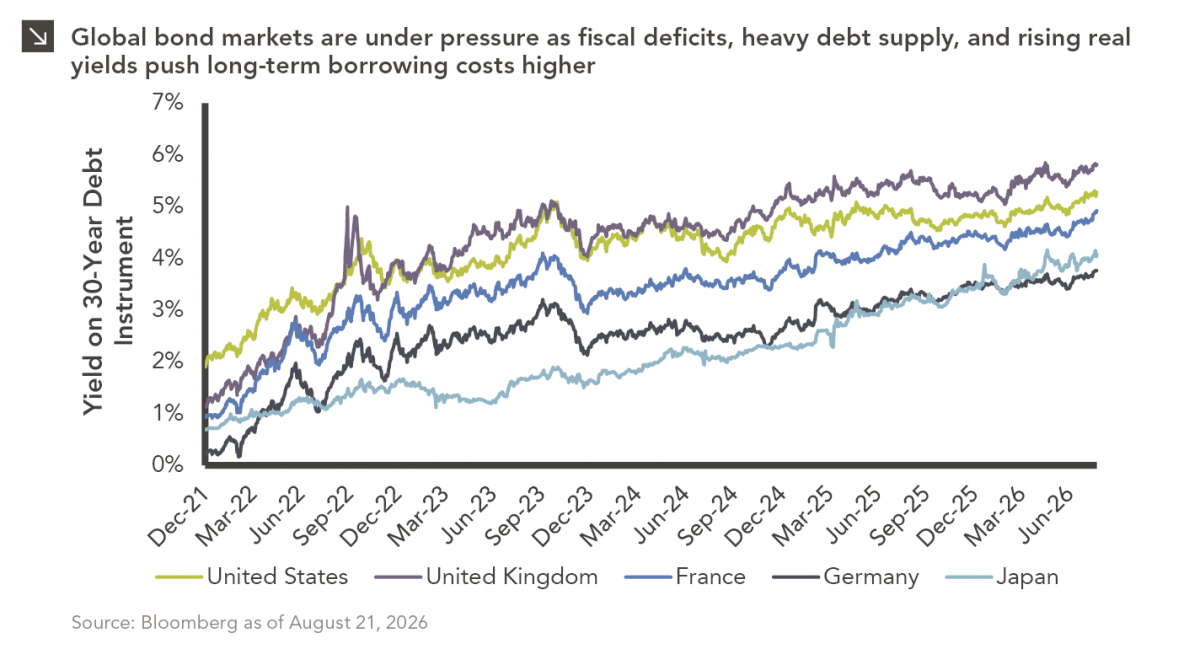
The global bond market is facing renewed pressure as investors demand higher yields to hold long-dated government debt, pushing borrowing costs in several developed economies to extreme levels relative to recent history. For instance, the 30-year U.S. Treasury yield sits at nearly 5.3% as of this writing, near its highest level since 2007, after rising more than 40 basis points in the last two months. Additionally, 30-year borrowing costs in France recently reached their highest level since 2008, long-term yields in Germany have moved to levels not seen in more than 15 years, 30-year gilt yields have approached 6%, and comparable Japanese yields are near record highs.

While some country-specific factors are contributing to this sell-off, many of the drivers are global in nature. For instance, governments are running significant deficits at a time when interest rates remain well above the exceptionally low levels that prevailed for much of the past decade. In the U.S., interest expenses on the national debt have become an increasingly important contributor to the budget deficit, with fiscal-year-to-date interest costs now above $1.1 trillion as higher Treasury yields raise the government’s financing bill. It is important to note that the current environment also differs from previous periods of rising deficits. Historically, fiscal deterioration has often occurred alongside economic weakness, prompting central banks to cut interest rates and provide support to government bonds. Today, however, governments are adding to borrowing needs while monetary policy remains relatively restrictive. This dynamic could keep upward pressure on long-term yields even if central banks eventually begin lowering short-term rates.

Another important development is the changing composition of sovereign bond market investors. While government bonds have traditionally benefited from steady demand from institutions (e.g., pension funds and other liability-driven entities), demographic changes, pension reforms, and regulatory developments are impacting that demand. Consequently, governments are increasingly dependent on private investors, who are generally more sensitive to valuation and expected returns. This dynamic is particularly important at the long end of the curve, where the additional yield investors require to own longer-dated securities (i.e., the term premium) can have an outsized impact on borrowing costs. Government debt is also competing with a rapidly expanding supply of corporate bonds, as the capital requirements associated with artificial intelligence infrastructure have prompted technology-oriented companies to raise unprecedented amounts of debt (much of which is concentrated in longer maturities). As a result, bond investors now have more opportunities to deploy capital, and issuers must compete for that demand by offering attractive yields. Inflation is another reason investors have become less comfortable locking in yields for decades. The conflict in the Middle East has pushed energy prices higher, raising concerns about renewed inflationary pressures and the possibility that central banks could be forced to maintain restrictive monetary policy for longer than previously anticipated. That risk is particularly problematic for long-duration bonds, which have prices that are highly sensitive to changes in interest rates and inflation expectations. It should be noted, however, that the recent increase in long-term yields has not been driven entirely by rising inflation expectations, as long-dated inflation breakevens have remained largely contained across major markets. Instead, a significant portion of the increase has come from higher real yields (i.e., the inflation-adjusted compensation investors receive for owning bonds). That distinction is important because if real yields continue to rise because investors are demanding greater compensation for fiscal and economic uncertainty, long-term bonds could remain under pressure even without a major acceleration in expected inflation. The deterioration in long-term borrowing conditions is already influencing how governments approach debt issuance. For instance, the United Kingdom has reduced its planned issuance of longer-dated bonds and increased its reliance on shorter maturities. The problem with this approach is that shortening maturities does not eliminate underlying fiscal burdens but rather shifts more debt into the near-term refinancing pipeline. This leaves governments more exposed to future interest-rate movements. The U.S. Treasury is also taking steps to support liquidity in the long-end of the market, recently doubling the size of planned buybacks of longer-dated Treasuries to at least $4 billion per operation. While this initiative may provide some near-term support, its initial impact was short-lived, underscoring the challenge policymakers face in addressing the broader fiscal and supply-demand forces driving long-term yields higher.

One of the key takeaways here is that the long ends of yield curves across major economies are increasingly being shaped by forces that extend beyond traditional monetary policy expectations, with even the U.S. Treasury taking steps to support demand and liquidity in longer-dated bonds. Additionally, investors should note that rising long-term yields raise the discount rates applied to future corporate earnings, potentially creating a difficult backdrop for growth-oriented companies whose valuations depend heavily on cash flows expected many years in the future. On the positive side, the repricing in long-duration bonds could eventually create opportunities for investors with fresh capital, as higher real yields provide a more attractive starting point for long-term fixed income returns. The key question is whether yields are now high enough to compensate investors for the fiscal, inflationary, and supply-related risks currently embedded in the market.

2026 Halftime Market Insights

This video is a recording of a live webinar held July 23 by Marquette’s research team analyzing the first half of 2026 across the economy and various asset classes as well as themes we’ll be monitoring in the coming months.


Our quarterly Market Insights series examines the primary asset classes we cover for clients including the U.S. economy, fixed income, U.S. and non-U.S. equities, hedge funds, real assets, and private markets, with commentary by our research analysts and directors.

Featuring:
Greg Leonberger, FSA, EA, MAAA, FCA, Partner, Director of Research
Frank Valle, CFA, CAIA, Associate Director of Fixed Income
James Torgerson, Senior Research Analyst
Fred Huang, Research Analyst
David Hernandez, CFA, Director of Traditional Manager Search
Evan Frazier, CFA, CAIA, Senior Research Analyst
Dennis Yu, Research Analyst
Amy Miller, Associate Director of Private Equity
Hayley McCollum, Senior Research Analyst

Sign up for research alerts to be invited to future webinars and notified when we publish new videos.

3Q 2025 Market Insights

This video is a recording of a live webinar held October 22 by Marquette’s research team analyzing the third quarter across the economy and various asset classes as well as themes we’ll be monitoring through the rest of 2025.

Our quarterly Market Insights series examines the primary asset classes we cover for clients including the U.S. economy, fixed income, U.S. and non-U.S. equities, hedge funds, real assets, and private markets, with commentary by our research analysts and directors.

Featuring:
Greg Leonberger, FSA, EA, MAAA, FCA, Partner, Director of Research
Frank Valle, CFA, CAIA, Associate Director of Fixed Income
James Torgerson, Senior Research Analyst
Catherine Hillier, Senior Research Analyst
David Hernandez, CFA, Director of Traditional Manager Search
Evan Frazier, CFA, CAIA, Senior Research Analyst
Dennis Yu, Research Analyst
Amy Miller, Associate Director of Private Equity

Sign up for research alerts to be invited to future webinars and notified when we publish new videos.

If you have any questions, please send our team an email.

2025 Halftime Market Insights

This video is a recording of a live webinar held July 17 by Marquette’s research team analyzing the first half of the year across the economy and various asset classes as well as themes we’ll be monitoring through the rest of 2025.


Our quarterly Market Insights series examines the primary asset classes we cover for clients including the U.S. economy, fixed income, U.S. and non-U.S. equities, hedge funds, real assets, and private markets, with commentary by our research analysts and directors.

Featuring:
Greg Leonberger, FSA, EA, MAAA, FCA, Partner, Director of Research
Frank Valle, CFA, CAIA, Associate Director of Fixed Income
James Torgerson, Senior Research Analyst
Catherine Hillier, Senior Research Analyst
David Hernandez, CFA, Director of Traditional Manager Search
Evan Frazier, CFA, CAIA, Senior Research Analyst
Dennis Yu, Research Analyst
Amy Miller, Associate Director of Private Equity
Chad Sheaffer, CFA, CAIA Senior Research Analyst

Sign up for research alerts to be invited to future webinars and notified when we publish new videos.

If you have any questions, please send our team an email.

Policy Uncertainty Blurs the Outlook

As we enter the second half of the year, Liberation Day-induced market volatility seems like a distant memory with the S&P hitting another all-time high on July 10th and non-U.S. stocks significantly outpacing their U.S. counterparts through June 30th. Meanwhile, the One Big Beautiful Bill was signed into law by President Trump on July 4th with varying expectations on its impact to growth but a consensus view that it will push the deficit higher.

In this edition:

  • Tariff and policy uncertainty
  • Risk factors and market indicators
  • Equity market drivers
  • Currency and regional trends
  • What to watch in the second half

1Q 2025 Market Insights

This video is a recording of a live webinar held April 16 by Marquette’s research team analyzing the first quarter of 2025 (and recent weeks) across the economy and various asset classes as well as themes we’ll be monitoring in the coming months.

Our Market Insights series examines the primary asset classes we cover for clients including the U.S. economy, fixed income, U.S. and non-U.S. equities, hedge funds, real estate, infrastructure, private equity, and private credit, with presentations by our research analysts and directors.

Featuring:
Greg Leonberger, FSA, EA, MAAA, FCA, Partner, Director of Research
Frank Valle, CFA, CAIA, Associate Director of Fixed Income
Catherine Hillier, Senior Research Analyst
David Hernandez, CFA, Director of Traditional Manager Search
Evan Frazier, CFA, CAIA, Senior Research Analyst
Dennis Yu, Research Analyst
Hayley McCollum, Senior Research Analyst
Chad Sheaffer, CFA, CAIA Senior Research Analyst

Sign up for research alerts to be invited to future webinars and notified when we publish new videos.

If you have any questions, please send our team an email.


2025 Market Preview Video

This video is a recording of a live webinar held January 16 by Marquette’s research team analyzing 2024 across the economy and various asset classes as well as themes we’ll be monitoring in 2025.

Our Market Insights series examines the primary asset classes we cover for clients including the U.S. economy, fixed income, U.S. and non-U.S. equities, hedge funds, real estate, infrastructure, private equity, and private credit, with presentations by our research analysts and directors.

Featuring:
Greg Leonberger, FSA, EA, MAAA, FCA, Partner, Director of Research
Frank Valle, CFA, CAIA, Associate Director of Fixed Income
James Torgerson, Research Analyst
Catherine Hillier, Senior Research Analyst
David Hernandez, CFA, Director of Traditional Manager Search
Evan Frazier, CFA, CAIA, Senior Research Analyst
Dennis Yu, Research Analyst
Michael Carlton, Research Analyst
Chad Sheaffer, CFA, CAIA Senior Research Analyst

Sign up for research alerts to be invited to future webinars and notified when we publish new videos.

If you have any questions, please send our team an email.

Multi-Asset Credit: Taking Offense From Good to Great

Before the football season began, we authored a white paper that detailed offensive and defensive elements of a fixed income portfolio. For most investors, an aggregate (core) mandate provides defense while strategic allocations to high yield, senior secured loans, and emerging market debt (EMD) are the primary sources of offense. Relative to an aggregate benchmark, this structure has outperformed over market cycles. However, just as championship teams adjust and innovate throughout a season, so too should an investor’s portfolio.

Multi-Asset Credit (MAC) strategies are single portfolios that dynamically allocate across a broad range of global credit markets to provide higher levels of income and a diversity of fixed income exposures. These mandates can serve as a single-solution credit allocation or as a credit alpha overlay in the context of a broader credit portfolio. There is no perfect definition of MAC, but what they do offer is diversification, flexibility, and ease of access and operations. While these markets are not new, investors may be unfamiliar with the mechanics of a MAC strategy and its potential benefits.

This newsletter provides an overview of MAC, including the opportunity set, allocation structure and considerations, diversification benefits, and sample MAC manager performance.

1Q 2024 Market Insights Video

This video is a recording of a live webinar held April 25 by Marquette’s research team analyzing the first quarter of 2024 across the economy and various asset classes and themes we’ll be monitoring in the coming months.

Our quarterly Market Insights series examines the primary asset classes we cover for clients including the U.S. economy, fixed income, U.S. and non-U.S. equities, hedge funds, real assets, and private markets, with commentary by our research analysts and directors.

Sign up for research alerts to be invited to future webinars and notified when we publish new videos. If you have any questions, please send us an email.