2017 Market Preview

January 2017

Similar to past market preview newsletters, we enter the year with a new set of questions. What shape will Trump’s policies take and how will they impact the market? Will the formal start of the Brexit have an impact on portfolios? To what degree and pace will the Fed increase interest rates? These topics among many others are covered in the following articles as we offer our annual market preview newsletter. Each year presents new challenges to our clients, and other headlines will emerge as the year goes on; it is critical to understand how asset classes will react to each new development and what such reactions will mean to investors. The following articles contain insightful analysis and key themes to monitor over the coming year, themes which will underlie the actual performance of the asset classes covered. Recognizing that many of our clients may not have time to cover the following 30 pages of material, we offer the primary conclusions for each asset class heading into 2017.

Download PDF

2016 Market Preview

January 2016

Similar to previous years, we offer our annual market preview newsletter. Each year presents new challenges to our clients, and 2016 is off to a volatile start with equity markets down significantly, oil dropping below $30, the Fed poised to further increase interest rates, and fears of a China slowdown rippling through the markets. However, other headlines will emerge as the year goes on, and it is critical to understand how asset classes will react to each new development and what such reactions will mean to investors. The following articles contain insightful analysis and key themes to monitor over the coming year, themes which will underlie the actual performance of the asset classes covered.

Download PDF

2015 Market Preview

January 2015

Similar to previous years, we offer our annual market preview newsletter. Each year presents new challenges to our clients, and 2015 is no different: U.S. equities are at all-time highs, uncertainty reigns for international equities, and to everyone’s surprise, interest rates fell dramatically in 2014…but are poised to rise from historic lows over the next year. In the alternative space, real estate remains a solid contributor to portfolio returns, and private equity delivered on return expectations, though dry powder is on the rise. Hedge fund results were mixed, but have shown to add value in past rising interest rate environments. Further macroeconomic items that bear watching for their potential impact on capital markets include the precipitous fall in oil prices, the strengthening U.S. dollar, job growth, and international conflicts.

Download PDF

Are MLP Valuations Too Rich?

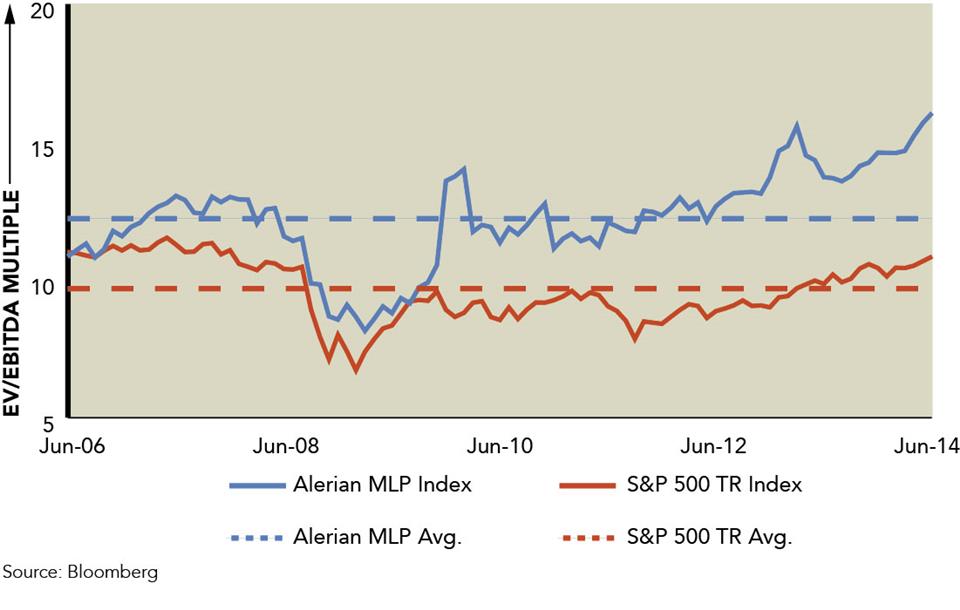
This week’s Chart of the Week takes a look at Master Limited Partnerships (“MLPs”) and their current valuations based on their EBITDA Multiple (calculated by Enterprise Value divided by the 12-month EBITDA). Generally, a higher multiple implies a more expensive valuation. Relative to long-term averages and the S&P 500, MLPs appear expensive today. The elevated valuations, however, are pricing in higher expected rates of growth.

This week’s Chart of the Week takes a look at Master Limited Partnerships (“MLPs”) and their current valuations based on their EBITDA Multiple (calculated by Enterprise Value divided by the 12-month EBITDA). Generally, a higher multiple implies a more expensive valuation. Relative to long-term averages and the S&P 500, MLPs appear expensive today. The elevated valuations, however, are pricing in higher expected rates of growth. These higher growth expectations do not come as a surprise given the recent increase in domestic energy production and expected midstream infrastructure expenditures, which could approach $640 billion between now and 2035.1  Compared to the prior study done in 2011 ($261B), the 2014 estimates represent a 145% increase in infrastructure spending.

Paying a premium for MLPs relative to historical averages may not necessarily be a bad thing assuming that the estimated growth within the energy infrastructure sector comes to fruition. If, however, there is a catalyst in the market such as a rapid increase in interest rates, regulatory change, or an international crisis, MLPs may experience a correction.

1 Interstate Natural Gas Association of America

2014 Market Preview

January 2014

Similar to previous years, we present our annual market preview newsletter. Each year presents new challenges to our clients, and 2014 is no different: We are coming off a banner year for U.S. equities, low interest rates continue to stymie fixed income investors, and while developed market equities enjoyed a strong 2013, emerging market stocks sputtered. In the alternative space, real estate and hedge funds proved accretive to portfolio returns, while growing dry powder in the private equity space is starting to raise a few eyebrows.

Download PDF

Emerging Trends in Alternative Asset Classes

2013 Marquette Investment Symposium session

In this presentation from our 2013 Investment Symposium, we explore various emerging trends in the alternatives space, including low volatility equity, tail risk, managed futures, gold, MLPs, GTAA, risk parity, farmland, direct lending, and opportunistic credit.


Investment Symposium 2013
Recorded September 13, 2013

Please contact us for access to this video.

The Emergence of Infrastructure

A briefing on the infrastructure asset class and key points from our newly published position paper.

Join us for a live webinar to discuss the asset class with our infrastructure authority Elizabeth Francis and investment consultant Miguel Zarate.

We’ll brief participants on key points from our newly published infrastructure position paper [Ed: note 2018 update], including:

  • History of infrastructure – From its early beginnings in the 1980s to its current day role in an institutional portfolio
  • Benchmarking infrastructure investing – The challenges of investing in a less established asset class with a limited performance history
  • The case for infrastructure in institutional portfolios – From the growing opportunity set to diversification and hedging against inflation
  • Infrastructure related risks – Understanding the variety of risks that may adversely affect infrastructure investments
  • Infrastructure manager due diligence – With more than 270 firms and 450 funds, manager selection is critical to maximizing returns
  • Recommendation – Including open-end vs. closed-end funds and why this long-term investment is well matched for some pension funds


Live Webinar – Wednesday, November 30, 2011 – 10:00 AM CT 

Who should attend: Institutional investment stewards, investment managers

Please contact us for access to this video.

Infrastructure Position Paper

Examines the infrastructure asset class in great detail, from its early beginnings in the 1980s to its current day role in an institutional portfolio.

Infrastructure is a relatively new asset class to institutional investors and over the last five years has emerged as a sustainable addition to client portfolios. The following paper examines the asset class in great detail, from its early beginnings in the 1980s to its current day role in an institutional portfolio. In particular, the nuances of infrastructure, as well as its unique characteristics are discussed in an effort to cultivate a thorough understanding of the asset class. Recommendations as well as guidance towards making an allocation to the asset class are also included.

Download PDF

Please see our 2018 Update to this Infrastructure position paper.