Will Assets Flow to Water Infrastructure Opportunities?

U.S. water infrastructure provides and treats around 355 million gallons of water per day to support cooking, bathing, and productivity in virtually all sectors of the economy. The infrastructure in place, however, is in poor condition; the American Society of Civil Engineers (“ASCE”) assigned a “D” and “D+” grade to both drinking water and wastewater infrastructure, respectively. Based on this assessment, the ASCE estimated that a minimum of $123 billion per year over the next 10 years needs to be invested in U.S. water infrastructure. As illustrated in this week’s chart, current annual spending on water infrastructure totals around $41 billion per year, but only one-third of capital needs are expected to be funded over the next ten years, representing an annual funding gap of $82 billion.¹ Consequently, we would anticipate water infrastructure improvement projects and water reuse² as a source of investment over the next several decades.

Print PDF> Will Assets Flow to Water Infrastructure Opportunities?


1 Value of Water Campaign, ”The Economic Benefits of Investing in Water Infrastructure,” 2017.
2 Water reuse refers to reclaimed or recycled water, which is the process of converting wastewater into water that can be reused for other purposes

The opinions expressed herein are those of Marquette Associates, Inc. (“Marquette”), and are subject to change without notice. This material is not financial advice or an offer to purchase or sell any product. Marquette reserves the right to modify its current investment strategies and techniques based on changing market dynamics or client needs.

2019 Market Preview

Coming off a difficult 2018, investors face a litany of questions going into this year, whose potential answers will undoubtedly have an impact on the capital markets. The following set of newsletters examines the primary asset classes we cover for our clients, with in-depth analysis of last year’s performance and more importantly, trends, themes, and projections to watch for in 2019. We hope these materials can assist you and your committees as you plan for the coming year, and please feel free to reach out to any of us should you have further questions about the articles or wish to review the 2019 Market Preview Webinar recording. Here’s to a better year from the capital markets in 2019!

U.S. Economy: The View from the Top?
by Jeffrey Hoffmeyer, CFA, Lead Analyst, Asset Allocation

Fixed Income: Kicking Off the Year with Moderate Valuations, a Less-Hawkish Fed and Growing Global Tariffs
by Ben Mohr, CFA, Senior Research Analyst, Fixed Income

U.S. Equities: The Pro-Growth Narrative Fizzles Out
by Samantha T. Grant, CFA, CAIA, Senior Research Analyst, U.S. Equities
and Rob Britenbach, CIPM, Research Analyst, U.S. Equities

Non-U.S. Equities: Can They Get Back on Track?
by David Hernandez, CFA, Senior Research Analyst, International Equities
and Nicole Johnson-Barnes, Research Analyst

Real Estate: Navigating Through a Late Market Cycle
by Jeremy Zirin, CAIA, Senior Research Analyst, Real Assets

Infrastructure: Stable Cash Flows in an Uncertain Market Environment and the Evolving Landscape
by Jeremy Zirin, CAIA, Senior Research Analyst, Real Assets

Hedge Funds: Is Market Volatility Here to Stay?
by Joe McGuane, CFA, Senior Research Analyst, Alternatives

Private Equity: Poised for Robust Deployment
by Derek Schmidt, CFA, CAIA, Senior Research Analyst, Private Equity


The opinions expressed herein are those of Marquette Associates, Inc. (“Marquette”), and are subject to change without notice. This material is not financial advice or an offer to purchase or sell any product. Marquette reserves the right to modify its current investment strategies and techniques based on changing market dynamics or client needs.

America’s Infrastructure Report Card

Pending a final vote count in Florida, the U.S. midterm election results are in with the Democrats regaining control of the House and Republicans maintaining majority control of the Senate. While a split Congress may lead to gridlock on various policies, one thing both parties should be able to agree on is the need for infrastructure investments in the U.S.

The historical under-investment, coupled with the lack of available public-sector funding, has impaired the government’s ability to deliver public services at adequate levels. The American Society of Civil Engineers (ASCE) estimated that $4.5 trillion needs to be invested through 2025 to upgrade the nation’s infrastructure. In its annual report, the ASCE in 2017 gave an overall “D+” grade for the condition and capacity of infrastructure in the U.S., further highlighting the need for additional investment.

Consequently, governments and public agencies have begun looking beyond the traditional funding methods to private investment in infrastructure via privatizations and public-private partnerships (“PPPs”). As a result, ownership and operation of infrastructure assets has been gradually moving from the public to the private sector on a global level. With this trend, the role of government has shifted from the provider of services to that of a regulator. This has provided a stream of investment opportunities and fueled development of a distinct alternative asset class for institutional investors that complements fixed income, public equities, real estate, and traditional private equity investments, and whose popularity is likely to increase as more investments and hence products come to fruition.

Print PDF

The opinions expressed herein are those of Marquette Associates, Inc. (“Marquette”), and are subject to change without notice. This material is not financial advice or an offer to purchase or sell any product. Marquette reserves the right to modify its current investment strategies and techniques based on changing market dynamics or client needs.

Infrastructure Position Paper – 2018 Update

Infrastructure is a relatively new asset class to institutional investors and over the last twelve years has emerged as a sustainable addition to client portfolios. The following paper examines the asset class in great detail, from its early beginnings in the 1980s to its current day role in an institutional portfolio. In particular, the nuances of infrastructure — as well as its unique characteristics — are discussed in an effort to cultivate a thorough understanding of the asset class. Recommendations and guidance towards the manager search process and making an allocation to the asset class are also included.

Download PDF >

The opinions expressed herein are those of Marquette Associates, Inc. (“Marquette”), and are subject to change without notice. This material is not financial advice or an offer to purchase or sell any product. Marquette reserves the right to modify its current investment strategies and techniques based on changing market dynamics or client needs.

2018 Market Preview

Each year, investors face numerous questions that can impact their portfolios, and 2018 is no different. How will tax reform further impact the capital markets? How much – and often – will the Fed raise rates in the coming year? Can international equities continue to outperform their U.S. counterparts?  Should we be concerned about the levels of dry powder in the private equity market? These topics among many others are covered in the following articles as we offer our annual market preview newsletters. In the links below, readers will find a preview newsletter for each asset class that we cover, as well as a general U.S. economic preview. Each article contains insightful analysis and key themes to monitor over the coming year, themes which will underlie the actual performance of the asset classes covered. We hope that this set of articles can assist you and your committees as you plan for 2018. Should you have any questions about any of the content, please feel free to contact myself or any of the authors or consultants here at Marquette. We also have a webinar recording available by request if you would like to hear a high-level presentation of the topics presented in these articles. Happy New Year!

U.S. Economy by Jeffrey Hoffmeyer, CFA, Lead Analyst, Asset Allocation

Fixed Income by Ben Mohr, CFA, Senior Research Analyst, Fixed Income

U.S. Equities by Samantha T. Grant, CFA, CAIA, Senior Research Analyst, U.S. Equities & Rob Britenbach, CIPM, Research Analyst, U.S. Equities

Non-U.S. Equities by David Hernandez, CFA, Senior Research Analyst, International Equities

Real Estate by Jeremy Zirin, CAIA, Senior Research Analyst, Real Assets

Infrastructure by Jeremy Zirin, CAIA, Senior Research Analyst, Real Assets

Hedge Funds by Joe McGuane, Senior Research Analyst, Alternatives

Private Equity by Derek Schmidt, CFA, CAIA, Senior Research Analyst, Private Equity

2017 Market Preview

January 2017

Similar to past market preview newsletters, we enter the year with a new set of questions. What shape will Trump’s policies take and how will they impact the market? Will the formal start of the Brexit have an impact on portfolios? To what degree and pace will the Fed increase interest rates? These topics among many others are covered in the following articles as we offer our annual market preview newsletter. Each year presents new challenges to our clients, and other headlines will emerge as the year goes on; it is critical to understand how asset classes will react to each new development and what such reactions will mean to investors. The following articles contain insightful analysis and key themes to monitor over the coming year, themes which will underlie the actual performance of the asset classes covered. Recognizing that many of our clients may not have time to cover the following 30 pages of material, we offer the primary conclusions for each asset class heading into 2017.

Download PDF

2016 Market Preview

January 2016

Similar to previous years, we offer our annual market preview newsletter. Each year presents new challenges to our clients, and 2016 is off to a volatile start with equity markets down significantly, oil dropping below $30, the Fed poised to further increase interest rates, and fears of a China slowdown rippling through the markets. However, other headlines will emerge as the year goes on, and it is critical to understand how asset classes will react to each new development and what such reactions will mean to investors. The following articles contain insightful analysis and key themes to monitor over the coming year, themes which will underlie the actual performance of the asset classes covered.

Download PDF

2015 Market Preview

January 2015

Similar to previous years, we offer our annual market preview newsletter. Each year presents new challenges to our clients, and 2015 is no different: U.S. equities are at all-time highs, uncertainty reigns for international equities, and to everyone’s surprise, interest rates fell dramatically in 2014…but are poised to rise from historic lows over the next year. In the alternative space, real estate remains a solid contributor to portfolio returns, and private equity delivered on return expectations, though dry powder is on the rise. Hedge fund results were mixed, but have shown to add value in past rising interest rate environments. Further macroeconomic items that bear watching for their potential impact on capital markets include the precipitous fall in oil prices, the strengthening U.S. dollar, job growth, and international conflicts.

Download PDF

Are MLP Valuations Too Rich?

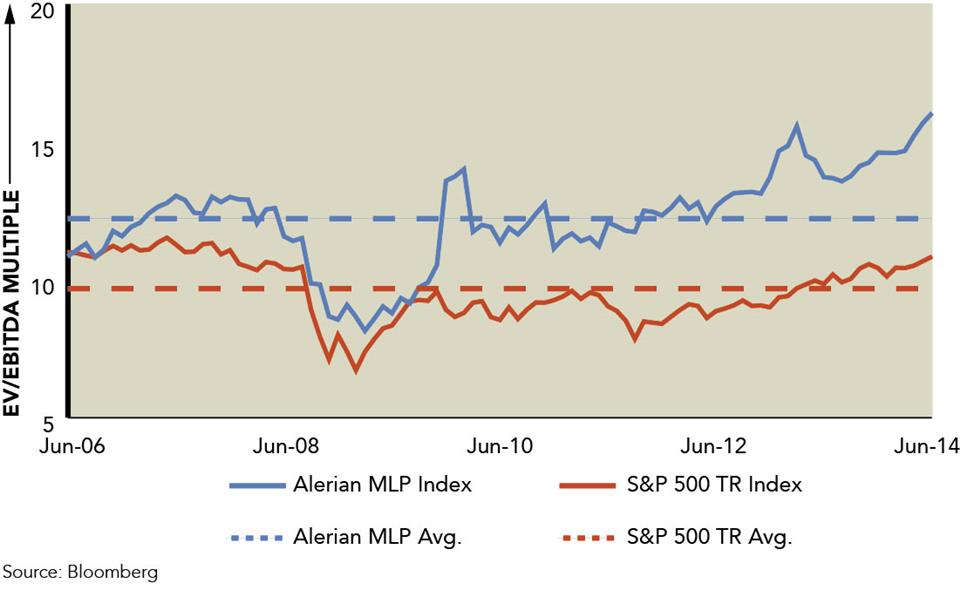
This week’s Chart of the Week takes a look at Master Limited Partnerships (“MLPs”) and their current valuations based on their EBITDA Multiple (calculated by Enterprise Value divided by the 12-month EBITDA). Generally, a higher multiple implies a more expensive valuation. Relative to long-term averages and the S&P 500, MLPs appear expensive today. The elevated valuations, however, are pricing in higher expected rates of growth.

This week’s Chart of the Week takes a look at Master Limited Partnerships (“MLPs”) and their current valuations based on their EBITDA Multiple (calculated by Enterprise Value divided by the 12-month EBITDA). Generally, a higher multiple implies a more expensive valuation. Relative to long-term averages and the S&P 500, MLPs appear expensive today. The elevated valuations, however, are pricing in higher expected rates of growth. These higher growth expectations do not come as a surprise given the recent increase in domestic energy production and expected midstream infrastructure expenditures, which could approach $640 billion between now and 2035.1  Compared to the prior study done in 2011 ($261B), the 2014 estimates represent a 145% increase in infrastructure spending.

Paying a premium for MLPs relative to historical averages may not necessarily be a bad thing assuming that the estimated growth within the energy infrastructure sector comes to fruition. If, however, there is a catalyst in the market such as a rapid increase in interest rates, regulatory change, or an international crisis, MLPs may experience a correction.

1 Interstate Natural Gas Association of America

2014 Market Preview

January 2014

Similar to previous years, we present our annual market preview newsletter. Each year presents new challenges to our clients, and 2014 is no different: We are coming off a banner year for U.S. equities, low interest rates continue to stymie fixed income investors, and while developed market equities enjoyed a strong 2013, emerging market stocks sputtered. In the alternative space, real estate and hedge funds proved accretive to portfolio returns, while growing dry powder in the private equity space is starting to raise a few eyebrows.

Download PDF