Credit Trash is Return Treasure

July 12, 2023 | James Torgerson, Senior Research Analyst

This chart description is for illustrative purposes only and its accuracy cannot be guaranteed. Please see full disclosures at end of PDF document in the web post. General description: Eight-line chart showing 2023 returns for various below-investment grade leveraged loan and high yield indices. Chart subtitle: 2023 has been the year of the junk rally as CCC bonds and loans have outperformed their higher-quality peers. Chart source: Credit Suisse as of June 30, 2023. Chart visual description: Data is daily, from January 3 through June 30. Y-axis is labeled “Return” and ranges from 0% to 12% in 2% increments. X-axis is labeled monthly from Jan-23 through Jun-23. CS leveraged loan indices’ lines are plotted in shades of green, and get lighter from better to worse quality: CS Leveraged Loan Index in darkest green, BB Loans, B Loans, and CCC Loans in light green. CS High Yield indices are plotted in shades of purple, with same better to worse quality in darker to lighter shades: CS High Yield Index in dark purple, BB High Yield, B High Yield, and CCC High Yield in lightest purple. Chart data description: Lines generally follow same movements upward and downward throughout the year, but CCC categories have tended to lead since February. Most recent data point at June 30: CS Leveraged Loan Index at 6.33%, BB Loans at 4.58%, B Loans at 6.86%, and CCC Loans at 8.32%. CS High Yield Index at 5.84%, BB High Yield at 4.49%, B High Yield at 5.82%, and CCC High Yield at 10.99%. Please contact us for the full data set. End chart description. See disclosures at end of document.

“One man’s trash is another man’s treasure” may be a cliché, but it has never been more applicable to the below-investment grade, or junk, market. As the macroeconomic backdrop has proven to be more resilient than investors feared heading into 2023, one of the primary beneficiaries has been CCC corporates — traditionally the riskiest securities within the high yield and leveraged loan markets. CCC bonds and loans are the least credit-worthy within their respective markets and tend to perform poorly in periods of economic stress. With the economy so far avoiding recession, this segment of the market has posted significant gains year-to-date. CCC bonds and loans were up 11.0% and 8.3% through the first half, respectively, notably outperforming the broader high yield and leveraged loan indices, up 5.8% and 6.3%, and especially the highest-rated, or BB, segments of each market, up 4.5% and 4.6%, respectively.

On top of better-than-feared macroeconomic conditions, other factors have contributed to the junk rally in these markets. Leveraged credit balance sheets, even amongst the lowest-rated issuers, remain well positioned to weather headwinds. High yield issuer leverage is at a 10-year low while leveraged loan issuer leverage levels are at multi-year lows with interest coverage metrics slightly below all-time highs. Defaults are expected to increase, though only to the long-term average of the asset class, assuaging fears of a wave of defaults. Additionally, market technicals have helped fuel this rally as issuance has remained light, causing what supply is out there to benefit from a continual bid due to the elevated yield on these securities. All of this said, CCCs are still typically the riskiest part of the fixed income market, and continued performance hinges on the notoriously-unpredictable economy.

Print PDF > Credit Trash is Return Treasure


The opinions expressed herein are those of Marquette Associates, Inc. (“Marquette”), and are subject to change without notice. This material is not financial advice or an offer to purchase or sell any product. Marquette reserves the right to modify its current investment strategies and techniques based on changing market dynamics or client needs.

James Torgerson
Senior Research Analyst

Get to Know James

The opinions expressed herein are those of Marquette Associates, Inc. (“Marquette”), and are subject to change without notice. This material is not financial advice or an offer to purchase or sell any product. Marquette reserves the right to modify its current investment strategies and techniques based on changing market dynamics or client needs.
Related Content

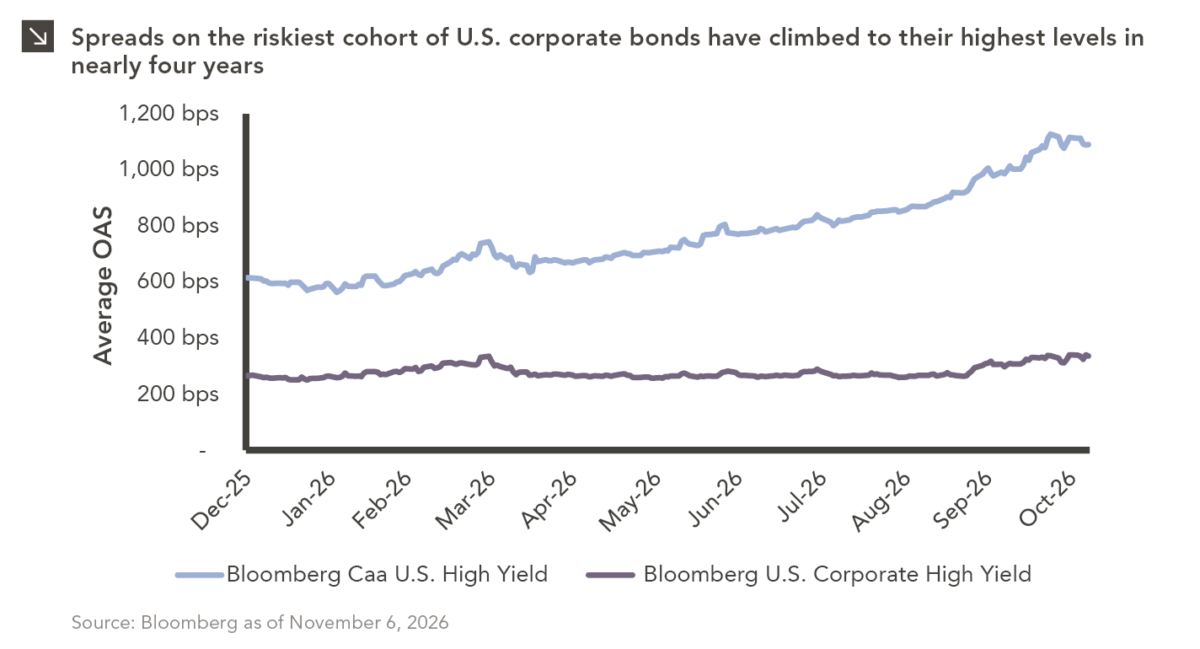
Line chart showing average option-adjusted spreads (OAS), in basis points, on Bloomberg CCC U.S. High Yield and Bloomberg U.S. Corporate High Yield bonds from December 2025 through October 2026. CCC-rated high yield spreads increased from approximately 600 bps to 1,100 bps, reaching their highest levels in nearly four years, while broader U.S. corporate high yield spreads remained relatively stable, increasing from approximately 260 bps to 330 bps. Source: Bloomberg as of November 6, 2026. For full dataset, please contact marquettemarketing@marquetteassociates.com.

11.09.2026

C’s Get Degrees (of Pain)

The U.S. distressed debt market is showing increasingly pronounced signs of stress. As of this writing, option-adjusted spreads on CCC-rated…
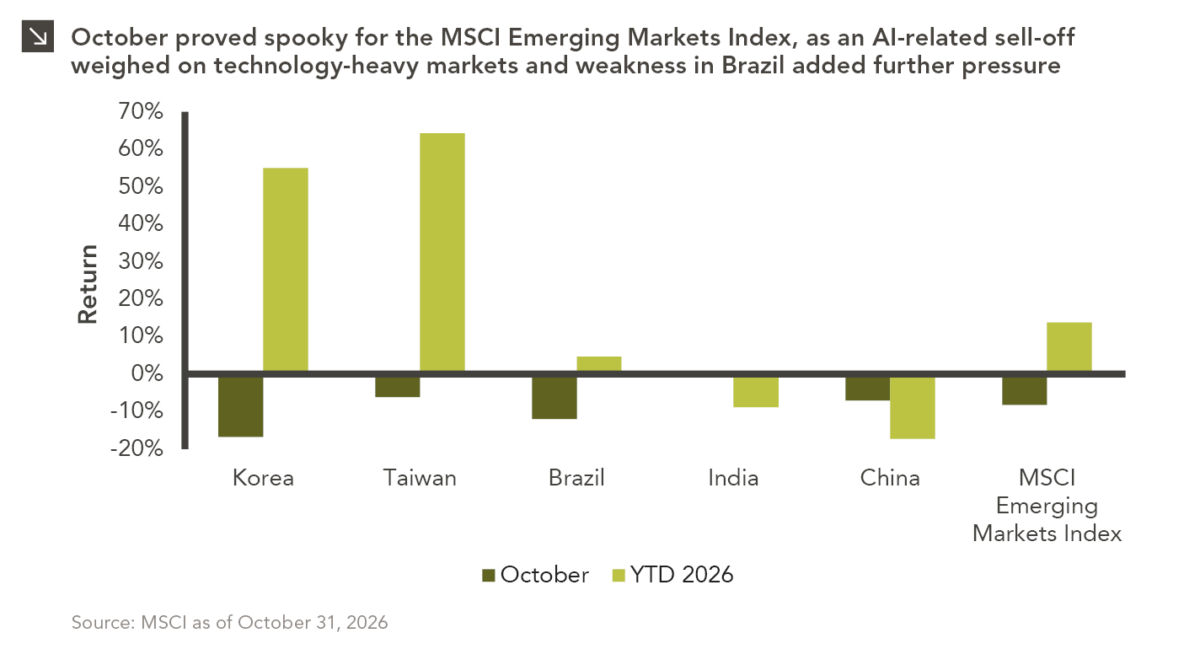
Bar chart comparing October and year-to-date 2026 returns for Korea, Taiwan, Brazil, India, China, and the MSCI Emerging Markets Index. October returns are below zero for most markets, while year-to-date returns range from negative to positive. For full dataset, please contact marquettemarketing@marquetteassociates.com.

11.02.2026

The Haunting of Emerging Markets

Emerging markets faced a challenging October, with the space declining by around 8.3% amid renewed concerns over the sustainability of…
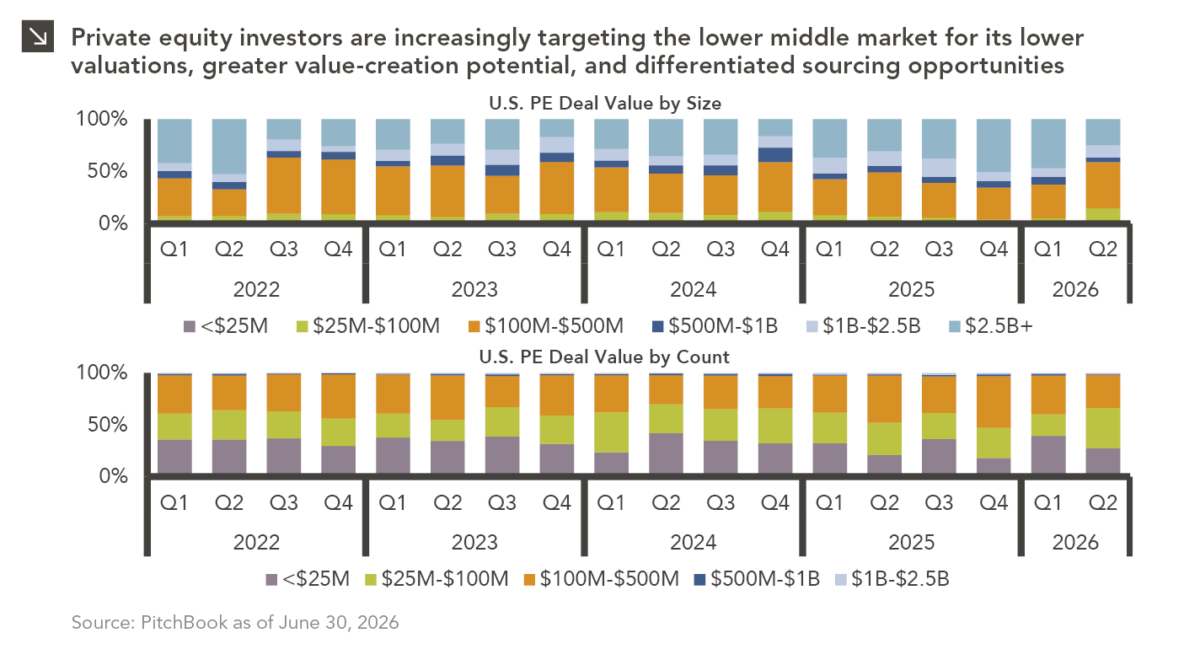
Stacked bar chart showing U.S. private equity deal value by deal size from Q1 2022 through Q2 2026. The y-axis shows percentage of total deal value from 0% to 100%, and the x-axis shows quarters by year. Stacked bar chart showing the percentage of U.S. private equity deal count by deal size from Q1 2022 through Q2 2026. The y-axis ranges from 0% to 100%, and the x-axis shows quarters by year. For full dataset, please contact marquettemarketing@marquetteassociates.com.

10.26.2026

Smaller Deals, Larger Appeal

Private equity activity is increasingly shifting toward smaller transactions, with total deal value for transactions of $100 million or less…

10.08.2026

3Q 2026 Market Insights

This video is a recording of a live webinar held October 22 by Marquette’s research team analyzing the third quarter…

10.22.2026

Will Higher Rates Cramp the Markets?

Anyone who has run a marathon knows the last six miles are brutal — no matter how well the first…
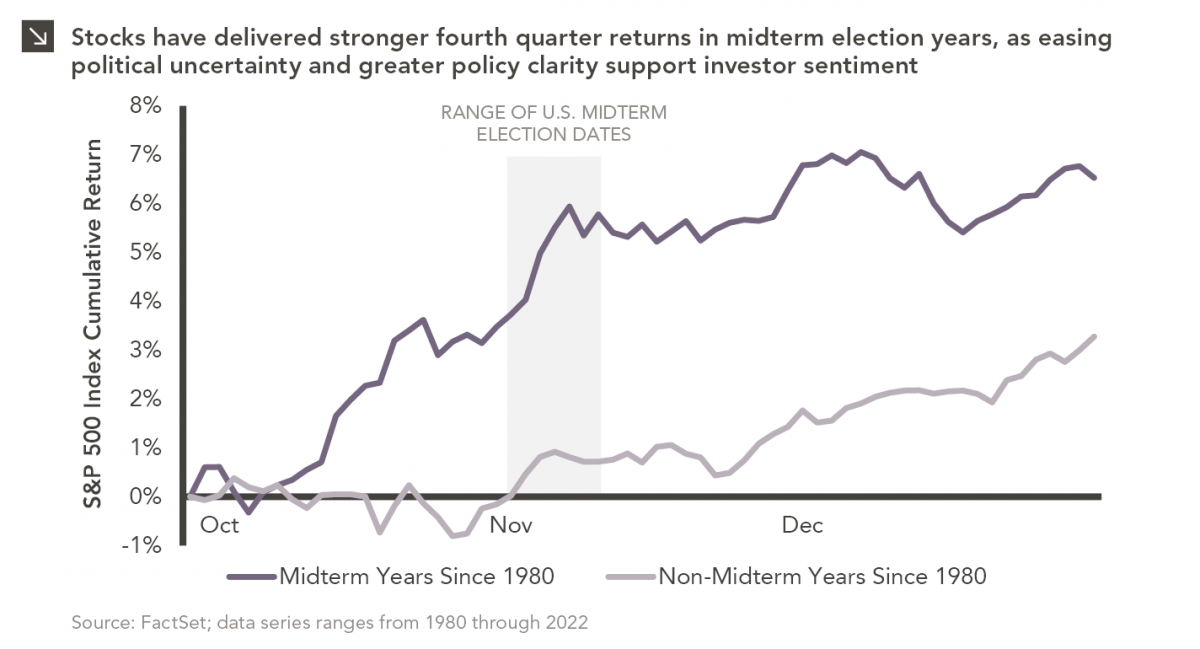
Line chart comparing S&P 500 Index cumulative returns for midterm and non-midterm election years since 1980. The x-axis shows October through December, and the y-axis shows S&P 500 Index cumulative return, ranging from -1% to 8%. For full dataset, please contact marquettemarketing@marquetteassociates.com.

10.19.2026

Divided We Rise?

Since 1980, the S&P 500 Index has generally performed well in the weeks surrounding U.S. midterm elections. Specifically, the index…

More articles

Subscribe to Research Email Alerts

Research Email Alert Subscription

Research alerts keep you updated on our latest research publications. Simply enter your contact information, choose the research alerts you would like to receive and click Subscribe. Alerts will be sent as research is published.

We respect your privacy. We will never share or sell your information.

Thank You

We appreciate your interest in Marquette Associates.

If you have questions or need further information, please contact us directly and we will respond to your inquiry within 24 hours.

Contact Us >