Evan Frazier, CFA, CAIA
Senior Research Analyst


The development of artificial intelligence is advancing along two largely distinct paths. The first centers on generative AI powered by large language models, with the long-term objective of creating systems that can reason across domains at levels superior to those of human beings. The second focuses on embodied intelligence (i.e., robotics). In this space, the objective is not abstract reasoning but rather the deployment of capable machines that can operate effectively in the physical world. Over the last five years, capital and attention have overwhelmingly gravitated toward companies involved in generative AI, with the Bloomberg Artificial Intelligence Index up a staggering 276% in that time. Robotics, by comparison, has been widely viewed as a longer-dated theme, with the Bloomberg Robotics Index up only 77% over that same period (even less than the S&P 500 Index return of 134%). These dynamics can be observed in this week’s chart.
Going forward, there are reasons to believe that this performance trend may shift in the years ahead. For instance, human-level general intelligence could be far more distant than markets currently assume, and language models may not prove sufficient to reach it. At the same time, practical robots (e.g., warehouse automation, humanoid assistants, etc.) appear closer to commercial reality than previously believed, particularly in aging societies facing persistent labor shortages. One possible accelerant for robotics companies in the years ahead is the use of advanced simulation. By training in virtual environments, robots can acquire motor skills and coordination far more rapidly than through physical trial and error alone, potentially pulling forward adoption timelines relative to current investor expectations. Importantly, transformative impact does not require robots to achieve artificial general intelligence but rather functional capability (i.e., the ability to move objects, operate safely, and sustain useful work with sufficient battery life). Commercial momentum in robotics is already building. In 2024, for example, Agility Robotics opened a manufacturing facility in Oregon with capacity to produce up to 10,000 humanoid units annually, and Amazon has now begun testing Agility’s robots in its warehouses. Additionally, companies like Tesla are showcasing humanoid prototypes performing increasingly fluid physical tasks, and BYD has signaled interest in future household robotics. While price points remain prohibitive for mass adoption today, several structural forces are converging to improve the economics of robotics. Manufacturing costs are declining as scaling drives down prices for components like sensors and actuators, while improvements in AI models are enhancing robotic perception and control. Taken in tandem with the fact that generative AI leaders are currently investing heavily in costly, power-hungry data centers, it is fair to say that a once slower-moving, less glamorous segment of the AI ecosystem may now benefit from relative capital efficiency.
Despite these developments, markets continue to assign a significant valuation premium to generative AI over robotics, which can also be observed in the chart above. Factor analysis helps explain part of the gap, as AI-heavy indexes skew toward momentum and growth while robotics-oriented benchmarks exhibit greater exposure to value, quality, and, in some cases, even dividend income. Further, the generative AI complex is dominated by large technology platforms including Alphabet, Microsoft, and NVIDIA, whereas robotics companies tend to be more industrial in nature (e.g., automation specialists, automakers, and emerging consumer-robotics firms). This valuation disconnect suggests that investors may be overemphasizing long-term breakthroughs in cognition while underappreciating near-term progress in physical automation, especially as physical robots transition from research environments into factories, homes, and hospitals. Indeed, while much of today’s excitement centers on artificial brains, it may ultimately be robotic brawn that drives the next leg of growth within the technology sector.
Print PDF
The opinions expressed herein are those of Marquette Associates, Inc. (“Marquette”), and are subject to change without notice. This material is not financial advice or an offer to purchase or sell any product. Marquette reserves the right to modify its current investment strategies and techniques based on changing market dynamics or client needs.
01.26.2026
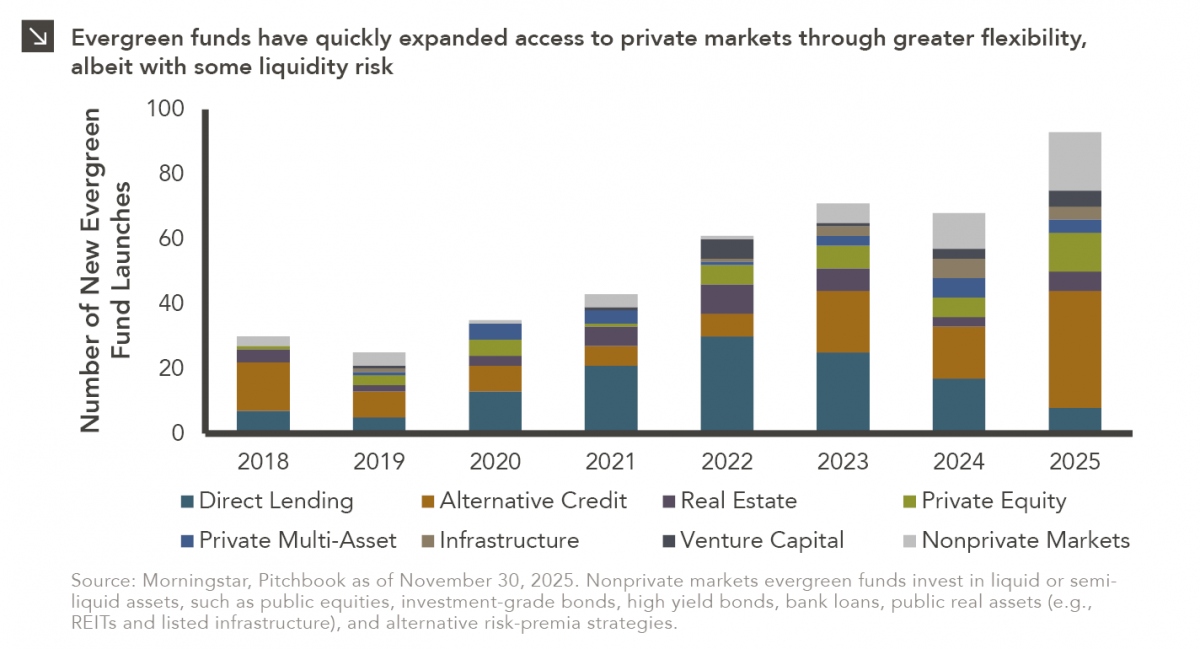
In recent years, access to traditionally illiquid private markets has expanded through the rapid growth of evergreen funds, which provide…

01.22.2026
Anyone who has gone snowmobiling knows it can be simultaneously exhilarating and terrifying. Throttling across snow and through a forest…
01.20.2026
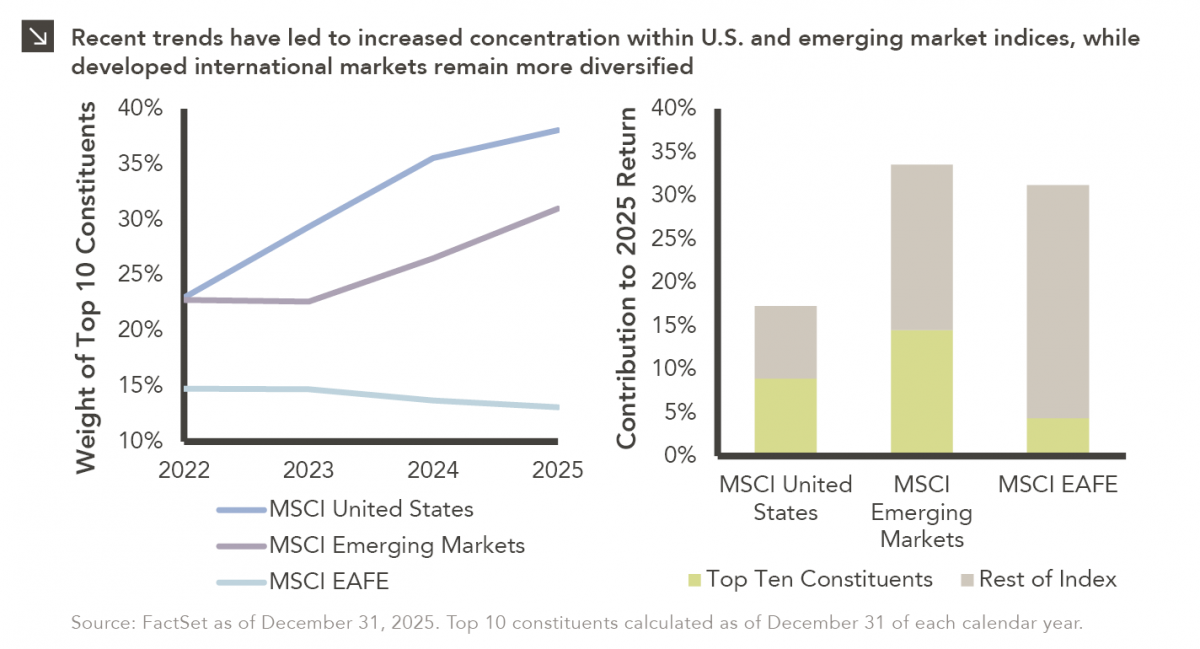
Last week, Alphabet joined NVIDIA, Microsoft and Apple as the only companies to ever reach a market capitalization of $4…

01.07.2026
This video is a recording of a live webinar held January 15 by Marquette’s research team analyzing 2025 across the…

01.12.2026
The capture of Venezuelan president Nicolás Maduro is a watershed moment for a country whose natural resource economy has been…

12.29.2025
While the holiday season was once marked by bustling bars, readers may notice that nightlife isn’t what it used to…
Research alerts keep you updated on our latest research publications. Simply enter your contact information, choose the research alerts you would like to receive and click Subscribe. Alerts will be sent as research is published.
We respect your privacy. We will never share or sell your information.
If you have questions or need further information, please contact us directly and we will respond to your inquiry within 24 hours.
Contact Us >