Time to Buy U.S. Small-Cap Value Stocks?

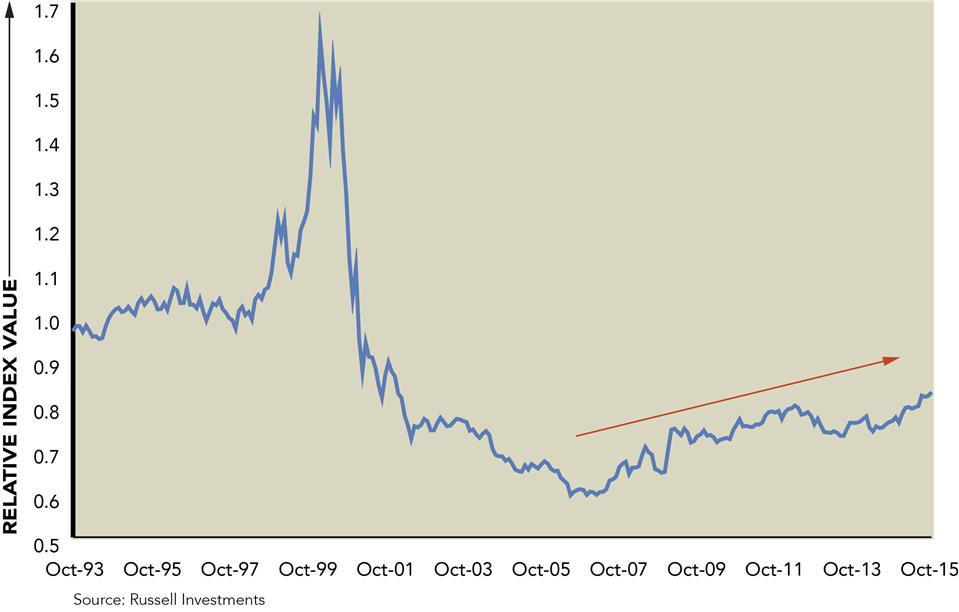
Through the first seven months of 2015, growth stocks have far outpaced their value brethren in the U.S. equity market. While the theme has played out across all size sectors of the market, this trend has been most obvious for small-cap stocks.

Through the first seven months of 2015, growth stocks have far outpaced their value brethren in the U.S. equity market. While the theme has played out across all size sectors of the market, this trend has been most obvious for small-cap stocks. The Russell 2000 Growth index has returned 9.18% while the Russell 2000 Value index has dropped 2%. Given this disparity, it is worth examining whether now is an appropriate time to re-allocate to small-cap value stocks, since their recent struggles have driven prices lower. To help answer this question, we turn to a comparison of the current index price versus its 200-day average, a common valuation metric used to measure the relative value of a particular stock or index versus a longer-term average. As shown in the chart, the index dipped below its 200-day trading average in July and is now trading at a discount relative to its historic values.

From the broader perspective of portfolio construction, small-cap value stocks have historically offered upside potential and outperformance versus other style and size sectors in the U.S. equity market. In addition, since smaller companies’ operations tend to be more domestically focused, they could potentially provide a sanctuary from the rough geopolitical turmoil that is occurring in Europe and Asia. On a related note, the potential drag from a stronger U.S. Dollar would also be muted due to small-cap companies’ limited international exposure. Given the long-term benefits of small-cap value stocks along with the current valuation of the index, now may be an attractive opportunity to either rebalance or create exposure to the asset class.

How Will the High Level of M&A Activity Impact Investors?

For this week’s chart of the week we take a look at quarterly M&A deals, measured by volume. Typically, summer is a quiet period for M&A activity; however, we have seen the volume of deals for the month of July already surpass $475 billion dollars which would put it on pace to surpass the previous quarter high that was last seen in 2007, just before the start of the great recession.

For this week’s chart, we take a look at quarterly M&A deals, measured by volume. Typically, summer is a quiet period for M&A activity; however, we have seen the volume of deals for the month of July already surpass $475 billion dollars which would put it on pace to surpass the previous quarter high that was last seen in 2007, just before the start of the great recession. There are a variety of explanations for the increased M&A activity: pressure from activist investors, hostile takeovers, and companies with large cash positions beginning to deploy their savings as they better position themselves for future growth. Whether it is a close competitor or a company that compliments current operations, we have seen a great increase in deals over the previous two quarters.

One of the concerns with the elevated M&A activity is that companies are stretching for valuations when acquiring other firms, and given the elevated prices they are paying, it will be difficult to realize a profitable return on the size of their investments. Comparing deal counts to their respective volumes, we have seen less deals over the past two years, but higher dollar volumes than during the 2006–2007 boom years for M&A. The next two months bear watching to see if the furious M&A activity continues, or if the pace begins to abate. Of course, the real result of this activity will not be known for years, but the success – or lack thereof – of these mergers and acquisitions will no doubt manifest itself in capital market returns.

Some Perspective on the Size of Chinese Equity Market Losses

Over the last month, the Chinese equity market has been a cause of concern for investors and it is impossible to ignore its impact on recent market volatility.

Over the last month, the Chinese equity market has been a cause of concern for investors and it is impossible to ignore its impact on recent market volatility. In an effort to provide some perspective on the size of recent market losses in relation to Chinese consumers, this week’s chart of the week compares the size of the market cap loss to household assets represented by household deposits, 2014 GDP, household financial balance sheets, and household total balance sheets. As shown above, the Chinese equity market cap loss only represented 12% of household financial balance sheet assets which include stocks, bonds, and cash. Additionally, the market cap loss only represented 5% of total household assets which notably include personal real estate. Although the recent loss in the Chinese equity market was not insignificant, at this point in time the overall effect on the Chinese economy is bearable and should not be considered catastrophic.

Putting Greece in its Place

There has been much talk about a potential “Grexit”, as some believe it is inevitable and may be the best solution in the long run. Nonetheless, Greece is receiving its third bailout in five years to prevent such a thing.

There has been much talk about a potential “Grexit,” as some believe it is inevitable and may be the best solution in the long run. Nonetheless, Greece is receiving its third bailout in five years to prevent such a thing. The new bailout plan comes with some tough austerity measures in which Greece will have to make cuts to pensions and increase taxes in order to receive €86B ($96B) in new loans.

The fear of contagion has been cited as a reason for yet another Greek bailout. If Greece were to leave the Eurozone, a dangerous precedent may be set and other countries with high debt levels (such as Spain, Italy, and Portugal) may decide to follow. Even if these countries do stay, they may have difficulty finding investors to purchase their bonds. On the other hand, by continuing to bail out Greece, these countries may be less willing to make reforms and come to expect their own bailouts if their debt gets out of hand.

However, this week’s chart puts the Greece situation into perspective, particularly for U.S. investors. For all the attention Greece receives, it has a smaller economy than the state of Wisconsin and is less than half the size of Illinois. Even among the Eurozone, Greece contributes a mere 1.9% to the area’s GDP. Though there is the possibility of a domino effect, it seems unlikely that the events in Greece will have a large effect on the global economy.

The Impact of Interest Rates on Real Estate Returns

As the U.S. faces a potential interest rate hike this fall, it is worthwhile to review the impact of interest rates on the real estate sector. This week’s chart looks at the historical performance of the NFI ODCE Index versus the 10-Year Treasury.

As the U.S. faces a potential interest rate hike this fall, it is worthwhile to review the impact of interest rates on the real estate sector. This week’s chart looks at the historical performance of the NFI ODCE Index versus the 10-Year Treasury. The correlation between the two variables is positive but weak, owing in part to a time lag between the change in interest rates and when the change impacts property values.

A moderate interest rate hike after the Financial Crisis may be viewed as the Fed’s vote of confidence that we are seeing economic recovery. Factors that drive interest rates up — such as inflationary pressures from economic growth — cause real estate fundamentals to improve and potentially offset the negative impacts of rising rates. Additionally, we expect to see income rise as property managers pass on higher interest rates to tenants by increasing rents, thus providing a partial hedge against rising rates. While we are still in the initial expansion stage, economic growth and rising interest rates should prove accretive for real estate investments.

Downside Protection for U.S. Equity Managers

This week, we take a look at down market captures (DMC) relative to top, middle and bottom tier managers for U.S. large-cap equities. Down market captures illustrate how active managers perform during periods of negative benchmark performance. In this case, we are comparing the last 12 years of rolling 1-year down market captures for U.S. large-cap core managers who feature the S&P 500 index as their primary benchmark.

This week, we take a look at down market captures (DMC) relative to top, middle, and bottom tier managers for U.S. large-cap equities. Down market captures illustrate how active managers perform during periods of negative benchmark performance. In this case, we are comparing the last 12 years of rolling 1-year down market captures for U.S. large-cap core managers who feature the S&P 500 index as their primary benchmark.

Theoretically, passive management is less beneficial than active management in down markets as passive management will capture 100% of the index returns during the negative periods. In examining the median manager down market captures (red line in chart), we see that the majority of the time active managers are able to outperform the benchmark in times of market declines (a reading below 100 indicates that the manager lost less than the benchmark).1  This is more evident when looking at the DMCs of managers in the 25th percentile. These managers are consistently outperforming the benchmark during the down market, and losing less capital for their investors. Managers in the 75th percentile consistently have DMCs greater than 100%, meaning they captured more than the negative performance of the benchmark, thus failing to protect in a downside market.

Given the overall efficiency of the U.S. large-cap equity asset class, many investors have moved away from active management over the last five years. And while this trend is not likely to reverse itself anytime soon, those who have identified above median managers may face less downside risk in the event of a market correction.

1It should be noted that outperforming the benchmark in times of market drops does NOT equate to positive returns; the manager just loses less than the benchmark.

Do Current Valuation Levels Suggest an Upcoming Correction?

Over the past few years, investors have become concerned about higher equity valuations and the potential for another pullback or crash. The U.S. equity market is currently in its third longest bull market dating back to WWII, increasing worries that the run may be coming to an end soon.

Over the past few years, investors have become concerned about higher equity valuations and the potential for another pullback or crash. The U.S. equity market is currently in its third-longest bull market dating back to WWII, increasing worries that the run may be coming to an end soon.

This week’s chart examines modern valuations for the S&P 500 to give us a snapshot of where the equity markets are relative to the last 35 years of market data. Using the trailing 12-month P/E ratio, we see that historical valuations are somewhat normally distributed, with the mean falling between 16x and 18x earnings. As of June 18th, the P/E ratio was at 18.75, with its range highlighted in red on the chart. Though this is above average historical valuations, it is still far below the high end of the spectrum that we saw during the tech bubble.

This does not necessarily mean there will not be a crash sometime soon since many factors other than valuations can affect the market. In the second half of 2007 leading up to the recession, valuations were within the mean bar of 16x–18x, yet the index collapsed due to earnings falling dramatically after the housing crash. Though the potential for a pullback is ever-present, a significant correction based solely on valuations seems unlikely.

Relative Yields for REITs and MLPs Trending Up?

Given the prolonged low rate environment in the aftermath of the credit crisis, investors have been on a continual search for yield. Historically, REITs and Master Limited Partnerships (“MLPs”) have been among the highest yielding asset classes, which led to strong performance in the years following the 2008 financial crisis.

Given the prolonged low rate environment in the aftermath of the credit crisis, investors have been on a continual search for yield. Historically, REITs and Master Limited Partnerships (“MLPs”) have been among the highest yielding asset classes, which led to strong performance in the years following the 2008 financial crisis. However, since the taper tantrum in May of 2013 MLPs and REITs have underperformed the S&P 500 by 1,136 and 648 bps, respectively.1 Currently, REITs2  and MLPs3  are yielding 3.8% and 6.0% compared to the S&P 500 yield of 1.9% as of May 2015.

This week’s chart looks at the historical relative yields of REITS (red lines) and MLPs (blue lines) compared to the S&P 500. The chart shows that if you owned MLPs or REITs since June 2006, on average, you were receiving 3x and 2x yield over the S&P 500 respectively. However, by early 2013 both MLPs and REITs looked expensive based on their yields relative to the S&P.4 Of course, given the underperformance of both MLPs and REITs over the last few years, the relative yields of both asset classes are again starting to look more attractive. REITs still seem a little expensive as yields remain relatively low (compared to history) but MLP yields (relative to the S&P) are now above their long-term average and look relatively attractive, and may present an opportunity for investors to boost portfolio returns.

1 As of May 29, 2015
2 REITs are represented by the FTSE NAREIT All Equity REITs Index
3 MLPs are represented by the Alerian MLP Index
4 Prices are inversely related to yields: if the yield is below the average it is more expensive

Compelling Valuations for Energy Distressed Debt

Given the environment of record issuance and low yields, one is hard-pressed to find fixed income bargains. With the S&P 500 and P/E ratios at record peaks, bargains in equities are similarly few and far between. Energy distressed debt, however, is presenting extraordinary bargains.

Given the environment of record issuance and low yields, one is hard-pressed to find fixed income bargains. With the S&P 500 and P/E ratios at record peaks, bargains in equities are similarly few and far between. Energy distressed debt, however, is presenting extraordinary bargains. Since the energy dislocation began, an unprecedented amount of high yield energy bonds, especially those of shale fracturing E&P companies, have been trading in distressed/stressed territory. As shown in this week’s chart, the bars represent the par value of U.S. high yield energy bonds. The blue bars show the cross-section for May 2015, when $2.5 billion of bonds were priced at zero to 20 cents on the dollar, $2.1 billion were at 20 to 40 cents on the dollar, $7.0 billion were at 40 to 60 cents on the dollar and $19.9 billion were at 60 to 80 cents on the dollar. These values sum to $32 billion, or 15%, of bonds trading between zero and 80 cents on the dollar, which is known as distressed/stressed territory. Contrast this with June 2014, shown in the red bars, when only $0.8 billion, or less than 1%, were distressed/stressed. Clearly, this is an opportunity set that has emerged in the last twelve months and could pay off for investors.

There are two key channels through which investors can access this unprecedented opportunity. One is investing with an energy direct lender, which has two advantages. First, direct lenders can buy into a company’s debt at the top of the capital structure, above any existing bank loans and high yield bonds. This, in turn, gives the investor first-in-line access to the company’s assets in the event of a liquidation. Second, a direct lender can create further protection by negotiating heavy covenants, in contrast to the covenant-light bank loans and high yield bonds existing in the marketplace today.

The second approach is investing with a manager that specializes in buying distressed debt and working with the issuer through a restructuring to extract outsized value from the position. Because such managers would invest in existing covenant-light paper, it is beneficial to choose one that diversifies across oil and gas, coal, electric utilities, and alternative energy.

While distressed energy debt may not be appropriate for all institutional investors, it could also prove accretive to clients in the coming years. As we have seen many times in the past, buying at depressed prices often leads to outsized returns in subsequent years. Given the overall high valuations in the financial markets, we believe distressed energy offers a compelling valuation at this time and could help boost future portfolio returns.

Divergence of Unemployment Rates in Europe

The Maastricht Treaty mandates the European Central Bank (“ECB”) to target inflation. In contrast, the Federal Reserve targets maximum employment, appropriate inflation, and moderate long-term interest rates. When comparing unemployment rates between the world’s two largest currency blocks, the United States has seen a much stronger recovery with lower levels of dispersion between states.

The Maastricht Treaty mandates the European Central Bank to target inflation. In contrast, the Federal Reserve targets maximum employment, appropriate inflation, and moderate long-term interest rates. When comparing unemployment rates between the world’s two largest currency blocks, the United States has seen a much stronger recovery with lower levels of dispersion between states. The U.S. benefits from its ability to utilize fiscal stimulus, automatic stabilizers, and unconventional monetary policy.

On the other hand, the European Central Bank does not have the power or the authority to use automatic stabilizers on behalf of individual nations dealing with asymmetric shocks. It can only expand and contract its balance sheet by purchasing debt or issuing bonds as a third party. As this week’s chart shows, one of the direct consequences is that improving unemployment – among other economic challenges – is extremely difficult across a diverse set of countries. Thus, unlike the United States which has seen improvement in unemployment across all of its states, a notable divergence continues to exist across European nations and remains a challenge for future economic growth in select countries.