Third Quarter Review of Asset Allocation: Risks and Opportunities

The third quarter saw mixed results for financial markets. Economic fundamentals generally remain strong but signs of deterioration are starting to emerge. Unemployment currently hovers around 3.5%, and inflation is near the Fed’s target of 2%. However, 3Q GDP growth was under 2% (though the 1.9% figure exceeded the 1.7% estimate), and the PMI index has been below 50 since August (a reading under 50 is indicative of contraction in the manufacturing sector). Overall, the most important global trends we see are the following:

  • The U.S.-China trade conflict continues to weigh heavily on both countries as talks remain ongoing;
  • The Federal Reserve (“Fed”) reversed course by cutting interest rates and further cuts are still possible;
  • The U.S. Treasury yield curve inverted briefly, which historically has signaled a recession over the subsequent 12–24 months;
  • Brexit negotiations were extended to January 31, 2020, therefore further perpetuating the uncertainty around the UK’s exit from the EU;
  • Negative interest rates continue to grow in prevalence around the world.

The impact of these shifting dynamics is explored further in this newsletter as we review third quarter performance and expectations going forward for each of the major asset classes.

Read > Third Quarter Review of Asset Allocation: Risks and Opportunities


The opinions expressed herein are those of Marquette Associates, Inc. (“Marquette”), and are subject to change without notice. This material is not financial advice or an offer to purchase or sell any product. Marquette reserves the right to modify its current investment strategies and techniques based on changing market dynamics or client needs.

3Q 2019 Market Briefing

Live Webinar – Thursday, October 24, 2019 – 1:00-2:00 PM CT


Please join Marquette’s asset class analysts for a live webinar based on our 3Q 2019 Market Environment. This webinar series is designed to brief clients on the market as soon as possible after quarterly market data becomes available.

The overall U.S. economy will be discussed, along with fixed income, U.S./non-U.S. equity, hedge funds, private equity, real estate and infrastructure.

Featuring:
Greg Leonberger, FSA, EA, MAAA, Partner, Director of Research
Jeffrey Hoffmeyer, CFA, Lead Analyst, Asset Allocation
Ben Mohr, CFA, Director of Fixed Income
Samantha Grant, CFA, CAIA, Senior Research Analyst, U.S. Equities
David Hernandez, CFA, Senior Research Analyst, Non-U.S. Equities
Joe McGuane, CFA, Senior Research Analyst, Alternatives
Jeremy Zirin, CAIA, Senior Research Analyst, Real Assets
Brett Graffy, CAIA, Research Analyst

Who should attend: Institutional investment stewards, private clients, investment managers

Live webinar attendees will be able to submit questions to the presenters and vote in audience polls during the event. Questions will be answered during the final 15 minutes of the webinar, as time allows.

If you are unable to attend the webinar live, you can also view it afterward on demand. Registrants will automatically receive a follow-up email shortly after the end of the webinar to notify them of webinar recording availability

Investing 101 Video Series

Our Investing 101 video series covers the fundamentals of investing. This series aims to create a knowledge base for trustees, staff, and other investors of the key terms and concepts that they encounter most frequently, with guidance provided by several of Marquette’s research analysts and directors.

The series covers:

Marquette encourages open dialogue with our consultants and research team. For more information, questions, or feedback, please send us an email.

All is Not Lost for 2019

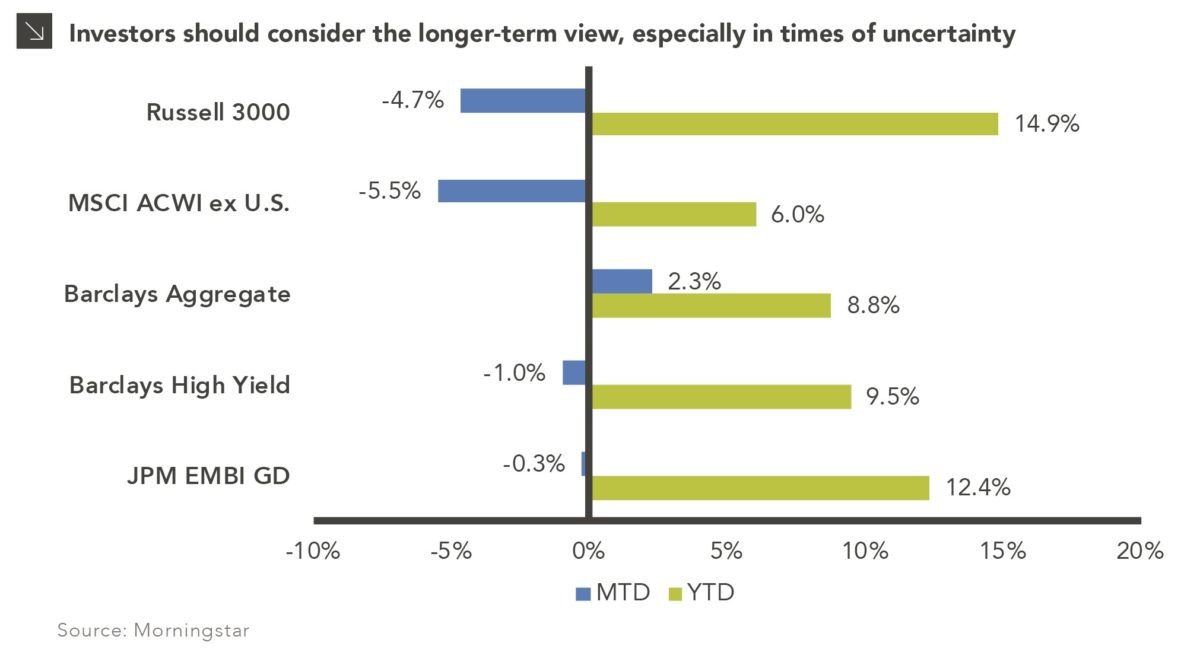
Given this week’s volatility driven by (brief) yield curve inversion, the ongoing U.S.-China trade dispute, disappointing economic data from Germany, and overall growing pessimism about future growth, investors’ growing concerns about portfolio returns are entirely justified. However, despite this week’s volatility and mostly negative news, almost all asset classes have delivered positive returns for the year, with the great majority of U.S. equity strategies up double digits. Furthermore, most fixed income strategies have profited from falling interest rates, as shown by positive returns from investment grade as well as below investment grade sectors. And for all the negative news out of the Eurozone and China, international equities — as represented by the ACWI ex-US index — are still up more than 6% through August 15th. While the rest of the year is likely to feature elevated volatility and lower returns, barring a major market correction most portfolios should remain in positive territory, despite what has transpired the first half of August. If nothing else, we encourage investors to take a long-term view of the markets and not overreact in times of market stress, as stepping back and taking a longer-term view of the markets indicates that 2019 has been a profitable year to date.

Print PDF > All is Not Lost for 2019

The opinions expressed herein are those of Marquette Associates, Inc. (“Marquette”), and are subject to change without notice. This material is not financial advice or an offer to purchase or sell any product. Marquette reserves the right to modify its current investment strategies and techniques based on changing market dynamics or client needs.
Second Quarter Review of Asset Allocation: Risks and Opportunities

Overall, the second quarter was positive for financial markets, thanks to strong economic fundamentals and expected Fed stimulus. Unemployment remains low at 3.7% and inflation (1.8% year over year) is near the Fed’s long-term target of 2%. However, there are increasing concerns about a global economic slowdown and early forecasts for 2Q GDP growth are around 1.5%, far lower than what we’ve seen in recent quarters. Globally, the most important trends we see are the following:

  • The U.S.-China trade conflict remains ongoing as talks between the two countries resumed, but little progress has been made;
  • The Federal Reserve is expected to cut rates in July and markets are forecasting another one to two cuts by the end of the year;
  • Business sentiment is declining ­— most notably in the PMI manufacturing index, which is now dangerously close to falling below its growth threshold;
  • Britain continues to struggle with its Brexit and elected a new PM (Boris Johnson) on July 23rd;
  • China and Europe are expected in increase their stimulus measures to combat slow growth and overall global uncertainty;
  • Late-cycle dynamics in credit and equity markets.

The impact of these trends is explored further in this newsletter as we review second-quarter performance and expectations going forward for each of the major asset classes.

Read > Second Quarter Review of Asset Allocation: Risks and Opportunities

The opinions expressed herein are those of Marquette Associates, Inc. (“Marquette”), and are subject to change without notice. This material is not financial advice or an offer to purchase or sell any product. Marquette reserves the right to modify its current investment strategies and techniques based on changing market dynamics or client needs.

Bank Loans Position Paper

Bank loans represent a key strategic asset class for most institutional investors’ fixed income portfolios. Some of the critical benefits of bank loans include yield that is typically greater than that of core bonds, a floating rate and therefore very little interest rate risk, and a senior secured level in the debt capital structure of issuers such that default risk is minimized and recovery rates are maximized. This position paper covers the history of the asset class as well as some unique characteristics that make it a vital part of many institutional investors’ portfolios. We will also examine its historical returns and correlations with other asset classes, as well as its risks ranging from credit to liquidity risk and interest risk to reinvestment risk. We will conclude with an assessment of its recent valuations as well as how to access this asset class.

Download PDF >

The opinions expressed herein are those of Marquette Associates, Inc. (“Marquette”), and are subject to change without notice. This material is not financial advice or an offer to purchase or sell any product. Marquette reserves the right to modify its current investment strategies and techniques based on changing market dynamics or client needs.


Are Low Default Rates a Reason to Reach for Higher Yields?

As indicated in Moody’s 2018 Annual Defaults Report, recent default rates on corporate debt have been significantly below long-term historical averages. Is this as positive for forward returns as one would think?

This week’s chart of the week shows recent corporate default rates against the longer-term averages and the return/risk ratio. As expected, the default rates are lower across the board and especially so in the sub-investment grade space. B rated debt has the largest change in default rate at 9.3%, leaving the trailing 5-year default rate at nearly half of its longer-term average. Lower default rates have been great for returns, so what’s the risk?

Just as equity analysts extrapolate recent high company earnings growth into the future, the risk is that credit analysts extrapolate the unordinarily low default rate into the future. The recent economic environment has been hospitable for low default rates with steadily increasing corporate margins and an increased ability to pay down debt. As some investors move into more volatile and lower quality debt to chase the higher yield that these bonds offer, the return per unit of risk decreases because the default rate increases by more than the additional yield benefit. If default rates were to increase and revert to the mean, lower credit rating bonds would be hit especially hard.

However, active investment managers strive to mitigate some of these risks. They can tilt their portfolios to higher quality bonds or choose bonds that they believe are rated incorrectly by rating agencies, thus lowering their portfolio’s default rate. In total, the recent low default rates have been great for trailing returns, however the future environment is uncertain and the strategy of reaching for higher yield may not perform as it has in recent history.

Print PDF > Are Low Default Rates a Reason to Reach for Higher Yields?

The opinions expressed herein are those of Marquette Associates, Inc. (“Marquette”), and are subject to change without notice. This material is not financial advice or an offer to purchase or sell any product. Marquette reserves the right to modify its current investment strategies and techniques based on changing market dynamics or client needs.

2019 Market Preview

Coming off a difficult 2018, investors face a litany of questions going into this year, whose potential answers will undoubtedly have an impact on the capital markets. The following set of newsletters examines the primary asset classes we cover for our clients, with in-depth analysis of last year’s performance and more importantly, trends, themes, and projections to watch for in 2019. We hope these materials can assist you and your committees as you plan for the coming year, and please feel free to reach out to any of us should you have further questions about the articles or wish to review the 2019 Market Preview Webinar recording. Here’s to a better year from the capital markets in 2019!

U.S. Economy: The View from the Top?
by Jeffrey Hoffmeyer, CFA, Lead Analyst, Asset Allocation

Fixed Income: Kicking Off the Year with Moderate Valuations, a Less-Hawkish Fed and Growing Global Tariffs
by Ben Mohr, CFA, Senior Research Analyst, Fixed Income

U.S. Equities: The Pro-Growth Narrative Fizzles Out
by Samantha T. Grant, CFA, CAIA, Senior Research Analyst, U.S. Equities
and Rob Britenbach, CIPM, Research Analyst, U.S. Equities

Non-U.S. Equities: Can They Get Back on Track?
by David Hernandez, CFA, Senior Research Analyst, International Equities
and Nicole Johnson-Barnes, Research Analyst

Real Estate: Navigating Through a Late Market Cycle
by Jeremy Zirin, CAIA, Senior Research Analyst, Real Assets

Infrastructure: Stable Cash Flows in an Uncertain Market Environment and the Evolving Landscape
by Jeremy Zirin, CAIA, Senior Research Analyst, Real Assets

Hedge Funds: Is Market Volatility Here to Stay?
by Joe McGuane, CFA, Senior Research Analyst, Alternatives

Private Equity: Poised for Robust Deployment
by Derek Schmidt, CFA, CAIA, Senior Research Analyst, Private Equity


The opinions expressed herein are those of Marquette Associates, Inc. (“Marquette”), and are subject to change without notice. This material is not financial advice or an offer to purchase or sell any product. Marquette reserves the right to modify its current investment strategies and techniques based on changing market dynamics or client needs.

U.S. Credit Market Health Check

This week’s chart looks at two key indicators of the health of the U.S. credit market. The first, on the left, shows a growing portion of covenant-light (“cov-lite”) bank loans relative to full-covenant bank loans.¹ The second indicator, on the right, shows a growing portion of loan-only bank loan issuers, which remove the benefit of a credit cushion for bank loan investors.² Recent studies by Credit Suisse show that recovery rates for cov-lite issuers are 10-15% worse than non-cov-lite issuers, and recovery rates for loan-only unitranche issuers are 15% worse than non-unitranche issuers. As such, there is some structural deterioration in the bank loan market, but the general consensus is that this should not be a 2019 story, but 2-3 years out. This means that there is not a very high concern of a credit crunch in 2019, but potentially in 2020-2021 if prices get to frothy levels again by then.

That said, defaults remain low, so at least for now, there is no sign of immediate trouble. And spreads have widened out over the last couple of months to be wider than average excluding 2008 and 2009 levels, showing that there has been some release in pressure and the market is perhaps pricing in some of these concerns. Most bank loan strategies are now focused on quality credit selection, avoiding deals with high leverage and unreliable assets or unreliable earnings. That said, as this cycle wears on, we would certainly want to remember that despite their senior secured nature, bank loans are still sub-investment grade debt and should be balanced with a healthy core bond allocation.

Print PDF

¹ Covenant-light means that the bank loan issuer is subject to few restrictions, also known as covenants, in managing its business. For example, covenants could be maximum leverage (debt divided by cash flows) or minimum coverage (cash flows divided by interest expenses). The rise in cov-lite deals has been a reality since 2005 and they appear to be here to stay. One reason for their rise is due to the standardization and syndication of bank loans as a public security, thereby making them become more like high yield bonds, which have very little covenants, and less like private credit.

² This means that, in the event of bankruptcy, the bank loan investors do not have a high yield, junior subordinated debt tranche beneath them for the losses to eat into after the equity tranche. The bank loan investors will see immediate losses right after the equity tranche in this case.

The opinions expressed herein are those of Marquette Associates, Inc. (“Marquette”), and are subject to change without notice. This material is not financial advice or an offer to purchase or sell any product. Marquette reserves the right to modify its current investment strategies and techniques based on changing market dynamics or client needs.


Are Bonds Approaching Moderate Value?

This week’s chart looks at how bonds have fared during the global volatility of the last two months. In summary, bonds have retrenched a bit but have protected principal overall as expected and served as good diversifiers to other asset classes such as equities and alternatives. Spreads have widened moderately and are now showing some value across the board.

The four sections of the chart show the spread versus the average for core bonds, bank loans, high yield bonds and emerging markets debt. The timeframes are from the end of 2008 to today, but the averages are based on the last 20 years excluding 2008 and 2009 as outliers. As we can see, each of the spreads are rising and approaching averages. They are no longer near post-2008 tights anymore. This signifies that there may perhaps be some moderate value in fixed income today.

The fundamentals and the global macro backdrop support a moderate outlook. U.S. and European high yield and leveraged loan default rates remain low. Leverage, coverage, issuance and outstanding amounts do not point to a frothy market. Aggressive issuance is experiencing a shift away from high yield and into bank loans but remains modest overall. As the effect of Trump’s tax cuts continues to be felt through strong corporate earnings and the global tariff escalation continues to evolve, the Federal Reserve has enough optimism about the economy to warrant its continued pace of rate hikes. Collectively, these trends suggest stable if not improving valuation, fundamental and macro factors as we approach the New Year.

Print PDF

The opinions expressed herein are those of Marquette Associates, Inc. (“Marquette”), and are subject to change without notice. This material is not financial advice or an offer to purchase or sell any product. Marquette reserves the right to modify its current investment strategies and techniques based on changing market dynamics or client needs.