Emerging Markets Debt a Better Play than Developed Market Debt

Emerging markets debt (“EMD”) represents an outstanding asset class for investors to diversify away from U.S.-centric core bonds, which includes U.S. Treasury, U.S. investment grade corporate and U.S. mortgage-backed bonds, as well as U.S.-centric bank loans and high yield bonds.

Emerging markets debt (“EMD”) represents an outstanding asset class for investors to diversify away from U.S.-centric core bonds, which includes U.S. Treasury, U.S. investment grade corporate and U.S. mortgage-backed bonds, as well as U.S.-centric bank loans and high yield bonds. It gives investors a large and expanding investment opportunity set that has very low correlation with U.S. equities and U.S. bonds.

In addition to stronger yields, where EMD is currently between 6% to 10% versus developed market bond yields between 0% to 6%, emerging markets also exhibit much stronger fundamentals versus their developed markets counterparts. Case in point, GDP growth has been much stronger in the emerging world than the developed world, especially so in the last few years, and is expected to continue for some time. Moreover, demographics are much more favorable for the emerging world, where population growth, especially in the younger, working segment, is expected to outstrip the developed world for quite some time. Lastly, as shown above, emerging market countries have much stronger debt and deficit profiles than developed market countries.

The left axis shows the debt as a percentage of GDP. The greater a country’s debt, the further towards the bottom of the chart it will show. The top axis shows the country’s fiscal deficit as a percentage of its GDP. The greater a country’s fiscal deficit, the further to the right it will show.

Emerging market countries are clustered toward the top left, due to their lower debt-to-GDP ratios and lower fiscal deficits. Developed market countries are clustered towards the bottom right, due to their higher debt-to-GDP ratios and higher fiscal deficits. Greece and Japan are in especially dire straits, and are literally off the charts.

What this chart tells us is that, as a whole, EMD represents a relatively secure asset class as the countries in question have much less debt to service than their developed market counterparts. In addition, they have been more fiscally sound, with lower deficits than their developed market counterparts. All of this adds up to strong support for emerging market countries and corporations to pay both the interest and principal on their bonds. Couple this with their higher yields and low correlations to other asset classes, and it makes it a must-have for most institutional portfolios.

Investors can take advantage of this space through a dedicated emerging markets debt manager that provides a U.S. dollar-denominated “hard currency” sovereign EMD focus, a “local currency” sovereign EMD focus, a corporate EMD focus, or a blended strategy that invests in both hard and local currency EMD bonds as well as sovereign and corporate EMD bonds. Marquette recommends a blended EMD allocation for investors to take advantage of the broadest diversification.

Volatility Index Spikes in August

This week’s chart of the week takes a closer look at the CBOE volatility index (“VIX”) and the German implied volatility index (“VDAX”) in light of recent geopolitical events. Volatility indices are often describes as “fear indices” that tend to increase with market uncertainty.

This week’s chart of the week takes a closer look at the CBOE volatility index (“VIX”) and the German implied volatility index (“VDAX”) in light of recent geopolitical events. Volatility indices are often described as “fear indices” that tend to increase with market uncertainty.  As uncertainty increases, investors typically prefer the safety of U.S. Treasuries, driving up bond prices and pushing yields lower.

• On August, 1st, President Obama announced sanctions on Russia; VIX and VDAX reached their highest levels in more than five months over concern of Russian retaliation.
• On August, 7th, President Obama authorized a targeted strike against Iraq; triggering the VDAX to reach the highest level of the year as concern over global equity markets lead investors to push the 10-Year Treasury yield to 2.43%.
• Finally, August, 15th marked the fall of the 10 Year-U.S. Treasury yield to the lowest in 14 months at 2.34%, due in part to the global tension in Ukraine and conflict in the Middle East.

After spiking in early August on geopolitical worries, the VIX has returned to more normal levels seen throughout most of the year. However, with many of the geopolitical hotspots right on Germany’s doorstep, German market volatility has remained elevated. While U.S. investors may have put the latest crisis behind them, it is worth noting that markets closer to the epicenter of the conflict are not as sanguine.

Uneven Labor Market Recovery

This week’s Chart of the Week examines how total employment has changed by sector since the beginning of the recession. Recently, nonfarm employment recovered the total net jobs lost during the recession, but as the chart shows not all industries have fared equally during the recovery

This week’s Chart of the Week examines how total employment has changed by sector since the beginning of the recession. Recently, nonfarm employment recovered the total net jobs lost during the recession, but as the chart shows not all industries have fared equally during the recovery. It comes as little surprise that construction and manufacturing have been among the hardest hit, dropping about 20% and 12% respectively, for a combined loss of 3.1 million jobs. Additionally it should be noted that this does not account for population growth, making these losses more significant.

When the overall landscape of the economy changes so dramatically multiple issues can arise. First and most importantly, workers who lost jobs in sectors hit hardest have not seen their jobs return. As a result they must change careers and find work in a different industry, or risk being unemployed for the long-term. However, even if they are willing to make this career change they might not have the skills necessary to find a job in another industry. Similarly, expanding sectors may have difficulty finding qualified workers for their newly created positions. Both of these issues are inefficiencies that cause a drag on economic growth.

Service Sector of U.S. Economy Strengthens

This weeks’ Chart of the Week looks at the state of the service sector in the U.S., as measured by the Institute for Supply Management (ISM) Non-Manufacturing Index. On August 5th, the ISM released July data for the ISM Non-Manufacturing Index, which posted a reading of 58.7 (a reading greater than 50 indicates expansion in the service sector while a reading below 50 indicates contraction).

This weeks’ Chart of the Week looks at the state of the service sector in the U.S., as measured by the Institute for Supply Management (ISM) Non-Manufacturing Index. On August 5th, the ISM released July data for the ISM Non-Manufacturing Index, which posted a reading of 58.7 (a reading greater than 50 indicates expansion in the service sector while a reading below 50 indicates contraction). This was the highest reading since December 2005 and is one of the highest on record for the index (which dates back to July 1997). This index is important because it serves as a gauge of the overall strength of the service sector of the U.S. economy, and considering that the service sector is the single largest component of U.S. GDP (representing 45.7% of GDP as of 2Q 2014), it has fairly significant implications for the broad economy.

A deeper look into the underlying constituents of the ISM Non-Manufacturing Index points to continuing strength in the service sector. The new orders component, which reflects the level of new orders from customers, posted a reading of 64.9 in July. This was the highest reading of the new orders index since August 2005 and is also one of the highest on record. The employment component of the Non-Manufacturing Index also showed strength in July, posting a reading of 56.0. This was higher than the 54.4 reading in June but it is still lagging the broad Non-Manufacturing index. Given that the new orders index has increased significantly from 50.4 in December 2013 to 64.9 in July, we could see significant growth in service sector employment during the second half of the year if companies start to hire additional employees in order to keep pace with the increased demand.

An Alternative to U.S. Small-Cap Equity

This week we examine the valuation of developed non-U.S. small-cap equity (MSCI EAFE small-cap) compared to U.S. small-caps (Russell 2000). The chart displays the relative price-to-earnings (P/E) and price-to-book (P/B) ratios for the two asset classes. A lower number indicates the U.S. is more expensive compared to non-U.S small-cap stocks.

This week we examine the valuation of developed non-U.S. small-cap equity (MSCI EAFE small-cap) compared to U.S. small-caps (Russell 2000). The chart displays the relative price-to-earnings (P/E) and price-to-book (P/B) ratios for the two asset classes. A lower number indicates the U.S. is more expensive compared to non-U.S small-cap stocks. Based on the historical averages for both P/E and P/B, non-U.S. equity looks relatively attractive.

Small-cap companies in the U.S. have performed well in this historically low interest rate environment. Now five years into the economic recovery, market participants expect a rate hike from the Fed to occur sometime mid next year. With U.S. small-cap stocks lacking extraordinary earnings growth, many investors are questioning their valuations. In the Eurozone and Japan, two areas that account for over 40% of the MSCI EAFE small-cap index, the economies are earlier in their respective recoveries and experts anticipate lower interest rates to persist in these regions, which should be accretive for equities in those markets. Investors looking to reduce their U.S. small-cap exposure should consider developed non-U.S. small-cap, given the accommodative central bank policies and relative valuations.

Are MLP Valuations Too Rich?

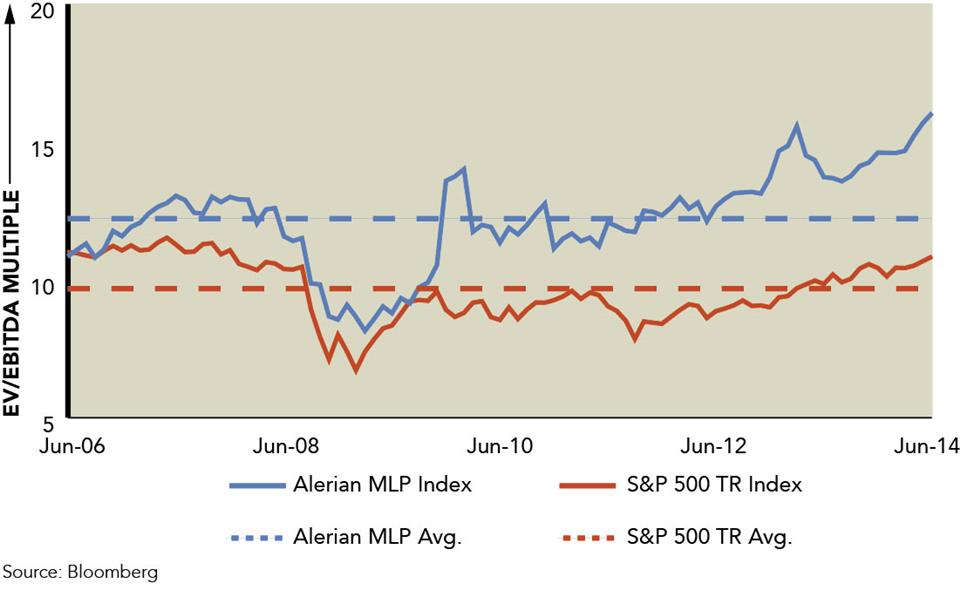
This week’s Chart of the Week takes a look at Master Limited Partnerships (“MLPs”) and their current valuations based on their EBITDA Multiple (calculated by Enterprise Value divided by the 12-month EBITDA). Generally, a higher multiple implies a more expensive valuation. Relative to long-term averages and the S&P 500, MLPs appear expensive today. The elevated valuations, however, are pricing in higher expected rates of growth.

This week’s Chart of the Week takes a look at Master Limited Partnerships (“MLPs”) and their current valuations based on their EBITDA Multiple (calculated by Enterprise Value divided by the 12-month EBITDA). Generally, a higher multiple implies a more expensive valuation. Relative to long-term averages and the S&P 500, MLPs appear expensive today. The elevated valuations, however, are pricing in higher expected rates of growth. These higher growth expectations do not come as a surprise given the recent increase in domestic energy production and expected midstream infrastructure expenditures, which could approach $640 billion between now and 2035.1  Compared to the prior study done in 2011 ($261B), the 2014 estimates represent a 145% increase in infrastructure spending.

Paying a premium for MLPs relative to historical averages may not necessarily be a bad thing assuming that the estimated growth within the energy infrastructure sector comes to fruition. If, however, there is a catalyst in the market such as a rapid increase in interest rates, regulatory change, or an international crisis, MLPs may experience a correction.

1 Interstate Natural Gas Association of America

Favorable Relative Valuation for U.S. Large-Cap Stocks

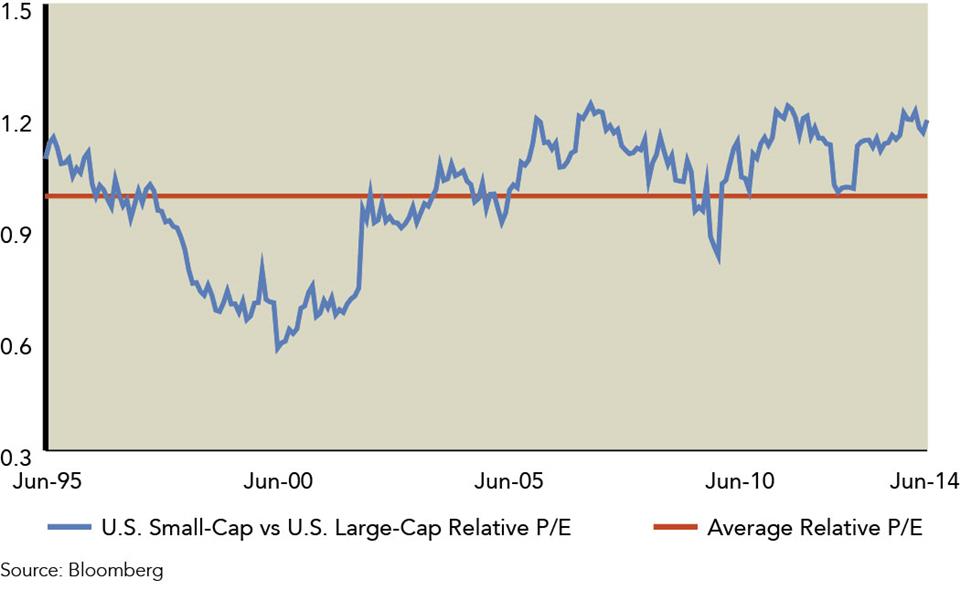
This week’s Chart of the Week examines the historical valuation premium of U.S. small-cap stocks (as represented by the Russell 2000 index) relative to U.S. large-cap stocks (based on the Russell 1000 index). A line above 1.0 indicates a higher relative valuation for the Russell 2000 compared to the Russell 1000. As of June 30th, 2014, the small-cap index carried an 18.7% premium relative to the large-cap index

This week’s Chart of the Week examines the historical valuation premium of U.S. small-cap stocks (as represented by the Russell 2000 index) relative to U.S. large-cap stocks (based on the Russell 1000 index). A line above 1.0 indicates a higher relative valuation for the Russell 2000 compared to the Russell 1000. As of June 30th, 2014, the small-cap index carried an 18.7% premium relative to the large-cap index. Investors should typically expect small-caps to command a larger P/E multiple relative to large-caps given that small-cap stocks tend to have higher expected earnings growth rates assigned to them. Despite this, the chart above indicates that small-caps are currently at the upper end of their historical relative valuation premium. This suggests a more favorable entry point for large-cap stocks versus small-cap stocks.

With U.S. equity markets over 5-years into the current recovery and major indices trading near all time highs, small-cap stocks are facing a few headwinds. As the Fed winds down its asset purchasing program and as the market begins to anticipate a rise in interest rates, small-cap performance will be more linked to the health of the U.S. economy and face a greater sensitivity to a rise in interest rates versus large-caps. In addition, large-cap stocks derive a larger percentage of their revenues outside of the U.S. and would be poised to benefit to a greater extent over small-caps from higher expected growth rates outside of the U.S. With relative valuation levels between small-caps and large-caps currently at a high level, a better risk/reward trade-off exists for U.S. large-cap stocks.

Projecting the Increase in the Fed Funds Rate

On July 9, the Federal Reserve released the minutes from the June FOMC meeting which indicated that it is planning to continue the taper of its bond buying program at the current pace and expects to end the bond purchases entirely in October. With the Fed’s bond buying program (more formally known as quantitative easing) coming to an end, the next step for the Fed will likely be an increase in the fed funds rate.

On July 9, the Federal Reserve released the minutes from the June FOMC meeting which indicated that it is planning to continue the taper of its bond buying program at the current pace and expects to end the bond purchases entirely in October. With the Fed’s bond buying program (more formally known as quantitative easing) coming to an end, the next step for the Fed will likely be an increase in the fed funds rate. In order to illustrate the market’s expectations for the timing of the increase in the fed funds rate, this week’s Chart of the Week shows the implied fed funds rate derived from the fed funds futures market. As the chart indicates, the market currently expects the fed funds rate to remain within the current target level of 0.00–0.25% (0–25 basis points) throughout 2014 and expects the first rate hike to occur at the June 2015 meeting. From there, the market is currently pricing in a series of gradual hikes in the second half of 2015 and throughout 2016 and 2017.

It should be noted that while the fed funds futures market has historically been fairly accurate at predicting near term movements in the fed funds rate (i.e., six months and in), it has a fairly poor track record of predicting longer-term movements (i.e., greater than six months out) especially during periods of transition in Fed policy. Nonetheless, it is important to be aware of what the fed funds futures market’s current expectations are, as changes in these expectations have the potential to significantly impact the broad markets.

The Fed Is Adding Repos to Its Toolbox

A repurchase agreement (“repo”) is a transaction in which a dealer sells securities to an investor and agrees to repurchase the securities at a future date. Typically, the dealer sells the securities at a discount to the repurchase price.  The repo market is relevant because it is a critical mechanism for the U.S. financial system to facilitate short-term lending between major financial institutions, money market vehicles, and the Federal Reserve.

A repurchase agreement (“repo”) is a transaction in which a dealer sells securities to an investor and agrees to repurchase the securities at a future date. Typically, the dealer sells the securities at a discount to the repurchase price. Effectively, the arrangement is akin to a collateralized loan with the difference between the sales price and repurchase price equating to an interest payment and the securities serving as collateral in the event of default (i.e., failure to repurchase).

The repo market is relevant because it is a critical mechanism for the U.S. financial system to facilitate short-term lending between major financial institutions, money market vehicles, and the Federal Reserve. The credit crisis in 2008 was preceded by heightened leverage in the repo market. When the fragile state of banking institutions’ balance sheets became apparent, money market funds and private lenders collectively barred access to capital for borrowers perceived to be weak. Due to a general lack of transparency as well as market fear, access to capital from the repo market dried up and sealed the fate of the likes of Lehman Brothers and Bear, Stearns & Co. who depended on it as a source of borrowing. Since then, the Federal Reserve has been aware of the need for reforms to reduce reliance on private banks and money market funds for liquidity in the repo market during times of stress.

This week’s chart shows evidence of the Fed’s intervention in the U.S. repo market to manage liquidity in lending markets and promote the stability of the financial system. In 2008, the Fed acted as a lender of cash, increasing its position in repurchase agreements, attempting to supply much needed capital to the banking system. More recently, the Fed has done the opposite. On September 23, 2013, the Fed began testing its reverse repurchase agreement program. As part of the new program, the Fed has been increasing its position in reverse repurchase agreements which means it absorbs cash from private institutions, thus acting as a borrower. While some believe this is simply a measure of monetary tightening, a more compelling argument is that the Fed is maintaining its role as a provider of liquidity despite taking the other side of the trade. In the face of high demand for U.S. Treasury securities as collateral for private institutions and money market funds, the Fed is using reverse repos to increase the availability of those securities in the market by drawing them from its own balance sheet. Meanwhile, the New York Fed is monitoring the weighted average maturity of banks’ borrowings in the repo market to identify vulnerable institutions with an overreliance on borrowing. Though the program has not yet been permanently instituted, it seems probable that the Fed hopes to use this new tool to stabilize bond markets ad infinitum.

A Stock Picker’s Market?

So far, 2014 has seen a number of things fall: unemployment, interest rates, the pace of QE3, and correlations among U.S. equities. It is conventional wisdom that in times of crisis, correlations move to one and all equities fall in unison. Since 2008 when the correlations between sectors in the S&P 500 did indeed approach one, active equity managers have bemoaned the lack of dispersion that is commonly present in the U.S. equity market.

So far, 2014 has seen a number of things fall: unemployment, interest rates, the pace of QE3, and correlations among U.S. equities. It is conventional wisdom that in times of crisis, correlations move to one and all equities fall in unison. Since 2008 when the correlations between sectors in the S&P 500 did indeed approach one, active equity managers have bemoaned the lack of dispersion that is commonly present in the U.S. equity market. When dispersion is low and correlations are high, it is difficult for active managers to outperform a benchmark. During periods of high correlation, the market reacts to macro-type factors, punishing or rewarding all equities at once with little regard to stock specific fundamentals.

In 2014 however, correlations have once again begun to exhibit a downward trend, allowing active managers more opportunities to separate themselves from a benchmark. As measured by rolling 21-trading day windows, average correlations between the 10 sectors of the S&P 500 and the index itself reached a low of 63% in May, a level not seen since late 2010. If the trend of lower correlations continues throughout the year, expect greater dispersion between individual equities to be closely followed by greater dispersion between active managers and their benchmarks.