Can Continuing Employment Growth Boost Business Spending?

This week’s chart of the week compares business spending (represented by non-defense capital goods orders) to employment (represented by total nonfarm employees) in the United States. As the chart illustrates, both employment and business spending have been steadily rising since the economic recovery began back in 2009.

This week’s chart of the week compares business spending (represented by non-defense capital goods orders) to employment (represented by total nonfarm employees) in the United States. As the chart illustrates, both employment and business spending have been steadily rising since the economic recovery began back in 2009. However, the growth of business spending, which contributed significantly to economic growth in the early stages of the recovery (increasing by an average of approximately $640 million per month from May 2009 through December 2011) has slowed as of late (increasing by an average of approximately $34 million per month from January 2012 through December 2013).

Employment growth, on the other hand, has been fairly steady over the past several years (increasing by an average of approximately 180,000 jobs per month each of the past three calendar years). With the ongoing strength in employment growth, the United States is approaching a new all-time high in total employment (i.e., peak employment). At the current rate of employment growth, the United States should reach a new peak employment this summer. This is a significant development because reaching new peak employment has historically led to significant growth in business spending, as businesses have to purchase new technology, equipment, and space to accommodate a larger workforce.

It will be important to monitor how businesses react once the economy reaches new peak employment. If business spending increases as it has in the past, it will provide another tailwind to an already strengthening economic recovery.

Is the Stock Market Overpriced?

Given the monumental run of the equity markets in 2013, we have frequently been asked if the stock market (as measured by the S&P 500 index) is overvalued heading into 2014. The answer unfortunately is not a simple yes or no, because it depends on the valuation method and measurement period.

Given the monumental run of the equity markets in 2013, we have frequently been asked if the stock market (as measured by the S&P 500 index) is overvalued heading into 2014. The answer unfortunately is not a simple yes or no, because it depends on the valuation method and measurement period. This week’s Chart of the Week looks at one valuation measure, the S&P 500 trailing 12-month price-to-earnings (P/E) ratio. We compare today’s P/E ratio with its 10, 20, 30, and 40-year averages.

As the chart shows, there is no clear cut answer when comparing these different averages to the current value — the analysis is very much contingent on the time period utilized when calculating the long-term average. Based on the 20- and 30-year averages one may conclude that the market is fairly priced, if not underpriced. However, the exaggerated P/E ratios as part of the tech bubble likely provide an upward bias to truly objective “long-term” averages. Fortunately, the 40-year average is sufficient to more effectively smooth out the spikes from the Tech Bubble valuations. Using this time period to determine the long-term average, it does indeed appear that the market is overvalued and expensive by historical means. However, this is far from a guarantee that the market will experience a correction in 2014, though we encourage our clients who experienced outsized gains in their equity portfolios in 2013 to consider rebalancing back to their target ranges. If nothing else, one thing is for sure: in order to sustain this current bull market run, the S&P 500 will need to produce strong earnings growth over the next year.

2014 Market Preview

January 2014

Similar to previous years, we present our annual market preview newsletter. Each year presents new challenges to our clients, and 2014 is no different: We are coming off a banner year for U.S. equities, low interest rates continue to stymie fixed income investors, and while developed market equities enjoyed a strong 2013, emerging market stocks sputtered. In the alternative space, real estate and hedge funds proved accretive to portfolio returns, while growing dry powder in the private equity space is starting to raise a few eyebrows.

Download PDF

A Challenging Year for Core Bonds

This week’s chart depicts the challenging environment core fixed income investors faced in 2013. The ten-year Treasury rate jumped causing significant price depreciation while the coupons failed to cover the losses.

This week’s chart depicts the challenging environment core fixed income investors faced in 2013. The ten-year Treasury rate jumped causing significant price depreciation while the coupons failed to cover the losses. The Barclays Agg index declined 2.0% in 2013, the first negative calendar year return since 1999. This performance was made up of a -4.6% price return and a 2.6% coupon return.

Facing the prospects of low income and prices losses, many investors transitioned away from traditional core bonds in favor of higher yields and/or lower interest rate risk. It should be noted that this allocation change generally accompanies an increase in credit risk as there is no free lunch. While the bull market in fixed income is likely over and return expectations have been lowered, traditional bonds still serve an important role as an anchor to diversified portfolios, providing a steady source of income and principal repayment to investors.

Fixed Income Repositioning

This week’s Chart of the Week examines the estimated net mutual fund flows that occurred within fixed income from January 2013 through November 2013. Notable fund flow trends during this time included investors diversifying away from more traditional bond categories such as intermediate-term, municipal, government, inflation-protected bonds, and money markets.

This week’s Chart of the Week examines the estimated net mutual fund flows that occurred within fixed income from January 2013 through November 2013. Notable fund flow trends during this time included investors diversifying away from more traditional bond categories such as intermediate-term, municipal, government, inflation-protected bonds, and money markets. With generally low yield levels across fixed income asset classes and the expectation of a rising interest rate environment, investors added to categories such as bank loans, nontraditional bonds (which include unconstrained and opportunistic categories), world bonds, and short-term bonds.

Favored bond categories in 2013 tended to carry less interest rate risk such as bank loans and shorter maturity securities. Tactical investments like nontraditional bond and world bond categories where the investment manager typically has more control over interest rate or credit exposures taken at any given time also drew investment dollars. Short and ultra-short bonds were favored as a substitute for money market funds in the current low yield environment.

As investors reposition their fixed income portfolios for an expected low growth and rising interest rate environment, strategies with low interest rate risk or an emphasis on tactical flexibility within their mandates will likely continue to see net positive fund flows.

Has Household Income Peaked for Good?

In this week’s Chart of the Week, we track the real median household income in the United States over the last twenty-five years. The movement in this economic variable illustrates how the purchasing power of the typical American household has changed over time. This is an important statistic because it underpins the American ideal that every generation will do better than the previous.

In this week’s Chart of the Week, we track the real median household income in the United States over the last twenty-five years. The movement in this economic variable illustrates how the purchasing power of the typical American household has changed over time. This is an important statistic because it underpins the American ideal that every generation will do better than the previous.

Currently, real household income is sitting near a twenty-year low and has declined every year since 2007. In fact, since peaking in 1999, real household income has decreased in ten of the last thirteen years. Given the importance of consumption to GDP growth — about two-thirds of total GDP growth is driven by consumption — this downward trend in real income for the median household would appear to pose (another) notable headwind to stronger economic growth in the near future and adds to the murky outlook for 2014 GDP expansion.

An End to Household Deleveraging?

This week’s chart of the week compares the total household mortgage liability (i.e. outstanding mortgage balances) to the total owners’ equity in household real estate (i.e. home equity) for all households in the United States. As the chart indicates, in 3Q 2013 the total owners’ equity in household real estate exceeded the total household mortgage liability for the first time since the 2007/2008 financial crisis.

This week’s chart of the week compares the total household mortgage liability (i.e., outstanding mortgage balances) to the total owners’ equity in household real estate (i.e., home equity) for all households in the United States. As the chart indicates, in 3Q 2013 the total owners’ equity in household real estate exceeded the total household mortgage liability for the first time since the 2007/2008 financial crisis. This recent turnaround was driven primarily by the rebound in housing prices over the past few years (causing an increase in owners’ equity) and the large number of foreclosures on underwater homeowners over the past several years (causing both a decrease in outstanding mortgage balances and an increase in owners’ equity).

This development is significant because it may signal that household deleveraging, which has been a drag on economic activity for the past several years, is finally starting to come to an end. While still too early to determine if this data point is part of a larger economic trend, further readings of a positive gap between equity and liability should translate to stronger economic growth in the coming years.

What’s Next for the S&P 500?

This week’s chart illustrates the distribution of returns for the S&P 500 in the year following a return greater than 25%. Since 1926, the S&P 500 has produced a calendar year total return greater than 25% on 23 separate occasions.

This week’s chart illustrates the distribution of returns for the S&P 500 in the year following a return greater than 25%. Since 1926, the S&P 500 has produced a calendar year total return greater than 25% on 23 separate occasions. In the 12 months following, 15 observations or 65% of the time, the returns were positive (average return of +21.3%). Conversely, 8 observations or 35% of the time the results were negative (average return of -8.8%). Interestingly, since 1950 there have been 15 calendar years of +25% returns, yet only 3 (20%) of the following calendar years were negative. Many investors are calling for a market correction in 2014; however, a majority of the time returns have been positive and have averaged 10.9% following a calendar year return greater than 25% for the S&P 500.

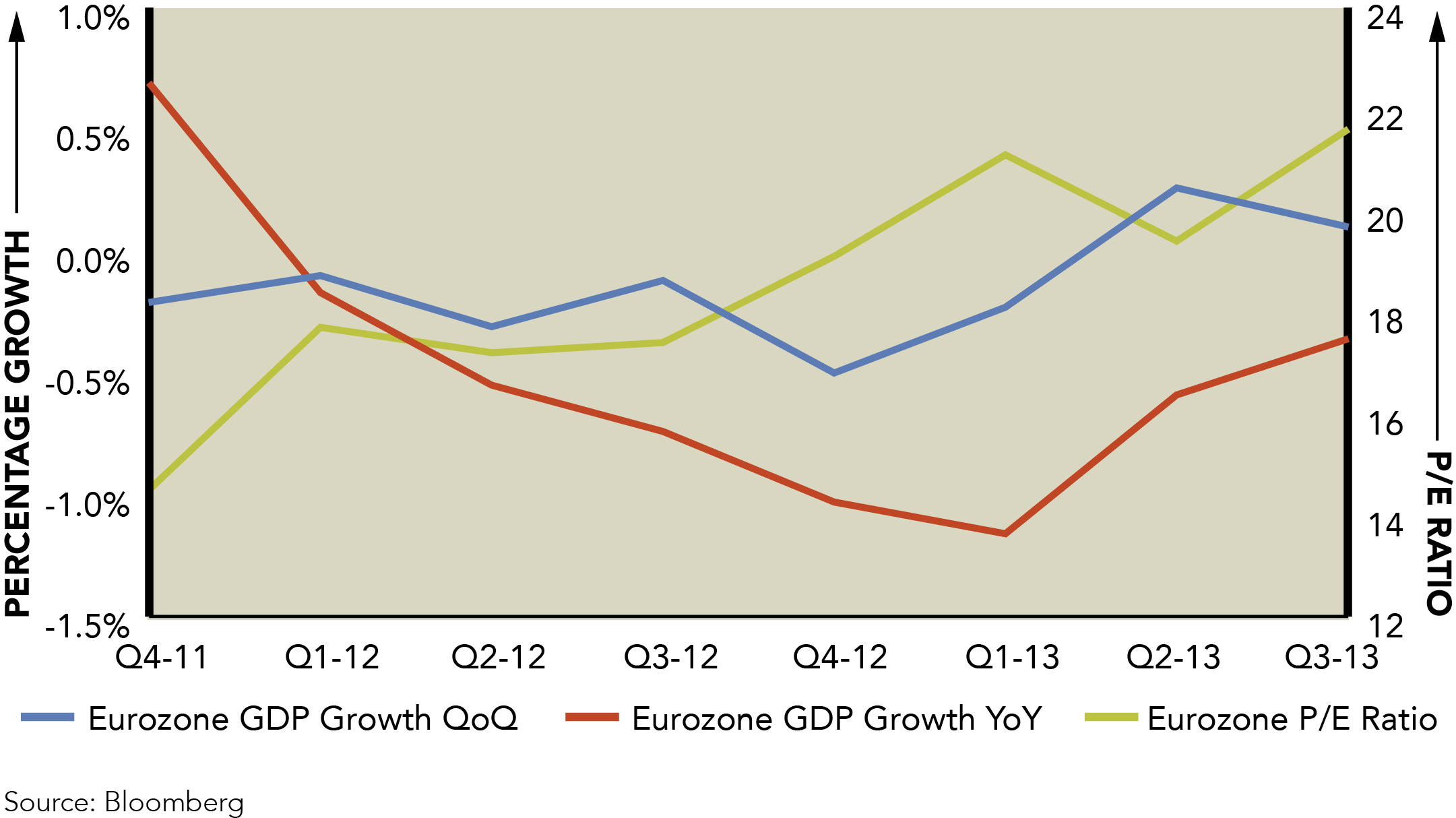
Eurozone Valuations Outpace GDP Growth

This week’s Chart of the Week examines GDP growth and valuation levels in the eurozone. The chart above depicts eurozone quarterly GDP growth compared to both the prior quarter and year. As the chart shows, eurozone GDP growth is at very low or even negative levels.

This week’s Chart of the Week examines GDP growth and valuation levels in the eurozone. The chart above depicts eurozone quarterly GDP growth compared to both the prior quarter and year. As the chart shows, eurozone GDP growth is at very low or even negative levels. Growth versus the prior year has been negative since the first quarter of 2012, while growth versus the prior quarter only recently turned positive (albeit very slow at .26%) in the second quarter of 2013.

The eurozone GDP growth or lack thereof does not seem to accurately correspond to eurozone valuation levels. As seen in the chart, the eurozone’s P/E ratio has continued to increase over the past 8 quarters despite little to no growth. The P/E ratio was 14.5 at the end of the fourth quarter of 2011. Since then, the P/E ratio has climbed to 21.6 on speculation that Europe will experience a strong recovery. However, despite continued investor optimism, the main question still remains: will the European recovery truly come to fruition?

Bull Market to Continue?

The Conference Board Leading Economic Index (LEI), which consists of 10 economic variables, increased 0.7 percent from the previous month to 97.1 in September. The LEI attempts to predict future changes in the overall economy. Prior to the September release, economists estimated a median 0.6 percent increase according to a Bloomberg survey. The reported 97.1 September number represents the highest point since April 2008 (97.2).

The Conference Board Leading Economic Index (LEI), which consists of 10 economic variables, increased 0.7 percent from the previous month to 97.1 in September. The LEI attempts to predict future changes in the overall economy. Prior to the September release, economists estimated a median 0.6 percent increase according to a Bloomberg survey. The reported 97.1 September number represents the highest point since April 2008 (97.2).

Examining the historical data, two inflection points, which are circled in the chart, stand out the most. The first inflection point, the peak in April of 2000 (95.5), led to an additional 4.5% increase in the S&P 500 through August 2000. The second inflection point, March 2006 (107.9) led to the S&P 500 increasing by nearly 20% the following year ending in October of 2007. While past performance does not guarantee future results, the historical data from the LEI suggest that the market’s bull-run may continue as the economy continues its expansion, though at a modest rate.