Time to Bail on Bank Loans?

With record net inflows, compressed spreads, rising levels of corporate debt and a dramatic increase in covenant-light loans, bank loan investors have become concerned about their investments. While there are many ways to assess future prospects for the asset class, one key indicator to examine is the amount of 2nd lien bank loans compared to the total bank loan market.

With record net inflows, compressed spreads, rising levels of corporate debt, and a dramatic increase in covenant-light loans, bank loan investors have become concerned about their investments. While there are many ways to assess future prospects for the asset class, one key indicator to examine is the amount of 2nd lien bank loans compared to the total bank loan market. 2nd lien loans outstanding as a percentage of the market is a useful gauge because it shows the level of risk investors are willing to take just to hold senior secured debt that is subordinate to 1st lien holders in the event of a bankruptcy and/or liquidation. A primary concern about the amount of 2nd lien loans is that as the market heats up and investors reach more and more for yield or, as in the case of 2007, become enamored with the illusion of safety and superior yield offered by subordinated paper, companies will issue more and more 2nd lien loans to meet that demand, as was seen throughout 2006 and 2007.

The good news is that we are not yet in such an environment. As shown in the chart above, 2nd lien bank loans outstanding as a percentage of all bank loans outstanding is currently at 3.9%, well below the peak of 6.8% reached in 2007. While it has risen from its recent trough of 2.7% in March 2013, it is still below the 10-year average of 4.5%. Although yields on bank loans have compressed over the last several years, the asset class still remains one of the most compelling fixed income investments available to institutional investors, especially relative to the much lower yields found in other sectors. Going forward, it is critical to keep a pulse on inflows, leverage, cov-lite issuance, and 2nd lien loans as a means to monitor the health of the bank loan market. However, at the present time, investors should remain in bank loans and maintain their allocations until 2nd lien loans outstanding as a portion of the whole rise well above their long-term average.

Taylor Rule Provides Clues to Future Short-Term Rates

Developed by Stanford economist John Taylor in 1992, the Taylor Rule is a mathematical model designed to estimate the level of short-term interest rates consistent with the Federal Reserve’s mandate to promote price stability and full employment. In making its prediction, the model measures current inflation and unemployment data against a set of ideal targets.

Developed by Stanford economist John Taylor in 1992, the Taylor Rule is a mathematical model designed to estimate the level of short-term interest rates consistent with the Federal Reserve’s mandate to promote price stability and full employment. In making its prediction, the model measures current inflation and unemployment data against a set of ideal targets. Currently, the model utilizes the Fed’s stated inflation target of 2% and an unemployment rate of 5.6% as the ideals for a healthy economic environment.

Prior to the great recession, the output of the Taylor Rule proved to be fairly accurate in predicting short-term interest rates. As the financial crisis deepened, however, the Taylor Rule began to suggest that a negative level of short-term rates would be necessary in order to restore economic growth. Bound by zero as the floor for interest rates, the Fed was unable to lower short-term rates to meet the level prescribed by the Taylor Rule. With further interest rate decreases no longer an option, the Fed turned to quantitative easing as a means to further loosen monetary policy. Five years later, with the U.S. economy on more stable ground, the level of short-term rates prescribed by the Taylor Rule has once again turned positive. Not surprisingly, the Fed has begun to slow the pace of quantitative easing with the program scheduled to come to an end altogether later this year. As investors eye Fed clues for the future path of short-term rates, consider the Taylor Rule as a useful guide.

Good News for “Abenomics” and Japanese Wage Growth

In an attempt to revive the long struggling Japanese economy, Prime Minister Shinzo Abe implemented his “Abenomics” strategy which included an unprecedented open-ended asset purchase program. The monetary easing policy was implemented with the goal of spurring domestic spending and increasing exports via a devalued currency.

In an attempt to revive the long struggling Japanese economy, Prime Minister Shinzo Abe implemented his “Abenomics” strategy which included an unprecedented open-ended asset purchase program. The monetary easing policy was implemented with the goal of spurring domestic spending and increasing exports via a devalued currency. Equity investors reacted positively to the plan and the MSCI Japan Index returned 27.4% in 2013. With both corporate profits and business confidence rising, the initial results of “Abenomics” appear promising.

To keep things on course, Japanese companies will need to boost workers’ wages, a phenomenon that has rarely occurred for earners. This week’s chart shows the year-over-year change in wage earnings has been largely negative over the last 24 months. However in recent weeks during the annual wage negotiations (known as “shunto,” which translates to “spring offensive”) between unions and employers, several large companies, including Toyota, Honda, and Toshiba announced significant wage increases for the first time since 2008. Now economists will observe whether medium and small size companies follow suit. A rise in wages will help continue the initial positive momentum created by the monetary easing policies of “Abenomics” and could mean Japanese equities still have some upside left.

Economic Surprise Index Turns Negative

In this week’s chart we take a look at the CITI Economic Surprise Index. As a matter of background, the CITI Economic Surprise Index is a composition of various economic indicators that are released; anything above 0 indicates that economic reports are beating expectations and anything below 0 is underperforming estimates.

In this week’s chart, we take a look at the CITI Economic Surprise Index. As a matter of background, the CITI Economic Surprise Index is a composition of various economic indicators that are released; anything above 0 indicates that economic reports are beating expectations and anything below 0 is underperforming estimates. Since its peak in mid-January, the index has been on a steady decline and just reached its lowest point since June of last year.

The start of 2014 saw several key economic indicators fall short of expectations including retail sales, new jobs, manufacturing, and the consumer confidence index; such trends help explain the decline. On the bright side, many experts have blamed the historically dreadful weather conditions as key contributors to such pull-backs in economic activity, and expect a rebound once spring arrives. Indeed, the market appears to agree: after a negative January (-3.5%), the S&P 500 returned 4.6% in February, shrugging off much of the poor economic data. Given the optimistic outlook shared by most economists for 2014, it is expected that the Economic Surprise Index will swing back to positive territory as winter gives way to spring.

Emerging Markets: The Case for Sub-Asset Class Diversification

March 2014 Investment Perspectives

The purpose of this newsletter is not to debate whether one index provider’s methodology is superior to another index provider’s; there are several papers in the market place that expertly do this in great depth. Rather, we wish to highlight that given the broad choice of core equity EM mandates that are available in the marketplace, investors should look to be on the same definitional page as their chosen or desired asset manager(s) as to what constitutes “emerging market” exposure.

Download PDF

Expect Fed Funds Rate to Remain Unchanged at 6.5% Unemployment

With the unemployment rate (6.6%) approaching the Fed’s forward guidance target of 6.5%, this week’s chart examines two additional labor market indicators: the number of people working part time for economic reasons and the number of individuals who have been unemployed for longer than six months.

With the unemployment rate (6.6%) approaching the Fed’s forward guidance target of 6.5%, this week’s chart examines two additional labor market indicators: the number of people working part-time for economic reasons and the number of individuals who have been unemployed for longer than six months. In her February report to Congress, the new Fed Chairperson, Janet Yellen, identified these two data points as important gauges for evaluating the health of the U.S. job market.

While we have seen steady improvement in the headline unemployment number (down from a high of 10.0%), much of the “recovery” has been due to a decreasing labor participation rate, and overall the labor market remains relatively weak. Many individuals have resorted to working part-time due to poor labor demand and this segment constitutes 5.3% of currently “employed” workers. While below the high (7.0%) it is still above the long-term average of 4.4%. In addition, a large percentage of the unemployed (35.6%) have been so for more than six months. This is above the long-term average of 25.5% yet below the peak of 45%.

With the risk of inflation remaining relatively low, the market expects the central bank to refrain from increasing the fed funds rate at least through the first half of 2014 in an attempt to strengthen the economy and labor market even if the unemployment rate drops below 6.5%.

Price Recovery in Secondary Market for Private Equity

This week’s chart looks at median secondary market pricing for private equity fund interests. Because private equity is an illiquid asset class, investors that have private equity portfolios and need immediate liquidity must sell their interests in existing private equity funds to other investors.

This week’s chart looks at median secondary market pricing for private equity fund interests. Because private equity is an illiquid asset class, investors that have private equity portfolios and need immediate liquidity must sell their interests in existing private equity funds to other investors. This is called the “secondary market”, which has grown substantially since the credit crisis; over $20 billion of fund interests traded hands in 2013 on the secondary market. The above chart shows that in the immediate aftermath of the credit crisis, during 2009, buyers required a steep discount to net asset values to assume the risks of existing fund interests. At the bottom of the market, during the second quarter of 2009, sellers received just $0.30 on the dollar if they decided to sell their private equity investments. However, as the crisis abated those steep discounts vanished. Pricing was particularly aggressive in 2013 with secondary buyers requiring only a 7–10% discount to net asset value. Given these modest discounts, it appears the opportunities in the private equity secondary market are scarce these days.

Youth Unemployment and Aggregate Student Debt

This week we take a look at the unemployment rates among young people and the rising levels of student debt. Following the crash in 2008 the aggregate student debt has more than doubled, rising from $500 billion to over $1 trillion. This is the result of not only traditional students struggling to afford tuition, but also due to many people returning to school in the hopes of improving their skill sets in a tough job market.

This week we take a look at the unemployment rates among young people and the rising levels of student debt. Following the crash in 2008, the aggregate student debt has more than doubled, rising from $500 billion to over $1 trillion. This is the result of not only traditional students struggling to afford tuition, but also due to many people returning to school in the hopes of improving their skill sets in a tough job market. The drastic increase is even more worrisome given the high levels of unemployment facing those who carry the majority of this debt. Workers between the ages of 15 and 24 are significantly more likely to be unemployed than their elders, with their current unemployment rate at 14.2% compared to 6.1% for those ages 25-54.

However, this is not necessarily as bad as it seems. As high as the present unemployment numbers are compared to the rest of the population, they are fairly consistent with historical averages. Additionally, the systematically high youth unemployment is not unique to the U.S. Most recently available data shows this figure in the European Union as 23.3% compared to 10.8% for the total population, and 16.0% and 7.8% respectively, among OECD countries.

Ultimately, there are two primary worries about the massive level of student debt. The first — and most obvious — is a widespread pattern of defaults on this outstanding debt, a potential disruption to the credit markets, and by extension, a headwind for growth. The second — while not as severe but still a threat to economic growth — is a reduction in consumption from students who are spending a larger percentage of their income on debt service, rather than consuming goods and services. Collectively, these two forces could emerge as a drag on economic growth at a time when the U.S. economy seems to need all the help it can get.

The Fragile Five

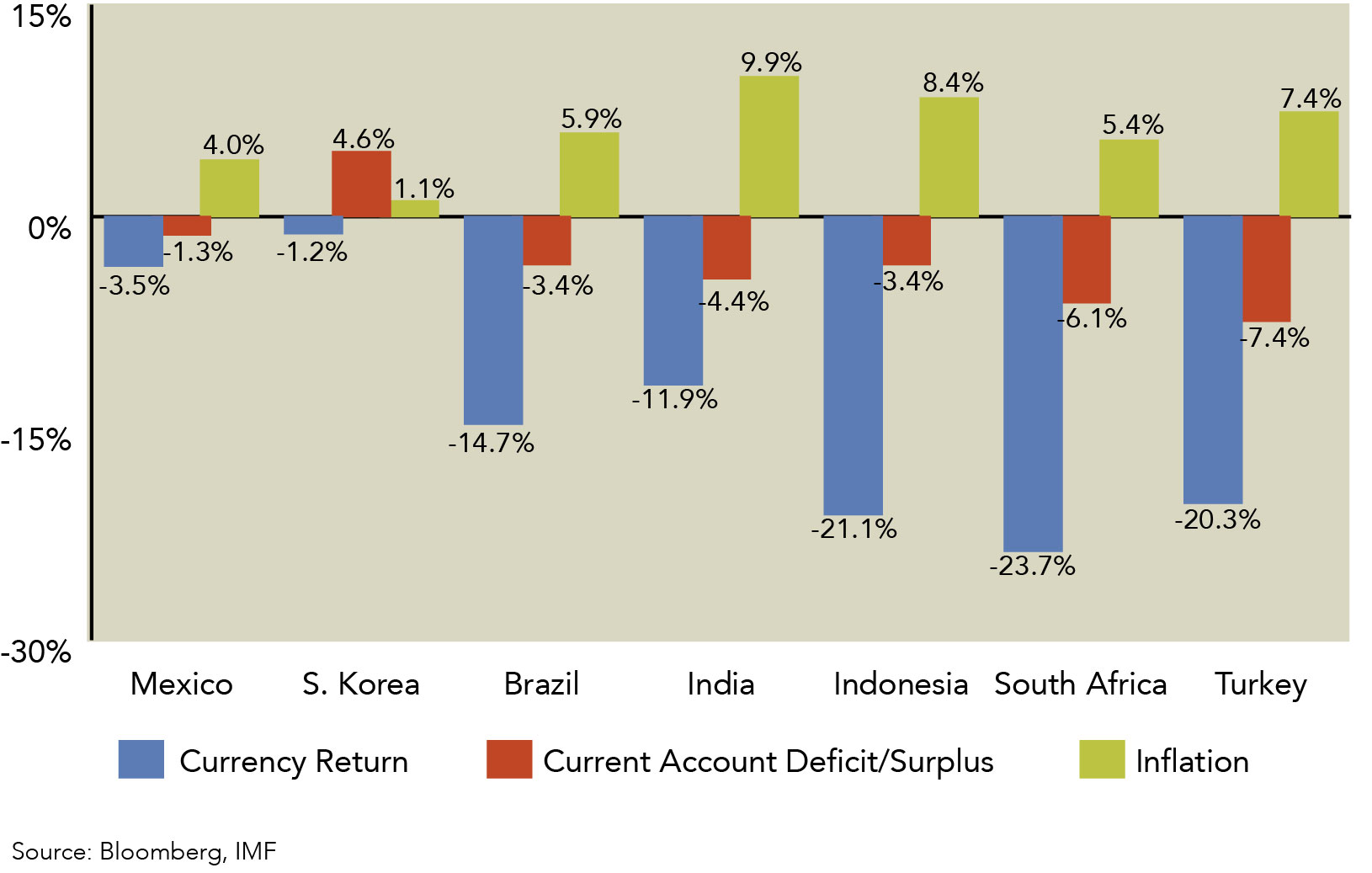
Given the continued poor performance of emerging market (“EM”) investments, this week’s chart examines the structural issues challenging a number of EM countries, namely the “fragile five” (Brazil, India, South Africa, Turkey, and Indonesia). The chart illustrates how countries with high inflation and large current account deficits have seen their currencies decrease dramatically against the U.S. dollar.

Given the continued poor performance of emerging market (“EM”) investments, this week’s chart examines the structural issues challenging a number of EM countries, namely the “fragile five” (Brazil, India, South Africa, Turkey, and Indonesia). The chart illustrates how countries with high inflation and large current account deficits have seen their currencies decrease dramatically against the U.S. dollar. In comparison the currencies of Mexico and South Korea have remained relatively resilient.

As liquidity is gradually withdrawn from the global economy, these structural issues within emerging markets have come to the forefront. Investors are concerned that after years of expansion and unlimited access to cheap capital despite poor policy fundamentals, these EM countries will have a very difficult time implementing the necessary structural reforms, while also maintaining strong growth.

In response, central banks of all the fragile five countries have taken decisive action and increased their benchmark interest rates within the last four months. Furthermore, due to emerging markets’ continued weak performance, valuations are not only attractive for the asset class as a whole, but more importantly for stronger and more stable EM countries such as Mexico and South Korea. While there is still policy and political uncertainty affecting emerging markets, there is no doubt that value is present in the asset class.

*Currency return from January 1, 2013 to February 4, 2014.

Emerging Markets: A Crisis of Confidence

February 2014 Investment Perspectives

After a disappointing 2013 and a significant sell-off to begin 2014, many investors are questioning their ongoing allocations to emerging markets (“EM”). Since 2013, EM countries have consistently underperformed their developed market counterparts, with equities losing 8.8% and local currency debt declining 12.5%. This compares to the S&P 500 and the EAFE which have returned 27.2% and 20.1%, respectively, over the same time period.

Download PDF