Household Wealth Rises, Will Job Growth Follow?

This week’s chart illustrates recent shifts in the personal savings rate and household net worth. As seen in the graph, household wealth is approaching its pre-recession level as the recovery in the stock and housing markets has helped repair household finances.

This week’s chart illustrates recent shifts in the personal savings rate and household net worth. As seen in the graph, household wealth is approaching its pre-recession level as the recovery in the stock and housing markets has helped repair household finances. The Federal Reserve’s tactics of holding interest rates low and offering stimulus in the form of Treasury and mortgage purchases seem to be creating its intended wealth effect, albeit slower than anticipated.

As household finances improve, consumers will be less inclined to save and more likely to purchase goods and services. Currently, the personal savings rate is hovering around 2.5% which is substantially less than its recession high of 6%. If the current rallies in the stock and housing markets continue, we should see a trickledown effect to many sectors of the economy, most notably jobs. In theory, an increase in consumer demand should lead to an increase in labor demand as companies ramp up production in response to more consumer spending. Additionally, labor demand will increase wages, further perpetuating the wealth effect.

Valuation of the S&P 500 at Prior Bear Market Inflection Points

On April 30, 2013 the S&P 500 Index closed at a level of 1597.57, which is the all time record high for the index. The new record high in the S&P 500, coupled with the fact that the index is up more than 105% during the four year rally since the March 9, 2009 low, has caused many market observers to speculate that the market is due for a significant correction.

On April 30, 2013 the S&P 500 Index closed at a level of 1597.57, which is the all time record high for the index. The new record high in the S&P 500, coupled with the fact that the index is up more than 105% during the four year rally since the March 9, 2009 low, has caused many market observers to speculate that the market is due for a significant correction. This week’s Chart of the Week takes a look at the trailing 12 month Price to Earnings Ratio (P/E Ratio) of the S&P 500 at inflection points of the five bear market corrections (defined as a drawdown of at least 20%) since 1970.

As the chart illustrates, with the exception of the bear market correction that began in 1980, the current 15.68 P/E Ratio of the S&P 500 is significantly lower than the valuation of the index at the inflection points of the past five bear market corrections. To put the current valuation of the S&P 500 in context, the average P/E Ratio of the S&P 500 at the end of the past five bull market runs has been 19.91, and the average P/E Ratio of the index since 1970 has been 16.39.

To be sure, the current P/E Ratio of the S&P 500 by no means guarantees that the current bull market run will continue. It does however indicate that if P/E Ratios were to return to their longer term averages (not to mention the average levels at prior inflection points), there is still significant upside potential for the U.S. equity market.

The Continuing Case for Emerging Market Stocks

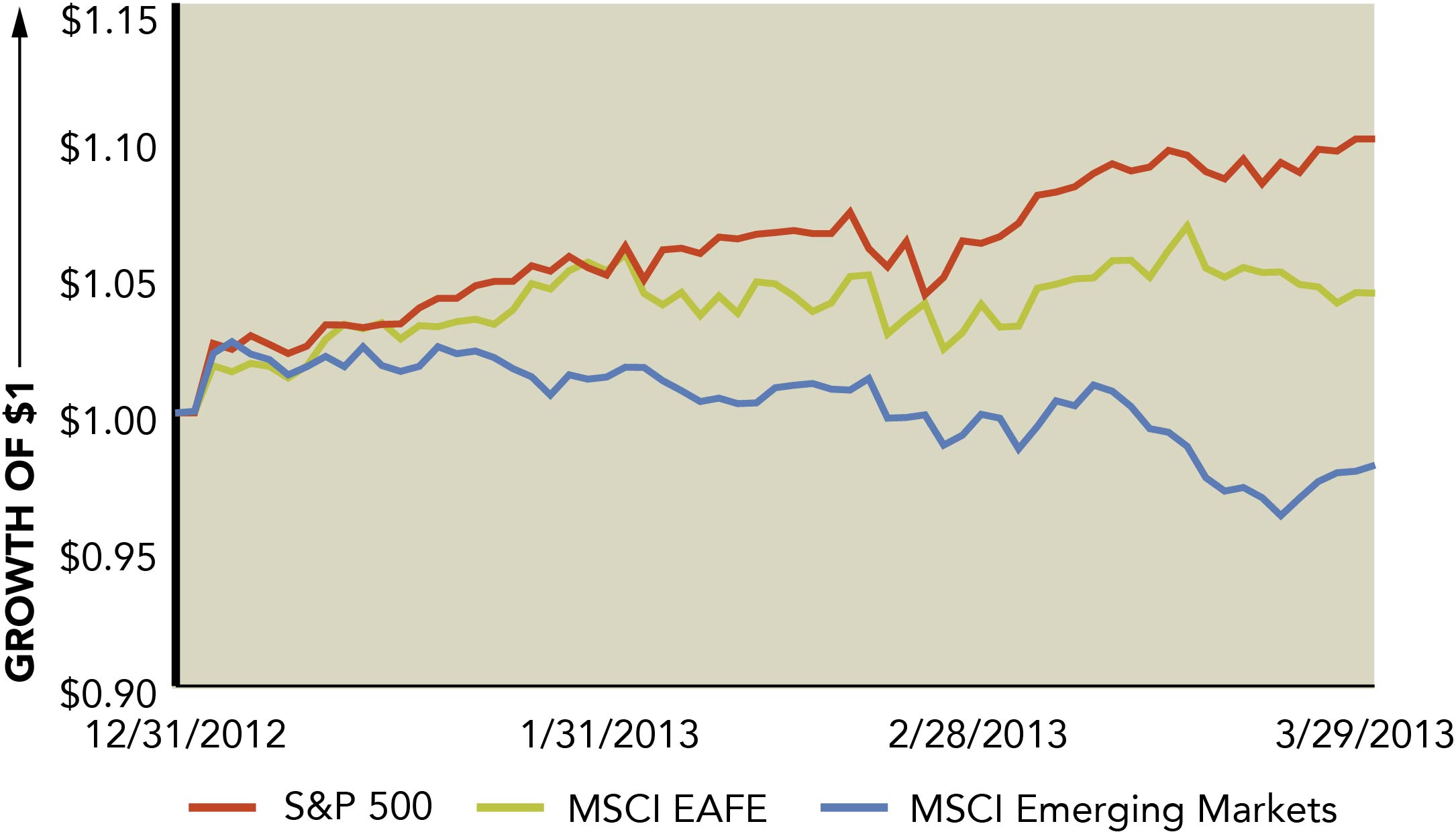
This week’s Chart of the Week examines the relative performance of equity markets from a global perspective. Since January 1, 2013, U.S. large-cap stocks have returned a cumulative 10.03%, international large-cap stocks have returned a cumulative 4.38% and emerging market stocks have returned a disappointing -1.92% through March 31, 2013.

This week’s Chart of the Week examines the relative performance of equity markets from a global perspective. Since January 1, 2013, U.S. large-cap stocks have returned a cumulative 10.03%, international large-cap stocks have returned a cumulative 4.38% and emerging market stocks have returned a disappointing -1.92% through March 31, 2013.

Many factors can be attributed to the underperformance of emerging markets including countries’ management of their monetary policies. With slowing global demand and inflationary pressure taking a toll on emerging markets, countries have been forced to adjust their monetary policies. Brazil has increased interest rates to combat inflation, which has impacted the Brazilian Real. More generally, a combination of slowing demand for their products and rising inflation has weakened the export market for emerging market countries. In contrast, Japan’s recent activity to devalue the Yen had made its exports significantly more attractive, thus boosting its competitiveness, a move that has benefitted returns for the MSCI EAFE index.

Currently, emerging markets trade at a price-to-earnings ratio of 12 compared to 15 for U.S. large-cap stocks. This favorable valuation level relative to U.S. stocks combined with superior long–term growth prospects continue to make emerging market stocks an attractive investment option, despite recent market struggles.

U.S. Stock Market Continues Its Upward Climb

This week’s chart takes a look at the S&P 500 index in direct correlation to corporate profit earnings. Thriving on corporate profits, the S&P 500 index closed at 1593.37 this past Thursday, its highest level in history. Profits by corporations, in addition to a recovering housing market have helped expand the economy for 14 consecutive quarters.

This week’s chart takes a look at the S&P 500 index in direct correlation to corporate profit earnings. Thriving on corporate profits, the S&P 500 index closed at 1593.37 this past Thursday, its highest level in history. Profits by corporations, in addition to a recovering housing market have helped expand the economy for 14 consecutive quarters. Corporate profits can be attributed to the elevated growth in emerging economies in conjunction with the positive contribution of drastically lower interest rates to the bottom line.

With corporate spreads tightening and record low interest rates, investors seeking higher returns are diverting from secure investments and saving accounts to riskier investments such as stocks. The preceding 10 months have demonstrated that stocks have advanced approximately 25%, as measured by the S&P 500, with $6 trillion of wealth created for U.S. households, institutional investors, and corporations.

With corporate profits blooming, the U.S. stock market is becoming one of the strongest bull markets in 50 years. Charged by growing signs of a recuperating economy, the S&P 500 has now recouped more than all of its losses since the financial collapse and crisis of 2008.

S&P 500 Rally to Continue or Treasury Yields to Rise?

In this week’s chart we look at the historical gap between the earnings yield of the S&P 500 and the ten year Treasury yield. The larger the gap is between the earnings yield and 10 year Treasury rate, the more attractive equities appear relative to bonds.

In this week’s chart we look at the historical gap between the earnings yield of the S&P 500 and the ten year Treasury yield. The earnings yield of the S&P 500 is the inverse of the P/E ratio and shows the percentage return in earnings for each dollar invested. We can compare this to the 10 year Treasury yield as one method to measure the difference in valuations between bonds and equities. The larger the gap is between the earnings yield and 10 year Treasury rate, the more attractive equities appear relative to bonds.

As shown in the chart, the difference between earnings yield and interest rates has been hovering near 5% for the past year. The previous time this surpassed 5% was in February 2009 which was followed by the S&P 500 bottoming that March and the beginning of a bull market. Currently, the gap is again elevated as the earnings yield has remained relatively high while ten year Treasury rates are near record lows. Could this signal that the current bull market still has plenty of room to run or that Treasury yields must soon begin to rise? This is a dynamic that bears watching over the rest of 2013.

Banking on Bank Loans

This week we look at the historic net asset flows for bank loans courtesy of Morningstar’s Asset Flows report. February 2013 saw the largest ever monthly net asset inflow for bank loan mutual funds and ETFs.

This week we look at the historic net asset flows for bank loans courtesy of Morningstar’s Asset Flows report. February 2013 saw the largest ever monthly net asset inflow for bank loan mutual funds and ETFs. This tops the previous best, January 2011, by 14%. Investors undoubtedly have been attracted to spreads well above the historic median.

In late 2011 with historically wide spreads, high yield experienced its largest net asset inflows and carried that momentum into the following year. Investors were paid off with double digit returns in 2012. Based on net asset flow data, investors are now banking on bank loans to produce strong returns in 2013. Net flows have been positive for eight straight months including the February high. Of course, investments can quickly change course as seen in 2011. The previous largest net inflow for bank loans occurred in January 2011 and was followed by the largest net outflow seven months later leading to disappointing returns that year. Thus while valuations appear compelling and fund flows have been positive, just like anything when it comes to investments, positive returns are not guaranteed!

Warning Signs From the Bond Market?

Viewed by many on Wall Street as the “smart money,” the bond market often serves as a leading indicator for the stock market in search of future direction. In 2007, it was the bond market that was first to flash warning signs of a looming crisis as stocks continued their steady upward march.

Viewed by many on Wall Street as the “smart money,” the bond market often serves as a leading indicator for the stock market in search of future direction. In 2007, it was the bond market that was first to flash warning signs of a looming crisis as stocks continued their steady upward march. Investment grade corporate spreads reached their tightest point of 82 basis points in late February 2007. By the time the S&P 500 peaked later that year in October, corporate spreads had widened out to nearly 140 basis points. As the crisis bottomed in early 2009, it was again the bond market that was first to reverse course. Corporate spreads reached their widest point in early December 2008 and it wasn’t until March 2009 that the stock market found a bottom.

As equities have once again approached their all time highs, the bond market may serve as a useful reference for investors looking to the future. Corporate spreads tightened to the mid 130’s at the beginning of January 2013 and have remained there while stocks continue to rise. Although there is room for spreads to tighten further before reaching the lows set during previous peaks in the equity markets, any dramatic reversal in equity prices will likely be preceded by their bond counterparts.

Passive Strategies Gaining in Popularity

March 2013 Investment Perspectives

Index-based investment strategies, those that passively invest with the goal of replicating the return pattern of a specific benchmark, were first created and marketed to investors beginning in the early 1970s. The well-known financial concept known as Efficient Market Hypothesis was developed earlier in the 1960s and postulated that it was not possible for an investor to consistently beat market returns on a risk-adjusted basis over time since market prices incorporate all available information. The adoption of this hypothesis by the finance community certainly contributed to the proliferation and validation of passive strategies.

Download PDF

Speed Bump Ahead?

With the Dow Jones Industrial Average setting a new nominal high this week and the CBOE Volatility Index below 14, the financial news media has been beset with headlines about the recent rally in the U.S. equity markets. Analysts’ views on the sustainability of the rally are mixed, but it is not uncommon to hear market experts warn of a pullback to interrupt the recent rally.

With the Dow Jones Industrial Average setting a new nominal high this week and the CBOE Volatility Index below 14, the financial news media has been beset with headlines about the recent rally in the U.S. equity markets. Analysts’ views on the sustainability of the rally are mixed, but it is not uncommon to hear market experts warn of a pullback to interrupt the recent rally. While some may be pointing to underlying fundamentals or economic data, one could simply point to history as an indicator. This week’s chart looks at the maximum intra-year drawdown for the S&P 500 Index1  for the last 30 years.

Since 1983, the S&P 500 Index has only had five negative calendar years. Despite this fact, 25 out of the last 30 calendar years have had an intra-year drawdown of more than -7%, and the median calendar year maximum drawdown over the last 30 years was just over -10%. Year to date in 2013, the maximum drawdown is -2.8%. Therefore, based on this data, it seems reasonable that we will see a larger drawdown at some point this year. While returns may come in above 8% again for 2013, it is unlikely that the markets will rise at a steady pace each week.

1We use the S&P 500 instead of Dow Jones Industrial Average because it is a more commonly used benchmark by institutional investors

More Signs of Life for the U.S. Economy

In spite of the most recent bad macroeconomic news coming out of Europe and Italy (to say nothing of the sequester here in the U.S.), we continue to see reasons for optimism in the U.S. economy. This week’s chart of the week unveils the latest home prices and consumer confidence increases reported earlier this week.

In spite of the most recent bad macroeconomic news coming out of Europe and Italy (to say nothing of the sequester here in the U.S.), we continue to see reasons for optimism in the U.S. economy. This week’s chart of the week unveils the latest home prices and consumer confidence increases reported earlier this week. In looking at the S&P/Case-Shiller index, the leading measure of U.S. housing prices, we see that prices were up 0.9% in December and 6.8% for the year compared to analyst expectations of 6.6%. In addition, January new home purchases skyrocketed by 15.6% from December’s reading. Collectively, the recent increases in the Case-Shiller Index, new home purchases, and consumer confidence are indicative of signs of life in the U.S. economy and may suggest further appreciation in the housing market.