Italian Debt Conundrum

This week’s chart depicts the amount of Italian government bonds held by Italian banks. As seen in the chart, this amount hovered between $200 and $250 billion until December of 2011, which is when the first round of the Long-Term Refinancing Operation (LTRO) began.

The chart above depicts the amount of Italian government bonds held by Italian banks. As seen in the chart, this amount hovered between $200 and $250 billion until December of 2011, which is when the first round of the Long-Term Refinancing Operation (LTRO) began. A notable aspect of the LTRO was that it allowed Italian banks to borrow funds from the ECB for 3 years at a 1% interest rate with appropriate collateral. Given these favorable terms, Italian banks used portions of the funds obtained from the ECB to invest in higher yielding bonds issued by their government. As a result, the number of Italian bonds owned by Italian banks has since swelled to nearly $350 billion. Ultimately, this trend has been helpful to lower the interest rate on Italian bonds, but is troublesome since a large portion of the debt that Italy issued has been purchased by Italian banks because foreigners have been skittish to invest. Foreign investors have cut their holdings of Italian governments bonds to their lowest level since 2005. As Italian banks purchase more Italian government bonds, the public and private sectors become more intertwined.

Italy has a substantial portion of debt maturing in the next few months (table below). It remains to be seen if there will be sufficient demand (foreign and domestic) to refinance these obligations at a reasonable interest rate.

Italy – Principal Maturity

Month

Aug-12

Sep-12

Oct-12

Nov-12

Dec-12

Amt (Mil)

$30,663

$27,462

$36,751

$26,975

$53,718


ECB president Mario Draghi has indicated a willingness on behalf of the ECB to step in and purchase Italian bonds that fall on the short end of the yield curve to ensure liquidity. This implied guarantee means that Italy will most likely issue short term debt to attract investors. By issuing short-term debt, Italy essentially buys itself a little more time to demonstrate economic improvement to attract foreign investment. However, a lack of progress will likely translate into larger near-term debt and rising interest rates.

The Ongoing Debt Challenge in Europe

This week’s Chart of the Week shows that through the first quarter of 2012, euro area governments’ debt-to-GDP ratio stood at 88.2%, up from 87.3% at the end of the fourth quarter of 2011. This was the eighth debt-to-GDP increase in the last nine quarters.

This week’s Chart of the Week highlights the euro area’s ongoing debt problem. As the chart above shows, through the first quarter of 2012, euro area governments’ debt-to-GDP ratio stood at 88.2%, up from 87.3% at the end of the fourth quarter of 2011. This was the eighth debt-to-GDP increase in the last nine quarters. Since the fourth quarter of 2009, only four countries (Estonia, Hungary, Sweden, and Norway) have reduced their debt-to-GDP levels. The countries with the highest government debt-to-GDP ratios at the end of the first quarter of 2012 were Greece (132% despite the most recent debt write-down), Italy (123%), and Portugal (112%). The lowest ratios were Estonia (6.6%), Bulgaria (16.9%), and Luxembourg (20.9%).

Even though many of the most indebted countries have instituted rigorous austerity cuts, debt-to-GDP levels have continued to rise, mostly due to a lack of growth. Severe austerity cuts have resulted in larger than expected decreases in GDP, which has led to continued increases in debt-to-GDP levels. For example, Italy has contracted more than expected for each of its prior two GDP releases (-.7% and -.8%). Furthermore, on July 27, the IMF lowered Spain’s 2012 GDP forecast from -1.5% to -1.7%.

It is no secret that the euro area has established very stringent debt and deficit ratios for the weakest members. However, with euro area unemployment at 11.2% (much higher in certain countries such as Spain, whose rate is 24.6%) and a systematic lack of growth, euro area leaders must find a way to establish policies that will allow for economic expansion alongside spending reductions. Until this happens, economic growth and capital market performance from these countries will likely remain choppy.

Emerging Olympic Champions?

The growth and development of Olympic champions is due to a myriad of factors, many of which are impossible to account for by data analysis. However, are there any parallels between countries’ economic growth and Olympic success?

The growth and development of Olympic champions is due to a myriad of factors, many of which are impossible to account for by data analysis. However, are there any parallels between countries’ economic growth and Olympic success? In particular, as countries mature into developed economies, does their increased prosperity translate into more Olympic success, as a result of greater resources to develop athletes?

To answer this question, we analyzed medal distribution (via number of medals won) by splitting countries into one of three groups:

  • G-7 nations: Canada, France, Germany, Great Britain, Italy, Japan, and the United States
  • BRIC nations: Brazil, Russia, India, China
  • ROW: all other countries

If our hypothesis proves true, we would expect emerging market countries – which have experienced significant growth over the last fifteen years – to constitute a larger percentage of the medals won with each subsequent staging of the summer Olympics.

A look at the data reveals this to indeed be the case. Though our analysis strictly focuses on the major emerging market countries, we see the BRIC nations taking home more medals each Olympic summer. On average, BRICS have increased their medal count approximately 15% each time the summer Olympics have taken place (in relation to the G-7 nations), using 1996 as the starting point. Going forward, we would expect greater convergence between these two groups of countries, as the BRICs continue to mature into large developed economies. To this point, China’s early success in this year’s games illustrates the growing Olympic success of emerging market countries, a trend which will likely continue.

State and Local Government Budget Cuts a Drag on GDP

This week’s Chart of the Week shows the contribution to GDP growth in the United States from spending at the state and local government level since 1990. As the chart shows, state and local government spending, which has contributed an average of 0.23% to GDP growth annually over the past 30 years, has declined to a level well below its 30 year average.

This week’s Chart of the Week shows the contribution to GDP growth in the United States from spending at the state and local government level since 1990. As the chart shows, state and local government spending, which has contributed an average of 0.23% to GDP growth annually over the past 30 years, has declined to a level well below its 30 year average.

The sharp reduction is mainly due to a significant plunge in tax revenues for state and local governments, which is a direct result of the recession that began in December 2007. Since almost all state and local governments are subject to balanced budget requirements, they have had to slash spending in order balance their budgets. As a result of these budget cuts, government spending at the state and local level has detracted an average of 0.20% from GDP growth annually since the first quarter of 2008. Given the drag that state and local government spending has been on overall GDP growth in the United States for the past several years, it is not surprising that growth has been well below trend since the recovery began in the third quarter of 2009.

Global Growth Trending Downward

On Monday, the IMF lowered its 2012 forecast for global growth to 3.5% down from an estimate of 3.6% made earlier this year. The growth forecast for 2013 was also lowered to 3.9% from 4.1% as growth around the world continues to stagnate.

On Monday, the IMF lowered its 2012 forecast for global growth to 3.5% down from an estimate of 3.6% made earlier this year. The growth forecast for 2013 was also lowered to 3.9% from 4.1% as growth around the world continues to stagnate. Emerging economies – a primary driver of future growth – have seen growth rates drop from 7.5% in 2010 to a projected 5.6% in 2012. The most notable member of the emerging economies, China, has begun to pursue expansionary monetary policy in hopes of reversing its slowing economic growth. Another significant headwind for global growth is the European Union, which is expected to be flat in 2012, as Spain, its third largest contributor, continues to be mired in a national debt crisis. In the U.S., growth is expected to remain well below trend as the economic recovery, now in its fourth year, struggles to gain momentum. Collectively, the struggles of these countries will make it difficult to achieve global growth north of 4% over the next few years.

A Hot Summer for Corn Prices

This summer’s unusually hot weather combined with little rain is shaping up to have a profound impact on corn yields for 2012. At the close of trading on Monday, corn futures settled at $7.75, up 40% since June 1, and 12% since July 1.

This summer’s unusually hot weather combined with little rain is shaping up to have a profound impact on corn yields for 2012. At the close of trading on Monday, corn futures settled at $7.75, up 40% since June 1, and 12% since July 1. These radical increases in price are a clear reflection of small yields for corn, and thus lower supply to meet both domestic and foreign demand. Further compounding the corn outlook is weather forecasts, which continue to predict below average rainfall for the next few weeks. As a result, we are likely to see further increases in corn prices.

What does it all mean for investors? If one is long corn via a futures contract or commodities fund, this news is likely accretive. However, for companies that rely on corn as a key input for production, this represents an added cost of production and a drag on profitability. For consumers, higher corn prices will probably equate to higher grocery bills.

U.S. Manufacturing: Headwinds but Hope

Despite the crisis in Europe, global stock markets have generally been buoyed by strong earnings growth from the globe’s two largest economies, the US and China. However, evidence of a slowdown in China has fueled debate over whether the US will be able to continue growing in the face of European and Chinese weakness.

Much focus has already been directed to the economic slowdown in the Eurozone with Italy, Spain, Portugal, and Greece already in recession. Despite the crisis in Europe, global stock markets have generally been buoyed by strong earnings growth from the globe’s two largest economies, the US and China. However, evidence of a slowdown in China has fueled debate over whether the US will be able to continue growing in the face of European and Chinese weakness. While still growing rapidly relative to mature economies, China’s GDP growth dropped to 8.1% in the 1st quarter and is projected to fall to 7.4% in the 2nd quarter. The decrease in GDP growth prompted the Chinese Central Bank to cut interest rates in June for the first time in three years.

Monday’s release of the ISM Manufacturing PMI is raising alarms that the impact of a global slowdown is beginning to be felt in the US. In the month of June, the Purchasing Managers Index fell 7.1% from 53.5 to 49.7, signaling a general softening in US manufacturing activity. More troubling was that the ISM Manufacturing New Orders sub-index fell from 60.1 to 47.8 over the month. While this data did not shake the stock market, investors should be wary of a potential backlash if the Fed does not provide the additional monetary stimulus that some seem to be anticipating. However, the recent slowdown in inflation (CPI) indicates that there may be room for the Fed to act.

Despite the global growth headwinds, there is reason to remain optimistic about the profitability of US manufacturers. The ISM Manufacturing Prices sub-index fell drastically in June from 47.5 to 37.0. That means that the cost of US manufacturers’ production inputs is at the lowest since early 2009. The combination of a strong US Dollar and less demand from China for raw materials such as steel, copper, and fuel is providing input cost relief to many US companies.

Currency Challenges for the BRICs

Given the volatility of the global markets in recent years, foreign currencies have become a substantial factor to consider when investing in non-U.S. securities. The BRICs (Brazil, Russia, India, and China), generally known as the most influential emerging markets, are experiencing various situations that have had a negative effect on their respective currencies.

Given the volatility of the global markets in recent years, foreign currencies have become a substantial factor to consider when investing in non-U.S. securities. The BRICs (Brazil, Russia, India, and China), generally known as the most influential emerging markets, are experiencing various situations that have had a negative effect on their respective currencies. Brazil has seen a resurgence in its consumer default rate as previous bad loans are manifesting themselves. Many analysts believe that this is similar to the recent subprime loan collapse in the United States, as the consumer debt default rate reached 7.6% in April. India is in danger of losing its investment grade rating due to trade and budget deficits. Russia’s main export of crude oil has suffered a 26% drop in price this quarter alone, driving investors to more stable nations. China has avoided the major drops that other currencies have versus the dollar, and the economic policies have thus far kept the currency value at a secure value, though it dropped over 1% in the second quarter. Furthermore, home prices fell in 54 of 70 cities tracked in China during the month of May. China has also reduced its annual growth target to 7.5% from 8.0% due to the slowing of demand for its exports as consumer demand in other nations has been sluggish.

The weakening currencies could present an opportunity for investors looking to enter emerging markets, as it may increase the competitiveness of the emerging markets countries affected, and hurt corporations based in developed countries with strong presence in the BRICs. For example, analysts believe the currency effect in Brazil will be a significant headwind this quarter for Coca-Cola Co., which has been investing heavily in South America and has experienced substantial growth in the region.

A Moving Picture of U.S. Household Debt

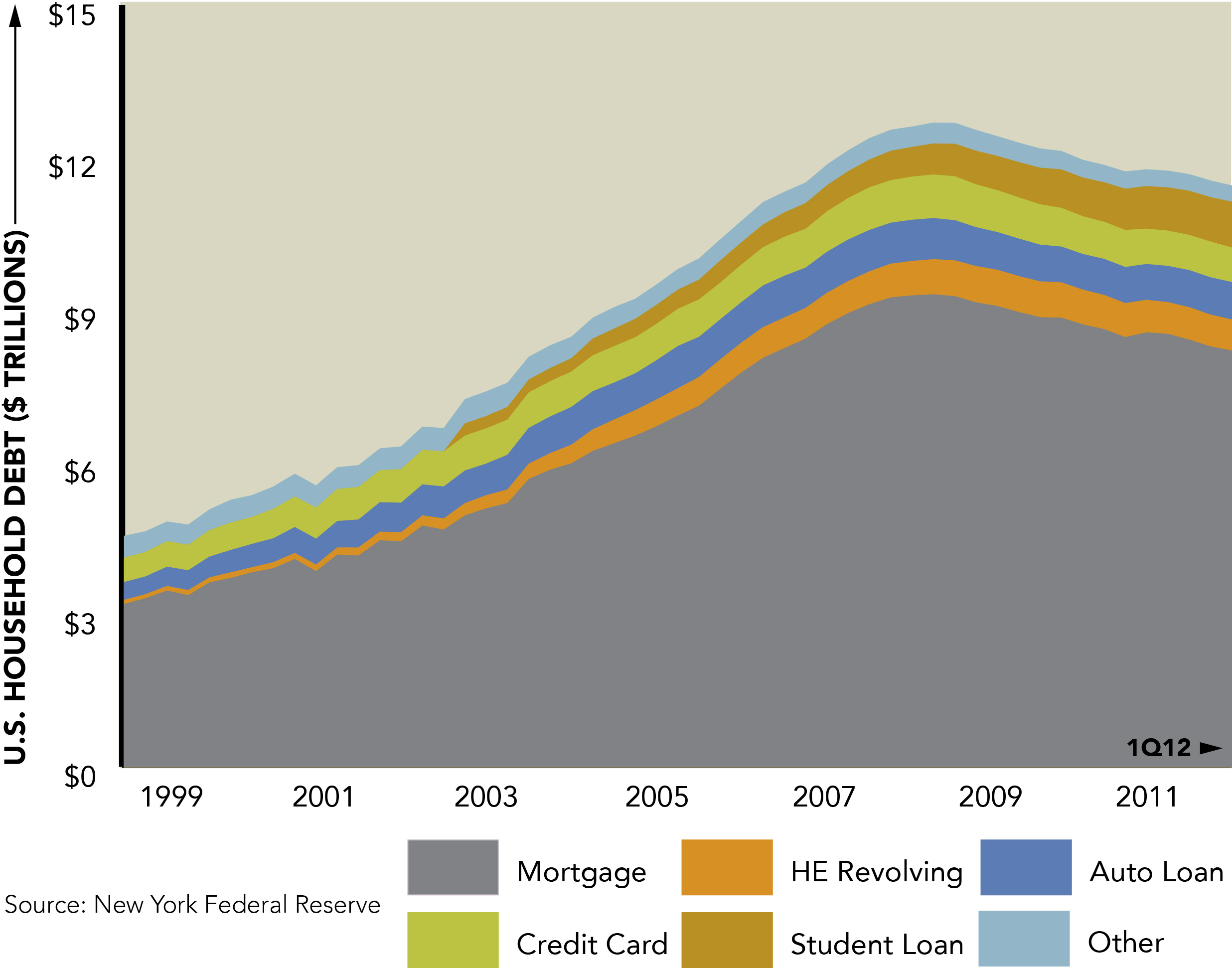
This week’s chart shows the components and level of U.S. household debt from March 1999 through March 2012. Categories of U.S. household debt include Mortgage, Home Equity Revolving, Auto Loan, Credit Card, Student Loan (which the Fed began tracking as an independent category in the first quarter of 2003), and Other which includes consumer finance and retail loans.

This week’s chart shows the components and level of U.S. household debt from March 1999 through March 2012. Categories of U.S. household debt include Mortgage, Home Equity Revolving, Auto Loan, Credit Card, Student Loan (which the Fed began tracking as an independent category in the first quarter of 2003), and Other which includes consumer finance and retail loans.

In its Quarterly Report on Household Debt and Credit, the Federal Reserve Bank of New York announced that total household indebtedness was $11.44 trillion as of the first quarter of 2012. The effects of U.S. household balance sheet repair since the 2008 recession can be seen in the above chart: after household debt peaked at $12.68 trillion in the third quarter of 2008, U.S. households have reduced total debt levels by $1.24 trillion (10.8%). In addition to a reduction in consumer spending, total debt levels were reduced due to banks exercising greater caution when issuing credit cards and mortgages. All categories of household debt decreased during this time with the exception of student loans which grew by 47.9%. During this time, college tuition costs continued to rise and households took on greater amounts of student loans in hopes of improved employment prospects. Student loans are now the second largest component of U.S. household debt behind mortgages.

As households continue to de-lever and focus on balance sheet repair, their consumption will not be as large of a driver to total GDP as it has been historically, therefore creating another headwind for robust economic growth.

Emerging Market Small-Cap Stocks: What’s the Story?

June 2012 Investment Perspectives

By now, most investors are familiar with emerging market stocks and their benefits to overall portfolio performance. Favorable demographics, urbanization, escalating levels of wealth, and rising consumer spending are all long-term secular trends that have emerged as compelling reasons to include emerging markets in institutional portfolios.

Download PDF