Investment Grade Credit vs. Treasuries

Most investors understand that over the long-term, the investment grade credit sector tends to outperform the U.S. government sector due to its risk. Many may be surprised however, at the size of the outperformance.

Most investors understand that over the long-term, the investment grade credit sector tends to outperform the U.S. government sector due to its risk. Many may be surprised however, at the size of the outperformance. Since its 1973 inception to May 2012, the BarCap U.S. Credit Index has outperformed the BarCap Government Index by just 38bps. Today’s Chart of the Week shows the rolling three year outperformance of the BarCap Credit Index versus the BarCap Government Index. Up until 2007, credit enjoyed a long period of relatively steady outperformance, interrupted by the recession after the tech bubble burst.

To achieve this outperformance, investors in credit would have experienced a standard deviation of 7.79%, compared to 5.61% for governments. The maximum decline for credit versus governments was -19.26%, and -7.92% respectively. This decline in credit was actually experienced from September 1979 to March of 1980, not in 2008.

Thus, while the credit crunch of 2008 was an extreme event, the actual margin of underperformance in credit had been seen before in the 1980’s. It is also important to note that the raw outperformance numbers are likely overstated in favor of the credit index, which has a longer duration. As rates have been in a secular downward trend over the past 30-years, this has boosted longer duration returns. The duration of the BarCap Credit Index as of May 31 was 6.73, compared to 5.43 for the BarCap Government Index. From 1997 to 2012, the period for which duration numbers are available, the credit index has had an average duration 0.91 higher than the government index.

Of course, past returns do not necessarily predict future returns. The forward outlook for credit has tended to be more positive during periods of elevated spreads, as investors are paid a higher premium to take on credit risk. As of the end of May, the option adjusted spread of the BarCap Credit Index was 193bps, compared to its long-term average of 121bps.

How Low Will They Go?

Over the last few weeks, renewed concerns over the European debt crisis coupled with the release of negative economic data in the U.S. has led to a significant sell-off in global equity markets. As a result, U.S. Treasuries – which still serve as a favorite safe-haven despite last summer’s downgrade – have set record low yields across the curve.

Over the last few weeks, renewed concerns over the European debt crisis coupled with the release of negative economic data in the U.S. has led to a significant sell-off in global equity markets. As a result, U.S. Treasuries – which still serve as a favorite safe-haven despite last summer’s downgrade – have set record low yields across the curve. The nominal yield on the 10 year U.S. Treasury Bond set an all time record low of 1.47% on June 1, 2012, leading many to wonder how much further yields will fall before finally rebounding. Most important is that the new low pushed the real yield on the instrument further into negative territory. When adjusted for inflation, investors are actually losing money when they purchase 10 year Treasury bonds. The Federal Reserve continues to run an extremely inflated balance sheet which has contributed to keeping rates artificially low for quite some time now. While convention says yields must rise at some point, how long investors will be willing to accept a negative real yield on ten years’ worth of U.S. Government debt is anyone’s guess.

Market Returns and the Election Cycle

With election campaigning in full swing, we have received a number of questions from our clients regarding what will happen to the market if a particular candidate or party wins, or whether certain years of the presidential cycle are better for investors. This week’s chart of the week examines past studies on election years and market returns, as well as other market patterns.

With election campaigning in full swing, we have received a number of questions from our clients regarding what will happen to the market if a particular candidate or party wins, or whether certain years of the presidential cycle are better for investors. This week’s chart of the week examines past studies on election years and market returns, as well as other market patterns.

Thus far in 2012, there have been numerous articles focused on finding the relationship between the market cycle and the election cycle. Notable findings of these articles are highlighted below:

  • The stock market tends to be positive in an election year. The median return over the 21 election years since 1926 has been 11.1%.
  • The stock market has performed better in years where a Democrat has been president (median return of 18.4% vs. 7.7%).
  • The first year of a presidential term is typically a poor year for investors (median return of 4.9%), while the third year of a term is typically a good year for investors (median return of 22.7%).

Heading into the 2008 election year, various articles highlighted similar election year market performance, which at that time had a median return of nearly 14%. Of course, 2008 turned out to be one of the worst years for the stock market. This performance was not due to the election year, but rather a massive collapse in the housing market, the credit crisis, and one of the deepest recessions the United States has experienced.

While certain patterns may exist in the return data, the data set is extremely limited; it most likely is a case of identifying random patterns in limited data set. For instance, an investor who only invested in the stock market during odd years would do significantly better than investing in all years, or an investor who only invested in even years. Similar extrapolations can be made based on years ending with a certain digit (3, 5, etc).

In order to be statistically significant, one would need over 2,000 election year data points in order to achieve a 0.05 significance level. Similar levels of observations would be needed for the other data points highlighted in the table. While there may or may not be particular reasons behind these realized returns phenomenon, from a statistical standpoint it would be unwise to base any investment decisions off of them.

Could Bond Returns Continue to Exceed Expectations?

This chart shows the current yield curve (red line) and the expected return an investor can expect to achieve owning government bonds at each maturity along the curve, assuming they maintain a constant duration. As the chart shows, investors in 10-year bonds will earn almost double the 1.7% return indicated by the yield curve if rates remain unchanged.

Much has been made of the low bond yields on risk-free U.S. government debt. The yield on 10-year government debt dropped to just 1.7% as of May 18th. Many investors assume that if rates stay where they are today bond returns will be less than 2% over the coming years. However, this ignores both the steepness of the yield curve and the fact that most institutional investors maintain a fairly constant duration in their bond portfolios. This chart shows the current yield curve (red line) and the expected return an investor can expect to achieve owning government bonds at each maturity along the curve, assuming they maintain a constant duration. As the chart shows, investors in 10-year bonds will earn almost double the 1.7% return indicated by the yield curve if rates remain unchanged.

While this may come as a surprise, the math is fairly straightforward. An investor that buys a 10-year U.S. government bond today will pay $100.47 and receive a $1.75 coupon. The 10-year risk free interest rate is 1.70% and the 9-year risk free rate is 1.51%. This means that one year from now our investor owns a 9-year bond that pays a $1.75 coupon. However, because the current market interest rate for a 9-year risk free bond is 1.51%, the bond has appreciated to $101.99. To maintain the duration of the investment, our investor sells the 9-year bond at $101.99 and buys a new 10-year bond. Since rates have not changed a 10-year bond still sells for $100.47. Our investor’s total return is thus:

($101.99+$1.75)/$100.47 = 3.25%

This simple illustration and the implications for an institutional portfolio are discussed in greater detail in Marquette’s April 2011 Investment Perspectives “Short Duration vs. Core Bonds in a Rising Rate Environment”. Currently, the yield curve is predicting a fairly substantial rise in interest rates a few years in the future. However, if such a rise does not materialize and the current low rate environment persists, bond returns may once again exceed expectations.

Loan Growth… A Reason for Optimism?

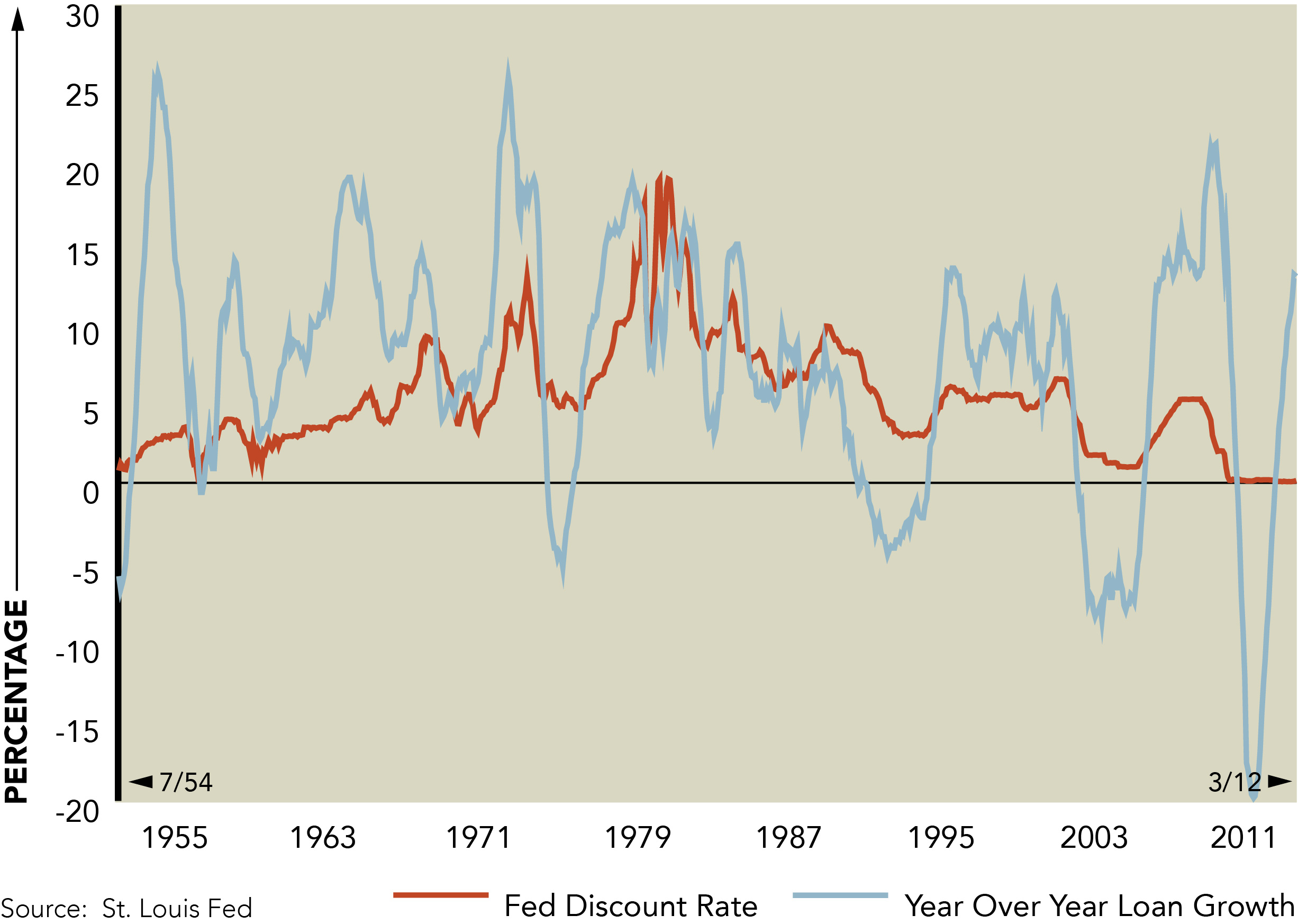
Since the 2008 recession began, the Federal Reserve has seemingly used all available tools to stimulate the economy. In particular, the Fed has relied heavily on controlling the Federal Funds Rate, which is the rate that the Fed charges banks for overnight loans.

Since the 2008 recession began, the Federal Reserve has seemingly used all available tools to stimulate the economy. In particular, the Fed has relied heavily on controlling the Federal Funds Rate, which is the rate that the Fed charges banks for overnight loans. By keeping this discount rate low, the Fed can theoretically stimulate loan growth by making credit cheaper for banks to obtain.

In this week’s Chart of the Week, the percentage change (year over year) of total commercial and industrial loans issued by all commercial banks is compared to the Fed Funds rate. Historically, these have moved in tandem as the Fed raises the rate to control growth of credit during expansions and lowers the discount rate to stimulate credit during recessions. Recently, the Federal Reserve has held the Fed Funds rate near zero in response to the largest contraction of total loans over the last 60 years. It is also interesting to note that despite recent loan growth of nearly 15%, the Fed continues to maintain a near-zero Fed Funds rate.

Although the economy continues to grow more slowly than anyone would like, the recent year over year surge in commercial and industrial loans offers some cause for optimism. Typically, loan growth leads to economic expansion as companies resume investments that were delayed during the previous recession. This direct investment spending helps current economic growth while the resulting increase in productivity from investment drives long term economic growth. As long as the Fed remains committed to keeping the Fed Funds rate near zero for the foreseeable future, it looks like loan volumes should continue to grow and help spur economic growth.

New Jobs… Familiar Feeling

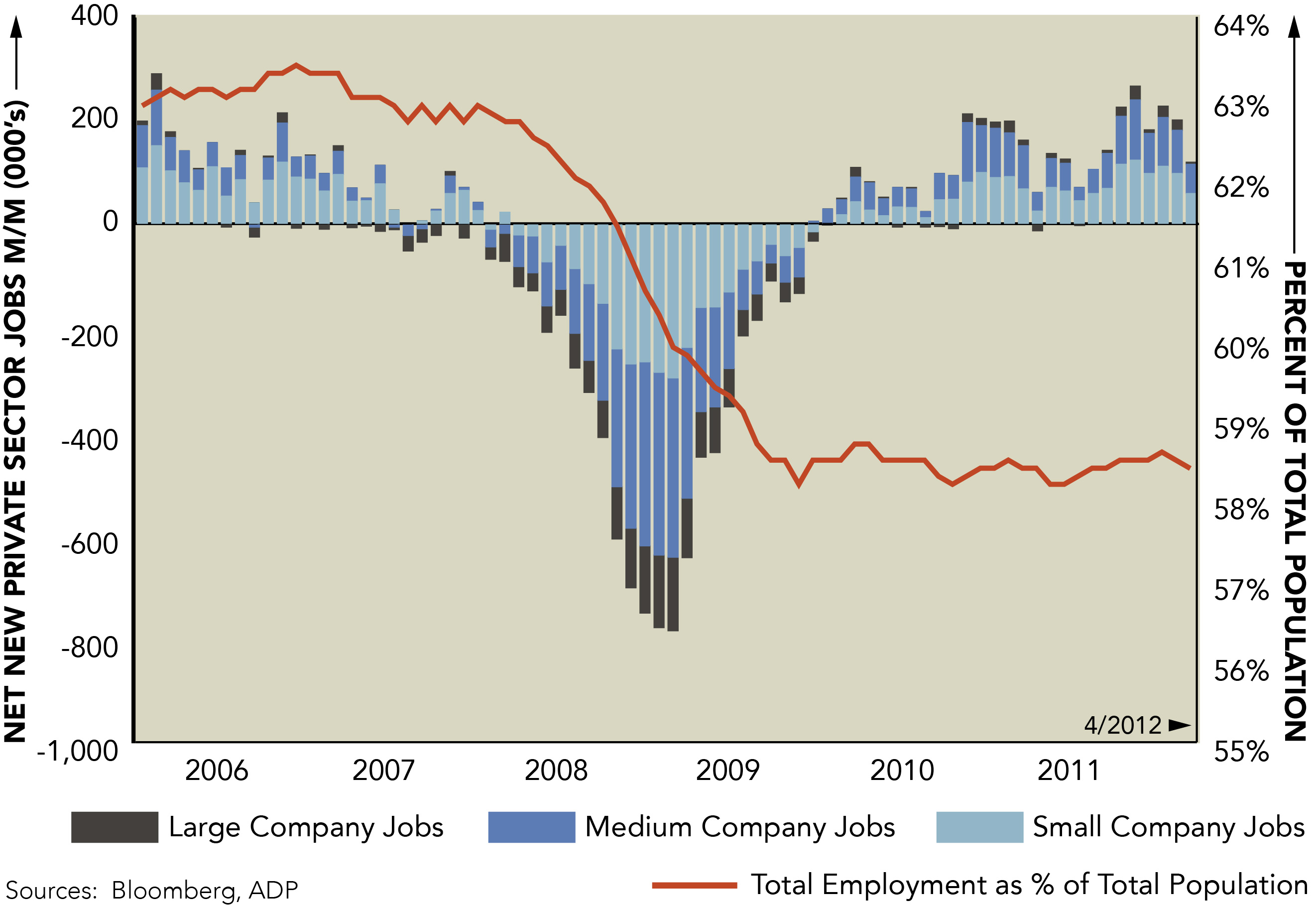
On Friday, the U.S. Department of Labor announced that 115,000 jobs were created in April and the national unemployment rate fell from 8.2% to 8.1%. Though these data points showed improvement, their release prompted an immediate equity market selloff.

On Friday, the U.S. Department of Labor announced that 115,000 jobs were created in April and the national unemployment rate fell from 8.2% to 8.1%. Though these data points showed improvement, their release prompted an immediate equity market selloff. So what gives? In this Chart of the Week, we consider an expanded view of the labor market to explain Friday’s reaction.

At the beginning of 2006, the U.S. private sector labor market was close to full employment, and more jobs were being created every month. Comparing today’s total number of private sector jobs to those pre-recession levels, the private sector has only 2% less total jobs. The chart above illustrates why the true situation is not as healthy as the headline unemployment numbers suggest: although the private sector has been adding jobs for a little over two years now, the job growth has been almost exclusively from small and medium sized companies. A recovery in job creation by larger companies and public sector jobs which, on average, pay higher wages has yet to take hold.

Despite the fact that we have seen job creation over the last two years, the total number of Americans employed as a percentage of the population has been stagnant: the new jobs that have been created are only enough to keep pace with population growth. The unemployment rate is falling mainly because the percentage of Americans who have given up seeking work (and are therefore not included in that calculation) remains elevated.

This challenge is no more evident than with young Americans. During the 90’s, an average of 77.2% of 20-24 year olds and 52.3% of 16-19 year olds participated in the labor markets. Today, those percentages stand at 70.6% and 33.8%, respectively. As long as the labor market continues to force young people to start careers later, start saving later, and start raising families later, the outlook for full recovery and long-term economic growth remains challenged. Friday’s negative reaction to sustained slow job growth shows that small improvements are no longer enough to satisfy investors’ concerns which are becoming increasingly forward-looking.

Still the American Dream?

This week’s chart chronicles the trends of home ownership and prices since the turn of the century. The financial crisis of 2008 coupled with a surge of foreclosures and high unemployment rates have contributed to a decade low home ownership rate of 66 percent.

This week’s chart chronicles the trends of home ownership and prices since the turn of the century. During the robust residential real estate market of the mid-2000’s, home ownership rates peaked at 69.2 percent with the home price index exceeding $200,000. However, the financial crisis of 2008 coupled with a surge of foreclosures and high unemployment rates have contributed to a decade low home ownership rate of 66 percent. Not surprisingly, the home price index has cratered as ownership has declined.

A recovery for home ownership and prices faces several headwinds. To begin with, plunging home prices, a shaky job market, and frail economy have many first time home buyers resistant to committing to a purchase, in spite of the attractive price opportunities. For purchasers looking to take advantage of low interest rates, other hurdles remain, chief among them stricter underwriting standards for mortgages and higher required down payments.

Collectively, these trends help explain the booming rental market of today, as seen from the perspectives of demand, supply, and investment. Perhaps more importantly, does this mean that the American dream of owning a home is quickly becoming a thing of the past?

U.S. Income Inequality

Income inequality in the United States has emerged as a popular topic in the media as well as the upcoming presidential election. The upcoming presidential debates are certain to feature a fair amount of political rhetoric in an attempt to address the issue of income inequality.

Income inequality in the United States has emerged as a popular topic in the media as well as the upcoming presidential election. The Occupy Movement has garnered a great deal of media attention in the past six months, with its premise of protesting economic and social inequality. The upcoming presidential debates are certain to feature a fair amount of political rhetoric in an attempt to address the issue of income inequality.

The chart above depicts the percentage of total income1 that the top 10% of earners (in 2010, families with a market income above $108k) are responsible for. As seen in the chart, the line forms a “U” shape where the top 10% accounted for approximately 45% of total income prior to WWII, declined to the low/mid 30’s until the late 1970’s and has risen to approximately 45% today.

In addition, we can use the GINI ratio (index of income concentration) to further scrutinize income disparity. The GINI ratio is a statistical measure of income equality ranging from 0-1. A measure of 1 indicates perfect inequality; i.e. one person has all the income and the rest have none. A measure of 0 indicates perfect equality; i.e. all people have equal shares of income. As also seen in the chart, the GINI ratio has also risen precipitously since its inception in 1967. Currently the GINI index stands at 0.47, which stands out as one of the highest when compared to other developed economies:


Germany 0.27
France 0.32
Italy 0.32
Canada 0.32
Japan 0.38
Uruguay 0.45
Russia 0.42
Singapore 0.47

There are many theories as to why we have seen such growth in income inequality since the late 1970’s. Potential explanations include:

  • Immigration of unskilled workers has put downward wage pressure on native born workers.
  • Advances in computers and automation may have replaced moderate to low skilled workers, thereby decreasing demand for these types of employees.
  • Decline of private sector labor unions and their ability to maximize incomes of their members.
  • Tax policy – corporate and individuals.
  • Relatively small increases in the minimum wage.
  • Corporate deregulation (in particular financials – 10% of corporate profits in 1970’s, 40% today – increase in executive compensation, prevalence of lobbyists).
  • Education gap between rich and poor has grown substantially. Cost of tuition is prohibitive for low income families. This has led to a shortage of highly skilled workers; therefore, demand (compensation) goes up for these types of workers.

The upcoming presidential debates will surely contain a healthy dose of discussion regarding income inequality, with a bulk focusing on tax policy and education reform. It will be interesting to see how each candidate plans to address these issues and the effect these policies will have on the financial markets. Is income inequality a detriment to the greater economy, or an essential part of capitalism?

_________________________________________________________________________________________________________

1 Income is defined as the sum of all income components reported on tax returns (wages and salaries, pensions received, profits from businesses, capital income such as dividends, interest, or rents, and realized capital gains) before individual income taxes. Government transfers such as Social Security retirement benefits or unemployment compensation benefits are excluded from the income definition. Non-taxable fringe benefits such as employer provided health insurance is also excluded from the income definition. Therefore, the income measure is defined as cash market income before individual income taxes.

Trends in Personal Savings Rates

This week’s chart shows the personal savings rate from January 1959 to February 2012. The average for that time period is represented, along with averages over the last 30, 20, and 10 years.

This week’s chart shows the personal savings rate from January 1959 to February 2012. The average for that time period is represented, along with averages over the last 30, 20, and 10 years. Averages are plotted according to their respective time periods.

The chart shows a noticeable decline in the personal savings rate over the 53 year period. The 53 year average is 7% compared to a 30 year average of 5.2%, a 20 yr average of 4.1%, and a 10 year average of 3.8%. Since consumers are saving less, they are spending more. This phenomenon has driven growth in consumer expenditures which in turn has contributed to growth in GDP. In the mid 1960s, consumer expenditures accounted for 61% of nominal GDP. By the early 80s it increased to 65.7% and in 2008 to 70.5%. The health of the economy has become more dependent on consumer spending.

During recessions the personal savings rate tends to spike up as consumers become more conservative. We saw this occur in the most recent recession with the savings rate climbing as high as 8.3%. As the economy has rebounded fear has subsided and consumers are spending more. In addition, with interest rates so low, consumers have less incentive to save. This has led to a personal savings rate of 3.7% in February 2012, which is below the 10 year average.

Trends in Tax Revenues

This week’s chart shows trends in tax revenues, indexed to 2007, for a group of ten selected countries (based on rolling twelve month averages for each). Taxes are the main source of government revenues and a crucial factor for the fiscal stability and economic growth of countries.

This week’s chart shows trends in tax revenues, indexed to 2007, for a group of ten selected countries (based on rolling twelve month averages for each). Taxes are the main source of government revenues and a crucial factor for the fiscal stability and economic growth of countries. Tax revenues are appropriated for public works, interest payments, financial assistance, education, infrastructure, growth incentives, and counter cyclical measures.

As the chart illustrates, there has been a divergence of tax revenues between developed and emerging market countries. Since 2007, most emerging market governments’ tax revenues have increased while the majority of developed countries’ tax revenues have either decreased or slightly increased.1 Many developed countries across the world continue to face revenue headwinds as they de-lever and recover from the 2008 financial crisis and subsequent economic slow-down, all of which have lowered tax revenues.

Going forward, this chart suggests a much more favorable backdrop for emerging market countries compared to developed countries. An increasing trend in tax revenues should allow emerging market countries to allocate money to public services as well as investment in infrastructure, education, research and development, and other important factors that contribute to countries’ long-term success and prosperity. Developed countries are struggling to maintain public services and programs with limited revenues and are being forced to borrow money; the U.S. has over $15 trillion in debt outstanding and is projected to run a deficit of approximately $1.2 trillion in 2012.2 As this occurs, investment in infrastructure, education, and other important growth platforms is placed on hold as more money is allocated towards debt and interest payments.

___________________________________________________________________________________

1 Bank of Korea, Bank of Italy, Federal Reserve, Bank of Thailand, UK Office for National Statistics, Bank of Greece, National Bank of Poland, Bank of Japan, Bank of Spain, Bank of the Republic of Columbia

2 Congressional Budget Office as of 03/31/2012