Post-Recession Employment Growth

This week’s chart analyzes job growth after the last four recessions by examining employment levels 60 months after the start of each recession. The data focuses on private employment, not government employment. Ellipses on the chart represent the end point of each recession, whereas squares represent the beginning of job growth.

This week’s chart analyzes job growth after the last four recessions by examining employment levels 60 months after the start of each recession. The data focuses on private employment, not government employment. Ellipses on the chart represent the end point of each recession, whereas squares represent the beginning of job growth.

The 1982 recession lasted seventeen months. After its cessation, it took only nine months for employee growth to emerge. While the 1990 recession lasted nine months, it endured an additional 26 until job growth began. The length of the 2001 recession was again brief lasting only nine months, but it withstood 30 months until growth mode. The most recent recession began in December of 2007 and lasted nineteen months. At 27 months and counting, we are still waiting for job growth to commence.

Five years after the ’82, ’90, and the ’01 recessions, private sector job levels were well ahead of their pre-recessions levels. Unfortunately, it is difficult to paint a happy picture on the current status of employment: while there has been progress in recovering lost jobs, substantial headwinds remain, as 6.3 million more jobs are needed to return to pre-recession levels.

Recessions and Income Declines

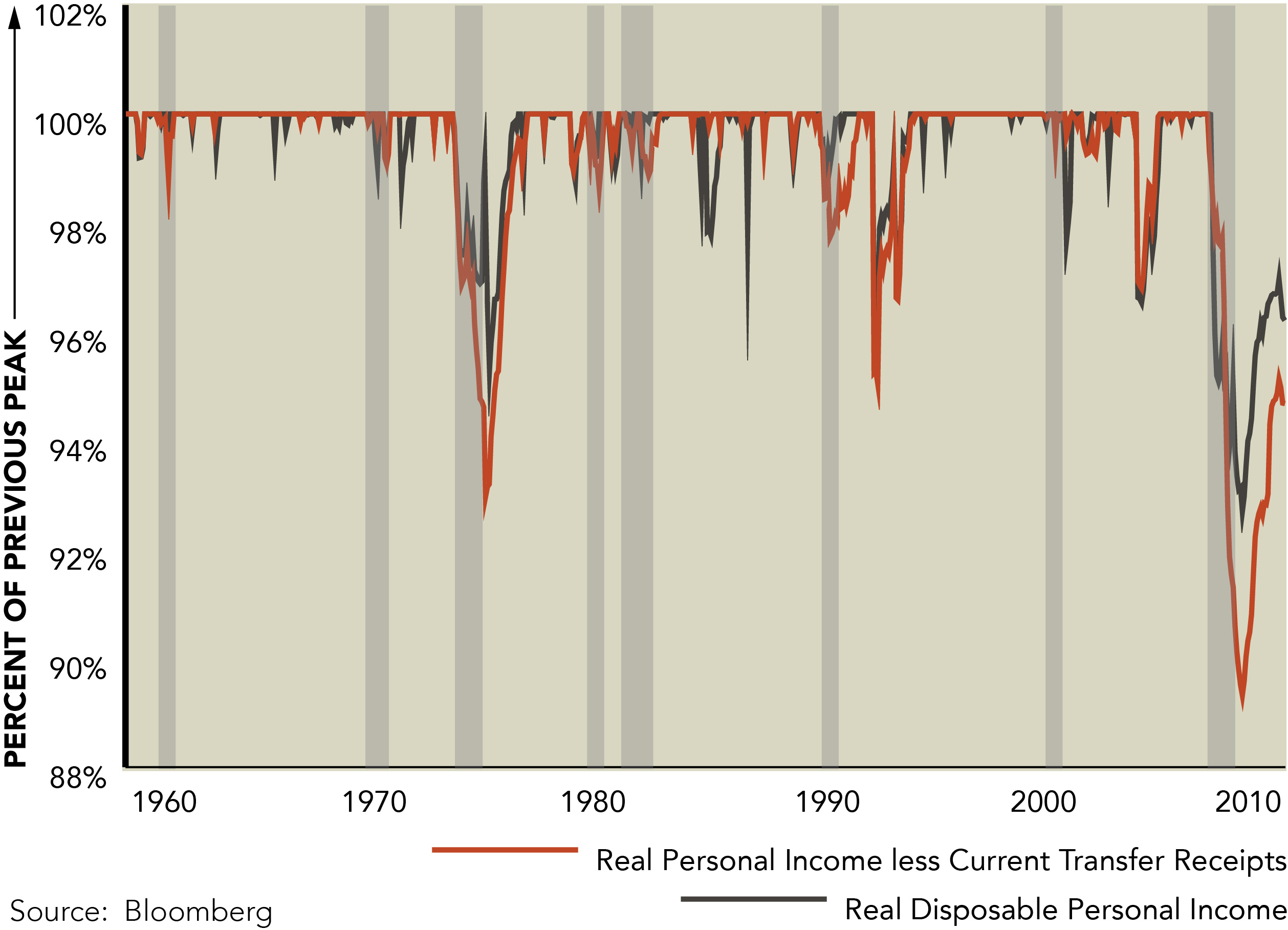
This chart looks at the drop and recovery in real personal income during recessions over the last 50 years (personal income is shown as a percentage of the previous peak to look at prior recessions on an apples-to-apples basis).

This chart looks at the drop and recovery in real personal income during recessions over the last 50 years (personal income is shown as a percentage of the previous peak to look at prior recessions on an apples-to-apples basis). The red line (Real Personal Income less Current Transfer Receipts) shows inflation adjusted after-tax disposable income not including government support (i.e. net social security receipts, unemployment insurance, etc.). The gray line (Real Disposable Income) shows inflation adjusted after-tax disposable income including government support.

A few things stand out. First is the depth of the 2008 – 2010 recession, which was far worse than any prior drop in U.S. incomes. Second, this chart shows the role of government support during recessions, as the drop in real disposable income is far less than would otherwise be expected, due to government support. Thirdly, the drop in real disposable incomes over the last three months is a worrying trend. This is especially true given the growing talk in Washington over reducing government support of disposable income through higher taxes and/or lower spending.

Falling real incomes and less government support does not bode well for U.S. economic growth over the coming quarters.

Too Important to Fail?

SIFIs are financial institutions deemed large and complex enough that their failure would cause ripple effects throughout the financial system. This week’s chart shows CDS spreads on SIFIs of select countries. For countries with multiple banks on the list, the average CDS spread of available data is taken.

The Financial Stability Board (“FSB”) recently released a list of global systemically important financial institutions (“SIFIs”). Based on information from its website, the FSB was established in 2009 and acts to promote financial stability. The current Chair of the FSB is Mario Draghi, the new head of the European Central Bank (“ECB”).

SIFIs are financial institutions deemed large and complex enough that their failure would cause ripple effects throughout the financial system. Of the twenty-nine banks on the FSB’s list, nine are American, and seventeen are European. The full list is shown below:

Asia

  • China: Bank of China
  • Japan: Mitsubishi, Mizuho, Sumitomo Mitsui

Europe

  • Belgium: Dexia
  • France: Banque Populaire, BNP Paribas, Credit Agricole, Societe Generale
  • Germany: Commerzbank, Deutsche Bank
  • Italy: Unicredit
  • Netherlands: ING
  • Spain: Santander
  • Sweden: Nordea
  • Switzerland: Credit Suisse, UBS
  • United Kingdom: Barclays, HSBC, Lloyds, Royal Bank of Scotland

North America

  • United States: Bank of America, Bank of New York Mellon, Citigroup, Goldman Sachs, JP Morgan, Morgan Stanley, State Street, Wells Fargo

This week’s chart shows CDS spreads on SIFIs of select countries. For countries with multiple banks on the list, the average CDS spread of available data is taken.

Rises in the CDS spreads of SIFIs represent growing concerns about systemic risk. Because these financial institutions are large, opaque, and interconnected, rising investor worries about the European debt crises can lead to rising investor concern about the financial health of SIFIs.

As seen in the chart, CDS spreads on Italian banks (Unicredit) began to widen in June. In July, 10-year yields on Italian government debt leapt from 5.0% to nearly 6.0%. The ECB began purchasing Italian bonds on August 8, quickly bringing 10-year Italian yields back down to 5.0%. CDS Spreads on Italian banks continued to rise, however, ending August up 43 bps.

In August, despite the apparent effectiveness of the ECB’s intervention, CDS spreads on U.S., French, German, and Swiss SIFIs increased dramatically. CDS spreads on Spanish and UK SIFIs increased from already elevated levels. French banks, for example, entered August with CDS spreads of 168.6 bps. They ended September up over 100 bps, at 281.9.

During this time, risk assets were pummeled, with the S&P 500 dropping 14.2% in August and September. High yield spreads widened from 540 bps to over 800 bps. Since September, both stocks and high yield bonds have recovered significantly, though high yield spreads remain elevated. Importantly, while CDS spreads on SIFIs are below their peaks, they are still much higher than they were in July. This indicates that despite the recovery in risk assets, investors are still wary of global systemic risk.

In this environment, all risk assets are exposed to global event risk, likely emanating from the EU. For example, the wrong headline out of Greece or Italy could ripple through the global economy causing drops in U.S. stock and corporate bond prices. Financials remain high risk, with potentially high reward. As Jeffries showed, investors may sell first and ask questions later. Attractive opportunities to add risk may present themselves, as the baby gets thrown out with the bathwater.

Update on European Markets

November 2011 Investment Perspectives

In light of the seemingly non-stop news about the debt of Greece and its fellow PIIGS1 countries, the following article summarizes the latest efforts to rectify the sovereign debt issues which have roiled markets across the world. In particular, new programs and commitments from assorted European institutions are summarized, along with the market ramifications – opportunities and risks – of the ongoing debt challenges in Europe.

Download PDF

PMI Warning Signs

The Purchasing Managers Index (“PMI”) attempts to gauge the health of the manufacturing sector in a given economy. As securities markets around the globe fluctuate wildly trying to predict the future path of global economies, this general economic indicator is flashing warning signs.

The Purchasing Managers Index (“PMI”) attempts to gauge the health of the manufacturing sector in a given economy. As securities markets around the globe fluctuate wildly trying to predict the future path of global economies, this general economic indicator is flashing warning signs. A reading above 50 signals a manufacturing sector that is generally expanding, while a reading below 50 indicates a contraction in the manufacturing space. In October, the U.S. index reported a reading of 50.8, indicating very slight expansion in the manufacturing sector for the month. However, this number is part of an overall downtrend for the U.S. since a reading of 61.4 was logged in February, 2011. The Eurozone as a whole fell deeper into contraction during the month of October, with an index reading of 47.1 after first dropping below 50 in August of 2011. The picture isn’t much brighter for emerging economies, which are expected by many to drive global growth in the future. Brazil reported a PMI of 46.5 in October, and even China remains only slightly expansionary at 50.4. While the PMI is not the sole factor used to predict economic growth, these recent readings represent another headwind for sputtering economies.

A Positive Quarter for Stocks?

Given the fourth quarter U.S. stock market performance to date, we have been asked if certain quarters have historically offered more positive performance. Based on S&P 500 data from 1926 through 3Q2011, the answer seems to be yes, as there does appear to be some persistency across the four quarters.

Given the fourth quarter U.S. stock market performance to date, we have been asked if certain quarters have historically offered more positive performance. Based on S&P 500 data from 1926 through 3Q2011, the answer seems to be yes, as there does appear to be some persistency across the four quarters. As the graph demonstrates, the fourth quarter has offered the highest frequency of positive returns and highest average return (3.55%). For the sake of comparison, the S&P 500 is up about 8.6% through October 25th, so while we would expect some reversion to the mean as the year winds down, there is reason for optimism about this quarter’s stock market returns.

The State of U.S. Manufacturing

Generally speaking, the new orders component serves as an indicator of future demand, while the inventories component serves as an indicator of current supply. Comparing new orders to inventories helps to illustrate the supply/demand dynamic within the manufacturing sector, which in turn can help provide insight into future economic activity. When demand (i.e. new orders) is greater than supply (i.e. inventories), it’s a sign of future economic growth. When demand is less than supply, it’s a sign of future economic weakness.

The Institute for Supply Management (ISM) Manufacturing Index (also referred to as the ISM Purchasing Managers’ Index, or PMI) is the most commonly used leading indicator of economic activity within the United States manufacturing sector. It is a monthly index based on a survey of more than 300 manufacturing firms across the country. The ISM Manufacturing Index is composed of five equally weighted subcomponents: new orders, production, employment, supplier deliveries, and inventories. The index is an important leading indicator insomuch as it serves as a snapshot of the overall trend in manufacturing. Readings above 50 indicate that manufacturing is generally expanding, while readings below 50 indicate that manufacturing is generally declining.

In the September ISM report, the Manufacturing Index posted a reading of 51.6 (up from 50.6 in August). This was the 26th consecutive month the index posted a reading above 50, indicating that manufacturing in the U.S. has been expanding for more than two years. However, a deeper look at some of its subcomponents (specifically new orders and inventories) paints a different picture.

Generally speaking, the new orders component serves as an indicator of future demand, while the inventories component serves as an indicator of current supply. Comparing new orders to inventories helps to illustrate the supply/demand dynamic within the manufacturing sector, which in turn can help provide insight into future economic activity. When demand (i.e. new orders) is greater than supply (i.e. inventories), it’s a sign of future economic growth. When demand is less than supply, it’s a sign of future economic weakness.

In the September ISM report, the difference between the new orders component and the inventories component (New Orders Minus Inventories Index in the chart above) posted a reading of -2.4. This was the fourth consecutive month when the difference between new orders and inventories has been negative (a negative value in this index indicates that inventories are greater than new orders). As the chart indicates, since 1970, any time there has been a negative reading in the New Orders Minus Inventories Index for at least three consecutive months, the economy was either about to enter a recession or was in the midst of a recession. Although the current string of negative readings may be a temporary phenomenon caused in part by supply chain disruptions due to the earthquake in Japan, it is certainly not a sign of a strengthening economy.

Buying Opportunity for European Stocks?

Developed Europe has some tough economic challenges ahead. Italy and Spain just had their credit ratings downgraded putting further pressure on banks holding sovereign debt from the PIIGS nations. While Greece may not be saved from default, European leaders have indicated their commitment to not let its major institutions fail without a fight.

Developed Europe has some tough economic challenges ahead. Italy and Spain just had their credit ratings downgraded putting further pressure on banks holding sovereign debt from the PIIGS nations. While Greece may not be saved from default, European leaders have indicated their commitment to not let its major institutions fail without a fight. Talks surrounding the establishment of a fund to stabilize European banks began to materialize when Belgo-French bank Dexia, crumbling under the weight of its exposure to sovereign debt and toxic assets, was guaranteed a 90 billion euro bailout by Belgium, France, and Luxembourg. For those who believe that the Eurozone will weather the storm, the good news is that stocks are quite cheap for the major European nations as measured by P/E ratios. For example, Germany’s major stock index has a P/E ratio of 9.8 vs. its 15.8 historical median. Compare that to the S&P 500 at 12.4, and you are still looking at some intriguing bargains if you believe that not all of Europe is as weak as its weakest links. Germany’s seasonally adjusted unemployment rate at just 6.9% vs. 9.1% in the U.S. seems to suggest just that. While risks abound, the U.S. stock market is not free of exposure to Europe and Germany and France have shown resolve to keep the Eurozone intact, so maybe it’s time to consider cheaper European stocks once again.

The Euronext 100 Index is comprised of the largest and most liquid stocks traded on the exchange, encompassing French, Dutch, Belgian, and Portugese stocks. The FTSE 100 Index tracks the largest UK companies on the London Stock Exchange. The DAX Index measures the performance of the largest German companies on the Frankfurt Stock Exchange. P/E ratios are sourced from Bloomberg. Historical medians are calculated from the maximum number of data periods available for each respective index

Greek Debt Claims by Nationality of Bank

With the global equity markets moving every day on the latest news of the European debt crisis – specifically the Euro-zone’s handling of the Greek crisis – it is important to understand banks’ actual exposure levels (direct and indirect) to Greek debt. Direct exposure entails the outright holding of Greek promissory notes, while indirect exposure comprises derivative contracts, extended guarantees, and credit commitments.

With the global equity markets moving every day on the latest news of the European debt crisis – specifically the Euro-zone’s handling of the Greek crisis – it is important to understand banks’ actual exposure levels (direct and indirect) to Greek debt. Direct exposure entails the outright holding of Greek promissory notes, while indirect exposure comprises derivative contracts, extended guarantees, and credit commitments.

French banking institutions have the largest amount of direct exposure at $56.9B, followed by German ($23.8B), British ($14.7B), American ($8.9B), Italian ($4.5B), Swiss ($3.1B), Japanese ($1.3B), and Spanish ($1.1B) firms. On a direct basis, American banks appear somewhat secure relative to their French, German, and British counterparts. However, U.S. banking institutions by far have the most indirect (possibly construed as riskier) exposure at $38.4B, followed by French ($8.4B), German ($5.2B), British ($4.6B), Italian ($1.7B), Swiss ($1.4B), Spanish ($0.4B), and Japanese ($0.06B) banks.

Any default or writedown of Greek debt will greatly affect the financial systems of all countries with repercussions likely to spread throughout the global stock market. Per SEC filings, JPMorgan, Citibank, Bank of America, Goldman Sachs, and HSBC collectively have $52.4B of exposure to the PIIGS nations. While a bailout is likely for the troubled European nations in some way, no clear resolution has been reached. Unfortunately, global equity markets can be expected to feature elevated volatility until the debt problems of Greece and its fellow European countries are completely resolved.

Where’s the Yield?

Wild uncertainty in the equity markets coupled with European debt concerns have driven U.S. Treasury yields to all-time lows, and left income-driven investors searching for alternative sources of yield. While bonds will always serve as major component of an income-driven portfolio, the overarching low yield environment has led investors to look beyond the traditional sources of return.

Wild uncertainty in the equity markets coupled with European debt concerns have driven U.S. Treasury yields to all-time lows, and left income-driven investors searching for alternative sources of yield. While bonds will always serve as a major component of an income-driven portfolio, the overarching low yield environment has led investors to look beyond the traditional sources of return. This week’s Chart of the Week examines the potential of other asset classes to provide the income streams that have historically been provided by bonds.

As shown above, dividend yields for U.S. large cap equities now exceed that of the 10-year Treasury, and the MSCI EAFE and EAFE Value indices have attractive yields as well, exceeding those of the BarCap Global Bond Index and the BarCap U.S. Corporate Bond Index. The NCREIF Property Index has generated an annual income return of 6.44% as of June, 30, 2011, which provides an opportunity for greater portfolio diversification with minimal correlation. These asset classes are more volatile than traditional bond portfolios in regards to capital appreciation, but the income generation has become favorable to many options in fixed income. While it would be premature to label these trends as a new regime, it will not be surprising to see income-driven investors tilt their portfolios to include greater allocations of higher yielding (and traditionally more volatile) asset classes.