Nikkei Two-Day Price Change

Over Monday and Tuesday of this week the Nikkei 225 (major Japanese stock market index) fell 16.1% – dropping from 10,254.43 on March 13th to close at 8,605.15 on Tuesday.

Over Monday and Tuesday of this week the Nikkei 225 (major Japanese stock market index) fell 16.1% – dropping from 10,254.43 on March 13th to close at 8,605.15 on Tuesday. As this chart shows, this is the worst two-day drop for the Japanese market since the 1987 stock market crash and worse than any two-day period during the financial crisis, or during the deflating of the Japanese stock market bubble in the early 1990’s. This chart also shows that periods of extreme stock market performance in one direction are often followed by large stock market performance in the opposite direction. While the devastation in Japan is shocking and the future uncertain, if history is any guide a substantial rebound in the Japanese market over the next week would not be surprising.

Labor Costs and Inflation

This week’s Chart of the Week shows the percentage changes in the Consumer Price Index and Unit Labor Costs (the average cost of labor per unit of output) since 1950.

With the recent surge in commodity prices and inflationary pressures beginning to take hold in many emerging market countries, inflation has once again become a major topic of discussion in the United States. This week’s Chart of the Week shows the percentage changes in the Consumer Price Index and Unit Labor Costs since 1950. As the chart illustrates, over the past 60 years, there has been a very strong correlation of 0.825 between changes in labor costs and changes in inflation (a correlation of 0 indicates there is no correlation and a correlation of 1 indicates a perfect correlation).

Given the strong correlation between labor costs and inflation, it makes sense to look at current labor market conditions to get a more accurate picture of the inflationary pressures currently affecting the United States. The U.S. currently has an unemployment rate of 8.9% and an underemployment rate of 15.9% (the underemployment consists of the unemployment rate plus individuals working part time who would prefer full time employment and individuals who are not working or actively seeking a job but would want to have a job.) In addition, capacity utilization is currently 76.1%, which is well below its historic average of 80%, and worker productivity, which increased at a rate of 2.6% in the fourth quarter of 2010, has been steadily increasing over the past several years. The amount of slack currently built up in the labor market makes it very unlikely that the U.S. will see significant upward pressure on labor costs in the near term. This makes it unlikely that the U.S. will see significant upward pressure on inflation in the near term.

U.S. Peak Employment

This week’s chart examines the peak employment level (total number of people working in the U.S. labor force), along with the time taken to return to that peak level after a recession.

The unemployment situation in the U.S. has been a major concern for economists when considering an economic recovery from the “Great Recession”. This week’s chart examines the peak employment level (total number of people working in the U.S. labor force), along with the time taken to return to that peak level after a recession. The chart looks at peak employment in percentage terms, so 100% indicates the U.S. is at a peak employment level, while anything below 100% indicates the employment level is lower than the previous peak employment.

The U.S. hit a peak employment level in November 2007, and has yet to make much progress towards reaching that peak again. Since 1948, this is the longest time period the peak employment level has remained under its previous high after a recession. Growth in the U.S. labor force (total number of people working or seeking work) has leveled off over the last few years while more than 1.7 million civilians have dropped out of the labor force since mid-2008. The nearly 14 million unemployed people that remain in the labor force average nearly 37 weeks of being unemployed.

Several economists, including those that authored a working paper at the San Francisco Fed, have noted that the natural unemployment rate, long considered to be 5%, may have increased over the last several years to stand as high as 6.9% today. After examining variables such as labor market skill mismatches, extended unemployment benefits and growth in productivity, these studies have concluded that the increase in the natural rate of unemployment is most likely temporary, though may last for several years.

Divergent Sources of Inflation

As commodity prices around the globe continue their steady march upward, convention would suggest that inflation in the U.S. isn’t far behind. However, as many developing nations have already felt the sting of rising costs, inflation in the U.S. remains largely absent.

As commodity prices around the globe continue their steady march upward, convention would suggest that inflation in the U.S. isn’t far behind. However, as many developing nations have already felt the sting of rising costs, inflation in the U.S. remains largely absent. Headline CPI rose only 1.6% in December over the previous year despite surging costs for oil, gold, cotton and many other commodities.

The cause for the divergence is a split between the pace of increases in the prices of goods and those for services. Producers, largely unable to absorb further increases in input costs, have begun to signal to consumers that price increases are inevitable. Thus the red line on the graph, which represents the cost of goods, has recently risen and is above its long term average, therefore adding inflationary pressure to the economy. Goods included in this metric include commodities and non-durables, less food and beverages. Meanwhile, the costs for many services (such as rent, electricity, and medical care) in the U.S. have grown at a much slower pace since the beginning of the crisis as high unemployment has stifled wage growth. The cost of services is shown by the blue line on the graph; the most recent values sit well below the long term average, therefore lessening inflationary pressure on the economy. At the end of January, inflation for goods registered an increase of 2.2% over the previous year while prices for services only advanced 1.2%. On average over the past 20 years, prices for services have grown 1.75 times faster than those for goods, but cheap labor from developing nations has kept prices for goods in check. So while rising commodity prices can be a driver of inflation here in the U.S., it will likely take acceleration in the prices of services before headline inflation can take off.

Global GDP Comparison

This week’s chart shows the relative economic size (measured as a percentage of U.S. GDP) of the top nine countries during each time period compared to the U.S. economy.

This week’s chart shows the relative economic size (measured as a percentage of U.S. GDP) of the top nine countries during each time period compared to the U.S. economy. Back in 1980, the economic giants of the world were Japan and developed Europe, with only two emerging nations near the top (China and Argentina). Moving ahead 30 years to 2010, China surpassed Japan as the second largest economy in the world, and a few more emerging nations (India and Brazil) are now considered two of the largest economies. Japan and the European nations lost relative economic size to the United States from 1980-2010, while Canada remains the same relative size. Projecting out to 2020, China jumps off the chart, with GDP equal to 99% of the U.S economic output. Japan and the developed European nations are estimated to lose more relative size to the United States while more emerging nations will be considered among the largest economies, most especially Russia and Korea. Clearly, the unprecedented growth in emerging economies is a trend expected to continue through the next decade.

2011 Market Preview

2011 Market Preview

Overall, 2010 was a positive year for investors, as capital markets continued their upward swing and economic growth showed further signs of progress.

Most major stock indices (U.S. and non-U.S.) posted double-digit positive returns in 2010, with small caps generally outperforming large caps. The bond market benefited from another fall in interest rates, therefore delivering positive returns to all of the major indices, with sectors such as high yield and senior secured loans again recording the largest gains. Alternative asset classes had more of a mixed 2010: hedge funds disappointed, while real estate and private equity began to show signs of life. On the economic front, GDP growth continued its positive trend, while inflation remained low. Despite these facts, many questions still remain. Will the stock market experience a correction in 2011? What should we expect from alternative asset classes? Is inflation a threat to the economy? Will the unemployment rate improve?

In the following articles, we will take a closer look at each asset class, examining the major news items from 2010, as well as critical issues for 2011. Each article contains insightful analysis and key themes to monitor over the coming year, themes which will underlie the actual performance of the asset classes covered. Articles are offered for the following asset classes: fixed income, U.S. equities, non-U.S. equities, hedge funds, real estate, infrastructure, and private equity. As a launching point, we take a broad view of the economy and examine some crucial macroeconomic topics as they pertain to the U.S. economy.

Download PDF

Cumulative Outperformance of SMB and HML

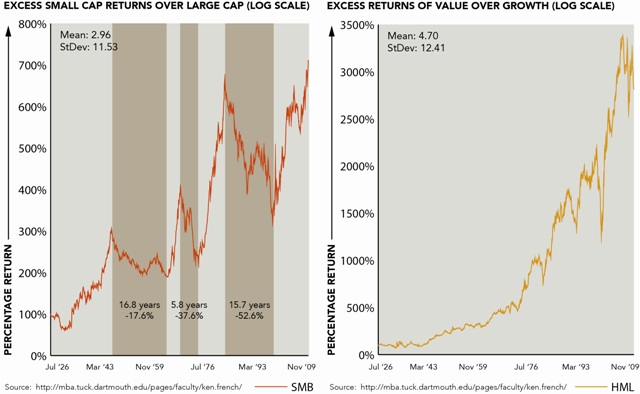
This week’s charts show the cumulative outperformance of the two Fama-French Factors, SMB and HML.

This week’s charts show the cumulative outperformance of the two Fama-French Factors, SMB and HML. SMB stands for small minus big, and is the excess performance of small market cap stocks minus large market stocks controlling for value. HML stands for high minus low, and is the excess performance of high book to market stocks minus low book to market stocks controlling for size. Graphs are shown on a log scale to highlight relative change. A change in relative size on a log scale chart is the same visual distance, which enables the viewer to more easily compare different fluctuations over time. For example, on an absolute scale graph, a price change from 50 to 100 appears much smaller than a price change from 100 to 200, even though both represent a doubling in price. On a log scale graph, these two changes appear the same.

As shown on the graphs there have historically been excess returns to small stocks and value stocks over the long term. While the volatility of both of these factors has been high (11.53 for SMB and 12.41 for HML), the value factor has earned a much higher premium over time than the size factor. This has led to long periods during which small cap stocks underperform large cap stocks, as highlighted on the graph.

While it is impossible to say given the data here, it is certainly plausible that there are business cycles that are more or less favorable to small companies compared to large companies. In fact, some academic research suggests small companies are more susceptible to shocks in profitability, which explains some of their underperformance starting in the mid 80’s. See Hou and van Dijk (2010) for more details.

The takeaway for investors is that while small caps may outperform over the long term (30 years or more), there can be extended periods during which they underperform large cap stocks. Small caps have certainly been a good bet over the past decade, but their strong performance versus large caps may or may not continue for the next.

Dow Breaks 12,000 for First Time Since 2008

On Tuesday, February 1, the Dow Jones Industrial Average (“Dow”) closed above 12,000 for the first time in two and a half years; the index was last above 12,000 on June 19, 2008.

On Tuesday, February 1, the Dow Jones Industrial Average (“Dow”) closed above 12,000 for the first time in two and a half years; the index was last above 12,000 on June 19, 2008. The Dow then dropped 46%, bottoming at 6,547 on March 9, 2009. With Tuesday’s close above 12,000, the index has risen 184% from its bottom, clearly rewarding investors who rebalanced into equities when the market was falling. Although the market has not reached its high water mark of 14,165 (achieved on June 9, 2007), hitting 12,000 was seen as another positive trend in the recovery process.

Impact of Oil Price on Inflation Expectations

This week’s Chart of the Week compares inflation expectations (measured by the breakeven rate) with oil prices, to see if there really is a strong correlation between the two values.

In the last four months of 2010, the price of oil rose from $72 as of August 31st to $91 as of December 31st, an increase of 26%. Over that same time period, the breakeven rate (the difference in yield between the ten year TIP and ten year nominal treasury) increased 34%, from 1.68% to 2.25%. Because the breakeven rate is commonly used as a proxy for inflation expectation, it is not a stretch to think that the run up in oil prices was driving inflation expectations (and inevitably, stories of “rising inflation” always seem to appear shortly after the price of oil shoots up). This week’s Chart of the Week compares inflation expectations (measured by the breakeven rate) with oil prices, to see if there really is a strong correlation between the two values. The blue bars represent the price of oil at the end of each month, and the red line chronicles the breakeven rate at each month end; data is used going back to 2003. Between 2003 and 2007, there seems to be a loose connection between the two, but it is not very tight, as the price of oil slowly creeps up but the breakeven rate is relatively static. From late 2008 through the end of 2010, the graphs seem to mirror each other more closely, most especially in late 2010. In total, however, the correlation is only .18, thus we conclude that the price of oil does not have a strong impact on expected inflation values, in spite of what we hear and read when oil prices rise dramatically.