Is It Finally Going to Happen Next Week?

In testimony before the House Financial Services Committee on November 4, Federal Reserve Chairwoman Janet Yellen remarked that a rate hike was still a “live possibility” in December, should economic data remain supportive.

In testimony before the House Financial Services Committee on November 4, Federal Reserve Chairwoman Janet Yellen remarked that a rate hike was still a “live possibility” in December, should economic data remain supportive. Prior to that comment, the market was unsure of any policy change at the Fed’s December meeting, with the Fed Fund’s Futures market implying a  50% probability of a rake hike. After Yellen’s comments, the probability of a hike in December jumped to nearly 70%, and currently sits at 80%, thanks to strong payroll reports over the last two months and further hawkish comments from FOMC members.

Despite this guesswork, Yellen and other members of the FOMC have stressed that the timing of the first rate hike in over nine years is less important that the pace of successive increases. While the futures market hasn’t been an overly reliable predictor of the future path of the Fed Funds rate, it is worth noting that the market appears to accept the Fed’s pledge to enact future increases in a slow and steady manner. Assuming a 0.25% increase on December 16 as a near certainty, the futures market doesn’t imply any meaningful probability of the next increase until the March 2016 meeting, with the most likely landing spot of the Fed Funds rate to be between 0.75% and 1.00% at the end of 2016. While a Fed Funds rate of 1.00% would be a notable shift from the Fed’s post-crisis zero interest rate policy, it would still be seen as highly accommodative in a historical context, and supportive of future economic growth.

How Soon Should We Expect the Next Recession?

What has become known as the Great Recession officially came to an end in June 2009. Since then, GDP has expanded to new real highs, we are approaching full employment, and the U.S. dollar is the strongest it has been in the past decade. Though various issues remain within the economy, overall things seem to be going well.

What has become known as the Great Recession officially came to an end in June 2009. Since then, GDP has expanded to new real highs, we are approaching full employment, and the U.S. dollar is the strongest it has been in the past decade. Though various issues remain within the economy, overall things seem to be going well.

The question on many people’s minds is how long can this last? Currently, we are 78 months out from the trough of the recession. Of the recessions since WWII, on average the period from the end of one recession to the start of the next lasts 58 months, suggesting we may be due. However, the last three recovery/expansion phases lasted longer than this and during the 1990s this period lasted 120 months leading up to the Tech Bubble.

Additionally, recessions do not occur simply with the passage of time; generally, there has to be a catalyst for the drop. Potential current areas of concern include slower wage growth, lower productivity, and the Fed tightening monetary policy.  However, the worst shocks to the economy are often unexpected; very few people predicted the housing crash. At this point though, there don’t seem to be any major red flags. The IMF’s most recent World Economic Outlook predicted only a 16% chance of the U.S. entering a recession through the first half of 2016. Also, with the last recession the worst since the Great Depression, it is plausible that the next crisis could be delayed as a result of people exhibiting more caution as it relates to spending and speculation. Ultimately, it is impossible to accurately predict when a recession will occur, so while the U.S. could enter a recession at anytime, we may still have several more years of expansion ahead of us.

How Much Longer Will Growth Outperform Value?

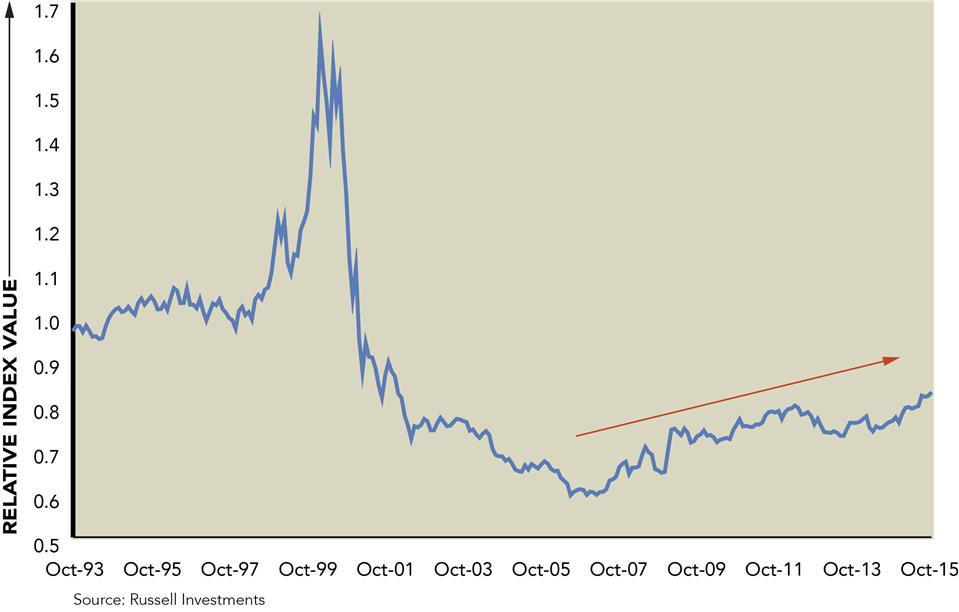
This week’s Chart of the Week examines the relative performance of growth versus value. The above chart shows the price level of the Russell 3000 Growth index relative to the Russell 3000 Value index. Growth is outperforming value when the line is in an uptrend and value is outperforming growth when the line is trending downward.

This week’s Chart of the Week examines the relative performance of growth versus value. The above chart shows the price level of the Russell 3000 Growth index relative to the Russell 3000 Value index. Growth is outperforming value when the line is in an uptrend and value is outperforming growth when the line is trending downward.

Investors may have noticed the recent outperformance of growth versus value year-to-date across small-, mid-, and large-cap. When viewed over a longer time horizon though, growth has outperformed value for almost ten years. The outperformance of growth prior to the tech bubble was much greater in magnitude; however, the current multi-year period of growth outperformance is the longest since the early 1980s.

One explanation for the current leadership of growth over value may simply be how these indices are constructed. Value indices feature a much larger allocation to the Financial and Energy sectors (representing approximately 43% of the Russell 3000 Value index as of 9/30/2015). When examining performance since the October 2007 market peak, Financials and Energy have lagged other sectors, posting cumulative returns of -20.8% and +3.1%, respectively. Areas such as Technology, Health Care, and Consumer Discretionary are among the best performing sectors since the October 2007 market peak and carry higher weightings within growth indices.

Over the long term, there will be periods when value is in favor and periods when growth is in favor. The duration of the current growth cycle calls into question how much longer growth’s outperformance will persist. Ultimately, it is extremely difficult to predict when the relative performance will shift, and yet another reminder that it is imperative to be diversified across the various size and style boxes of the U.S. equity market.

Divergent Central Bank Policy

This week’s Chart of the Week shows the divergence in Monetary Policy from the ECB, Bank of Japan and Federal Reserve. The Federal Reserve discontinued its quantitative easing (“QE”) strategy October 29th 2014; in contrast, after the end of 3Q14, the Bank of Japan and European Central Bank have increased asset holdings 30% and 26%, respectively.

This week’s Chart of the Week shows the divergence in Monetary Policy from the ECB, Bank of Japan, and Federal Reserve. The Federal Reserve discontinued its quantitative easing (“QE”) strategy on October 29th, 2014; in contrast, after the end of 3Q14, the Bank of Japan and European Central Bank have increased asset holdings by 30% and 26%, respectively.

During the same time period, the Euro and Yen have depreciated by over 10%, now trading at approximately 85% of their 10-year averages. The Bank of Japan and European Central Bank will continue large asset purchases for the foreseeable future in an effort to reduce borrowing costs and stimulate growth.

In the short term, foreign multinational corporations should utilize suppressed borrowing costs and weaker currencies as tailwinds for exports. This is best explained by third-party consumers’ attraction to the Eurozone and Japan’s relative prices of goods. QE’s goal to stimulate economic growth has had positive externalities on each bank’s respective currency; over the long run, the currency effect should be normalized as foreign direct investment is attracted to higher revenues and profits, yielding currency demand.

The Eurozone growth estimate of 0.3% advocates further action will be taken by the ECB through QE. Increased stimulus levels will force the Euro towards parity with the dollar for the first time in over a decade. Until there are better signs of growth from Eurozone nations, the ECB will be forced to use monetary stimulus and currency demand will continue to decline.

Babies Thrown Out With the Bathwater II: Emerging Markets Debt

Certain emerging markets countries have not been safe from being thrown out as “babies with the bathwater” during the past year’s global credit selloff trend.

Certain emerging markets countries have not been safe from being thrown out as “babies with the bathwater” during the past year’s global credit selloff trend.

This week’s Chart of the Week shows the spreads in basis points of the 10-year sovereign bonds from key Latin American, Asian, and EMEA (which stands for European, Middle Eastern and African) emerging countries.  The chart shows the widening of these spreads from December 2013 in the blue bars, through the energy dislocation of December 2014 and China’s devaluation of September 2015, to October 2015 in the red bars.  It is not surprising that Venezuela’s and Russia’s spreads are elevated as they are major oil exporters.

However, the countries that may at least in part have been subject to the “babies thrown out with the bathwater” effect have ranged from Latin America’s Mexico to Brazil, Asia’s Korea, and the EMEA region’s Bulgaria.  For example, Mexico’s spreads have widened from 112 basis points to 161 basis points from December 2013 to October 2015.  These emerging markets babies that have been thrown out with the bathwater represent possible value and interesting opportunities for emerging markets bond managers.

Are Retail Stocks on Sale?

Historically, the retail industry, a subset of the consumer discretionary sector, experiences an upswing during the winter months as holiday sales alone contribute 19% to yearly sales and Q4 earnings are generally released within the beginning of Q1. Highlighted in red is the November through February performance of the S&P Retail Select Industry Index; recession years aside, this upward trend usually holds.

Historically, the retail industry, a subset of the consumer discretionary sector, experiences an upswing during the winter months as holiday sales alone contribute 19% to yearly sales and Q4 earnings are generally released within the beginning of Q1. Highlighted in red is the November through February performance of the S&P Retail Select Industry Index; recession years aside, this upward trend usually holds.

In 2015, retail sales are expected to grow year over year by 3.7% and though this is a slight decrease from 2014’s 4.1% increase, it is still substantially above the 2.5% ten-year average. The U.S. employment rate is at a recent high of 94.8% however the participation rate has decreased to 62.4%, meaning that although the workforce appears to be buzzing along, some previous members of the workforce may be choosing to opt-out of their job searches and thus are less likely to take out their AMEX cards.

Though U.S. economic stats may be a mixed (gift) basket, currently the P/E ratio of the referenced retail index is at 22.37, down almost 30% year over year, making the retail industry seem attractive, especially for this time of year. Additionally, consumer confidence is currently at 97.6, modestly above the 93.8 level seen one year ago, leaving the U.S. consumer poised to shop ’til they drop.

How to Position Fixed Income Portfolios for the Rate Hike

October 2015 Investment Perspectives

Much has been written and discussed in the media about when the rate hike will begin and the pace at which it will occur. Ultimately, the timing and pace are difficult to predict because they depend on many moving parts, including unemployment, inflation, and a host of unpredictable economic and political factors. The right question to ask is: How should an institutional investor position a fixed income portfolio for the rate hike, regardless of the associated timing and speed?

Download PDF

High Yield: Don’t Throw the Babies Out With the Bathwater

This week’s Chart of the Week takes a look at the sell-off over the last month in risk credit as a direct result of global concern over China’s continued slowdown. Our chart shows the high yield bond spreads for each industry since the beginning of the year.

This week’s Chart of the Week takes a look at the sell-off over the last month in risk credit as a direct result of global concern over China’s continued slowdown.  Our chart shows the high yield bond spreads for each industry since the beginning of the year.

Not surprisingly, spreads for energy high yield issuers, shown in the purple, and spreads for metals/minerals high yield issuers, shown in the pink, have widened dramatically. In other words, their prices have depreciated significantly, as there is an inverse relationship between bond prices and their spreads.  This widening of energy and metals/minerals high yield bond spreads was due to the financial markets’ recognition of reduced Chinese demand for energy and metals/minerals.

However, all other sectors from chemicals, shown in the red, to utilities, shown in the orange, have seen their high yield spreads widen out as well. In our opinion, this is akin to throwing “the babies out with the bathwater.” In other words, the widening of spreads in all other industries except for energy and metals/minerals appears to be unjustifiably so.  The last two weeks have seen spread tightening across all industries as news of general stabilization has come out of China and Europe.  However, spreads for all other industries except for energy and metals/minerals remain elevated compared to where they were in the spring, suggesting some good value and opportunities in high yield within these industries.

How Have Capital Market Valuations Evolved Over the Last Year?

This week’s chart shows that current valuations across equity and fixed income markets are lower today compared to where they stood at the end of September last year. The big takeaway here is that equities broadly appear to still be cheaper than bonds.

This week’s chart shows that current valuations across equity and fixed income markets are lower today compared to where they stood at the end of September last year. The big takeaway here is that equities broadly appear to still be cheaper than bonds.

Japanese Government Bonds and German Bunds are some of the most expensive debt instruments currently available to investors. As it relates to the former, the Bank of Japan’s unprecedented stimulus has helped push Japanese Government Bond yields to record lows, and earlier this year, yields on securities with maturities up to five years turned negative for the first time. Looking ahead, the Fed’s willingness to delay an increase in U.S. interest rates should support demand for riskier assets and as a result, fixed income valuations may normalize over time. Compared to last year, the most precipitous drop in valuations has taken place in U.S. High Yield, U.S. Credit and U.S. dollar-denominated Emerging Markets Debt.

As it relates to equities, with the exception of the U.S., South Africa, and Mexico, valuations around other parts of the globe are on the lower end of their historical averages.  Finally, valuations in Canadian, Spanish, and Taiwanese equity markets have come down the most over the past year as these markets have sold off over the near term.

Note: Percentile ranks show valuations of assets versus their historical ranges. Example: If an asset is in the 75th percentile, this means it trades at a valuation equal to or greater than 75% of its history. Valuation percentiles are based on an aggregation of standard valuation measures versus their long-term history.

Has the Fed “Missed the Boat”?

The wait for the Federal Reserve to raise interest rates seems to be endless. Unemployment has fallen below the Fed’s desired level and inflation- when adjusted for the drop in oil prices – is just under target.  At the beginning of this year, many predicted September would be the right time for it to finally happen.

The wait for the Federal Reserve to raise interest rates seems to be endless. Unemployment has fallen below the Fed’s desired level and inflation — when adjusted for the drop in oil prices — is just under target. At the beginning of this year, many predicted September would be the right time for it to finally happen. Even with bad news coming out of China and other parts of the world hurting domestic financial markets, until the actual meeting, economists were still split on whether there would be a rate increase. But, clearly, there wasn’t.

Data suggests that a rate hike by the Fed in September would have been poor timing. Initial rate increases generally occur during periods of strong earnings growth. But for the past year, earnings have been relatively flat, and with global economies struggling this trend doesn’t seem likely to change. Additionally, after a rate increase valuations tend to fall. With the trailing 12-month P/E ratio for the S&P 500 dropping from 18.6x to just under 17x in the last two months stock prices have already undergone a sizeable correction. Any Fed action at this point in time would likely only lead to further losses.