Investors Leave Emerging Markets Behind

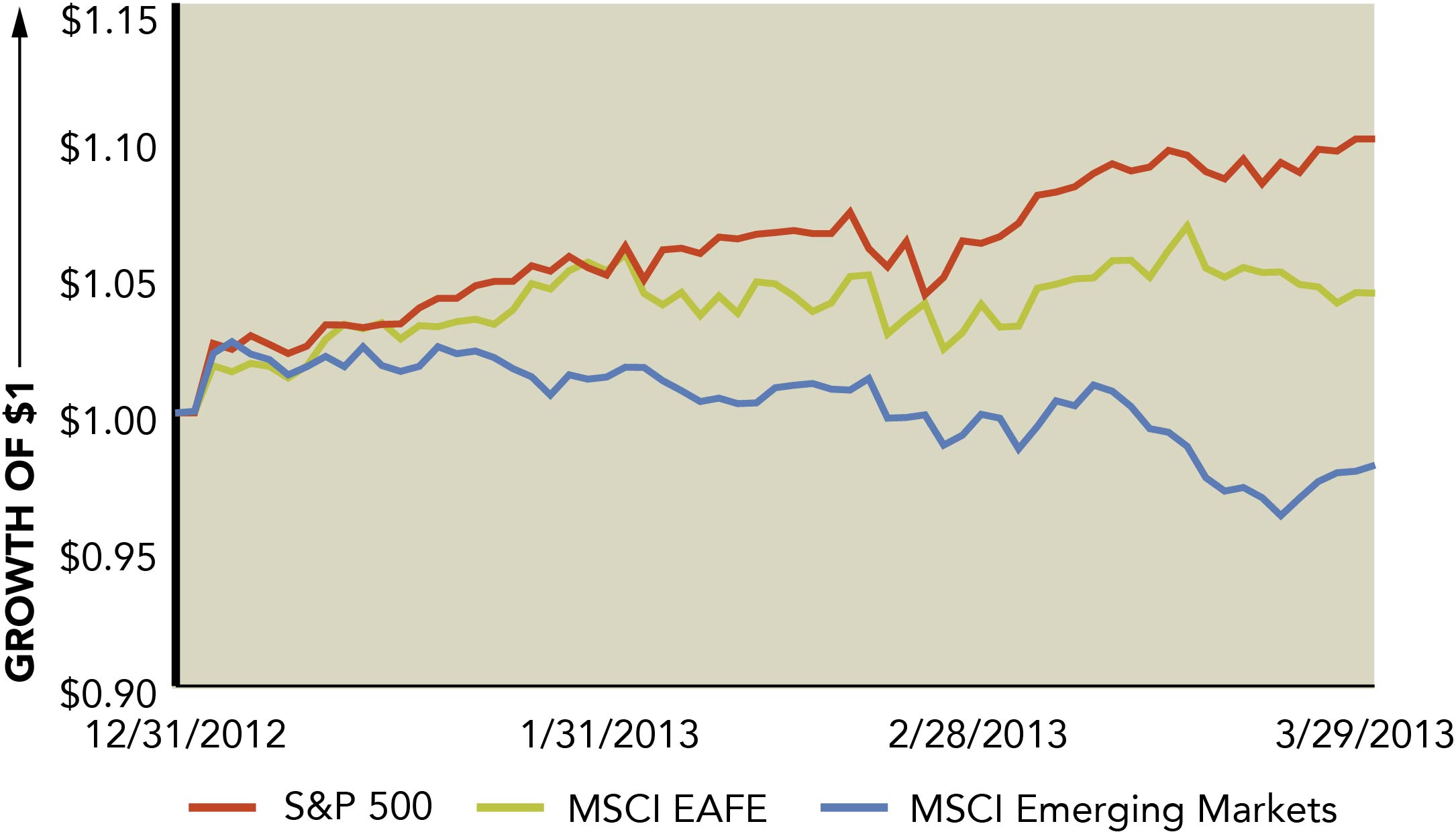
This week’s Chart of the Week highlights the relative underperformance of emerging market stocks compared to other “risky” asset classes. Since January 1, 2010, U.S. small-cap stocks1 have returned a cumulative 35.8% and international small-cap stocks2 have returned a cumulative 18% through October 2012. However, quite surprisingly, emerging market stocks3 are only up 8.9% over the same time-period.

This week’s Chart of the Week highlights the relative underperformance of emerging market stocks compared to other “risky” asset classes. Since January 1, 2010, U.S. small-cap stocks1 have returned a cumulative 35.8% and international small-cap stocks2 have returned a cumulative 18% through October 2012. However, quite surprisingly, emerging market stocks3 are only up 8.9% over the same time-period.

Emerging market equities are still treated as a risk-on, risk-off investment. As the graph above illustrates, it appears that investors have returned to some of the riskier equity markets, but have left emerging markets behind. The underperformance of international small-cap and emerging market stocks compared to U.S. small-cap stocks is somewhat explained by investors’ continued concerns with Europe. However, when looking at one of the traditional valuation metrics, price-to-earnings (“P/E”) ratio, it appears that investors may be unfairly discounting emerging market stocks. As of 9/30/2012, U.S. small-cap, international small-cap, and emerging market stocks had P/E ratios of 33.7, 19.8, and 12.5, respectively.

Continued global economic and policy uncertainty suggests that this trend may persist. However, given their low P/E ratios, coupled with growth rates and fiscal health relative to developed countries, emerging market stocks should deliver long-term compelling returns, despite their recent struggles versus other risky equity indices.

1Represented by the Russell 2000 Index
2Represented by the S&P Developed ex. U.S. Small-Cap Index
3Represented by the MSCI Emerging Markets Index

Real Estate Market on the Rebound?

Recently, the decline in the U.S. housing market has shown some evidence of bottoming. The national average home price has crept up off of lows according to the Case-Shiller Home Price Index, and inventories of existing homes on the markets have shrank significantly since the outset of the credit crunch.

Recently, the decline in the U.S. housing market has shown some evidence of bottoming. The national average home price has crept up off of lows according to the Case-Shiller Home Price Index, and inventories of existing homes on the markets have shrunk significantly since the outset of the credit crunch. Given this new data and a Federal Reserve fiscal policy including QE3 designed to induce access to home financing, it begs the question, “Has access to home financing returned?”

The Federal Reserve conducts a quarterly survey of banks operating in the U.S. called the Senior Loan Officer Opinion Survey on Bank Lending Practices. As part of this survey, mortgage lenders report changes in demand for residential loans as well as whether standards for loan approval are becoming more or less stringent. To assess the health of the loan market, this week’s chart focuses on prime mortgage borrowing, since this category reflects loan seekers that should be considered creditworthy. In the chart, we see that banks are reporting a notable increase in demand for prime residential loans this year. Meanwhile, lending standards required by banks remain strict. The data appears to show that for Americans with control over their personal finances, the affordability of home ownership is starting to outweigh the risks. Meanwhile, banks remain cautious. The percentage of outstanding prime mortgages on their balance sheets remains elevated above the historical average. If these trends continue, investors can expect slow improvements in the residential real estate market, but given the persistent attention to high lending standards that was absent pre-crisis, these improvements should prove to be sustainable and accretive to long-term value.

Lower Oil Prices: Good News or Bad News?

In the last week, U.S. crude oil prices hit a three month low dropping below $88 a barrel, attributable to economic slowdowns in China, Europe, and the U.S. Further downward pressure on oil prices has been caused by reduced earnings forecasts by U.S. corporations, unmet expected profits, and the growing worries for lower growth across the global economy.

In the last week, U.S. crude oil prices hit a three month low dropping below $88 a barrel, attributable to economic slowdowns in China, Europe, and the U.S. Further downward pressure on oil prices has been caused by reduced earnings forecasts by U.S. corporations, unmet expected profits, and the growing worries for lower growth across the global economy. Crude oil inventories rose by 5.9 million barrels to a total of 375.1 million barrels, the highest since 1982.

This drop in oil prices will have mixed results for consumers. On the bright side, the lower prices may contribute to some relief for consumers at the pump, thus leaving additional room in consumer budgets for consumption of other goods and services – an accretive trend for GDP growth. On the other hand, the price drop is a symptomatic factor for a regressing weak global economy and suggests further slow growth.

Passively Managed Funds Gaining in Popularity

Our Chart of the Week examines the migration of dollars from active to passive U.S. equity mutual funds over the last five years. During this time period, approximately $144 billion of investor money has flowed into passive funds (blue line) on a net basis, thus reflecting a growing frustration with the performance (and perhaps as importantly, fee level) of actively managed funds.

Our Chart of the Week examines the migration of dollars from active to passive U.S. equity mutual funds over the last five years. During this time period, approximately $144 billion of investor money has flowed into passive funds (blue line) on a net basis, thus reflecting a growing frustration with the performance (and perhaps as importantly, fee level) of actively managed funds. Even more telling is the movement out of actively managed funds, as shown by the red line on the chart. From 1st quarter of 2007 through the 3rd quarter of 2012, over $460 billion has been moved out of actively managed funds and into other investment vehicles.

Why the dramatic movement, most especially out of actively managed funds? A few explanations come to mind. First, it is no secret that the equity markets have largely traded on macroeconomic factors the last four years, so it has been hard for fundamentally-based managers to consistently add value when the market has not traded on those very optics used to evaluate equities. In addition, the bond bull market has attracted capital as investors have moved to ride rates down, as well as preserve the principal value of their investments. Last, as investors become more cost conscious, the low fees of passively managed funds have helped to attract additional capital.

The cloudy economic outlook suggests that this trend may continue. Whether it is a short term uncertainty such as the fiscal cliff or a longer-term matter about the future of a regional currency (Europe), it is conceivable that the market will remain a risk on / risk off trade over the next few years. Therefore, we may see continued flows into passively managed funds in the equity markets.

The Slowing Velocity of Money

In this week’s Chart of the Week we take a look at the velocity of the Money Zero Maturity (“MZM”) money supply over the last ten years. Velocity of money can be defined as the rate of turnover in the money supply; in other words, the number of times one dollar is used to purchase final goods and services included in GDP.

In this week’s Chart of the Week we take a look at the velocity of the Money Zero Maturity (“MZM”) money supply over the last ten years. Velocity of money can be defined as the rate of turnover in the money supply; in other words, the number of times one dollar is used to purchase final goods and services included in GDP. The MZM money supply is one of the more popular measures of the liquid money available for immediate consumption in the economy. Assuming all other factors remain constant, an increase in the velocity of money coincides with an increase in GDP. In addition, higher velocity of money is often associated with rising inflation.

The velocity of money has been dropping since 2005 and this trend accelerated during the financial crisis of 2008. Once the economy began growing again and exited recession in 2009, the velocity of money resumed growth as would be expected but soon began trending downward again. This continued downward trend in the velocity of money shows that as the Federal Reserve continues to increase the money supply through successive rounds of quantitative easing, each additional dollar injected into the economy has a decreasing effect on GDP. Conversely, if the Fed begins to reign in the supply of money and the velocity does not increase, GDP would likely decrease in response to any tightening policy enacted by the Fed. Going forward, the velocity of money will be another economic indicator to follow as we attempt to gauge the economy’s recovery.

Checking In On Unemployment

Since March 2009, the S&P 500 has returned 130% through September. Unemployment rates in the United States have improved as well, though more sluggishly. With the unemployment rate in the headlines, it may be insightful to look under the hood and see how the numbers have changed on a more detailed level.

Since March 2009, the S&P 500 has returned 130% through September. Unemployment rates in the United States have improved as well, though more sluggishly. With the unemployment rate in the headlines, it may be insightful to look under the hood and see how the numbers have changed on a more detailed level. Today’s chart of the week looks at the improvement in unemployment rates on a state by state basis since March of 2009. Changes are normalized by the unemployment rate ending in 2006 to show comparisons across states on a similar basis. The largest decreases in unemployment, or the “best” improvements, are shown in dark green. Mathematically, a state that falls into the dark green category of “less than -20%” means that unemployment since March of 2009 has fallen by at least 20% of the pre-crisis level in 2006. For example, unemployment in Alabama was 9.2% in March of 2009, and is 8.5% as of the most recent reading. This decline of 0.7% is about 20% of Alabama’s 2006 unemployment rate of 3.4%.

Looking at some of the individual states, a few stand out for assorted reasons. Utah, with one of the lowest unemployment rates in the country both pre- and post-crisis, has shown the greatest improvement since 2009 relative to pre-crisis levels. Michigan and Ohio, large rust belt states with some of the nation’s highest unemployment rates leading into the crisis, have also seen large improvements. Michigan currently has one of the higher unemployment rates in the country at 9.4%, but this is down from 12.6% in early 2009.

Housing bubble states Florida and Nevada both saw some of the largest increases in unemployment due to the crisis, with unemployment rates spiking north of 6% in both states. Since then however, Florida’s unemployment rate has experienced a strong improvement, while Nevada’s has continued to deteriorate. Nevada now has the worst unemployment rate in the nation at 12.1%, compared to 8.8% for Florida. States with a large amount of financial sector employees such as Connecticut, New York, and New Jersey are also among the states that have seen the largest declines in employment since 2009.

Other states of note include North Dakota, which with an unemployment rate of 3% is the only state with unemployment below 2006 levels, and Texas, which is in the same category as California on this chart but arrived there in a much different way. Though California had a large increase in unemployment during the crisis (5.6%) and relatively little improvement since then, Texas suffered a more modest deterioration in unemployment (2.3%) with a similarly weak rebound. On an absolute basis, California’s unemployment rate of 10.6% is one of the nation’s worst, while Texas’ rate of 7.1% is below the national average.

Mixed Messages From Improving Unemployment Rate

Since reaching 10% in October 2009, unemployment has been on a slow downward trajectory and fluctuated throughout 2012 within the range of 8.1% to 8.3%. At first glance, any reduction in this headline number appears to be good news.

Since reaching 10% in October 2009, unemployment has been on a slow downward trajectory and fluctuated throughout 2012 within the range of 8.1% to 8.3%. At first glance, any reduction in this headline number appears to be good news. However, upon closer examination, the recent decline in unemployment rate is attributable to both workers dropping out of the labor force (and therefore not being counted as part of the labor force) as well as new job creation. Of the 12.5 million people currently counted as unemployed, 40% of those have been without a job for 27 weeks or more.

This week’s Chart of the Week examines the historical median duration of U.S. unemployment. During August, the median duration was 18 weeks, having fallen from an all time high of 25 weeks in June 2010. The above chart illustrates headline unemployment in recent years; note the drop from its high in June 2010. While the median duration has dropped, the overall impact of longer-term unemployment on labor market health and the economy is still significant. In this environment, the prospects for a rapid economic recovery are much lower than improvements in headline unemployment would suggest. Those unemployed for longer durations of time run the risk of increasing structural unemployment as well as reducing potential output within the economy.

More Headwinds for Economic Growth?

On September 25, the Bureau of Labor Statistics released its final report on 2011 consumer expenditures. Although the information appears somewhat dated as we are practically entering the fourth quarter of 2012, the trends discovered in the analysis should have a material impact on GDP in the coming years, especially considering the importance of consumption to total GDP growth.

On September 25, the Bureau of Labor Statistics released its final report on 2011 consumer expenditures. Although the information appears somewhat dated as we are practically entering the fourth quarter of 2012, the trends discovered in the analysis should have a material impact on GDP in the coming years, especially considering the importance of consumption to total GDP growth.

At the broadest level, consumer spending rose 3.3% in 2011 which was preceded by a 2.0% decrease in 2010. Given the importance of consumer spending to GDP, the increase does benefit the overall outlook for economic growth. However, the spending increase of 3.3% narrowly surpassed an increase in the prices of goods and services which grew by 3.2%. So although consumer spending has increased, an upswing in prices has blocked consumers being much better off on a net basis.

More important – and the focus of this week’s chart – is how the increased spending dovetails with consumer incomes. If income increases do not move in at least lockstep with consumption increases, consumers will be squeezed at the margin and therefore spend a greater proportion of their incomes. As a way of investigating this, the chart above depicts the income before taxes and average annual expenditure per individual consumer over the last three years. The important relationship to note is the income level percentage change. Incomes increased only 1.93% year over year, while the expenditures rose 3.3%. When incomes are exceeded by expenses, it will be hard for the consumer to sustain this pattern without taking on debt of some kind.

The trend in the graph above – expenditures growing faster than incomes – is a cause for concern. Incomes are not increasing substantially, expenses are increasing, and consumer debt levels have increased year over year. Consumers will not be able to sustain this level of spending without greater incomes or increased debt. Unless this trend can be reversed, this is another reason to expect sub-par economic growth over the next few years.

Source: Bureau of Labor Statistics, Federal Reserve

Improvement in Housing Market?

This Chart of the Week examines home builders’ expectations of the newly built single family home market measured by the NAHB/Wells Fargo Housing Market Index. The HMI is based on a monthly survey conducted by the National Association of Home Builders.

This Chart of the Week examines home builders’ expectations of the newly built single family home market measured by the NAHB/Wells Fargo Housing Market Index (“HMI”). The HMI is based on a monthly survey conducted by the National Association of Home Builders. The index measures home builders’ perceptions of current sales, sales expectations for the next six months, and traffic of prospective buyers for newly built single family homes. An index value over 50 signifies more builders consider sales conditions good rather than poor.

While still below 50, the HMI has increased over the last five months and is now at a level of 40, which was last seen in June 2006. The improvement in builders’ confidence along with a gradual upward trend in existing home sales and stabilization of home prices are signs of modest improvement in the housing market after a historic collapse from the 2008 financial crisis. Historically low mortgage rates and attractive price opportunities have helped to stabilize the current housing market. However, a number of challenges remain, including high unemployment, a large number of looming foreclosures, strict credit standards, higher required down payments, and current underwater mortgages for would be buyers.

Impact of Government Transfer Payments on Disposable Income

This week’s Chart of the Week shows the impact of government transfer payments (Social Security, Medicare/Medicaid, unemployment insurance, veterans benefits, food stamps, training & education programs, etc.) on disposable income (defined as personal income minus personal income taxes) in the U.S. over the past several years.

This week’s Chart of the Week shows the impact of government transfer payments (Social Security, Medicare/Medicaid, unemployment insurance, veterans benefits, food stamps, training & education programs, etc.) on disposable income (defined as personal income minus personal income taxes) in the U.S. over the past several years.

As the chart illustrates, since the recession began in December of 2007, real disposable personal income in the U.S. has increased from $9,974.7 billion to $10,354.8 billion (an increase of 3.8%). However, when excluding government transfer payments, real disposable income has decreased from $8,203.4 billion to $7,979.3 billion (a decrease of 2.7%). There are several reasons for the discrepancy between discretionary income and discretionary income excluding transfer payments, but the two primary reasons are: the U.S. economy has approximately 3.5 million fewer jobs now than in December 2007, and the population of the U.S. is aging. The loss of 3.5 million jobs results in both a drag on income (fewer people working results in lower incomes) and a boost in government transfer payments (fewer people working results in increased payments for unemployment insurance, food stamps, Medicaid, and job training programs.). The aging population of the country drives a boost in spending on programs such as Social Security and Medicare.

Over the past 30 years, government transfer payments have represented 13.9% of total personal income in the U.S. From January 2008 to July 2012, government transfer payments have represented 17.4% of total personal income in the country. Given the persistently high unemployment rate, the current budget deficit, the looming fiscal cliff, and the potential for cuts to government transfer payments in the near term, it is important to understand where the growth in government transfers has come from. The table below shows the current breakdown of government transfers by category as well as the average from January 2008 to present and the 30 year average.

Breakdown of Government Transfers

Social Security

Medicare/
Medicaid

Unemployment
Insurance

Veterans’
Benefits

Other*

Current

32.7%

42.0%

3.4%

3.2%

18.8%

Jan 08-Present

31.8%

41.7%

4.9%

2.6%

19.0%

30 Year Avg.

36.2%

39.3%

3.6%

2.7%

18.2%

* Other includes programs such as welfare payments, food stamps, earned income tax credits, job training, and disaster relief.

As the table shows, part of the increase in government transfers are cyclical in nature and come from programs such as unemployment insurance, food stamps, and job training. These programs have begun to shrink and should continue to shrink as the economy improves. However, the aging population of the country will have a significant impact on the largest components of government transfers, Social Security and Medicare. These problems are structural in nature, and as the population continues to age, spending on these programs should continue to increase. This means that unless there are significant cuts to Social Security and Medicare, it is likely that government transfer payments will remain at this elevated level well into the future.