Catastrophe Bonds

Institutional investors are constantly searching for additional asset classes that may help diversify a portfolio and enhance returns. Catastrophe (“cat”) bonds may be such an asset class that could help diversify a portfolio’s interest rate, credit/equity and currency risk by providing non-correlating natural event risk. Cat bonds are typically issued by insurance companies that pool property and casualty policies. They pay coupons to the bondholder using the policy premiums received. When a natural event occurs — such as a hurricane or an earthquake — part of the principal of a cat bond may be used to pay the insurance claims on the pool of policies. In other words, the investor is paid to assume a part of the risk associated with natural events. Historically, cat bonds average 5% to 10% return annually.

This paper discusses the benefits of cat bonds and the mechanics of how they work, along with their market size. The characteristics of cat bonds and the types of cat bond strategies will also be examined. The paper will provide details about cat bonds’ merits and risks to help investors make informed decisions about whether to consider this asset class. It will conclude with a discussion of recent and long-term performance.

Read > Catastrophe Bonds White Paper

The opinions expressed herein are those of Marquette Associates, Inc. (“Marquette”), and are subject to change without notice. This material is not financial advice or an offer to purchase or sell any product. Marquette reserves the right to modify its current investment strategies and techniques based on changing market dynamics or client needs.


Investing 101 Video Series

Our Investing 101 video series covers the fundamentals of investing. This series aims to create a knowledge base for trustees, staff, and other investors of the key terms and concepts that they encounter most frequently, with guidance provided by several of Marquette’s research analysts and directors.

The series covers:

Marquette encourages open dialogue with our consultants and research team. For more information, questions, or feedback, please send us an email.

All is Not Lost for 2019

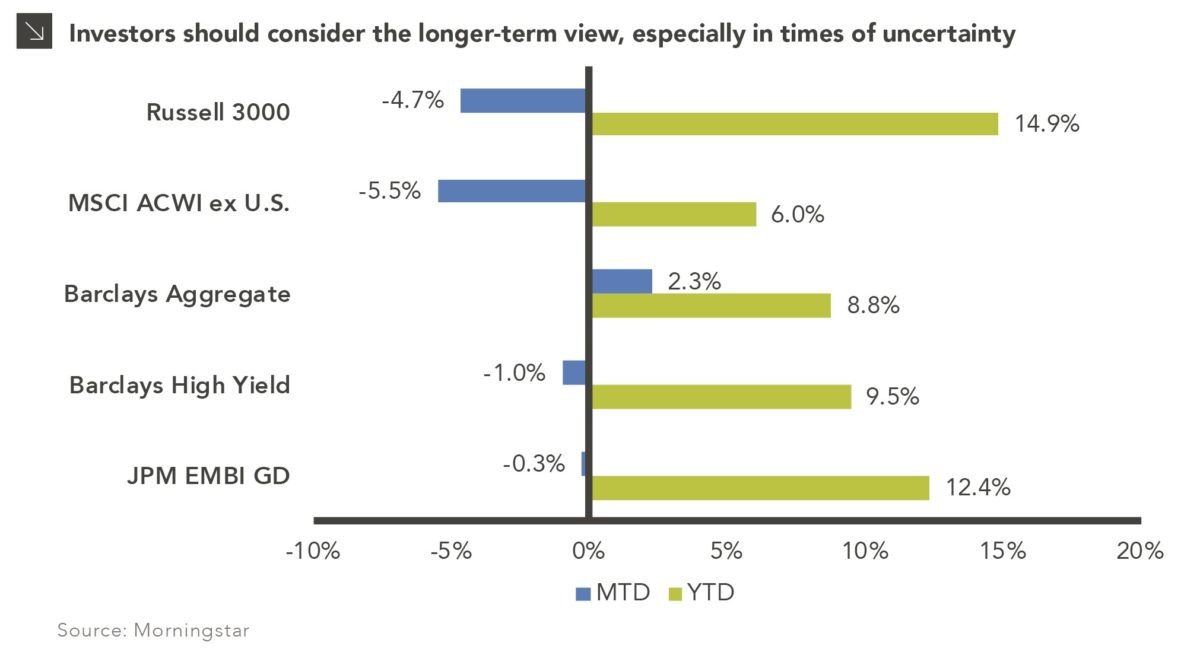
Given this week’s volatility driven by (brief) yield curve inversion, the ongoing U.S.-China trade dispute, disappointing economic data from Germany, and overall growing pessimism about future growth, investors’ growing concerns about portfolio returns are entirely justified. However, despite this week’s volatility and mostly negative news, almost all asset classes have delivered positive returns for the year, with the great majority of U.S. equity strategies up double digits. Furthermore, most fixed income strategies have profited from falling interest rates, as shown by positive returns from investment grade as well as below investment grade sectors. And for all the negative news out of the Eurozone and China, international equities — as represented by the ACWI ex-US index — are still up more than 6% through August 15th. While the rest of the year is likely to feature elevated volatility and lower returns, barring a major market correction most portfolios should remain in positive territory, despite what has transpired the first half of August. If nothing else, we encourage investors to take a long-term view of the markets and not overreact in times of market stress, as stepping back and taking a longer-term view of the markets indicates that 2019 has been a profitable year to date.

Print PDF > All is Not Lost for 2019

The opinions expressed herein are those of Marquette Associates, Inc. (“Marquette”), and are subject to change without notice. This material is not financial advice or an offer to purchase or sell any product. Marquette reserves the right to modify its current investment strategies and techniques based on changing market dynamics or client needs.

The Yield Curve Inverts: Time to Hunker Down?

This morning, the key range of the U.S. Treasury yield curve that is viewed as the bellwether of recessions — the 2-year versus the 10-year — inverted. The 10-year yield fell to 1.61%, below the 2-year’s 1.62%, as of the time of writing. The yield curve serves as a key indicator of market sentiment on future interest rates and therefore the future state of our economy. An upward sloping curve signifies a growing economy, while an inverted curve portends a contracting economy.

This newsletter details what investors should be aware of in light of the inversion, including the possibility of a recession, effects on the equity market, and other current events that may contribute to uncertainty and volatility.

Read > The Yield Curve Inverts: Time to Hunker Down?

The opinions expressed herein are those of Marquette Associates, Inc. (“Marquette”), and are subject to change without notice. This material is not financial advice or an offer to purchase or sell any product. Marquette reserves the right to modify its current investment strategies and techniques based on changing market dynamics or client needs.

Second Quarter Review of Asset Allocation: Risks and Opportunities

Overall, the second quarter was positive for financial markets, thanks to strong economic fundamentals and expected Fed stimulus. Unemployment remains low at 3.7% and inflation (1.8% year over year) is near the Fed’s long-term target of 2%. However, there are increasing concerns about a global economic slowdown and early forecasts for 2Q GDP growth are around 1.5%, far lower than what we’ve seen in recent quarters. Globally, the most important trends we see are the following:

  • The U.S.-China trade conflict remains ongoing as talks between the two countries resumed, but little progress has been made;
  • The Federal Reserve is expected to cut rates in July and markets are forecasting another one to two cuts by the end of the year;
  • Business sentiment is declining ­— most notably in the PMI manufacturing index, which is now dangerously close to falling below its growth threshold;
  • Britain continues to struggle with its Brexit and elected a new PM (Boris Johnson) on July 23rd;
  • China and Europe are expected in increase their stimulus measures to combat slow growth and overall global uncertainty;
  • Late-cycle dynamics in credit and equity markets.

The impact of these trends is explored further in this newsletter as we review second-quarter performance and expectations going forward for each of the major asset classes.

Read > Second Quarter Review of Asset Allocation: Risks and Opportunities
The opinions expressed herein are those of Marquette Associates, Inc. (“Marquette”), and are subject to change without notice. This material is not financial advice or an offer to purchase or sell any product. Marquette reserves the right to modify its current investment strategies and techniques based on changing market dynamics or client needs.

Russell Indices Incorporate “Uber” Exciting IPOs

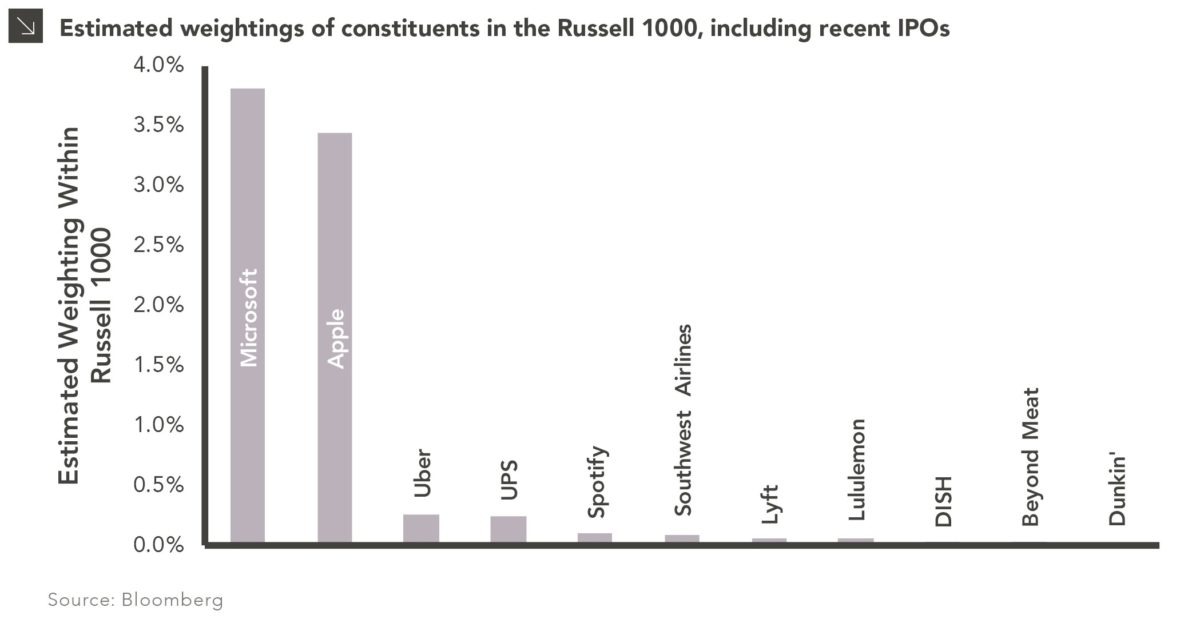
It’s that time of year again! The end of June brings longer summer days and the annual Russell index reconstitution. The Russell 1000’s constituent rebalancing this month also brings the inclusion of a few recent high-profile IPOs, most notably Uber, Lyft, Spotify, and Beyond Meat. This means all investors holding a passive allocation to the Russell 1000 will soon hold shares in these companies.

The Russell’s methodology weights constituent allocations based on the free-float market cap, which only includes shares readily available to trade. We show here estimated weightings of these newly IPO’d constituents alongside some well-known peers of similar weights. Notably, Microsoft has overtaken Apple as the largest index constituent. Uber, while likely the largest IPO of 2019, is still dwarfed by these two behemoths and will ultimately not become a massive component of the index’s roughly 1,000 constituents. Similarly, while the top few constituents seem to hold outsized portions of the index, the index’s performance is not dictated solely by them as they are significantly outnumbered by over 900 names which contribute to performance.

Print PDF > Russell Indices Incorporate “Uber” Exciting IPOs

The opinions expressed herein are those of Marquette Associates, Inc. (“Marquette”), and are subject to change without notice. This material is not financial advice or an offer to purchase or sell any product. Marquette reserves the right to modify its current investment strategies and techniques based on changing market dynamics or client needs.

Bank Loans Position Paper

Bank loans represent a key strategic asset class for most institutional investors’ fixed income portfolios. Some of the critical benefits of bank loans include yield that is typically greater than that of core bonds, a floating rate and therefore very little interest rate risk, and a senior secured level in the debt capital structure of issuers such that default risk is minimized and recovery rates are maximized. This position paper covers the history of the asset class as well as some unique characteristics that make it a vital part of many institutional investors’ portfolios. We will also examine its historical returns and correlations with other asset classes, as well as its risks ranging from credit to liquidity risk and interest risk to reinvestment risk. We will conclude with an assessment of its recent valuations as well as how to access this asset class.

Download PDF >

The opinions expressed herein are those of Marquette Associates, Inc. (“Marquette”), and are subject to change without notice. This material is not financial advice or an offer to purchase or sell any product. Marquette reserves the right to modify its current investment strategies and techniques based on changing market dynamics or client needs.


BREXIT: Three Strikes and May Is Out

On Friday, May 24th, Prime Minister Theresa May somberly announced her plans to resign as the Conservative Party leader and head minister of the U.K. Parliament on June 7th. When David Cameron turned over the reins in 2016, post the referendum vote results, May pledged to uphold the decision of the populous and lead the United Kingdom out of the bloc. Yet, May’s best efforts to deliver a withdrawal agreement have come up short, and with growing pressure from her party and another no-confidence vote on the horizon, May bowed out in hopes that a new leader will break the Brexit deadlock.

Angst about the state of Brexit and May’s performance had been coming to a boil throughout the month. On May 3rd, local elections across England yielded an upsetting blow to the country’s two main political parties, the Conservatives and the Labours, which jointly lost 1,380 local seats in backlash from the political dysfunction surrounding the second Brexit extension. May’s push to resolve the impasse prior to EU elections led to numerous resignation calls by both Conservative and Labour party MPs, with members of PM May’s inner circle throwing in the towel.

In light of her resignation, how has the market responded? Who is competing to be Britain’s next PM? Where does this leave the state of Brexit? The purpose of this newsletter is to address these questions and to provide our outlook on how Brexit will shape international investing conversations for the remainder of the year.

Read > BREXIT: Three Strikes and May Is Out

The opinions expressed herein are those of Marquette Associates, Inc. (“Marquette”), and are subject to change without notice. This material is not financial advice or an offer to purchase or sell any product. Marquette reserves the right to modify its current investment strategies and techniques based on changing market dynamics or client needs.


Municipal or Taxable Bonds for High Net Worth Investors?

Municipal bonds remain attractive and still make sense for high net worth investors on a go-forward basis even in the wake of the Tax Cuts and Jobs Act that went into effect in 2018 and the spread-widening that we experienced in the credit markets during the fourth quarter of 2018. This research brief compares the current state of municipal bonds versus taxable bonds, including:

  • The Municipal/Treasury Ratio
  • A Comparison of Long-Term Historical Returns
  • Tax-Equivalent Yields

Read > Municipal or Taxable Bonds for High Net Worth Investors?

The opinions expressed herein are those of Marquette Associates, Inc. (“Marquette”), and are subject to change without notice. This material is not financial advice or an offer to purchase or sell any product. Marquette reserves the right to modify its current investment strategies and techniques based on changing market dynamics or client needs.

First Quarter Review of Asset Allocation

Heading into 2019, the primary risks facing financial markets were the trade war with China, the U.S. government shutdown, Brexit uncertainty, and further Fed rate hikes. However, in the first quarter the majority of these worries subsided.

In this newsletter, we analyze the current market environment with a review of recent performance and future expectations for each major asset class. As always, we caution investors to stay diversified and rebalance as appropriate. There are always potential disruptors to the financial markets and the most powerful tend to be largely unexpected. We will continue to monitor markets and developments as they occur to guide our clients to the most optimal portfolio decisions given the backdrop of program goals and risk tolerance.

Read > First Quarter Review of Asset Allocation

The opinions expressed herein are those of Marquette Associates, Inc. (“Marquette”), and are subject to change without notice. This material is not financial advice or an offer to purchase or sell any product. Marquette reserves the right to modify its current investment strategies and techniques based on changing market dynamics or client needs.