The Yield Curve Inverted a Month Ago… Now What?

The U.S. Treasury yield curve briefly inverted a month ago, when the 10-year Treasury yield fell 4 basis points below the 2-year Treasury yield on August 27th. An inverted yield curve has historically signaled a recession to come, as was the case prior to the 2000 tech bubble and 2008 housing crisis. However, the stock markets in the U.S. have been resilient since this latest inversion. The S&P 500 is up 4.2% and the Russell 1000 is up 6.6% since August 27th. This is not surprising as historically there is roughly a 20-month lag between yield curve inversion and the start of a recession.

It should be noted, however, in this most recent case of inversion there is the additional ­— and unprecedented — phenomenon of yield-seeking from investors whose domestic yields are currently negative. Foreign countries currently own approximately $6.6 trillion of U.S. Treasuries. In fact, countries with negative interest rates such as Japan and Germany increased their U.S. Treasury holdings by 9.2% and 21%, respectively, over the last twelve months. Foreign holdings of U.S. Treasuries amount to roughly 30% of the total amount of U.S. Treasuries outstanding and as a result, the shape of the yield curve has been warped and therefore may be a less-reliable indicator for recessions. It is true that yield curve inversion typically signals a market’s pessimistic view of the economy. However, given the current demand dynamics from foreign investors, yield curve inversion may be less reliable of a recession prediction signal given the overall state of economic growth and consumer health.

Print > The Yield Curve Inverted A Month Ago… Now What?

The opinions expressed herein are those of Marquette Associates, Inc. (“Marquette”), and are subject to change without notice. This material is not financial advice or an offer to purchase or sell any product. Marquette reserves the right to modify its current investment strategies and techniques based on changing market dynamics or client needs.

Catastrophe Bonds

Institutional investors are constantly searching for additional asset classes that may help diversify a portfolio and enhance returns. Catastrophe (“cat”) bonds may be such an asset class that could help diversify a portfolio’s interest rate, credit/equity and currency risk by providing non-correlating natural event risk. Cat bonds are typically issued by insurance companies that pool property and casualty policies. They pay coupons to the bondholder using the policy premiums received. When a natural event occurs — such as a hurricane or an earthquake — part of the principal of a cat bond may be used to pay the insurance claims on the pool of policies. In other words, the investor is paid to assume a part of the risk associated with natural events. Historically, cat bonds average 5% to 10% return annually.

This paper discusses the benefits of cat bonds and the mechanics of how they work, along with their market size. The characteristics of cat bonds and the types of cat bond strategies will also be examined. The paper will provide details about cat bonds’ merits and risks to help investors make informed decisions about whether to consider this asset class. It will conclude with a discussion of recent and long-term performance.

Read > Catastrophe Bonds White Paper

The opinions expressed herein are those of Marquette Associates, Inc. (“Marquette”), and are subject to change without notice. This material is not financial advice or an offer to purchase or sell any product. Marquette reserves the right to modify its current investment strategies and techniques based on changing market dynamics or client needs.
 

Investing 101 Video Series

Our Investing 101 video series covers the fundamentals of investing. This series aims to create a knowledge base for trustees, staff, and other investors of the key terms and concepts that they encounter most frequently, with guidance provided by several of Marquette’s research analysts and directors.

The series covers:

Marquette encourages open dialogue with our consultants and research team. For more information, questions, or feedback, please send us an email.

All is Not Lost for 2019

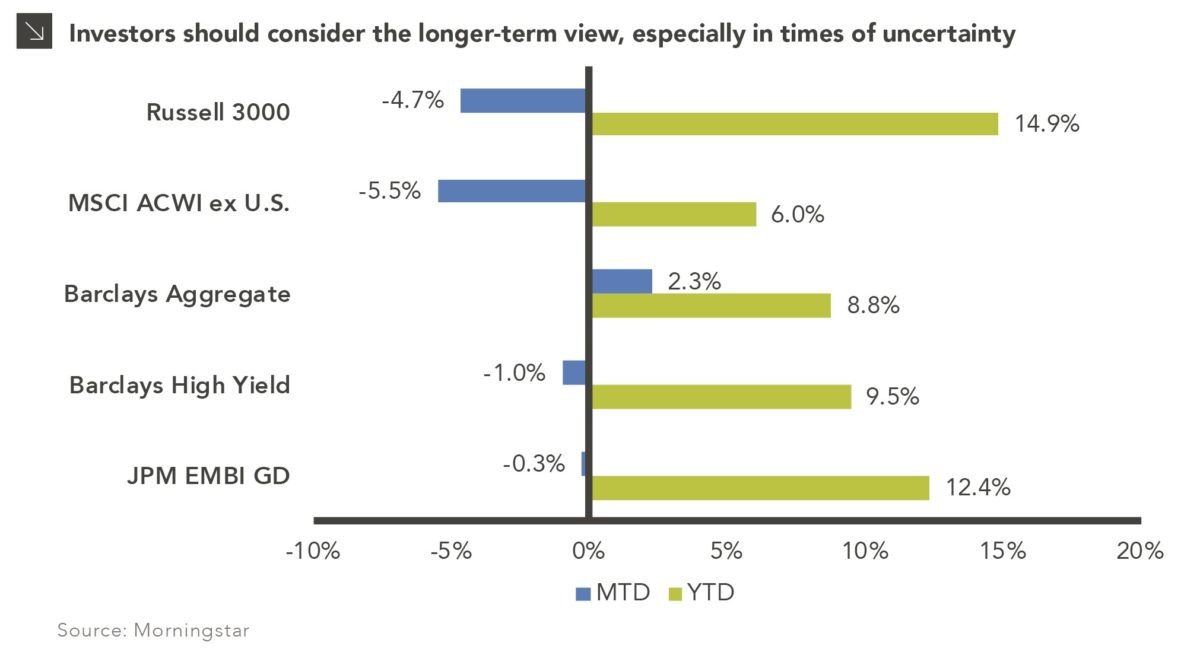
Given this week’s volatility driven by (brief) yield curve inversion, the ongoing U.S.-China trade dispute, disappointing economic data from Germany, and overall growing pessimism about future growth, investors’ growing concerns about portfolio returns are entirely justified. However, despite this week’s volatility and mostly negative news, almost all asset classes have delivered positive returns for the year, with the great majority of U.S. equity strategies up double digits. Furthermore, most fixed income strategies have profited from falling interest rates, as shown by positive returns from investment grade as well as below investment grade sectors. And for all the negative news out of the Eurozone and China, international equities — as represented by the ACWI ex-US index — are still up more than 6% through August 15th. While the rest of the year is likely to feature elevated volatility and lower returns, barring a major market correction most portfolios should remain in positive territory, despite what has transpired the first half of August. If nothing else, we encourage investors to take a long-term view of the markets and not overreact in times of market stress, as stepping back and taking a longer-term view of the markets indicates that 2019 has been a profitable year to date.

Print PDF > All is Not Lost for 2019

The opinions expressed herein are those of Marquette Associates, Inc. (“Marquette”), and are subject to change without notice. This material is not financial advice or an offer to purchase or sell any product. Marquette reserves the right to modify its current investment strategies and techniques based on changing market dynamics or client needs.

Second Quarter Review of Asset Allocation: Risks and Opportunities

Overall, the second quarter was positive for financial markets, thanks to strong economic fundamentals and expected Fed stimulus. Unemployment remains low at 3.7% and inflation (1.8% year over year) is near the Fed’s long-term target of 2%. However, there are increasing concerns about a global economic slowdown and early forecasts for 2Q GDP growth are around 1.5%, far lower than what we’ve seen in recent quarters. Globally, the most important trends we see are the following:

  • The U.S.-China trade conflict remains ongoing as talks between the two countries resumed, but little progress has been made;
  • The Federal Reserve is expected to cut rates in July and markets are forecasting another one to two cuts by the end of the year;
  • Business sentiment is declining ­— most notably in the PMI manufacturing index, which is now dangerously close to falling below its growth threshold;
  • Britain continues to struggle with its Brexit and elected a new PM (Boris Johnson) on July 23rd;
  • China and Europe are expected in increase their stimulus measures to combat slow growth and overall global uncertainty;
  • Late-cycle dynamics in credit and equity markets.

The impact of these trends is explored further in this newsletter as we review second-quarter performance and expectations going forward for each of the major asset classes.

Read > Second Quarter Review of Asset Allocation: Risks and Opportunities

The opinions expressed herein are those of Marquette Associates, Inc. (“Marquette”), and are subject to change without notice. This material is not financial advice or an offer to purchase or sell any product. Marquette reserves the right to modify its current investment strategies and techniques based on changing market dynamics or client needs.

When Will the SOFRing End?

Global authorities such as the SEC, Federal Reserve, European Commission and European Central Bank are currently transitioning the market’s use of LIBOR as a base rate for floating-rate securities such as bank loans, CLOs and private credit towards the use of the current front runner as a replacement: SOFR, which stands for the Secured Overnight Financing Rate.

This newsletter explains what a base rate is and how it is used in investing, why LIBOR is being transitioned to SOFR and the key differences between the two, and when the change is expected to take effect.

Read > When Will the SOFRing End?

For more coverage on LIBOR, please see our Bank Loans Position Paper and recent Chart of the Week, The Sixth Fed Hike and Rising LIBOR.

The opinions expressed herein are those of Marquette Associates, Inc. (“Marquette”), and are subject to change without notice. This material is not financial advice or an offer to purchase or sell any product. Marquette reserves the right to modify its current investment strategies and techniques based on changing market dynamics or client needs.

Bank Loans Position Paper

Bank loans represent a key strategic asset class for most institutional investors’ fixed income portfolios. Some of the critical benefits of bank loans include yield that is typically greater than that of core bonds, a floating rate and therefore very little interest rate risk, and a senior secured level in the debt capital structure of issuers such that default risk is minimized and recovery rates are maximized. This position paper covers the history of the asset class as well as some unique characteristics that make it a vital part of many institutional investors’ portfolios. We will also examine its historical returns and correlations with other asset classes, as well as its risks ranging from credit to liquidity risk and interest risk to reinvestment risk. We will conclude with an assessment of its recent valuations as well as how to access this asset class.

Download PDF >

The opinions expressed herein are those of Marquette Associates, Inc. (“Marquette”), and are subject to change without notice. This material is not financial advice or an offer to purchase or sell any product. Marquette reserves the right to modify its current investment strategies and techniques based on changing market dynamics or client needs.


When the Experts Are Wrong

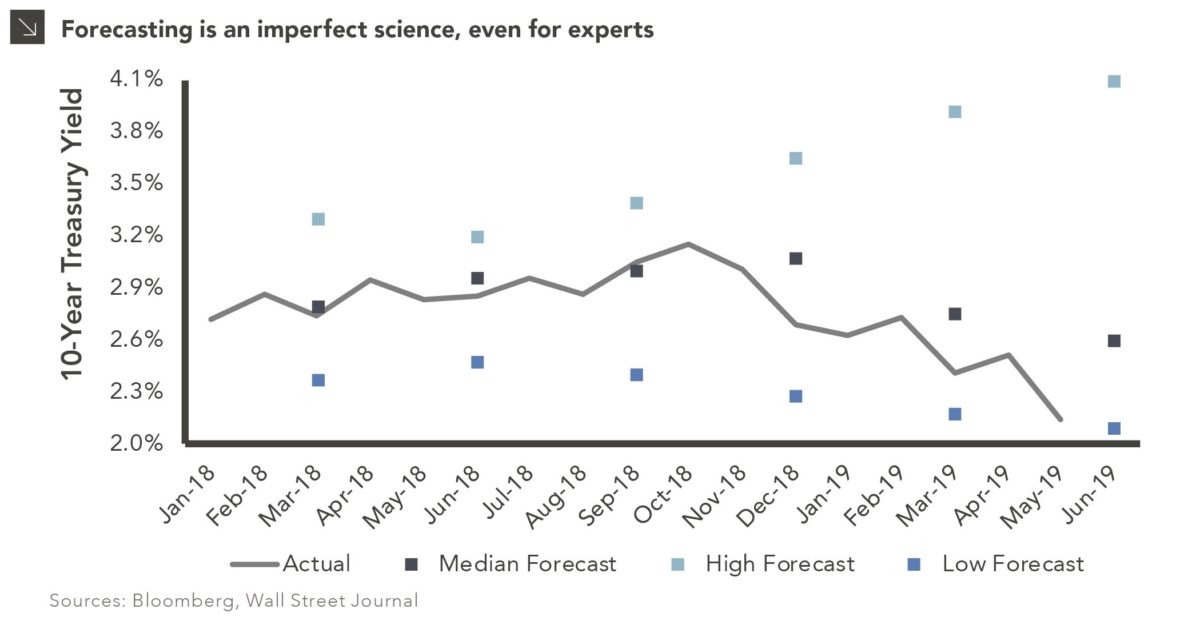
Since the end of October, the yield on the 10-year Treasury fell more than 1% and as of writing stands at 2.12%. The drop resulted in the yield curve inverting between the 3-month and 10-year maturities, and the 2-year yield is getting dangerously close to also surpassing the 10-year. This dramatic decline and inversion made investors nervous that a recession was on the horizon and caught most economists off-guard. In both 4Q and 1Q the 10-year yield ended lower than the average forecast from the Bloomberg consensus by about 0.4%. 2Q is on track to be even worse as the yield may fall below the forecasted low from the survey.

Towards the end of 2018, most believed the 10-year would rise thanks to continued growth and further rate hikes by the Fed. However, volatility and ongoing concerns about tariffs have pushed investors into safe-haven assets. This was further fueled by the weaker than expected job reports and most now believe the Fed will likely cut interest rates at least once before the end of the year. As a result, some institutions revised their forecasts for the remainder of 2019, going as low as 1.75% for the 10-year. That said, there is still a great deal of uncertainty and rates could just as easily rebound should we get more positive economic data, if the Fed chooses not to decrease rates, or if there is a resolution to the trade conflict. Overall, this serves as a reminder to investors that timing the market is an imperfect science and even experts can miss the mark by a wide margin. We continue to encourage clients to stick to their investment policies, invest for the long-term, and follow a disciplined rebalancing routine.

Print PDF > When the Experts Are Wrong

The opinions expressed herein are those of Marquette Associates, Inc. (“Marquette”), and are subject to change without notice. This material is not financial advice or an offer to purchase or sell any product. Marquette reserves the right to modify its current investment strategies and techniques based on changing market dynamics or client needs.

Are Low Default Rates a Reason to Reach for Higher Yields?

As indicated in Moody’s 2018 Annual Defaults Report, recent default rates on corporate debt have been significantly below long-term historical averages. Is this as positive for forward returns as one would think?

This week’s chart of the week shows recent corporate default rates against the longer-term averages and the return/risk ratio. As expected, the default rates are lower across the board and especially so in the sub-investment grade space. B rated debt has the largest change in default rate at 9.3%, leaving the trailing 5-year default rate at nearly half of its longer-term average. Lower default rates have been great for returns, so what’s the risk?

Just as equity analysts extrapolate recent high company earnings growth into the future, the risk is that credit analysts extrapolate the unordinarily low default rate into the future. The recent economic environment has been hospitable for low default rates with steadily increasing corporate margins and an increased ability to pay down debt. As some investors move into more volatile and lower quality debt to chase the higher yield that these bonds offer, the return per unit of risk decreases because the default rate increases by more than the additional yield benefit. If default rates were to increase and revert to the mean, lower credit rating bonds would be hit especially hard.

However, active investment managers strive to mitigate some of these risks. They can tilt their portfolios to higher quality bonds or choose bonds that they believe are rated incorrectly by rating agencies, thus lowering their portfolio’s default rate. In total, the recent low default rates have been great for trailing returns, however the future environment is uncertain and the strategy of reaching for higher yield may not perform as it has in recent history.

Print PDF > Are Low Default Rates a Reason to Reach for Higher Yields?

The opinions expressed herein are those of Marquette Associates, Inc. (“Marquette”), and are subject to change without notice. This material is not financial advice or an offer to purchase or sell any product. Marquette reserves the right to modify its current investment strategies and techniques based on changing market dynamics or client needs.

Municipal or Taxable Bonds for High Net Worth Investors?

Municipal bonds remain attractive and still make sense for high net worth investors on a go-forward basis even in the wake of the Tax Cuts and Jobs Act that went into effect in 2018 and the spread-widening that we experienced in the credit markets during the fourth quarter of 2018. This research brief compares the current state of municipal bonds versus taxable bonds, including:

  • The Municipal/Treasury Ratio
  • A Comparison of Long-Term Historical Returns
  • Tax-Equivalent Yields

Read > Municipal or Taxable Bonds for High Net Worth Investors?

The opinions expressed herein are those of Marquette Associates, Inc. (“Marquette”), and are subject to change without notice. This material is not financial advice or an offer to purchase or sell any product. Marquette reserves the right to modify its current investment strategies and techniques based on changing market dynamics or client needs.