First Quarter Review of Asset Allocation

Heading into 2019, the primary risks facing financial markets were the trade war with China, the U.S. government shutdown, Brexit uncertainty, and further Fed rate hikes. However, in the first quarter the majority of these worries subsided.

In this newsletter, we analyze the current market environment with a review of recent performance and future expectations for each major asset class. As always, we caution investors to stay diversified and rebalance as appropriate. There are always potential disruptors to the financial markets and the most powerful tend to be largely unexpected. We will continue to monitor markets and developments as they occur to guide our clients to the most optimal portfolio decisions given the backdrop of program goals and risk tolerance.

Read > First Quarter Review of Asset Allocation

The opinions expressed herein are those of Marquette Associates, Inc. (“Marquette”), and are subject to change without notice. This material is not financial advice or an offer to purchase or sell any product. Marquette reserves the right to modify its current investment strategies and techniques based on changing market dynamics or client needs.

The Latest Key Developments in the Healthcare Industry

Health systems today face significant challenges, further complicating an ever-changing landscape. Some of the most notable trends we see in the space include:

  • Higher interest rates, which impact borrowing costs as well as investment opportunities;
  • Efforts to gradually repeal the Affordable Care Act (“ACA”);
  • The emergence of value-based payment programs;
  • The advent of major vertical integrations such as CVS-Aetna;
  • A growing demand for digital healthcare

The following article summarizes these key issues for health systems and where appropriate, provides some potential solutions.

Read > The Latest Key Developments in the Healthcare Industry

With over 20 years of healthcare investment consulting experience, Marquette serves healthcare clients across a broad range of operating cultures — including health systems, stand-alone hospitals, and specialty organizations — and with a variety of focus areas — including operating funds, retirement planning, insurance, endowments, and foundations. For more Marquette coverage of the healthcare industry, please see our previous newsletter Healthcare Organizations’ Top 3 Investment Concerns for Balance Sheet Assets.

The opinions expressed herein are those of Marquette Associates, Inc. (“Marquette”), and are subject to change without notice. This material is not financial advice or an offer to purchase or sell any product. Marquette reserves the right to modify its current investment strategies and techniques based on changing market dynamics or client needs.

Higher Yields, Higher Returns

As bond yields are much higher today than they were only three years ago due to nine Federal Reserve rate hikes since the Great Recession, fixed income investors are encouraged by the higher yields that are expected to produce higher returns in the future. The Fed’s nine rate hikes, having raised the fed funds rate from the range of 0.00%–0.25% only three years ago to 2.25%–2.50% today, are expected to provide a general boost to annualized bond returns over the next five years.

Our chart of the week looks at the relationship between current yields in the bond markets and the expected future annualized returns for the next five years. We focus on the Bloomberg Barclays Aggregate Index (“Agg”) as that is the most common bond benchmark used by investors. The chart plots the starting yield of the Agg over the last five decades, from the 1970s to today, on the x-axis. The y-axis then shows the corresponding annualized returns of the Agg over the next five years.

We can see that there is a very linear relationship: the higher the yields at each starting point, the higher the returns for the next five years. As rates declined from the 1980s through the 1990s and 2000s to today in the 2010s, this relationship held true. There are a few outliers in the 1970s, however, as the Federal Reserve under Volcker at the time hiked rates to counter stagflation. But excluding some of these outliers in the 1970s, the chart shows a very strong linear association that higher returns over the next five years are a direct result of higher rates today.

There are secular forces at play, particularly the rising retirement trend across the world’s most powerful economies (Japan, China, U.S., and Europe) that may keep our current low-rate “new neutral” phenomenon a persistent reality for some time. However, the countering forces are new technologies that provide for more productivity. On the balance, fixed income investors are expected to benefit from generally stronger annualized returns over the next five years versus the last 10 years since the Great Recession.

Print PDF > Higher Yields, Higher Returns

The opinions expressed herein are those of Marquette Associates, Inc. (“Marquette”), and are subject to change without notice. This material is not financial advice or an offer to purchase or sell any product. Marquette reserves the right to modify its current investment strategies and techniques based on changing market dynamics or client needs.

Should Investors Reduce Equity Allocations After Yield Curve Inversion?

The yield curve plots the relationship between U.S. bond yields and their maturities, and typically slopes upward: the longer you hold the security, the higher the return given various risks through time such as inflation, opportunity cost, and economic uncertainty. The yield curve, however, can be inverted when high demand for long-term Treasuries drives the price up and the yield down resulting in a downward sloping curve. Yield curve inversion often signals a pessimistic view of the economy in which investors look for protection against slow economic growth and higher-than-expected inflation. Furthermore, the previous four instances of curve inversion have been followed by a market correction, though it can sometimes be years before a market correction follows inversion.

Last Friday, the 10-year Treasury yield fell below short-term yields with maturities ranging from 1-month to 1-year in response to disappointing Eurozone data, geopolitical risks around Brexit, and Fed Chairman Jerome Powell’s remark on a global economic slowdown. Shortly after the yield curve inverted — especially after the negative yield spread emerged between 3-month and 10-year Treasuries (regarded as the Fed’s most sensitive measure of market sentiment) — the equity market sold off and the S&P 500 total return fell by 1.89%. This immediate reaction led some investors to believe the correction was already unfolding.

While it is impossible to determine at this point if the correction is already here, investors should take comfort knowing that the equity market eventually rebounds from these corrections and shows resilience after the yield curve inverts. Our chart above shows the subsequent 3-month, 6-month, 1-year, 2-year, and 5-year returns of the S&P 500 index after the primary inversion data point — the spread between the 2-year and 10-year Treasury yields — first went negative (thus inverting). For example, after the 10s/2s yield inversion on December 27, 2005, S&P 500 annualized total returns after 1 year, 2 years and 5 years were 15.6%, 10.7% and 2.2% respectively. Over longer time periods after yield curve inversion, such as 7 or 10 years, equity returns more closely resemble their long-term averages. The other primary takeaway from the chart is that shorter-term equity returns — 3, 6, or 12 months — feature significant disparity from the last four yield curve inversions, indicating each instance is different in terms of magnitude and timing after initial 10s/2s inversion. Thus, we do not recommend that investors reduce their equity allocations in an attempt to time the potential correction after inversion, and over the longer-term, equities are still expected to be positive contributors to portfolio returns, even if the yield curve is temporarily inverted.

Print PDF> Should Investors Reduce Equity Allocations After Yield Curve Inversion?

The opinions expressed herein are those of Marquette Associates, Inc. (“Marquette”), and are subject to change without notice. This material is not financial advice or an offer to purchase or sell any product. Marquette reserves the right to modify its current investment strategies and techniques based on changing market dynamics or client needs.
Yield Curve Inversion Intensifies: Will This Time Be Different?

An inverted U.S. Treasury yield curve — one in which long term rates are lower than short term rates — is known by investors to be a predictive indicator of a market correction and subsequent recession to come. On Friday, the yield curve inverted between the one-month to one-year range vs. the 10-year for the first time since 2007, with the one-month to one-year range yielding 2.45%–2.49% vs. the 10-year yielding 2.44%. This is an extension of the inversion between the two-year and five-year, which began last December.

In this newsletter, we put the current yield curve inversion into historical context, examining the indicators of previous inversions and the various market corrections and recessions that have followed. We also look ahead, taking into account current optimism regarding Fed rate cuts and various other indicators in the credit markets, and note how investors can prepare for further changes.

Read> Yield Curve Inversion Intensifies: Will This Time Be Different?

The opinions expressed herein are those of Marquette Associates, Inc. (“Marquette”), and are subject to change without notice. This material is not financial advice or an offer to purchase or sell any product. Marquette reserves the right to modify its current investment strategies and techniques based on changing market dynamics or client needs.

2019 Market Preview

Coming off a difficult 2018, investors face a litany of questions going into this year, whose potential answers will undoubtedly have an impact on the capital markets. The following set of newsletters examines the primary asset classes we cover for our clients, with in-depth analysis of last year’s performance and more importantly, trends, themes, and projections to watch for in 2019. We hope these materials can assist you and your committees as you plan for the coming year, and please feel free to reach out to any of us should you have further questions about the articles or wish to review the 2019 Market Preview Webinar recording. Here’s to a better year from the capital markets in 2019!

U.S. Economy: The View from the Top?
by Jeffrey Hoffmeyer, CFA, Lead Analyst, Asset Allocation

Fixed Income: Kicking Off the Year with Moderate Valuations, a Less-Hawkish Fed and Growing Global Tariffs
by Ben Mohr, CFA, Senior Research Analyst, Fixed Income

U.S. Equities: The Pro-Growth Narrative Fizzles Out
by Samantha T. Grant, CFA, CAIA, Senior Research Analyst, U.S. Equities
and Rob Britenbach, CIPM, Research Analyst, U.S. Equities

Non-U.S. Equities: Can They Get Back on Track?
by David Hernandez, CFA, Senior Research Analyst, International Equities
and Nicole Johnson-Barnes, Research Analyst

Real Estate: Navigating Through a Late Market Cycle
by Jeremy Zirin, CAIA, Senior Research Analyst, Real Assets

Infrastructure: Stable Cash Flows in an Uncertain Market Environment and the Evolving Landscape
by Jeremy Zirin, CAIA, Senior Research Analyst, Real Assets

Hedge Funds: Is Market Volatility Here to Stay?
by Joe McGuane, CFA, Senior Research Analyst, Alternatives

Private Equity: Poised for Robust Deployment
by Derek Schmidt, CFA, CAIA, Senior Research Analyst, Private Equity


The opinions expressed herein are those of Marquette Associates, Inc. (“Marquette”), and are subject to change without notice. This material is not financial advice or an offer to purchase or sell any product. Marquette reserves the right to modify its current investment strategies and techniques based on changing market dynamics or client needs.

U.S. Credit Market Health Check

This week’s chart looks at two key indicators of the health of the U.S. credit market. The first, on the left, shows a growing portion of covenant-light (“cov-lite”) bank loans relative to full-covenant bank loans.¹ The second indicator, on the right, shows a growing portion of loan-only bank loan issuers, which remove the benefit of a credit cushion for bank loan investors.² Recent studies by Credit Suisse show that recovery rates for cov-lite issuers are 10-15% worse than non-cov-lite issuers, and recovery rates for loan-only unitranche issuers are 15% worse than non-unitranche issuers. As such, there is some structural deterioration in the bank loan market, but the general consensus is that this should not be a 2019 story, but 2-3 years out. This means that there is not a very high concern of a credit crunch in 2019, but potentially in 2020-2021 if prices get to frothy levels again by then.

That said, defaults remain low, so at least for now, there is no sign of immediate trouble. And spreads have widened out over the last couple of months to be wider than average excluding 2008 and 2009 levels, showing that there has been some release in pressure and the market is perhaps pricing in some of these concerns. Most bank loan strategies are now focused on quality credit selection, avoiding deals with high leverage and unreliable assets or unreliable earnings. That said, as this cycle wears on, we would certainly want to remember that despite their senior secured nature, bank loans are still sub-investment grade debt and should be balanced with a healthy core bond allocation.

Print PDF

¹ Covenant-light means that the bank loan issuer is subject to few restrictions, also known as covenants, in managing its business. For example, covenants could be maximum leverage (debt divided by cash flows) or minimum coverage (cash flows divided by interest expenses). The rise in cov-lite deals has been a reality since 2005 and they appear to be here to stay. One reason for their rise is due to the standardization and syndication of bank loans as a public security, thereby making them become more like high yield bonds, which have very little covenants, and less like private credit.

² This means that, in the event of bankruptcy, the bank loan investors do not have a high yield, junior subordinated debt tranche beneath them for the losses to eat into after the equity tranche. The bank loan investors will see immediate losses right after the equity tranche in this case.

The opinions expressed herein are those of Marquette Associates, Inc. (“Marquette”), and are subject to change without notice. This material is not financial advice or an offer to purchase or sell any product. Marquette reserves the right to modify its current investment strategies and techniques based on changing market dynamics or client needs.


Fourth Rate Hike of 2018; More to Come?

On Wednesday, December 19, the Federal Reserve executed its fourth rate hike of 2018. This 25-basis point hike, the ninth post-2008, takes the fed funds rate target range to 2.25%–2.50%. The market expected this hike and was focused on whether Fed Chair Powell, by going forth with the hike, might be showing his defiance against Trump’s urge not to hike.

Download PDF >

The opinions expressed herein are those of Marquette Associates, Inc. (“Marquette”), and are subject to change without notice. This material is not financial advice or an offer to purchase or sell any product. Marquette reserves the right to modify its current investment strategies and techniques based on changing market dynamics or client needs.

Should Investors Be Concerned About Yield Curve Inversion?

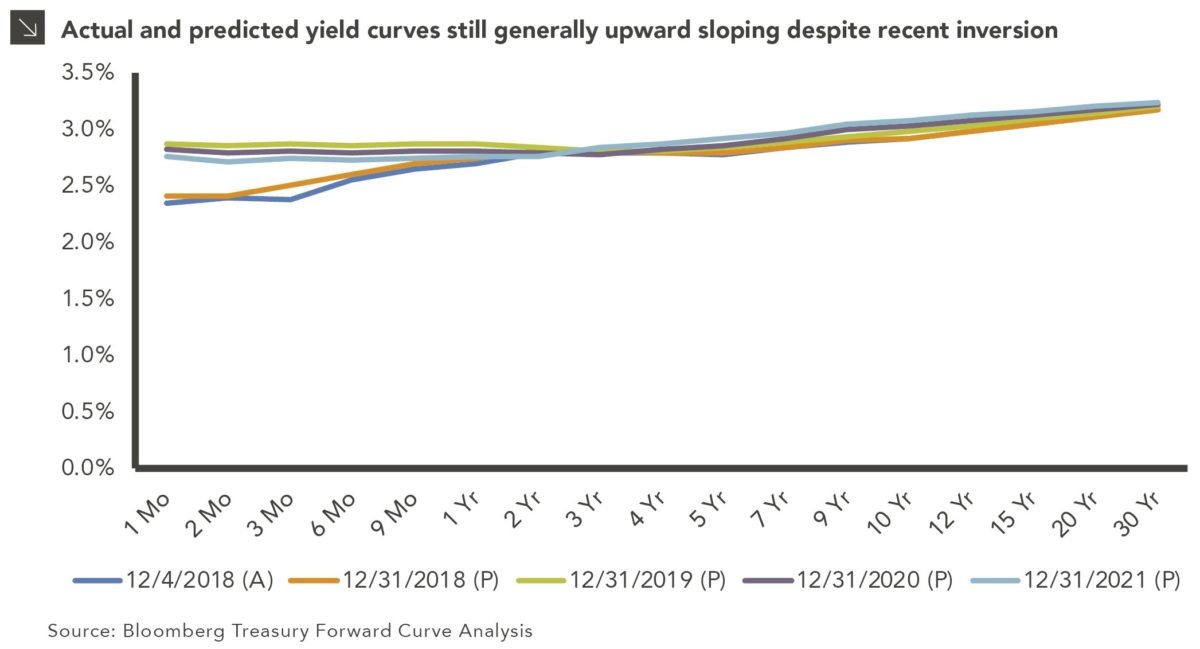
After eight post-recession Fed rate hikes since 2015, the U.S. Treasury yield curve continues to flatten. On Monday, December 3, the yield curve inverted by one basis point between the three-year yield at 2.84% and the five-year yield at 2.83%. The next day, that inversion intensified to two basis points, with the three-year yield at 2.81% and the five-year yield at 2.79%, causing an 800-point correction in the Dow. The bellwether steepness indicator — the difference between the two-year yield and 10-year yield — remains upward sloping, however, but narrowed from 15bp on Monday with the two-year at 2.83% and 10-year at 2.98% to 11bp on Tuesday with the two-year at 2.80% and 10-year at 2.91%.

Based on previous market cycles, an inverted yield curve has predicted a recession six months to two years after inversion. Prior to the 2008 crisis, the first sign of inversion occurred in the 4th quarter of 2005, when the three-year and five-year inverted first, followed by the two- and ten-year inverting in the same quarter, roughly two years before the crisis that began in early 2008. This week’s chart shows the actual yield curve at the end of the day on December 4, along with the predicted yield curve at the end of this year and the next three years based on Treasury forwards. We can see that the market expects the curve to be generally upward sloping for the rest of this year, but to further invert in the front of the curve to the belly, and remain inverted in that region, for the next three years. However, the market still shows the 10s minus 2s to be upward sloping, even in the outer years.

Over the last few quarters, the expectations for the Fed’s hikes declined from one this December plus four more in 2019 to one this December plus only one more in June 2019. With this first sign of inversion, the Fed may pause on a hike for December, but it has communicated the hike so much that it may have to move forward with it or risk a loss of credibility. As 2018 heads to a close, this recent inversion bears watching and will no doubt have an impact on this month’s as well as next year’s capital markets.

Print PDF

The opinions expressed herein are those of Marquette Associates, Inc. (“Marquette”), and are subject to change without notice. This material is not financial advice or an offer to purchase or sell any product. Marquette reserves the right to modify its current investment strategies and techniques based on changing market dynamics or client needs.

Are Bonds Approaching Moderate Value?

This week’s chart looks at how bonds have fared during the global volatility of the last two months. In summary, bonds have retrenched a bit but have protected principal overall as expected and served as good diversifiers to other asset classes such as equities and alternatives. Spreads have widened moderately and are now showing some value across the board.

The four sections of the chart show the spread versus the average for core bonds, bank loans, high yield bonds and emerging markets debt. The timeframes are from the end of 2008 to today, but the averages are based on the last 20 years excluding 2008 and 2009 as outliers. As we can see, each of the spreads are rising and approaching averages. They are no longer near post-2008 tights anymore. This signifies that there may perhaps be some moderate value in fixed income today.

The fundamentals and the global macro backdrop support a moderate outlook. U.S. and European high yield and leveraged loan default rates remain low. Leverage, coverage, issuance and outstanding amounts do not point to a frothy market. Aggressive issuance is experiencing a shift away from high yield and into bank loans but remains modest overall. As the effect of Trump’s tax cuts continues to be felt through strong corporate earnings and the global tariff escalation continues to evolve, the Federal Reserve has enough optimism about the economy to warrant its continued pace of rate hikes. Collectively, these trends suggest stable if not improving valuation, fundamental and macro factors as we approach the New Year.

Print PDF

The opinions expressed herein are those of Marquette Associates, Inc. (“Marquette”), and are subject to change without notice. This material is not financial advice or an offer to purchase or sell any product. Marquette reserves the right to modify its current investment strategies and techniques based on changing market dynamics or client needs.