What Does the COVID-19 Pandemic Mean for Private Equity Investments?

Given the significant amount of volatility in the public markets and uncertainty surrounding the economic outlook as a result of the COVID-19 pandemic, this newsletter provides an update and outlook for private market investors.

This newsletter covers the valuation process used by private equity and debt funds, the expected impact on first quarter valuations for private market funds, how portfolios are positioned to handle the economic slowdown, what GPs are doing in this environment to protect and position their portfolio companies for the slowdown, and Marquette Associates’ outlook for the remainder of the year.

Read > What Does the COVID-19 Pandemic Mean for Private Equity Investments?


The opinions expressed herein are those of Marquette Associates, Inc. (“Marquette”), and are subject to change without notice. This material is not financial advice or an offer to purchase or sell any product. Marquette reserves the right to modify its current investment strategies and techniques based on changing market dynamics or client needs.


Q1 2020 Market Insights Video

This video features an in-depth analysis of the first quarter’s performance with a special focus looking forward from the coronavirus pandemic and resulting economic and market impacts.

Our Market Insights series examines the primary asset classes we cover for clients including the U.S. economy, fixed income, U.S. and non-U.S. equities, hedge funds, real estate, infrastructure, private equity, and private credit, with presentations by our research analysts and directors. For more information, questions, or feedback, please send us an email.

Was March 23rd the Market Bottom?

The S&P 500 hit its recent peak on February 19th, 2020. Just sixteen trading days later it entered bear market territory and by March 23rd, the S&P 500 was down 33.2% from its all-time high. The intensity and speed of the sell-off surpassed both 1987 and 1929, two infamous years in investment history. Since March 23rd, the S&P 500 has rallied 27.4% through April 14th prompting the question: have we already seen the market bottom?

Identifying a market bottom is a near impossible task, one that is much easier with hindsight. Most bear markets see stocks rally 10% or more before falling back down and hitting a new bottom. The Global Financial Crisis produced five such bounces before finding its floor in March 2009. Near the turn of the century, the Tech Bubble produced three “false” rallies. Based on these data points, history would tell us that there are still further losses ahead. However, every bear market is unique and this one certainly fits that bill. Given the speed of the decline, might we see a faster recovery? The answer to that question is likely predicated on how well the spread of COVID-19 is controlled and whether we see a second wave of infections.

Print PDF > Was March 23rd the Market Bottom?


The opinions expressed herein are those of Marquette Associates, Inc. (“Marquette”), and are subject to change without notice. This material is not financial advice or an offer to purchase or sell any product. Marquette reserves the right to modify its current investment strategies and techniques based on changing market dynamics or client needs.

Did Volatility Risk Premium Strategies Deliver in March?

The longest bull market in history ended abruptly in March as U.S. stocks finished their worst quarter since the Global Financial Crisis (GFC). The magnitude and speed by which the S&P 500 index sold off from late February through March shocked investors; what happened over multiple years during the GFC happened in a matter of weeks. During that same time period, the CBOE Volatility Index (VIX) hit an all-time high, as markets tried to discern the extent of the economic fallout from the spread of COVID-19. Volatility Risk Premium (VRP) strategies — which are designed to provide equity upside but downside protection — were not immune to the financial market dislocations but performed in line with our expectations and are set to rebound more quickly when broader market indices stabilize.

This newsletter reviews VRP strategies and provides an overview of recent manager performance and expectations going forward.

Read > Did Volatility Risk Premium Strategies Deliver in March?


The opinions expressed herein are those of Marquette Associates, Inc. (“Marquette”), and are subject to change without notice. This material is not financial advice or an offer to purchase or sell any product. Marquette reserves the right to modify its current investment strategies and techniques based on changing market dynamics or client needs.

Light at the End of the Tunnel?

While the coronavirus pandemic is far from over, signs of improvement ranging from infections peaking to progress in the search for a cure seem to be arising on a daily basis lately. The following newsletter summarizes some of these key positive indicators and offers some guidance for portfolios in the months to come.

Read > Light at the End of the Tunnel?


The opinions expressed herein are those of Marquette Associates, Inc. (“Marquette”), and are subject to change without notice. This material is not financial advice or an offer to purchase or sell any product. Marquette reserves the right to modify its current investment strategies and techniques based on changing market dynamics or client needs.

Defined Contribution Guidance: Coronavirus Update

March certainly came in like a lion (though whether it came out like a lamb is debatable). The continued spread of the coronavirus pandemic led to sharp and steep sell-offs in both the bond and equity markets as investors fled to cash. An array of fiscal and monetary stimulus aimed at staving off a global recession followed suit.

With so many looming unknowns, what can plan sponsors do to best support defined contribution plan participants? This newsletter provides an overview of recent developments in response to the coronavirus and how plan sponsors can maintain fiduciary best practices and continue to help participants act prudently in the days that lie ahead.

Read > Defined Contribution Guidance: Coronavirus Update


The opinions expressed herein are those of Marquette Associates, Inc. (“Marquette”), and are subject to change without notice. This material is not financial advice or an offer to purchase or sell any product. Marquette reserves the right to modify its current investment strategies and techniques based on changing market dynamics or client needs.


Signs of a Market Bottom?

In just a matter of weeks, U.S. equities went from all-time highs to bear market correction territory. As of March 20th, the S&P 500 had a drawdown of -31.9% from its February 19th high. Following the steep sell-off, equities subsequently rallied the week of March 23rd, logging weekly gains that were among their best in history. With equities having officially fallen into correction territory then subsequently appearing to show signs of stabilization and fiscal/monetary stimulus poised to (theoretically) cushion the impact of COVID-19, investors are left to wonder if the worst is over.

However, identifying market bottoms is a difficult endeavor. Every bear market is unique and this one is no different. Based on the severity of economic contraction thus far, it is likely that we are headed for — or possibly already in — a recession. Notably, though, not all bear markets coincide with a recession and not all recessions coincide with a bear market. Given that a recession is looming if not already here, we examined the last 40 years of data when bear markets coincided with recessions to see if we can identify signs of a bottom. Over the past 40 years, there were four such periods: 1973–1975, 1981–1982, 2000–2001, and 2007–2009. In the following newsletter, we review four categories of data over these time periods: technical, valuation, economic, and COVID-19 to see if we can identify consistent indicators of a market bottom.

Read > Signs of a Market Bottom?


The opinions expressed herein are those of Marquette Associates, Inc. (“Marquette”), and are subject to change without notice. This material is not financial advice or an offer to purchase or sell any product. Marquette reserves the right to modify its current investment strategies and techniques based on changing market dynamics or client needs.


Another Unprecedented Surge in Initial Weekly Jobless Claims Due to COVID-19

As mentioned in last week’s chart, the number of Americans filing for unemployment over the past few weeks overwhelmed the system and created a backlog of claims that were unable to be processed right away. This week’s data updates that picture and shows another colossal jump in claims: over 6 million people filed for unemployment last week.

In this chart, we focus on 2020 data to show the scale of these numbers. Claims between the week of March 23rd and the week of March 16th more than doubled, and the jump from 2020’s weekly average before the pandemic set in to last week is more than 30 times higher.

The data from last week shows that the backlog of claims had an overwhelming effect. Businesses have been suffering and this has caused unemployment numbers over the past two weeks alone to total nearly 10 million Americans. As companies continue to lay off Americans as a result of stay-at-home orders and COVID-19 concerns, the initial unemployment claims have skyrocketed. Congress also passed a stimulus package that increased the incentive for people to see the process of filing for unemployment through, including unemployment benefit extensions and expansions in paid benefits. With the projected timeline for when businesses will be able to re-open being pushed further and further out, the hope is that COVID-19 cases will slow and companies will be able to take full advantage of increased consumer demand.

Print PDF > Another Unprecedented Surge in Initial Weekly Jobless Claims Due to COVID-19


The opinions expressed herein are those of Marquette Associates, Inc. (“Marquette”), and are subject to change without notice. This material is not financial advice or an offer to purchase or sell any product. Marquette reserves the right to modify its current investment strategies and techniques based on changing market dynamics or client needs.

April 2nd Update: A Quarter That Will Go Down in History

With March officially in the books, the following is a brief summary of what has transpired in the capital markets since our update early last week. As expected, the coronavirus has exploded across the U.S. and continued its spread across Europe as well. At the time of writing, the number of cases is approaching 1 million worldwide and has exceeded 200,000 here in the United States. Stocks finished their worst quarter ever on Tuesday and volatility continues to haunt the markets. While the worst may still not yet be behind us, we hope that the growing number of shelter in place edicts and more consistent social distancing may help to stem the coronavirus outbreak across the world. Please note that all return data in the following discussion utilizes the quarter end date of March 31st, 2020.

Read > April 2nd Update: A Quarter That Will Go Down in History


The opinions expressed herein are those of Marquette Associates, Inc. (“Marquette”), and are subject to change without notice. This material is not financial advice or an offer to purchase or sell any product. Marquette reserves the right to modify its current investment strategies and techniques based on changing market dynamics or client needs.

What Does the Coronavirus Pandemic Mean for Future Real Estate Returns?

This week’s chart examines forward-looking returns for private real estate based on historical spreads to the 10-Year Treasury Yield and the NCREIF-ODCE Index (proxy for core private real estate). Real estate valuations (spread-to-Treasuries) are currently above 300 bps as a result of COVID-19. Spreads of this magnitude have only been seen four times, each of which has been followed by strong 3- and 5-year returns. For example, during the Global Financial Crisis, real estate spreads-to-Treasuries surpassed 300 bps in the fourth quarter of 2009 which were followed by 12.2% and 12.4% returns for the NCREIF-ODCE Index in the subsequent 3 and 5-year periods, respectively.

Though the impacts from COVID-19 have not yet been fully felt in the private real estate market, it is clear that challenges lie ahead, particularly in the sectors that have been hit the hardest. For example, assets with short lease durations and heavier operating business components, such as hospitality (daily), and co-working office (monthly), as well as assets that rely on foot traffic, such as entertainment, food & beverage, and destination retail will be more affected by the pandemic. Further complicating matters, the lack of transaction volume, comparable sales, leases, and loan originations have made it nearly impossible for appraisers to adjust valuations at this point in time.

Beyond the aforementioned troubled sectors, the impacts from COVID-19 will ultimately vary by property type, geography, and risk profile. The following table highlights the potential near-term and long-term impacts of each property sector:
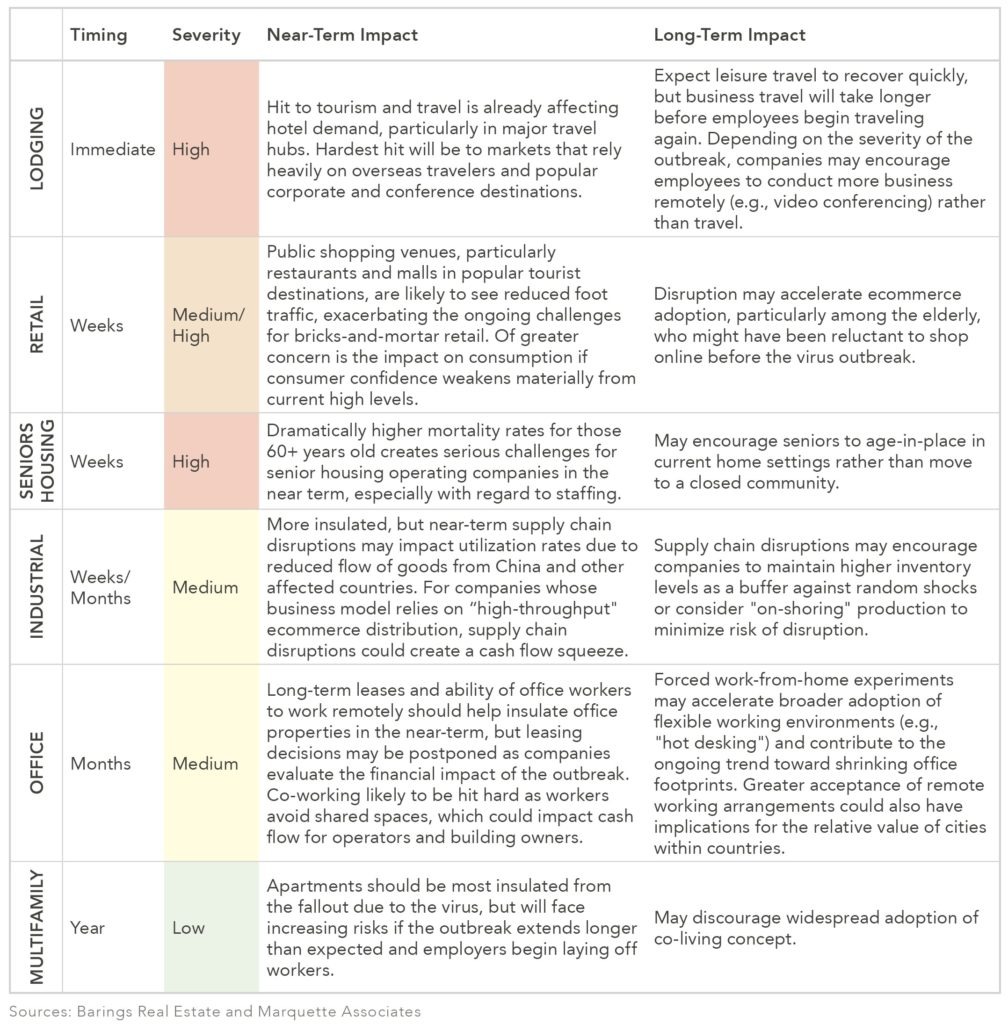
Impacts of Coronavirus Pandemic on Real Estate Property Sectors table

While global growth is being impacted in the near-term, we still expect a recovery to take hold once the disruption fades; we still maintain the view that the recovery is delayed, not derailed. However, the true impact of this on real estate returns will not be known for a while. Although longer-term forward-looking returns appear promising at this point, there is a relatively high degree of uncertainty because the ultimate impact on the aforementioned sectors (which should be the biggest headwind for real estate) will remain unknown until the coronavirus outbreak is contained and the economy begins to function at a normal level again.

Print PDF > What Does the Coronavirus Pandemic Mean for Future Real Estate Returns?


The opinions expressed herein are those of Marquette Associates, Inc. (“Marquette”), and are subject to change without notice. This material is not financial advice or an offer to purchase or sell any product. Marquette reserves the right to modify its current investment strategies and techniques based on changing market dynamics or client needs.