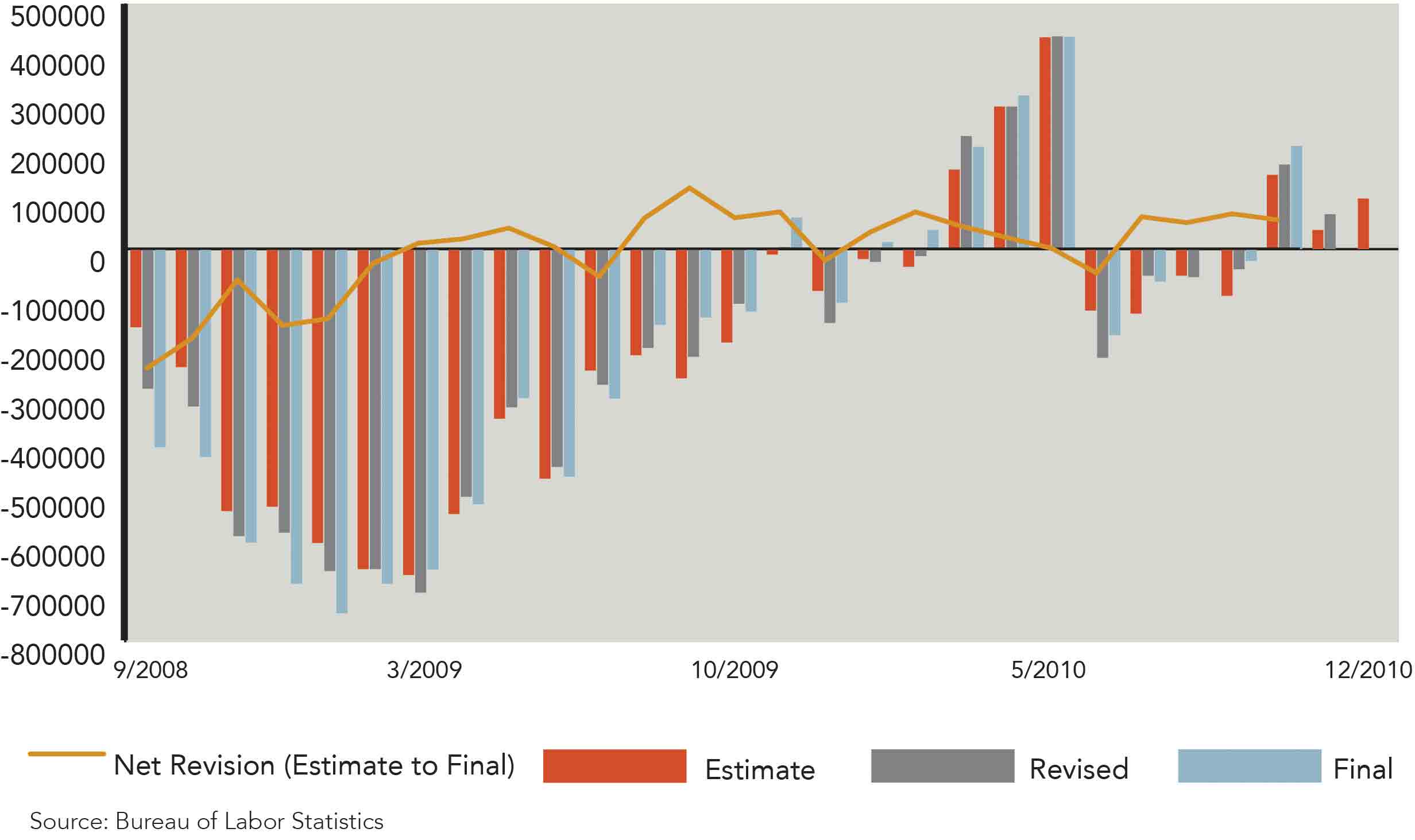
Nonfarm Payroll Employment Revisions

“Jobs” and “unemployment” have garnered a lot of attention during this economic recovery, mostly because the headline numbers have been disappointing.

“Jobs” and “unemployment” have garnered a lot of attention during this economic recovery, mostly because the headline numbers have been disappointing. However, it is important to realize that while the headline number, which is reported the first Friday of every month, gets most of the media attention, it is subsequently revised twice and it is the final number that gives the more accurate picture of job creation in the US economy. This is important for two reasons. First, as this chart shows through 2010 net revisions have been consistently positive (with June the only month showing a negative revision). Over the course of year net revisions have shown that 409,000 more net jobs were created than the headline numbers would lead one to believe. Second, the direction of revisions is indicative of the overall health of the job market and economy. As this chart shows, net revisions were strongly negative during the depth of the financial crisis in the fourth quarter of 2008 but as the economy began to improve net revisions turned positive. Given these trends it is likely that both the November and December job numbers will be revised higher in the coming months and revisions are like to remain positive in 2011.

Investing in an Inflationary Environment

Given the amount of fiscal and monetary stimulus enacted to revive the United States economy, many investors are concerned about inflation emerging as a credible threat to their portfolios, as inflation can reduce the real rate of return. While high inflation is not foreseeable in the near future, it is prudent to understand how to preserve a portfolio’s real rate of return during times of rising prices. Several asset classes can protect against higher than expected inflation, with varying degrees of statistical proof. The following paper examines the potential asset classes suitable for periods of high inflation, both on a qualitative and quantitative basis.

Download PDF

1Q 2009 Investment Perspectives

Understanding Sovereign Wealth Funds
Sovereign Wealth Funds (SWF) were first introduced as an investment vehicle more than seventy years ago, but their popularity has greatly increased over the past two decades. Although SWF have received criticism regarding their political involvement and influence over sector growth, economists believe more countries will start to introduce and further expand their involvement in SWF. Since SWF are becoming larger players in global financial markets, it is important to understand the motivation, structure and main players in the SWF arena.

Stimulus Bill Signed into Law, Mortgage Relief Plan Unveiled
Two major programs designed to halt the negative momentum of the financial crisis were recently announced: the stimulus bill and the Homeowner Affordability and Stability Plan. If successful, both of these initiatives could help reverse the direction of the current economy and restore positive growth. In the following, we summarize the highlights of each announcement.

Download PDF

2009 Market Preview

Our fourth quarter Investment Perspectives Newsletter provides an overview of 2008’s turbulent events in each asset class. We also highlight potential investment opportunities going into 2009.

No opening sentence can convey how difficult a year 2008 was for the financial markets. Most domestic equity indexes suffered losses over 35%, international stocks were crushed, fixed income prices dropped off a cliff as yields spiked, real estate values continued to fall and hedge funds blew up while getting hit with redemptions; it was the classic “correlation goes to one” as all asset classes delivered painfully negative returns. In total, close to $29 trillion was lost as a result of the global equity market declines. The only safe haven from the market carnage was in U.S. Treasuries, and investors flocked in droves, even accepting a negative yield on T-Bills for the comfort of (mostly) preserving the principal value of their assets. This “flight to quality” was representative of the fear running through investors as they took their money and made a mad dash for the exits. Their exit along with forced selling (“deleveraging”) and limited liquidity from hedge funds, investment banks and other speculators collectively fueled the second worst calendar year return on record. The only worse year was 1931 when the S&P 500 fell 43.4% in the midst of the Great Depression. Although the economy has not dipped to Depression-era lows, 2008 was a painful year.

Download PDF

Understanding TALF

In an effort to revive the credit markets, the Term Asset-Backed Securities Loan Facility (“TALF”) was established by the government as a means to promote private investment in the asset-backed securities market. Asset managers have been quick to move on this program, using TALF loan facilities to create TALF funds for interested clients. In the following paper, we investigate the TALF program and how it could provide liquidity to the credit market as well as attractive return opportunities for investors.

Download PDF