No Longer the Apple of Investor’s Eye

Apple (AAPL) shares dropped 12% last week after a disappointing earnings report and are down 37% from their September 2012 peak.

Apple (AAPL) shares dropped 12% last week after a disappointing earnings report and are down 37% from their September 2012 peak. As our Chart of the Week shows, after the recent fall in shares of Apple, Exxon Mobil (XOM) is once again the largest company in the S&P 500 index. Apple’s market capitalization first surpassed Exxon’s on August 10, 2011 and at one point Apple’s market capitalization was 57% larger than Exxon’s. Investors that own Apple through a passively managed index are likely to find that their exposure has shrunk considerably over the last few months.

Is Forward P/E Ratio a Good Predictor for Market Returns?

Today’s Chart of the Week looks at the historic level of the S&P 500 Index relative to the forward estimated price-to-earnings (“P/E”) ratio of the S&P 500 from January 1, 2006 to January 15, 2013. The purpose of this chart is to see whether or not the forward looking P/E ratio can predict performance of the index.

Today’s Chart of the Week looks at the historic level of the S&P 500 Index relative to the forward estimated price-to-earnings (“P/E”) ratio of the S&P 500 from January 1, 2006 to January 15, 2013. The purpose of this chart is to see whether or not the forward looking P/E ratio can predict performance of the index. The P/E ratio compares the value of the share price to estimated earnings per share over the subsequent year. A higher P/E suggests that the market may be approaching a downturn, while a lower P/E may represent a buying opportunity and potential for market gains. Over the last seven years, the forward P/E ratio has averaged 12.5 (depicted in green).

The correlation between forward P/E ratio and the following one year return has been negative, which is to be expected: as suggested above, lower P/E ratios are typically followed by a rising market, while higher P/E ratios have predicted negative returns. Looking at the chart, we see that this basic intuition is supported: low P/E ratios are followed by rising markets. However, the correlation has not been especially strong, with a value of -.39 for the seven years studied in this analysis. More importantly, the correlation has not been stable over this time period, thus making the reliance on forward P/E ratios to predict market performance relatively useless. Certainly, outliers of this ratio – such as its extreme low value on March 9, 2009 (the date that the market bottomed following the financial crisis) – have been useful indicators of extreme market conditions, but they have not proven to be a consistent market predictor.

Therefore, inference of 2013 stock market performance based upon the most recent figure of 11.9 (below the long term average of 12.5) is not meaningful. As much as we would like to extract a precise prediction for the following year’s stock market performance, the relationship between the two variables is not strong enough to predict future performance.

Buyer Beware?

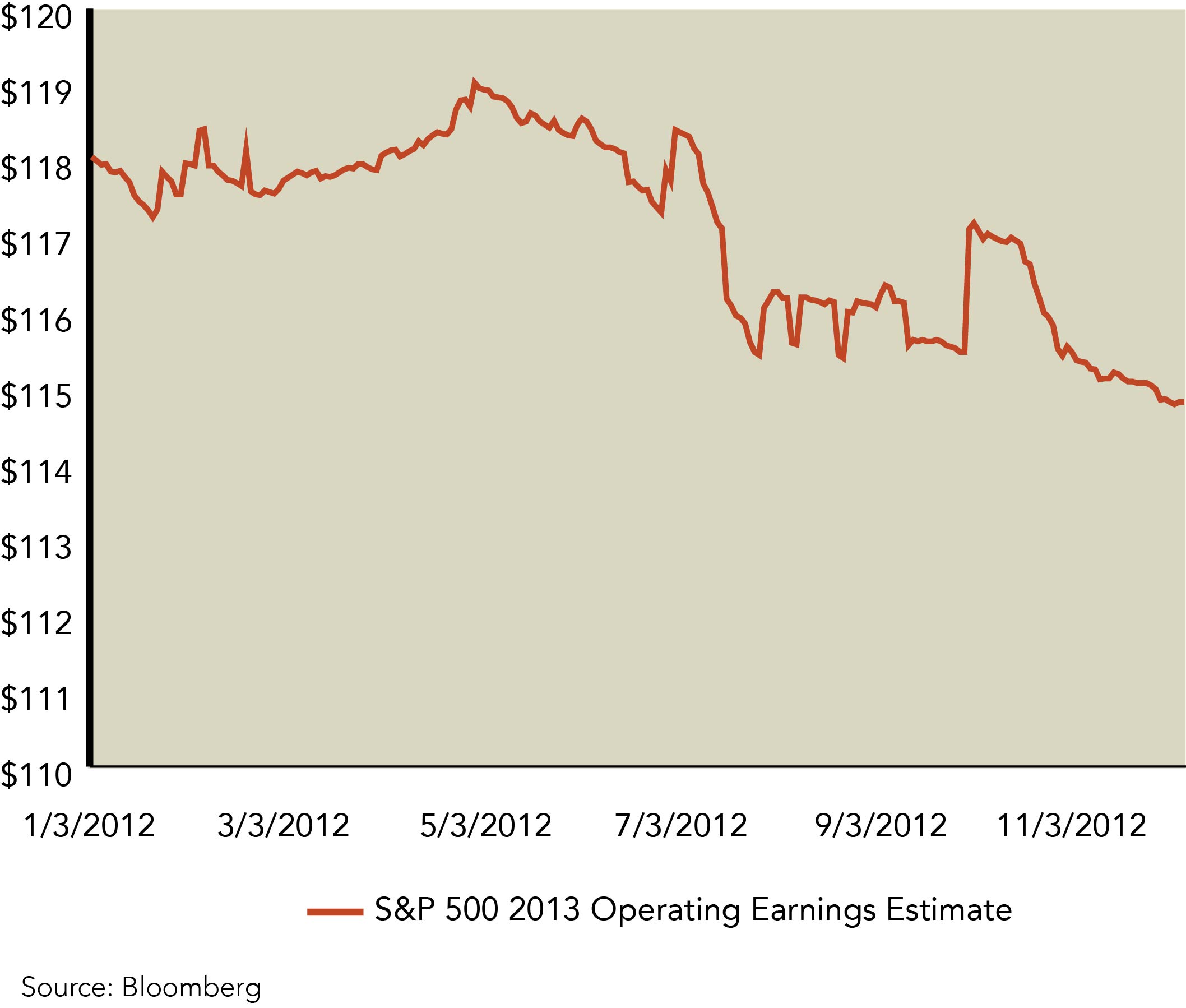
Our Chart of the Week looks at analyst expectations for 2013 S&P 500 operating earnings. This is a “bottoms-up” estimate which means it is based on earnings expectations for each of the 500 underlying companies in the S&P 500 index.

Our Chart of the Week looks at analyst expectations for 2013 S&P 500 operating earnings. This is a “bottoms-up” estimate which means it is based on earnings expectations for each of the 500 underlying companies in the S&P 500 index.

The S&P 500 index closed last night at 1427.84 and the consensus estimate for 2012 S&P 500 operating earnings is $103.92. This means the current market P/E (price/earnings) multiple is 13.7. Assuming that the current estimate of $114.81 for 2013 is accurate, and assuming no change in the market multiple, this implies a 2013 year-end value for the S&P of 1576 and a total return for equity investors of 12.8% (10.5% price appreciation plus a 2.3% dividend yield).

While this sounds attractive, the prediction above relies heavily on analysts’ 2013 earnings estimates for S&P 500 companies. But as the chart shows, analysts have consistently lowered their expectations for 2013 earnings over the course of the year. After peaking at $119.02 on May 1st earnings expectations have dropped 3.5% and have been falling steadily. Should this trend continue, it not only implies a lower year end value for the S&P 500, but earnings growth expectations are also falling. For investors, these patterns may result in lower than expected equity market returns in 2013.

Passively Managed Funds Gaining in Popularity

Our Chart of the Week examines the migration of dollars from active to passive U.S. equity mutual funds over the last five years. During this time period, approximately $144 billion of investor money has flowed into passive funds (blue line) on a net basis, thus reflecting a growing frustration with the performance (and perhaps as importantly, fee level) of actively managed funds.

Our Chart of the Week examines the migration of dollars from active to passive U.S. equity mutual funds over the last five years. During this time period, approximately $144 billion of investor money has flowed into passive funds (blue line) on a net basis, thus reflecting a growing frustration with the performance (and perhaps as importantly, fee level) of actively managed funds. Even more telling is the movement out of actively managed funds, as shown by the red line on the chart. From 1st quarter of 2007 through the 3rd quarter of 2012, over $460 billion has been moved out of actively managed funds and into other investment vehicles.

Why the dramatic movement, most especially out of actively managed funds? A few explanations come to mind. First, it is no secret that the equity markets have largely traded on macroeconomic factors the last four years, so it has been hard for fundamentally-based managers to consistently add value when the market has not traded on those very optics used to evaluate equities. In addition, the bond bull market has attracted capital as investors have moved to ride rates down, as well as preserve the principal value of their investments. Last, as investors become more cost conscious, the low fees of passively managed funds have helped to attract additional capital.

The cloudy economic outlook suggests that this trend may continue. Whether it is a short term uncertainty such as the fiscal cliff or a longer-term matter about the future of a regional currency (Europe), it is conceivable that the market will remain a risk on / risk off trade over the next few years. Therefore, we may see continued flows into passively managed funds in the equity markets.

Are U.S. Stocks Fairly Valued?

There are a variety of methods to measure market valuation but one of the simplest is to compare market capitalization to GDP. Investors can think of this as a price-to-sales multiple for the macro economy.

There are a variety of methods to measure market valuation but one of the simplest is to compare market capitalization to GDP. Investors can think of this as a price-to-sales multiple for the macro economy. For U.S. stocks over the last 50 years this ratio has averaged 0.76x (U.S. Market Cap/U.S. GDP). The gold line on the chart shows this ratio over the last 50 years and the dotted gold line shows the average. This simple valuation metric clearly shows the market was overvalued in 2000, and given that the market is currently valued at 1.07x U.S. GDP, stocks also look pricey today.

However, this valuation tool ignores the increasing importance of global sales and profits to U.S. firms. As many investors are aware, almost 40% of S&P 500 company profits come from overseas. The blue line shows the U.S. share of global GDP. Over the last 50 years, and particularly over the last decade, the U.S. share of global GDP has fallen to record lows, currently at just 21.5%. As the U.S. accounts for less of global GDP, U.S. GDP becomes a less relevant metric to value firms with a global reach.

As a result, global GDP may be the more relevant metric to follow. The dark gray line looks at the ratio of U.S. Market Cap to global GDP. The dotted dark gray line shows the long term average. Based on this metric, stocks were clearly cheap in the late 1970’s and early 1980’s, and expensive during the dot-com years around the turn of the century. Currently, based on global GDP, stocks do not look nearly as expensive today. In fact, stocks look fairly valued compared to their long term average.

While these metrics can act as a useful guide to broad over and under valuation in markets, they tell investors very little about where markets are headed in the short-term. However, as U.S. company sales and profits become more global, investors will increasingly want to focus on global benchmarks when looking at valuation.

Market Returns and the Election Cycle

With election campaigning in full swing, we have received a number of questions from our clients regarding what will happen to the market if a particular candidate or party wins, or whether certain years of the presidential cycle are better for investors. This week’s chart of the week examines past studies on election years and market returns, as well as other market patterns.

With election campaigning in full swing, we have received a number of questions from our clients regarding what will happen to the market if a particular candidate or party wins, or whether certain years of the presidential cycle are better for investors. This week’s chart of the week examines past studies on election years and market returns, as well as other market patterns.

Thus far in 2012, there have been numerous articles focused on finding the relationship between the market cycle and the election cycle. Notable findings of these articles are highlighted below:

  • The stock market tends to be positive in an election year. The median return over the 21 election years since 1926 has been 11.1%.
  • The stock market has performed better in years where a Democrat has been president (median return of 18.4% vs. 7.7%).
  • The first year of a presidential term is typically a poor year for investors (median return of 4.9%), while the third year of a term is typically a good year for investors (median return of 22.7%).

Heading into the 2008 election year, various articles highlighted similar election year market performance, which at that time had a median return of nearly 14%. Of course, 2008 turned out to be one of the worst years for the stock market. This performance was not due to the election year, but rather a massive collapse in the housing market, the credit crisis, and one of the deepest recessions the United States has experienced.

While certain patterns may exist in the return data, the data set is extremely limited; it most likely is a case of identifying random patterns in limited data set. For instance, an investor who only invested in the stock market during odd years would do significantly better than investing in all years, or an investor who only invested in even years. Similar extrapolations can be made based on years ending with a certain digit (3, 5, etc).

In order to be statistically significant, one would need over 2,000 election year data points in order to achieve a 0.05 significance level. Similar levels of observations would be needed for the other data points highlighted in the table. While there may or may not be particular reasons behind these realized returns phenomenon, from a statistical standpoint it would be unwise to base any investment decisions off of them.

An Apple a Day…

On March 19th, Apple made news once again by declaring the payout of a dividend for the first time since December 1995 and buy-back program of company stock. Apple announced a $2.65 per share dividend that will begin in July 2012. This represents a 0.45% quarterly yield and a 1.81% annual yield (dividend / share price).

One cannot walk down the street, shop at a mall, or sit next to someone on an airplane without those ubiquitous white ear buds visibly present. With the introduction of Apple’s iPod on October 23, 2001, and the subsequent releases of the iPhone (June 2007) and the iPad (January 2010), Apple’s technologies have been accepted as the premiere gadgets to own. This success has catapulted Apple to be one of the best performing companies in the United States and the world.

On March 19th, Apple made news once again by declaring the payout of a dividend, the first time since December 1995, and a buy-back program of company stock. Apple currently has $100 billion of cash on its balance sheet. Investors and pundits alike have wondered, what will Apple do with all that cash? Keep investing in the business? Increase the retail presence? Buy a strategic partner? Buy a competitor? Buy back stock? Those questions have been put to rest, at least for now.

Apple announced a $2.65 per share dividend that will begin in July 2012. This represents a 0.45% quarterly yield and a 1.81% annual yield (dividend / share price). The $10 billion released for the stock buy-back program will begin in the fourth quarter of 2012. All in, this plan will cost the company approximately $40 billion over the next three years ($29.7 billion for the dividends and $10 billion for the buy back).

The price of Apple stock has steadily increased over time (as depicted in the chart above), resulting in an increased market capitalization of the company. With approximately 932.4 million shares outstanding, the company has a market capitalization value of over $560.5 billion. Apple is easily the largest constituent in the S&P 500. Exxon Mobil is the next closest company at $408.6 billion.

Beware of Changing Correlations!

This week’s chart shows the dynamic nature of correlations between asset classes by comparing correlations amongst traditional asset classes over 20-year and 5-year historical periods. The chart above shows how much these correlations have all increased when comparing the 5-year figures to the longer dated 20-year period.

This week’s chart shows the dynamic nature of correlations between asset classes by comparing correlations amongst traditional asset classes over 20-year1 and 5-year2 historical periods.3 The chart above shows how much these correlations have all increased when comparing the 5-year figures to the longer dated 20-year period. What does this mean for investors? We see two main takeaways:

  1. For those that rely on mean-variance optimization programs for determining their asset allocation, it is imperative to understand the exact timeframe reflected in the correlations used as inputs, as different time periods will yield not only different correlations but critically, different portfolio structures.
  2. The correlation amongst traditional asset classes has increased in the last five years, thus it is more difficult to truly create a “diversified” portfolio that offers protection from large draw downs in the equity markets. This was never more apparent than during the financial crisis of 2008-2009.

As now outlined in both this chart and “Correlation Doesn’t Tell the Whole Story”, correlations can be helpful in conducting asset allocation studies, but they also feature some notable shortcomings that should be well understood by those who rely on them for portfolio decisions.

1 March 1992 – February 2012
2 March 2007 – February 2012
3 Indices used for analysis were Russell 1000, Russell 2000, MSCI EAFE, MSCI Emerging Markets, and BarCap Aggregate

Correlation Doesn’t Tell the Whole Story

Over the past five years, as globalization has become more pronounced and economies more intertwined, correlations have certainly increased to all time high levels. But since correlation does not capture magnitude of returns, investors should continue to utilize an asset allocation model that takes potential risk and return into account.

This week’s Chart of the Week covers increased correlations among asset classes. Correlation is a statistical measure showing how two variables move in relation to each other. It can range anywhere from -1 to1, and refers only to the direction of changes. Perfect negative correlation (-1), implies that two items move in completely opposite directions and perfect positive correlation (+1), implies that two items move in lock-step. The chart above shows the five-year correlations between the S&P 500 and a broad set of sample asset classes. As evident, all risk-assets have had a very high positive correlation to the S&P 500 over the past five years. Referring to the chart, aside from the three Treasury indices, no other asset class has a correlation less than .90, which is extremely high.

However, correlation only tells part of the story: just because two asset classes have high correlation does not mean that their returns will end up being the same. In fact, this will most likely never be the case. For example, over the time-frame captured above, despite very high correlations, emerging markets, the S&P 500, and the REIT index have annualized returns of 2.8%, -.56% and -3.48% respectively. Over the past five years, as globalization has become more pronounced and economies more intertwined, correlations have certainly increased to all time high levels. But since correlation does not capture magnitude of returns, investors should continue to utilize an asset allocation model that takes potential risk and return into account.

Good News From the ISM Index?

On Tuesday, the ISM factory index for December was released, with last month’s level reaching 53.9, the highest since April. Perhaps more importantly, this was above expectations of 53.5, thus providing an unexpected surprise to the upside to kick off 2012.

On Tuesday, the ISM factory index for December was released, with last month’s level reaching 53.9, the highest since April. Perhaps more importantly, this was above expectations of 53.5, thus providing an unexpected surprise to the upside to kick off 2012. Stocks and commodities rose in reaction to the better than expected data, and while the economy is far from back to full health, this was welcome news to kick off the 2012 year in the financial markets.