Distressed Investing: Missed Opportunity?

As the calendar flipped to 2020, many market prognosticators agreed that one of the longest economic expansions on record would continue throughout the year. Unemployment rates were near record lows across most major economies and many were expecting a record year for corporate earnings. The signing of the Phase One U.S-China trade deal helped drive markets to all-time highs in the early part of February. Nobody saw the rapid escalation of a global pandemic that pushed the global economy into recession and global markets into a tailspin.

This newsletter covers the shift in distressed investing this year amid the uncertainty surrounding the length and economic impacts of the pandemic, including a look back at the previous expansion that led to exponential growth of leveraged credit markets. Historically, distressed hedge funds have performed well after a crash, and as companies across many sectors face immense pressure, this current cycle is likely to create a robust opportunity set.

Read > Distressed Investing: Missed Opportunity?


The opinions expressed herein are those of Marquette Associates, Inc. (“Marquette”), and are subject to change without notice. This material is not financial advice or an offer to purchase or sell any product. Marquette reserves the right to modify its current investment strategies and techniques based on changing market dynamics or client needs.

Can Real Assets Help Protect Portfolios from Inflation?

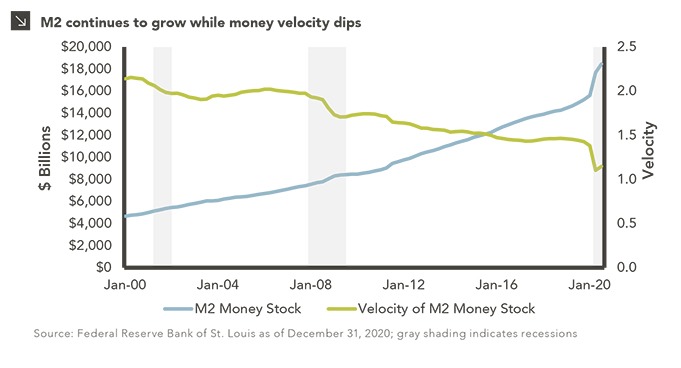
Against the current backdrop of unprecedented monetary stimulus, investors have become increasingly wary of future inflation and its potential degenerative effect on portfolio returns. While deflationary pressures appear more likely in the near term, the COVID-driven stimulus packages have created the potential for inflation once the pandemic has subsided. Predictably, investors are contemplating which asset classes can help hedge inflationary risk and real assets are a natural asset class to offset this risk.

During periods of upward price pressure, both real estate and infrastructure funds have at least some degree of pricing power, meaning they can boost rental income and revenue streams from their underlying holdings. In some cases, the embedded lease and contractual agreements of these holdings are linked to an inflation index, particularly for infrastructure. Therefore, the incomes of such holdings will rise as inflation rises and thus unlike fixed rate bonds, the real rate of return will not be eroded.

In order to examine this hypothesis, we compared traditional asset classes — stocks and bonds — to the real assets mentioned above: real estate and infrastructure. We compared cumulative returns during periods of above average inflation and during positive inflation surprises.¹ Although data is limited for real assets (particularly infrastructure), we analyzed cumulative returns for these four asset classes back to the earliest common date of index inception. Since the 2006 inception of the FTSE core infrastructure index, both real estate and infrastructure assets significantly outperformed U.S. equities and bonds during all periods when U.S. CPI rose above the period’s historical YOY average (1.9%). And during all quarters over the same period when developed world inflation experienced a material positive shock (“positive inflation surprises” defined previously), real assets also significantly outperformed both bonds and equities. Thus, while we have only experienced marginal inflationary pressure over the past 15 years, the data indicates that the inflation hedging mechanisms of real estate and infrastructure assets have been effective in protecting the purchasing power of portfolios. While it is difficult to forecast the ultimate timing, duration, and magnitude of inflation from this point forward, it is clear that real assets should offer a degree of insulation from the adverse effects of inflation.

Print PDF > Can Real Assets Help Protect Portfolios from Inflation?

¹ Surprises to developed world inflation are defined as periods where the expectations to the GDP weighted CPIs of the U.S., UK, and EU were below the actual CPI level by more than 10 bps.


The opinions expressed herein are those of Marquette Associates, Inc. (“Marquette”), and are subject to change without notice. This material is not financial advice or an offer to purchase or sell any product. Marquette reserves the right to modify its current investment strategies and techniques based on changing market dynamics or client needs.

EM: Less About “ME” and More About “IT”

In 2010, the emerging markets equity benchmark was all about “ME” as materials and energy constituted 28% of MSCI’s Emerging Markets Equity Index. Today, however, they account for half of that, and IT and Consumer Discretionary have nearly doubled, growing from 19% in 2010 to 34% in 2020.

In September of 2018, MSCI adjusted its sector classification standards, partially in response to the increasing integration of the internet into all aspects of our communication and business transactions. This change specifically reclassified e-commerce to include companies providing online marketplaces for consumer products and services in the Consumer Discretionary sector rather than their previous IT classification. Alibaba — the largest stock in the index and one of the largest internet-based companies in the world — serves as one example of a company reclassified under the 2018 standards.

Emerging Markets have become less reliant on commodity prices over the past decade and we see this as a positive. Investors can benefit from the larger investment opportunity set which includes companies that are capitalizing on technology trends that played out in the U.S. throughout the 2010s and continue today, including e-commerce, online payment processing, and social platform businesses.

For more coverage on the Emerging Markets Index, reference our recent newsletter, The Changing Landscape in EM Equity.

Print PDF > EM: Less About “ME” and More About “IT”


The opinions expressed herein are those of Marquette Associates, Inc. (“Marquette”), and are subject to change without notice. This material is not financial advice or an offer to purchase or sell any product. Marquette reserves the right to modify its current investment strategies and techniques based on changing market dynamics or client needs.
The Changing Landscape in EM Equity

Over the last ten years, the landscape for emerging market equities (EM) has changed. In the first decade of the century, BRIC investing was popular with an emphasis on materials and energy. Since then, the benchmark exposure to Brazil and Russia has halved, sector exposures have changed, and many new companies have entered the index. The number of stocks in the benchmark has nearly doubled, moving from 754 in 2010 to 1,385 in 2020.

This newsletter will review some of the most significant changes to the EM investing arena and what that means for client portfolios.

Read > The Changing Landscape in EM Equity


The opinions expressed herein are those of Marquette Associates, Inc. (“Marquette”), and are subject to change without notice. This material is not financial advice or an offer to purchase or sell any product. Marquette reserves the right to modify its current investment strategies and techniques based on changing market dynamics or client needs.

The VRP Opportunity From Here

Volatility Risk Premium (“VRP”) strategies have struggled this year. The market’s extreme moves led to losses for put writing strategies on the way down and losses for call writing strategies on the way back up. Obviously not to be ignored, but the last six month period has truly been an outlier event. Now with the dust seemingly settled, we assess the opportunity from here. With rates near lows and equity valuations near highs, VRP strategies screen favorably, offering a more independent return stream.

In this paper, we look at correlations between returns and multiples, showing the relative advantage of VRP strategies, as well as the outsized opportunity created by today’s elevated levels of uncertainty.

Read > The VRP Opportunity From Here


The opinions expressed herein are those of Marquette Associates, Inc. (“Marquette”), and are subject to change without notice. This material is not financial advice or an offer to purchase or sell any product. Marquette reserves the right to modify its current investment strategies and techniques based on changing market dynamics or client needs.

IPO Market Is Heating Up Again

The IPO market in 2019 generated a record amount of exit value for venture capital investors as large and anxiously awaited IPOs from Uber, Lyft, Slack, Peloton, Smile Direct, Chewy, Pinterest, and Beyond Meat drove the market and dominated the headlines. Entering 2020 — a presidential election year — the markets braced for another round of anticipated IPOs expected to come before the election. However, following the COVID outbreak in Q1 and the resulting global pandemic during Q2, the IPO market ground to a halt. This disruption resulted in a significant backlog of companies waiting to come to the public markets.

In this newsletter, we look at the recent reversal of this IPO backlog with companies coming public at a feverish pace during the third quarter and take a look at further expectations for the remainder of the year.

Read > IPO Market Is Heating Up Again


The opinions expressed herein are those of Marquette Associates, Inc. (“Marquette”), and are subject to change without notice. This material is not financial advice or an offer to purchase or sell any product. Marquette reserves the right to modify its current investment strategies and techniques based on changing market dynamics or client needs.

The Year of SPACs

If there is one corner of the financial market that has benefited from the pandemic, it is special purpose acquisition companies (SPACs). This atypical pathway to the public markets was once a niche strategy for small investment firms. Now, the strategy has become one of the hottest financial topics of 2020 after a massive uptick in the volume of these vehicles.

A record 82 special purpose acquisition corporations went public this year to raise a record $39 billion, far exceeding the $9.5 billion in gross proceeds for SPACs in 2019 or the $8.5 billion in 2018.

SPACs are vehicles that raise money in an IPO, and then place the funds in a trust while the sponsor searches for a business or multiple businesses to acquire. The companies then complete a merger and the target becomes a listed stock.

A private company going public via SPAC has a few advantages over a traditional IPO. Private companies can go public on a faster timeline and there is more certainty around a company’s valuation. Furthermore, the listing of a SPAC requires a much lower level of diligence than a similarly sized IPO since there are no financial statements to analyze. For a sponsor, raising a SPAC is similar to raising a closed-end fund, allowing for a shorter and more comfortable timeline during the fundraise. In addition, the reputation of SPACs has improved over the past decades as governance practices have been refined and made more shareholder-friendly.

The volatility and price declines earlier in 2020 made IPOs and direct listings impractical options for many private companies, which is where SPACs have stepped in. There has been a lot of talk particularly in the venture community not being satisfied with the IPO process. That has led to conversations about going the direct listing route, and now the SPAC route. There have been several companies that have gone the IPO route and set a price underwriters deemed reasonable, only to see the stock surge on the first day of trading, which ultimately results in money being left on the table. And with IPOs being inherently riskier, there was less incentive to take on more risk by going public during an election year and pandemic.

It is clear SPACs are here to stay, but it is uncertain whether they will continue at the same rapid pace as this year. While the population of companies that might combine with a SPAC is growing, it still represents a small subset of private companies, limiting the potential disruption of the traditional IPO process. While the momentum driving innovation around public listings is encouraging, SPACs will not provide a solution for every private business. That said, there is a two-year time period for a SPAC to acquire a business, guaranteeing they will remain around for at least the foreseeable future.

Print PDF > The Year of SPACs


The opinions expressed herein are those of Marquette Associates, Inc. (“Marquette”), and are subject to change without notice. This material is not financial advice or an offer to purchase or sell any product. Marquette reserves the right to modify its current investment strategies and techniques based on changing market dynamics or client needs.

How Will the 2020 Election Affect the Markets?

The 2020 presidential election is fast approaching on November 3rd and key election issues pertaining to the economy will be viewed with respect to a backdrop of crisis and uncertainty more than ever. Curbing the spread of COVID-19 is at odds with reopening the economy while racial injustice remains a focal point. A potential Biden presidency and Democrat-controlled Senate could result in tax increases aimed at stimulating the economy through public projects and providing a social safety net. In contrast, a second term with Trump would likely mean more of the status quo in terms of keeping the 2017 tax cuts, further trade negotiations with China, and his attempt to nullify Obama’s Affordable Care Act.

In this newsletter, we assess the platforms of both Biden and Trump with a focus on Biden’s proposed tax policies and a perspective on how they are expected to affect the economy and markets. We next examine the historical effect of politics on the markets such as equity performance based on which party controls the White House, Senate, and House of Representatives. Lastly, we take a look at 2020 election expectations based on recent polls and markets.

Read > How Will the 2020 Election Affect the Markets?


The opinions expressed herein are those of Marquette Associates, Inc. (“Marquette”), and are subject to change without notice. This material is not financial advice or an offer to purchase or sell any product. Marquette reserves the right to modify its current investment strategies and techniques based on changing market dynamics or client needs.

Resilience in U.S. States, Cities, Health Systems, and Universities: Municipal Asset Class Review & Outlook

To date during this COVID-19 pandemic, both U.S. municipal bond issuers as well as municipal bond strategies have proven to be resilient despite the mounting adversity brought on by the nationwide lockdowns and other social distancing guidelines. The broader market recovery has been relatively quick as the S&P 500 is now back to pre-COVID highs, corporate credit spreads are back to pre-COVID tights, and overall volatility has mostly stabilized. The rebound in the economy is proving to be slow, however — with recent signs of leveling off — and is not expected to fully rebound until a vaccine is approved and distributed.

In the following, we provide a quick review of how municipal bonds have weathered the crisis so far in 2020; an assessment of key valuation, fundamental, and technical indicators to formulate a thesis for investing in municipal bonds going forward; and perspectives on how specific segments of the asset class such as investment grade municipals vs. high yield municipals and select sectors of the municipal bond market such as healthcare and education are expected to fare during the balance of the recession and recovery.

Read > Resilience in U.S. States, Cities, Health Systems, and Universities: Municipal Asset Class Review & Outlook


The opinions expressed herein are those of Marquette Associates, Inc. (“Marquette”), and are subject to change without notice. This material is not financial advice or an offer to purchase or sell any product. Marquette reserves the right to modify its current investment strategies and techniques based on changing market dynamics or client needs.

A Key Rebalancing Consideration: Drawdowns

In times of market turbulence, investments may sustain peak-to-trough declines known as drawdowns. The COVID-induced drawdown in March was no exception. Our chart this week illustrates the drawdown history for core bonds, bank loans, high yield bonds, and hard currency sovereign emerging markets debt (“EMD”) compared with the S&P 500. While past performance is not indicative of future returns, historical drawdown risk associated with past market volatility is a helpful metric to consider in the recovery from the current global health pandemic. As evident in the chart, each of the fixed income plus sectors¹ is correlated with the S&P 500, but the magnitude of plus sector drawdown risk is much less than the magnitude of equity drawdown risk — with one notable exception. In the 1990s EMD exhibited larger drawdowns than equity. At that time, EMD was very thinly traded, less mature, and more susceptible to dramatic swings.

While rebalancing from equity to fixed income plus sectors increases credit risk and introduces some drawdown risk, the magnitude of that drawdown risk from plus sectors is expected to be less than the expected drawdown risk from equity. As such, in this low Treasury yield environment, we recommend that investors consider both fixed income plus sectors and equity as ways to achieve greater total return potential and yield in portfolios. A diversified portfolio that takes advantage of the lower correlations between bank loans, high yield, EMD, and equities may benefit from greater efficiency and a higher Sharpe ratio in addition to the lower-magnitude drawdown risk from plus sectors.

Print PDF > A Key Rebalancing Consideration: Drawdowns

¹Bank loans, high yield bonds, and emerging markets debt.


The opinions expressed herein are those of Marquette Associates, Inc. (“Marquette”), and are subject to change without notice. This material is not financial advice or an offer to purchase or sell any product. Marquette reserves the right to modify its current investment strategies and techniques based on changing market dynamics or client needs.