Buyer Beware?

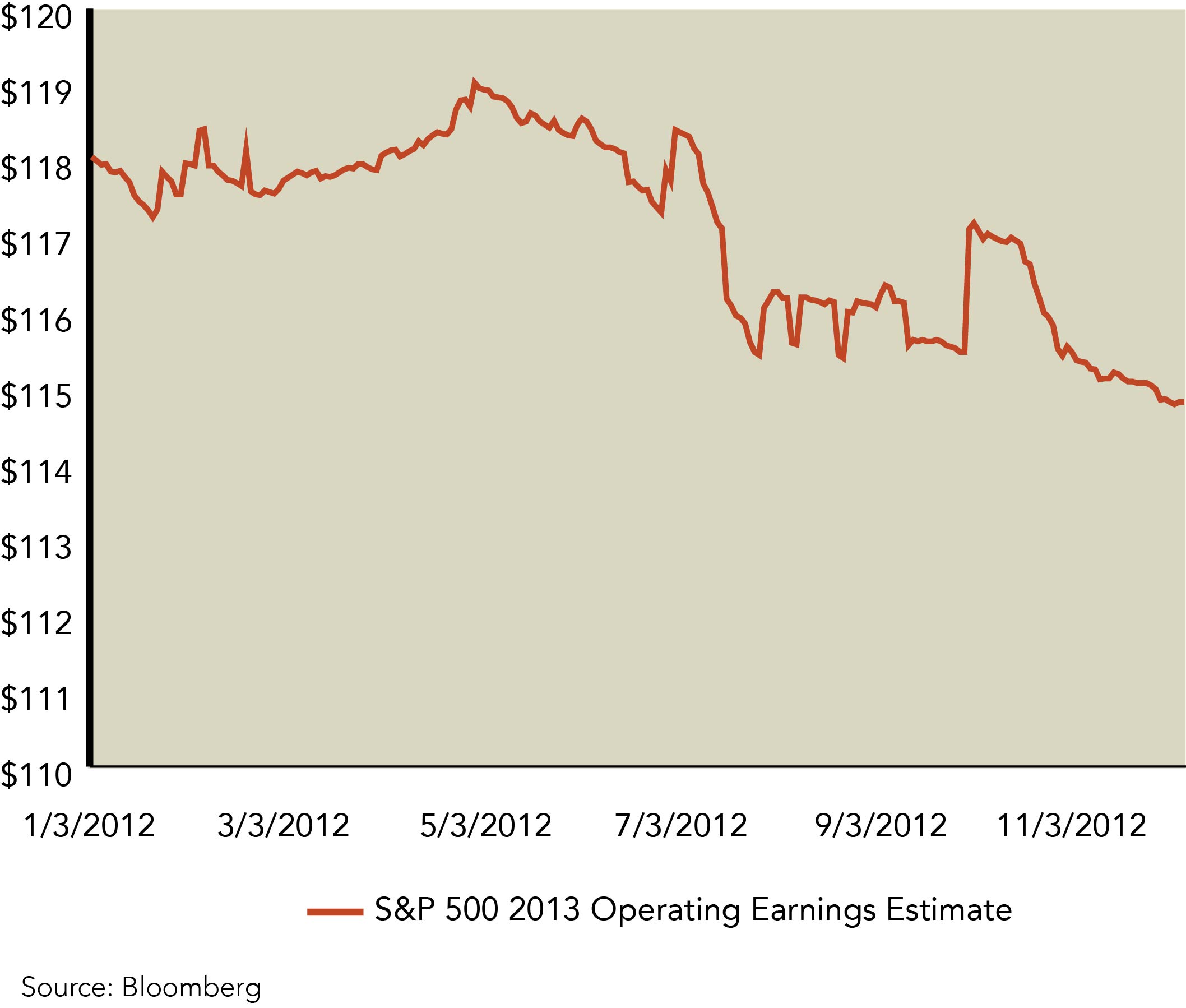
Our Chart of the Week looks at analyst expectations for 2013 S&P 500 operating earnings. This is a “bottoms-up” estimate which means it is based on earnings expectations for each of the 500 underlying companies in the S&P 500 index.

Our Chart of the Week looks at analyst expectations for 2013 S&P 500 operating earnings. This is a “bottoms-up” estimate which means it is based on earnings expectations for each of the 500 underlying companies in the S&P 500 index.

The S&P 500 index closed last night at 1427.84 and the consensus estimate for 2012 S&P 500 operating earnings is $103.92. This means the current market P/E (price/earnings) multiple is 13.7. Assuming that the current estimate of $114.81 for 2013 is accurate, and assuming no change in the market multiple, this implies a 2013 year-end value for the S&P of 1576 and a total return for equity investors of 12.8% (10.5% price appreciation plus a 2.3% dividend yield).

While this sounds attractive, the prediction above relies heavily on analysts’ 2013 earnings estimates for S&P 500 companies. But as the chart shows, analysts have consistently lowered their expectations for 2013 earnings over the course of the year. After peaking at $119.02 on May 1st earnings expectations have dropped 3.5% and have been falling steadily. Should this trend continue, it not only implies a lower year end value for the S&P 500, but earnings growth expectations are also falling. For investors, these patterns may result in lower than expected equity market returns in 2013.

Fed’s QE3 Expected to Total Nearly $1T – Marquette Associates Study

Institutional Fixed Income Managers Share QE3 Endgame Expectations

On September 14, the Federal Reserve announced that it would begin another round of quantitative easing by purchasing $40 billion dollars of mortgaged backed securities (MBS) a month. The plan, referred to as QE3 by analysts, is intended to boost a U.S. economy suffering from high unemployment. Investors have closely followed the Fed’s Quantitative Easing (“QE”) programs due to the unconventional monetary policies’ effects on broader asset markets, as well as the possibility that Fed actions may stoke inflation down the line. Given the open-ended nature of QE3, market expectations of the size, duration, and effectiveness of the plan may be both especially relevant and diverse.

Download PDF

Real vs. Potential GDP

Among the many factors the Congressional Budget Office (“CBO”) must estimate in budget projections provided to Congress, GDP is often the most important, as it provides a foundation for most other forecasts. While near term GDP growth can often be estimated with some accuracy based on current trends, longer term forecasts rely upon potential GDP.

Among the many factors the Congressional Budget Office (“CBO”) must estimate in budget projections provided to Congress, GDP is often the most important, as it provides a foundation for most other forecasts. While near term GDP growth can often be estimated with some accuracy based on current trends, longer term forecasts rely upon potential GDP. Utilizing the economic factors of labor input and physical capital, potential GDP is a measure of the maximum sustainable output of the national economy. It is the level that national output should be when the economy is at full employment and full resource utilization.

Going back to the 1950’s, real GDP has often plotted very near the CBO’s potential GDP forecast, often correcting any deviation quickly. Since the sharp economic downturn experienced in 2008, however, real GDP has remained below potential GDP, creating a sizeable output gap. In order to close that output gap, the national economy must grow at a faster rate than it has since 2008.

The various dotted lines on the graph contemplate constant forward growth rates in real GDP from the last recorded observation in the third quarter of 2012. Although it is unrealistic to assume the national economy will grow at a constant rate going forward, the analysis presents a hypothetical best/worst case scenario. If the national economy were to grow at a constant 5% annualized growth rate beginning in the fourth quarter of 2012, it would take the national economy until the third quarter of 2014 to realize its potential output. A 4% growth rate would reach potential GDP in the second quarter of 2015, and a 3% constant growth rate would reach potential GDP in the third quarter of 2020. If the national economy were to grow at a constant 2% rate – not far from the observed growth rates of the previous handful of quarters – the gap between real and potential output will continue to grow.

Dramatic Changes for Money Market Funds?

The challenges facing the money market industry continue to mount, with investors and asset managers growing more frustrated with recent trends. As the chart shows, while the decline has stabilized, the downward trend has yet to reverse itself.

The challenges facing the money market industry continue to mount, with investors and asset managers growing more frustrated with recent trends. Investors have now experienced several years of near zero returns out of money market funds. The low rate environment has also forced nearly all money market funds to waive part or all of their fees to ensure a positive or flat yield for investors. Revisions to SEC Rule 2a-7 have created money market funds with shorter maturities, higher credit quality and improved liquidity, all of which have added to lower potential returns for money market funds. In addition, the crisis surrounding Lehman Brothers in 2008 which led to the Reserve Primary Fund “breaking the buck” caused large outflows from money market funds into deposit accounts. Not surprisingly, assets in money market funds have dropped dramatically since 2008. As the chart shows, while the decline has stabilized, the downward trend has yet to reverse itself.

Proposed reforms to money market funds seem to further cloud the issue. The Financial Stability Oversight Committee (“FOSC”) recently outlined three possible reform options, while the Financial Stability Board (“FSB”) proposed similar measures. The FOSC proposals are as follows:

  • Require money market funds to have a floating net asset value.
  • Allow money market funds to continue using a stable net asset value, but require a NAV buffer of up to one percent of assets, and “minimum balance at risk” be made available for redemption on a delayed basis.
  • Allow money market funds to continue using a stable net asset value, but require a risk-based NAV buffer of 3 percent, combined with other measures including diversification requirements, increased minimum liquidity levels, and more robust disclosures.

The FSB is endorsing a recommendation that would convert stable NAV funds to floating NAV funds where possible. The money market industry has come out against these proposals, arguing that such moves would undermine the money market product and drive cash to less regulated financial instruments as investment managers come out with new, more profitable cash management strategies.

Investors rely on money market funds for principal protection, and converting to a floating NAV would have a large effect on the cash management industry. Investors would be left to choose between the safety of the underlying assets of a floating NAV money market fund, versus the creditworthiness of a banking institution, were they to allocate assets to a bank in a deposit account above the FDIC limit. If such regulations were made, the market would likely respond as it has done in the past by creating a product that allows investors to invest in a single product that reduces the administrative complexity of allocating assets to multiple bank deposit accounts to ensure FDIC protection.

Business Investment and GDP

Business investment spending (formally known as non-residential private fixed investment) measures spending by private businesses and nonprofit institutions on fixed assets in the U.S. economy. Business investment spending serves as an indicator of the willingness of private businesses and nonprofit institutions to expand their production capacity, and thus, movements in business investment spending serve as a barometer of confidence in, and support for, future economic growth.

This week’s Chart of the Week compares the rate of change in business investment spending to GDP growth. Business investment spending (formally known as non-residential private fixed investment) measures spending by private businesses and nonprofit institutions on fixed assets in the U.S. economy. According to the Bureau of Economic Analysis, fixed assets consist of structures, equipment, and software that are used in the production of goods and services. Business investment spending includes the creation of new productive assets, the improvement of existing assets, and the replacement of worn out or obsolete assets. Business investment spending serves as an indicator of the willingness of private businesses and nonprofit institutions to expand their production capacity. Thus, movements in business investment spending serve as a barometer of confidence in, and support for, future economic growth.

Given that business investment spending accounts for approximately 11% of total GDP in the U.S., it is not surprising that there is a fairly high correlation between business investment spending and GDP growth. As the chart illustrates, since 2000 the correlation between the quarterly change in business investment spending and the quarterly change in GDP is 0.7.

In 3Q 2012, business investment spending shrunk at an annualized rate of 1.3% compared to the previous quarter, while GDP grew at an annualized rate of 2.0% compared to the previous quarter. Business investment spending has historically been much more volatile than GDP growth, so it is important to note that a contraction in business investment spending in the third quarter does not automatically translate to a future contraction in GDP. In addition, external factors such as uncertainty surrounding the recent elections and the pending fiscal cliff in the U.S. may have caused businesses to temporarily delay investment spending. However, if this contraction in business investment spending continues over the next few quarters, it is likely indicative of a larger negative trend in the economy as a whole. In terms of impact on the financial markets, it is likely dilutive for the equity market, but accretive to Treasuries.

Investors Leave Emerging Markets Behind

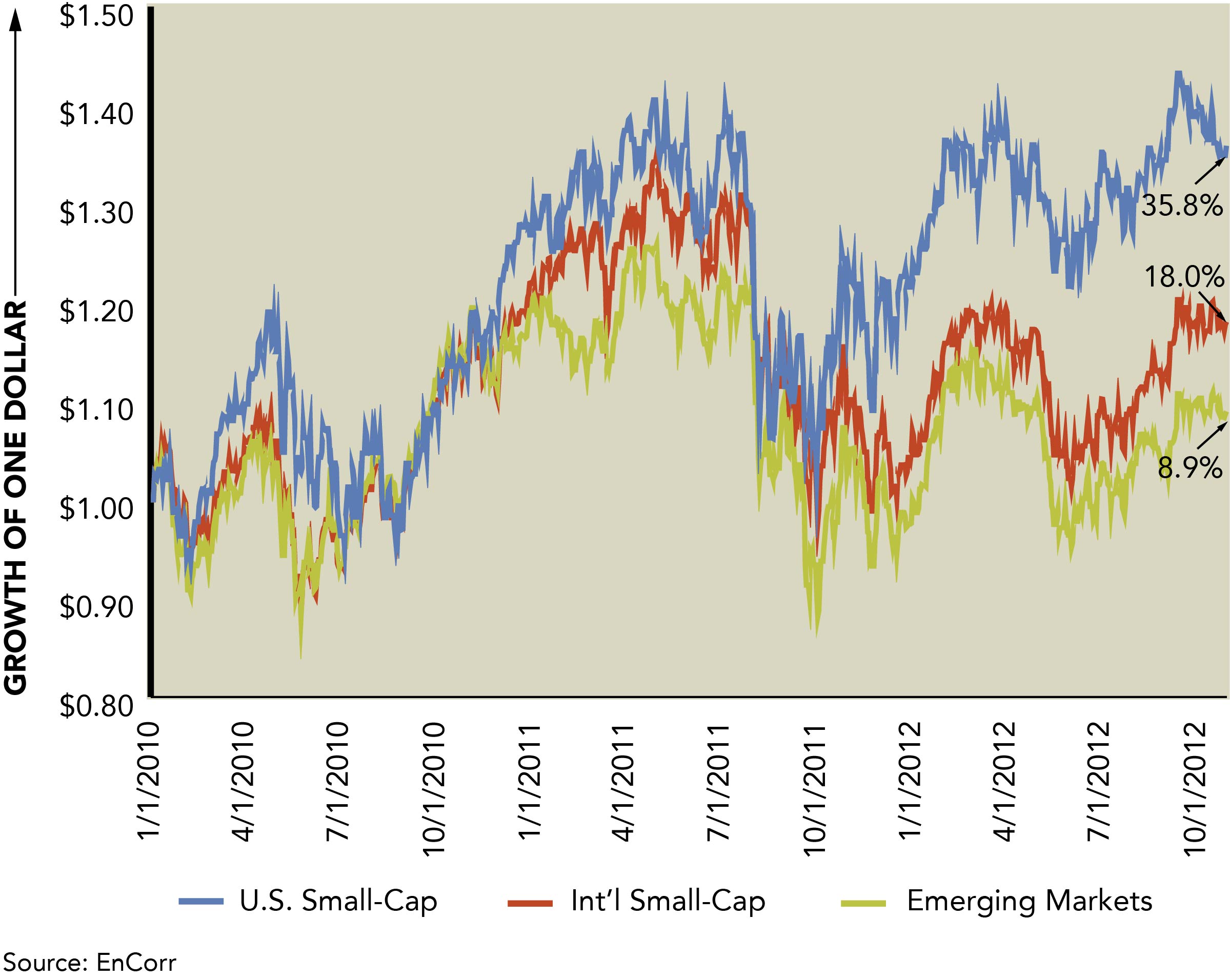
This week’s Chart of the Week highlights the relative underperformance of emerging market stocks compared to other “risky” asset classes. Since January 1, 2010, U.S. small-cap stocks1 have returned a cumulative 35.8% and international small-cap stocks2 have returned a cumulative 18% through October 2012. However, quite surprisingly, emerging market stocks3 are only up 8.9% over the same time-period.

This week’s Chart of the Week highlights the relative underperformance of emerging market stocks compared to other “risky” asset classes. Since January 1, 2010, U.S. small-cap stocks1 have returned a cumulative 35.8% and international small-cap stocks2 have returned a cumulative 18% through October 2012. However, quite surprisingly, emerging market stocks3 are only up 8.9% over the same time-period.

Emerging market equities are still treated as a risk-on, risk-off investment. As the graph above illustrates, it appears that investors have returned to some of the riskier equity markets, but have left emerging markets behind. The underperformance of international small-cap and emerging market stocks compared to U.S. small-cap stocks is somewhat explained by investors’ continued concerns with Europe. However, when looking at one of the traditional valuation metrics, price-to-earnings (“P/E”) ratio, it appears that investors may be unfairly discounting emerging market stocks. As of 9/30/2012, U.S. small-cap, international small-cap, and emerging market stocks had P/E ratios of 33.7, 19.8, and 12.5, respectively.

Continued global economic and policy uncertainty suggests that this trend may persist. However, given their low P/E ratios, coupled with growth rates and fiscal health relative to developed countries, emerging market stocks should deliver long-term compelling returns, despite their recent struggles versus other risky equity indices.

1Represented by the Russell 2000 Index
2Represented by the S&P Developed ex. U.S. Small-Cap Index
3Represented by the MSCI Emerging Markets Index

Real Estate Market on the Rebound?

Recently, the decline in the U.S. housing market has shown some evidence of bottoming. The national average home price has crept up off of lows according to the Case-Shiller Home Price Index, and inventories of existing homes on the markets have shrank significantly since the outset of the credit crunch.

Recently, the decline in the U.S. housing market has shown some evidence of bottoming. The national average home price has crept up off of lows according to the Case-Shiller Home Price Index, and inventories of existing homes on the markets have shrunk significantly since the outset of the credit crunch. Given this new data and a Federal Reserve fiscal policy including QE3 designed to induce access to home financing, it begs the question, “Has access to home financing returned?”

The Federal Reserve conducts a quarterly survey of banks operating in the U.S. called the Senior Loan Officer Opinion Survey on Bank Lending Practices. As part of this survey, mortgage lenders report changes in demand for residential loans as well as whether standards for loan approval are becoming more or less stringent. To assess the health of the loan market, this week’s chart focuses on prime mortgage borrowing, since this category reflects loan seekers that should be considered creditworthy. In the chart, we see that banks are reporting a notable increase in demand for prime residential loans this year. Meanwhile, lending standards required by banks remain strict. The data appears to show that for Americans with control over their personal finances, the affordability of home ownership is starting to outweigh the risks. Meanwhile, banks remain cautious. The percentage of outstanding prime mortgages on their balance sheets remains elevated above the historical average. If these trends continue, investors can expect slow improvements in the residential real estate market, but given the persistent attention to high lending standards that was absent pre-crisis, these improvements should prove to be sustainable and accretive to long-term value.

Lower Oil Prices: Good News or Bad News?

In the last week, U.S. crude oil prices hit a three month low dropping below $88 a barrel, attributable to economic slowdowns in China, Europe, and the U.S. Further downward pressure on oil prices has been caused by reduced earnings forecasts by U.S. corporations, unmet expected profits, and the growing worries for lower growth across the global economy.

In the last week, U.S. crude oil prices hit a three month low dropping below $88 a barrel, attributable to economic slowdowns in China, Europe, and the U.S. Further downward pressure on oil prices has been caused by reduced earnings forecasts by U.S. corporations, unmet expected profits, and the growing worries for lower growth across the global economy. Crude oil inventories rose by 5.9 million barrels to a total of 375.1 million barrels, the highest since 1982.

This drop in oil prices will have mixed results for consumers. On the bright side, the lower prices may contribute to some relief for consumers at the pump, thus leaving additional room in consumer budgets for consumption of other goods and services – an accretive trend for GDP growth. On the other hand, the price drop is a symptomatic factor for a regressing weak global economy and suggests further slow growth.

The Fiscal Cliff

Late October 2012 Investment Perspectives

Ramifications for the Economy, Financial Markets, and Institutional Portfolios

With the Presidential election quickly approaching on November 6th there has been a lot of talk about the upcoming “fiscal cliff” that awaits the eventual winner. Due to the lack of bipartisan consensus in Washington over the last few years there are a host of tax increases and spending cuts set to hit the economy if no action is taken by policy makers.

Download PDF

Passively Managed Funds Gaining in Popularity

Our Chart of the Week examines the migration of dollars from active to passive U.S. equity mutual funds over the last five years. During this time period, approximately $144 billion of investor money has flowed into passive funds (blue line) on a net basis, thus reflecting a growing frustration with the performance (and perhaps as importantly, fee level) of actively managed funds.

Our Chart of the Week examines the migration of dollars from active to passive U.S. equity mutual funds over the last five years. During this time period, approximately $144 billion of investor money has flowed into passive funds (blue line) on a net basis, thus reflecting a growing frustration with the performance (and perhaps as importantly, fee level) of actively managed funds. Even more telling is the movement out of actively managed funds, as shown by the red line on the chart. From 1st quarter of 2007 through the 3rd quarter of 2012, over $460 billion has been moved out of actively managed funds and into other investment vehicles.

Why the dramatic movement, most especially out of actively managed funds? A few explanations come to mind. First, it is no secret that the equity markets have largely traded on macroeconomic factors the last four years, so it has been hard for fundamentally-based managers to consistently add value when the market has not traded on those very optics used to evaluate equities. In addition, the bond bull market has attracted capital as investors have moved to ride rates down, as well as preserve the principal value of their investments. Last, as investors become more cost conscious, the low fees of passively managed funds have helped to attract additional capital.

The cloudy economic outlook suggests that this trend may continue. Whether it is a short term uncertainty such as the fiscal cliff or a longer-term matter about the future of a regional currency (Europe), it is conceivable that the market will remain a risk on / risk off trade over the next few years. Therefore, we may see continued flows into passively managed funds in the equity markets.