Goodbye Telecommunications Services Sector and Hello Communications Services Sector!

On November 15, 2017, S&P Dow Jones Indices, a leading provider of financial market indices, and MSCI Inc., a leading provider of research-based indices and analytics, conducted their annual review of the Global Industry Classification Standard (GICS). As a result, the pair decided to broaden and rename the Telecommunications Services sector to the Communications Services sector. The thought process is that over the past several years consumers and businesses have fundamentally transformed the way in which they communicate and access content.

In some ways, this trend started when Comcast, a cable company, announced its intention to purchase a stake of NBC Universal, a television network and content provider, in 2007. The latest example of the convergence between communications and media is the on-going asset fight between Fox, Comcast, and Disney for Sky PLC, a European satellite broadcaster. Moving away from traditional communications and media companies, firms like Alphabet through its Google search engine and YouTube, Facebook through its ever-expanding social media platform, and Netflix through its direct-to-consumer streaming content, have changed the way the world communicates and accesses content. The lines have officially blurred and S&P along with MSCI decided to take action.

What impact will this have on investors?

On September 21, 2018, the Telecommunications Services sector, the smallest sector at a 2% weight in the S&P 500 will quintuple in size to become the fourth largest sector in the index at the expense of the Information Technology and Consumer Discretionary sectors. This change is much larger than GICS’s creation of the Real Estate sector in 2016, which affected approximately 3% of the index’s market cap. Sleepy firms like AT&T, Verizon and CenturyLink will be grouped in the same sector as Alphabet, Facebook, and Netflix, just to name a few. Most notably, a sector classified as 100% value will be primarily growth-oriented.

The composition change is shown in the above chart; the formerly dominant names of AT&T, Verizon, and CenturyLink of the Telecom sector (shown in green) will now occupy a much smaller percentage of the new Communications Services sector, as shown by the considerably smaller blue boxes in the graph.

Luckily, most investment managers select stocks based on their investment merits and not their GICS sector classification. An investment manager that owns Alphabet (Google), which is currently classified as an Information Technology stock, on September 21st will continue to hold it on September 22nd. Much like the creation of the Real Estate sector in 2016, there is no action needed on the part of investors. We will continue to monitor new developments as S&P and MSCI finalize the change over the coming months.

Print PDF

The opinions expressed herein are those of Marquette Associates, Inc. (“Marquette”), and are subject to change without notice. This material is not financial advice or an offer to purchase or sell any product. Marquette reserves the right to modify its current investment strategies and techniques based on changing market dynamics or client needs.

Is Emerging Markets Debt Oversold?

Almost halfway through the year, emerging markets debt (“EMD”) returns are negative for the year, due to a variety of economic and political events. The most commonly cited explanations include the following:

  • The ongoing Fed rate hikes, including the first two this year in March and June, and also those expected in September and December as well as two more next year;
  • As discussed in our chart last week, the European Central Bank (“ECB”) will end its quantitative easing program in October;
  • The ongoing protectionist sentiment among the U.S., China and other countries that may stifle global commerce and potentially, global growth;
  • Italy’s two populist parties’ inability to initially form a coalition, which stoked fears of Italy’s exit from the EU — but they have since formed a coalition and selected a prime minister;
  • A truckers’ strike in Brazil that paralyzed many of the country’s major roads;
  • Turkish President Erdogan’s claim that higher interest rates cause inflation, and finally;
  • A run on the Argentine peso that exacerbated further downward pressure on the currency, resulting in a $50 billion emergency IMF loan.

The chart above illustrates how spreads have risen, which has led to higher yields and thus losses for EMD strategies so far in 2018. More specifically, the chart shows the spreads for the hard currency sovereign and local currency sovereign indices versus their averages. The hard currency sovereign index tracks bonds issued by emerging markets countries denominated in U.S. dollars or euros. The local currency sovereign index tracks bonds issued by emerging markets countries denominated in the issuer’s local currency, such as the Brazilian real or Malaysian ringgit.

Looking ahead, it could be argued that tightening by both the Fed and the ECB may slow global growth, raise interest rates, and strengthen currencies in both the U.S. and Europe, none of which would be favorable for EMD returns. However, at this point these moves may already be priced into current yields, and the worst of their impact on returns has already been felt. If so, what’s left are “idiosyncratic” headlines, which should theoretically have less of an impact on future returns.

Ultimately, despite the EMD market’s sensitivity to headlines, EM fundamentals remain strong. Leverage among issuers remains low on an absolute basis and is lower than developed market issuers. GDP growth remains high and is higher than developed market issuers. Furthermore, current account balances and inflation rates are generally improving. These strong fundamentals may suggest an impending reversal in the second half of the year for EMD returns.

Print PDF

The opinions expressed herein are those of Marquette Associates, Inc. (“Marquette”), and are subject to change without notice. This material is not financial advice or an offer to purchase or sell any product. Marquette reserves the right to modify its current investment strategies and techniques based on changing market dynamics or client needs.

The ECB Ends QE

Late last week the European Central bank (ECB) announced an end to its quantitative easing (QE) program. Over the last three years the ECB purchased 2.4 trillion euros in bonds to help boost the region’s economy. In October of this year the monthly bond purchases will be halved to 15B euro and move to zero at the end of the year. The ECB balanced this hawkish move with a commitment to keep interest rates at current levels at least through the summer of 2019. In addition, the ECB will continue to reinvest its proceeds from current bond holdings for “an extended period of time.”

The ECB’s actions signal confidence in the economic recovery and provide a timeline for markets to adjust. Despite the end of QE, policies remain accommodative and low borrowing costs should persist into the near future. The central bank remains ready to step in should the region’s economy need further support, but has taken the first steps towards a more normal monetary policy.

Print PDF

The opinions expressed herein are those of Marquette Associates, Inc. (“Marquette”), and are subject to change without notice. This material is not financial advice or an offer to purchase or sell any product. Marquette reserves the right to modify its current investment strategies and techniques based on changing market dynamics or client needs.
Do Private Markets Offer More Attractive Opportunities?

Across the private equity industry, valuations have continued to trend higher over the past few years with U.S. buyout valuation multiples reaching 11.8x EV/EBITDA in 2017. These elevated multiples have been supported by an environment of strong economic growth, favorable private market fundamentals, and significant levels of capital available to finance transactions. While buyout multiples may appear elevated relative to their historical averages, EV/EBITDA multiples are still 30% below the average valuation for U.S. small cap companies in the public market. Throughout this growth cycle private valuations have not risen as significantly as they have in the public markets. This valuation discount has provided value-sensitive investors a relative value trade as they seek to rebalance their portfolios.

Going forward, the significant reduction in U.S. corporate taxes that went into effect in 2018 will most directly benefit small U.S. companies as nearly all of their revenues are generated domestically. Throughout the first five months of 2018 we have seen strong growth from both public and private companies, which has led to an acceleration of earnings and cash flow generated by these companies. With less taxes to pay for every dollar of EBITDA, the growth of earnings has made private multiples even more attractive to institutional investors, and will likely drive even greater interest in private equity allocations.

Print PDF

The opinions expressed herein are those of Marquette Associates, Inc. (“Marquette”), and are subject to change without notice. This material is not financial advice or an offer to purchase or sell any product. Marquette reserves the right to modify its current investment strategies and techniques based on changing market dynamics or client needs.

MSCI Dips Toe into China A-share Pool

On May 31, 2018 MSCI decided to add 226 China large-cap A shares to the MSCI Emerging Markets (EM) Index. What is an A share? They are shares of Chinese companies that trade on local Chinese stock exchanges. Historically, foreign investors have had limited — if not zero — access to these markets. Three years ago, China launched its Stock Connect program, improving the accessibility to A shares and prompting their inclusion in the broad EM index. If A shares were just recently added, what constitutes the current 30.5% exposure to China? The China portion of the index is mainly comprised of the following:

  • H Shares – Chinese companies incorporated in China and listed on the Hong Kong stock exchange.
  • Red and P Chip – Chinese companies incorporated outside of China and listed on the Hong Kong stock exchange.
  • Overseas – Chinese companies listed on an overseas exchange, for example Alibaba which is listed in the NYSE.

By September 2018 China A-shares will constitute 0.8% of the index. This exposure represents a 5% inclusion rate of the A Share market and is tiny compared to the 16.2% exposure if MSCI used a 100% inclusion rate. While currently small, investors should expect A shares to become a larger portion of the index over the coming years, increasing the EM opportunity set.

Print PDF


The opinions expressed herein are those of Marquette Associates, Inc. (“Marquette”), and are subject to change without notice. This material is not financial advice or an offer to purchase or sell any product. Marquette reserves the right to modify its current investment strategies and techniques based on changing market dynamics or client needs.

And the Winner is… Commodities?

Through the end of May, 2018 has featured volatility and uncertainty across financial markets leading to some disappointing performance. Fixed income investments struggled as the yield curve rose with both core bonds and high yield slightly negative year to date. Broad U.S. equities are only up 2.5% after a rocky start to the year while international equities are negative following an exceptionally strong 2017. All this, along with fears about inflation, led to a surprising result: commodities are the best performing asset class in 2018. Despite this, the asset class is still by far the worst performer over both a 5 and 10-year period.

This week’s chart shows how difficult it is to time the market and why maintaining a consistently well-diversified portfolio is so important. The argument could be made that commodities were due to outperform (i.e. buy low and sell high) given their recent struggles. However, in 2014 commodities were down over 33%; investors hoping for a nice rebound the following year were in for a shock as commodities fell another 32.9% in 2015. On the flip side, last year emerging market (EM) equities was the top performing asset class, but those looking to chase this return now find themselves in the worst performing asset class YTD. There is little correlation between returns year to year and therefore we encourage clients to stick with long term allocations and avoid portfolio decisions based solely on recent returns.

Print PDF

The opinions expressed herein are those of Marquette Associates, Inc. (“Marquette”), and are subject to change without notice. This material is not financial advice or an offer to purchase or sell any product. Marquette reserves the right to modify its current investment strategies and techniques based on changing market dynamics or client needs.


Being on Guard for Curve Inversion

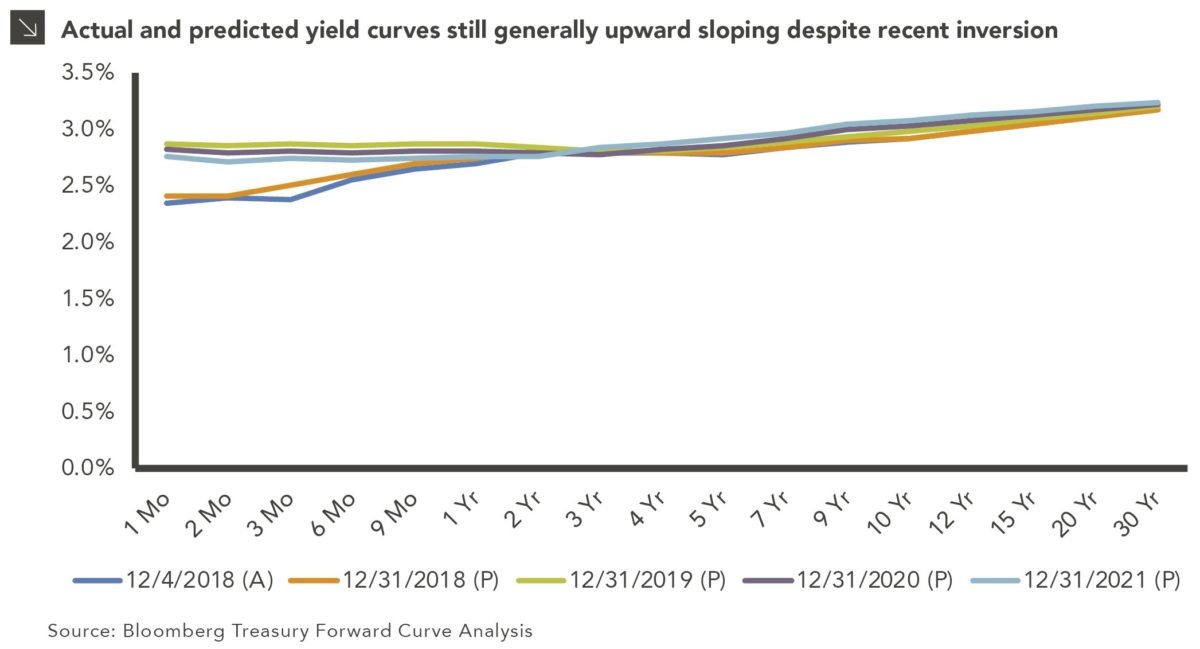
Our chart for this week examines the shape of the U.S. Treasury yield curve. With the 10-year Treasury yield recently rising above 3%, the yield curve is now as flat as it was in 2007, just before it inverted as a precursor to the 2008 financial crisis. An inverted yield curve shows that the market does not expect future interest rates to be as high as today’s interest rates, and may signify an economic downturn — going hand-in-hand with an equity and credit correction — to come.

The horizontal axis shows the maturities of U.S. Treasury bonds while the vertical axis shows their yields. Each line is a cross-sectional snapshot — rather than a time-series — of the U.S. Treasury yield curve. The bottom-most line is the spot curve, which shows the current¹ U.S. Treasury yield curve. The next line up is a Treasury forward curve that shows where the market expects the yield curve to be at the end of 2018. The next line up after that shows the forward curve for one year later, at the end of 2019; and the highest line shows the forward curve for the end of 2020.

As we can see, the market expects the curve to pivot at the long end, and rise at the short end, suggesting further flattening.

While it is comforting to know that the Federal Reserve now has in its toolbox the ability to cut rates to support the economy, it is a concern how easily the curve could invert, say, if the Fed hikes only a few more times coupled with a drop in the long end of the curve. This drop could be due to a resurgence of geopolitical tensions or slower growth expectations.

The Fed continues to have the dual mandate of minimizing unemployment while containing inflation. As inflation and inflation expectations continue to rise, we may see the Fed continue its rate hikes in order to rein in the economy, making inversion that much more likely. Because of this, we encourage investors to be on guard for curve inversion, which means taking moderate risk in portfolios, remaining diversified and maintaining a suitable amount of duration. We will continue to monitor the likelihood of curve inversion in the quarters to come — in the context of key metrics such as valuations, fundamentals and technicals — to help ensure that our clients’ portfolios are well-positioned.

¹ Data as of May 18, 2018

Print PDF

The opinions expressed herein are those of Marquette Associates, Inc. (“Marquette”), and are subject to change without notice. This material is not financial advice or an offer to purchase or sell any product. Marquette reserves the right to modify its current investment strategies and techniques based on changing market dynamics or client needs.

Growing Demand for “Other” Real Estate Sectors

This chart examines the most recent property type sector breakdown within the NFI-ODCE¹ including apartments, industrial, office, retail and other. While the actual “other” sector only represents 4% of the NFI-ODCE index exposure and typically includes land, parking and self-storage, what’s not that apparent is the “other” allocations within apartments and office.

Over the past several years, NCREIF has been trying to capture and measure “other” subtypes such as student housing and medical office, life sciences, manufactured housing and senior living under a field labeled for usage, but the reporting among ODCE managers has been inconsistent across the board. For example, a manager may report a student housing asset as “apartment” with a classification for garden, high rise or low rise, while at the same time submit the asset under the “usage” field making it unclear how much student housing is represented within the apartments sector.

With that said, managers have started and are likely to increase their exposures to these “other” property types given their unique risk-adjusted return profiles in this mature market cycle. For example, medical office and life science tenants tend to be much stickier and sign longer-term leases compared to traditional office tenants making them a more attractive tenant to have. The question going forward will be whether or not these “other” sectors develop into more mainstream standalone sectors and how much they will represent within the ODCE over the coming years.

Print PDF


¹The NCREIF Fund Index – Open End Diversified Core Equity (“NFI-ODCE”) – is an index of fund-level investment returns reporting on both a historical and current basis.


The opinions expressed herein are those of Marquette Associates, Inc. (“Marquette”), and are subject to change without notice. This material is not financial advice or an offer to purchase or sell any product. Marquette reserves the right to modify its current investment strategies and techniques based on changing market dynamics or client needs.


Equities Show Underlying Weakness

After hitting an all-time closing high on January 26th, the S&P 500 officially entered correction territory over the span of nine trading days with a 10% pullback. Since the February 8th low, price levels for the S&P 500 have shown signs of stabilization but have yet to fully recover. Through May 8th, the S&P 500’s year-to-date return was +0.55%. This headline number, however, masks the dispersion of returns among sectors and individual stocks so far this year. Despite the index being slightly positive year-to-date, many individual stocks within the index are in negative territory.

This week’s chart shows the S&P 500 price level along with the percentage of S&P 500 stocks trading above their 200-day moving averages. The 200-day moving average is a popular technical indicator used to gauge price trends in equity markets. This same indicator can also be applied to individual securities within an index to assess the level of participation or breadth.

The chart above highlights the narrow participation of securities within the S&P 500 since the prior all-time closing high. 83% of stocks in the S&P 500 were trading above their 200-day moving averages as of January 26th. This number fell to 56% by May 8th, indicating that price levels are being supported by a smaller percentage of individual stocks within the index. For example, the popular mega-cap acronym FAANG (Facebook, Apple, Amazon, Netflix, and Google/Alphabet) has been a key driver for equity returns this year. These five stocks account for over 11% of the S&P 500’s total weight and as a group have generated an average year-to-date return of +20%. While higher market cap stocks have supported overall equity returns year-to-date, such narrow market participation creates concerns should sentiment change among these stocks.

Print PDF


The opinions expressed herein are those of Marquette Associates, Inc. (“Marquette”), and are subject to change without notice. This material is not financial advice or an offer to purchase or sell any product. Marquette reserves the right to modify its current investment strategies and techniques based on changing market dynamics or client needs.

Turn Up the Vol-ume

Volatility is a normal and healthy component of any market. While 2017 lacked typical market volatility, 2018 has experienced its share and entered back into a more reactive and “normal” environment. In the first quarter alone, 2018 had almost triple the amount of +/- 1% days than the entire year of 2017. Although a reversal of 2017’s complacent behavior, this market movement is in line with recent history.

Another pivotal trend is the VIX premium over the V2X; the VIX reflects U.S. market volatility while the V2X is an equivalent measure of European markets. Typically, the VIX trades below the V2X (a negative premium), which reflects the average lower volatility of U.S. vs European markets. The first quarter of 2018 marks the first time this monthly average has peaked above 0 in quite some time. This is not exactly surprising given the economic policy uncertainty and rising rate environment in the U.S.

Volatility is back, and though this is a change of pace from 2017, is well within the bounds of normalcy and is likely to continue throughout 2018.

Print PDF


The opinions expressed herein are those of Marquette Associates, Inc. (“Marquette”), and are subject to change without notice. This material is not financial advice or an offer to purchase or sell any product. Marquette reserves the right to modify its current investment strategies and techniques based on changing market dynamics or client needs.