Evan Frazier, CFA, CAIA
Senior Research Analyst


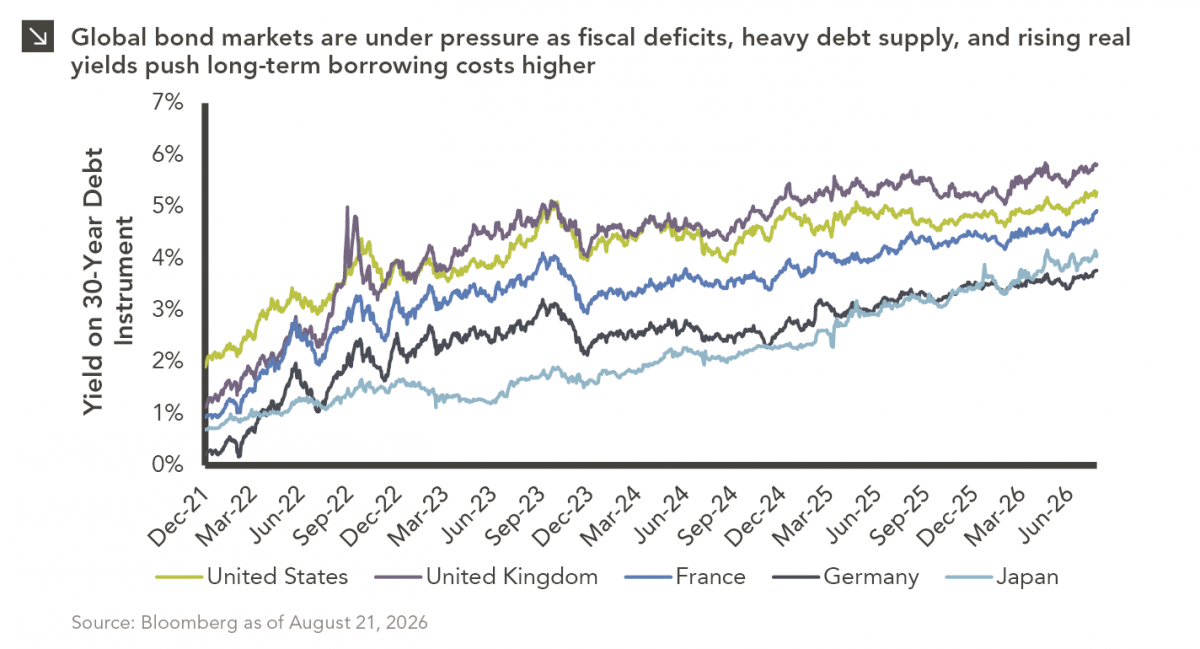
The global bond market is facing renewed pressure as investors demand higher yields to hold long-dated government debt, pushing borrowing costs in several developed economies to extreme levels relative to recent history. For instance, the 30-year U.S. Treasury yield sits at nearly 5.3% as of this writing, near its highest level since 2007, after rising more than 40 basis points in the last two months. Additionally, 30-year borrowing costs in France recently reached their highest level since 2008, long-term yields in Germany have moved to levels not seen in more than 15 years, 30-year gilt yields have approached 6%, and comparable Japanese yields are near record highs.
While some country-specific factors are contributing to this sell-off, many of the drivers are global in nature. For instance, governments are running significant deficits at a time when interest rates remain well above the exceptionally low levels that prevailed for much of the past decade. In the U.S., interest expenses on the national debt have become an increasingly important contributor to the budget deficit, with fiscal-year-to-date interest costs now above $1.1 trillion as higher Treasury yields raise the government’s financing bill. It is important to note that the current environment also differs from previous periods of rising deficits. Historically, fiscal deterioration has often occurred alongside economic weakness, prompting central banks to cut interest rates and provide support to government bonds. Today, however, governments are adding to borrowing needs while monetary policy remains relatively restrictive. This dynamic could keep upward pressure on long-term yields even if central banks eventually begin lowering short-term rates.
Another important development is the changing composition of sovereign bond market investors. While government bonds have traditionally benefited from steady demand from institutions (e.g., pension funds and other liability-driven entities), demographic changes, pension reforms, and regulatory developments are impacting that demand. Consequently, governments are increasingly dependent on private investors, who are generally more sensitive to valuation and expected returns. This dynamic is particularly important at the long end of the curve, where the additional yield investors require to own longer-dated securities (i.e., the term premium) can have an outsized impact on borrowing costs. Government debt is also competing with a rapidly expanding supply of corporate bonds, as the capital requirements associated with artificial intelligence infrastructure have prompted technology-oriented companies to raise unprecedented amounts of debt (much of which is concentrated in longer maturities). As a result, bond investors now have more opportunities to deploy capital, and issuers must compete for that demand by offering attractive yields. Inflation is another reason investors have become less comfortable locking in yields for decades. The conflict in the Middle East has pushed energy prices higher, raising concerns about renewed inflationary pressures and the possibility that central banks could be forced to maintain restrictive monetary policy for longer than previously anticipated. That risk is particularly problematic for long-duration bonds, which have prices that are highly sensitive to changes in interest rates and inflation expectations. It should be noted, however, that the recent increase in long-term yields has not been driven entirely by rising inflation expectations, as long-dated inflation breakevens have remained largely contained across major markets. Instead, a significant portion of the increase has come from higher real yields (i.e., the inflation-adjusted compensation investors receive for owning bonds). That distinction is important because if real yields continue to rise because investors are demanding greater compensation for fiscal and economic uncertainty, long-term bonds could remain under pressure even without a major acceleration in expected inflation. The deterioration in long-term borrowing conditions is already influencing how governments approach debt issuance. For instance, the United Kingdom has reduced its planned issuance of longer-dated bonds and increased its reliance on shorter maturities. The problem with this approach is that shortening maturities does not eliminate underlying fiscal burdens but rather shifts more debt into the near-term refinancing pipeline. This leaves governments more exposed to future interest-rate movements. The U.S. Treasury is also taking steps to support liquidity in the long-end of the market, recently doubling the size of planned buybacks of longer-dated Treasuries to at least $4 billion per operation. While this initiative may provide some near-term support, its initial impact was short-lived, underscoring the challenge policymakers face in addressing the broader fiscal and supply-demand forces driving long-term yields higher.
One of the key takeaways here is that the long ends of yield curves across major economies are increasingly being shaped by forces that extend beyond traditional monetary policy expectations, with even the U.S. Treasury taking steps to support demand and liquidity in longer-dated bonds. Additionally, investors should note that rising long-term yields raise the discount rates applied to future corporate earnings, potentially creating a difficult backdrop for growth-oriented companies whose valuations depend heavily on cash flows expected many years in the future. On the positive side, the repricing in long-duration bonds could eventually create opportunities for investors with fresh capital, as higher real yields provide a more attractive starting point for long-term fixed income returns. The key question is whether yields are now high enough to compensate investors for the fiscal, inflationary, and supply-related risks currently embedded in the market.
Print PDF
The opinions expressed herein are those of Marquette Associates, Inc. (“Marquette”), and are subject to change without notice. This material is not financial advice or an offer to purchase or sell any product. Marquette reserves the right to modify its current investment strategies and techniques based on changing market dynamics or client needs.

10.08.2026
This video is a recording of a live webinar held October 22 by Marquette’s research team analyzing the third quarter…

10.22.2026
Anyone who has run a marathon knows the last six miles are brutal — no matter how well the first…
10.19.2026
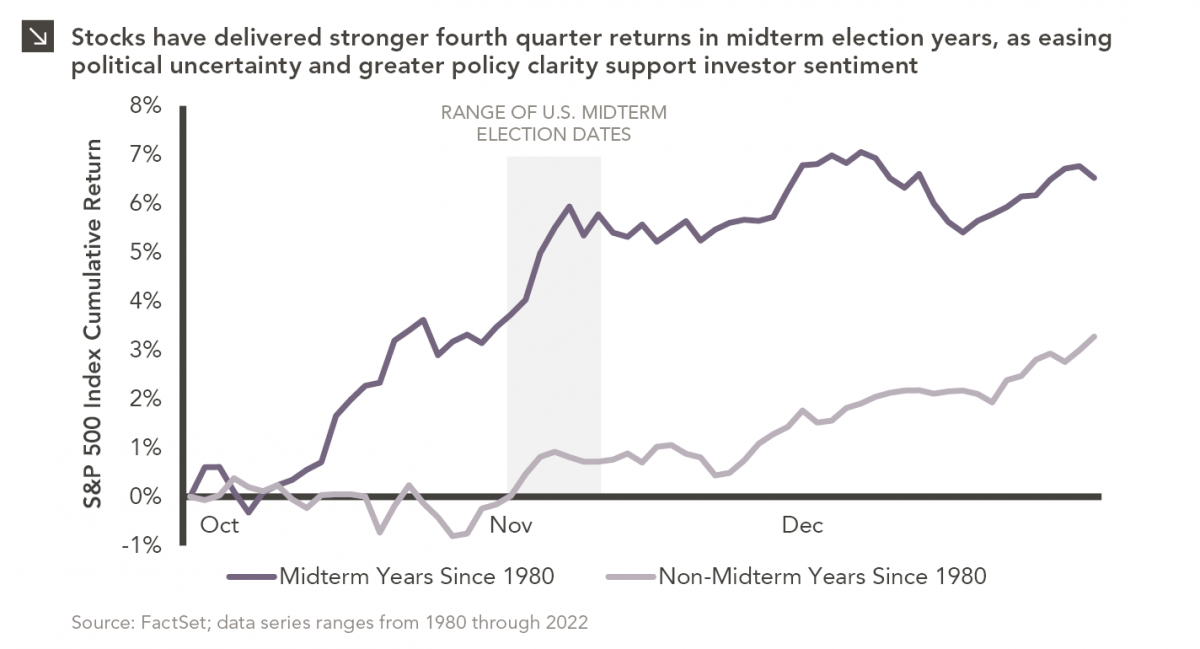
Since 1980, the S&P 500 Index has generally performed well in the weeks surrounding U.S. midterm elections. Specifically, the index…

10.12.2026
This week’s chart highlights the accelerating growth of electricity demand in the U.S., which has been driven primarily by the…
10.05.2026
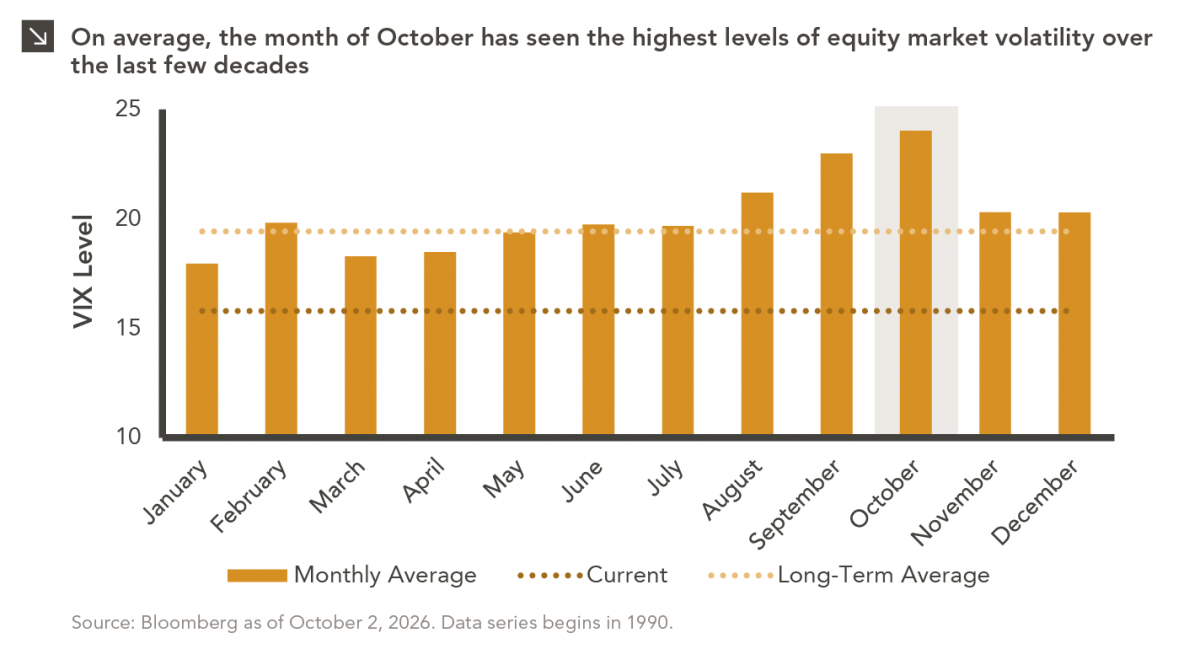
For investors, the spookiest thing about October might not be the ghosts and monsters that are bound to show up…
09.28.2026
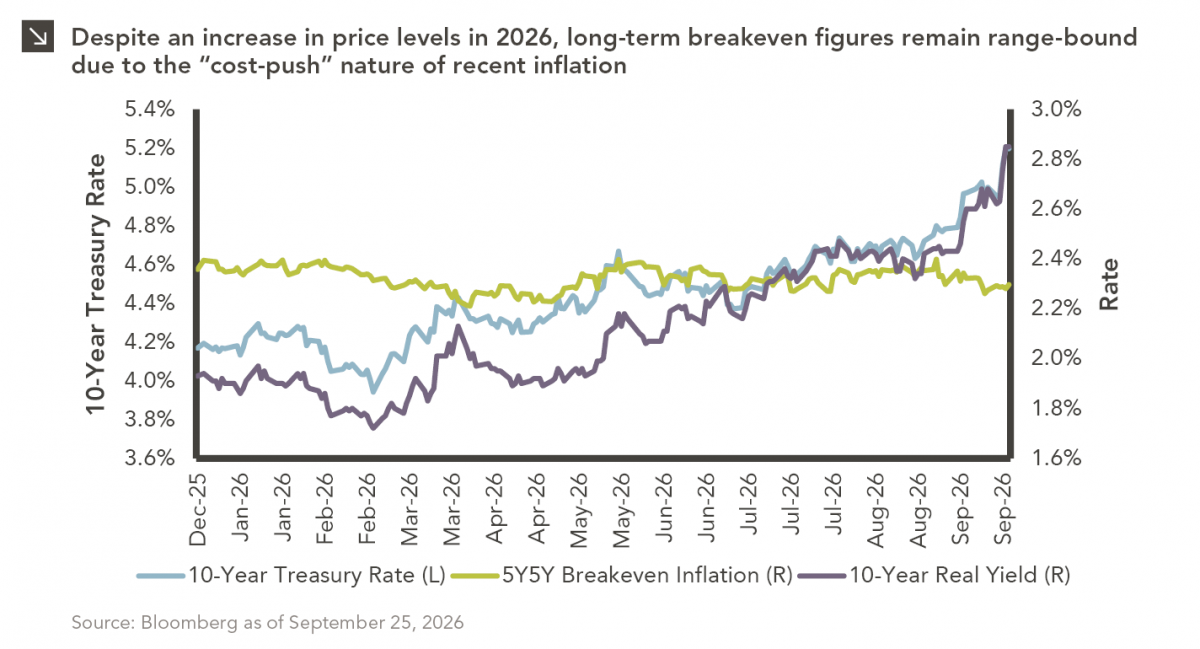
The phrase “expectations of higher inflation” has become a staple in financial news to explain the increase in nominal U.S….
Research alerts keep you updated on our latest research publications. Simply enter your contact information, choose the research alerts you would like to receive and click Subscribe. Alerts will be sent as research is published.
We respect your privacy. We will never share or sell your information.
If you have questions or need further information, please contact us directly and we will respond to your inquiry within 24 hours.
Contact Us >