Second Quarter Review of Asset Allocation: Risks and Opportunities

Overall, the second quarter was positive for financial markets, thanks to strong economic fundamentals and expected Fed stimulus. Unemployment remains low at 3.7% and inflation (1.8% year over year) is near the Fed’s long-term target of 2%. However, there are increasing concerns about a global economic slowdown and early forecasts for 2Q GDP growth are around 1.5%, far lower than what we’ve seen in recent quarters. Globally, the most important trends we see are the following:

  • The U.S.-China trade conflict remains ongoing as talks between the two countries resumed, but little progress has been made;
  • The Federal Reserve is expected to cut rates in July and markets are forecasting another one to two cuts by the end of the year;
  • Business sentiment is declining ­— most notably in the PMI manufacturing index, which is now dangerously close to falling below its growth threshold;
  • Britain continues to struggle with its Brexit and elected a new PM (Boris Johnson) on July 23rd;
  • China and Europe are expected in increase their stimulus measures to combat slow growth and overall global uncertainty;
  • Late-cycle dynamics in credit and equity markets.

The impact of these trends is explored further in this newsletter as we review second-quarter performance and expectations going forward for each of the major asset classes.

Read > Second Quarter Review of Asset Allocation: Risks and Opportunities

The opinions expressed herein are those of Marquette Associates, Inc. (“Marquette”), and are subject to change without notice. This material is not financial advice or an offer to purchase or sell any product. Marquette reserves the right to modify its current investment strategies and techniques based on changing market dynamics or client needs.

When Will the SOFRing End?

Global authorities such as the SEC, Federal Reserve, European Commission and European Central Bank are currently transitioning the market’s use of LIBOR as a base rate for floating-rate securities such as bank loans, CLOs and private credit towards the use of the current front runner as a replacement: SOFR, which stands for the Secured Overnight Financing Rate.

This newsletter explains what a base rate is and how it is used in investing, why LIBOR is being transitioned to SOFR and the key differences between the two, and when the change is expected to take effect.

Read > When Will the SOFRing End?

For more coverage on LIBOR, please see our Bank Loans Position Paper and recent Chart of the Week, The Sixth Fed Hike and Rising LIBOR.

The opinions expressed herein are those of Marquette Associates, Inc. (“Marquette”), and are subject to change without notice. This material is not financial advice or an offer to purchase or sell any product. Marquette reserves the right to modify its current investment strategies and techniques based on changing market dynamics or client needs.

When the Experts Are Wrong

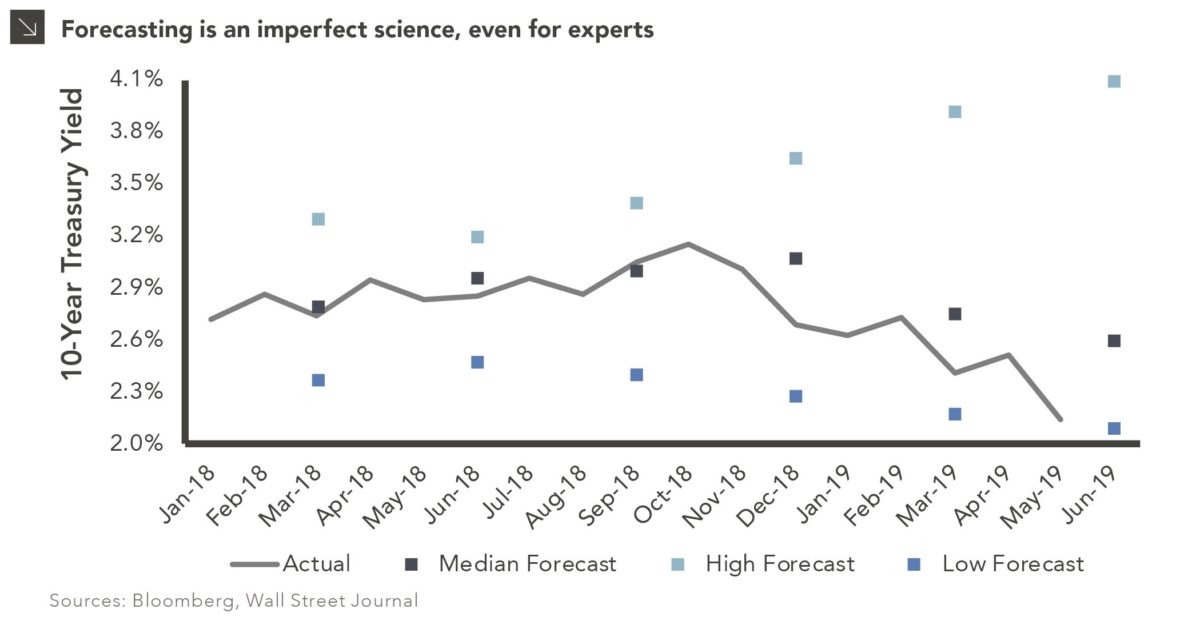
Since the end of October, the yield on the 10-year Treasury fell more than 1% and as of writing stands at 2.12%. The drop resulted in the yield curve inverting between the 3-month and 10-year maturities, and the 2-year yield is getting dangerously close to also surpassing the 10-year. This dramatic decline and inversion made investors nervous that a recession was on the horizon and caught most economists off-guard. In both 4Q and 1Q the 10-year yield ended lower than the average forecast from the Bloomberg consensus by about 0.4%. 2Q is on track to be even worse as the yield may fall below the forecasted low from the survey.

Towards the end of 2018, most believed the 10-year would rise thanks to continued growth and further rate hikes by the Fed. However, volatility and ongoing concerns about tariffs have pushed investors into safe-haven assets. This was further fueled by the weaker than expected job reports and most now believe the Fed will likely cut interest rates at least once before the end of the year. As a result, some institutions revised their forecasts for the remainder of 2019, going as low as 1.75% for the 10-year. That said, there is still a great deal of uncertainty and rates could just as easily rebound should we get more positive economic data, if the Fed chooses not to decrease rates, or if there is a resolution to the trade conflict. Overall, this serves as a reminder to investors that timing the market is an imperfect science and even experts can miss the mark by a wide margin. We continue to encourage clients to stick to their investment policies, invest for the long-term, and follow a disciplined rebalancing routine.

Print PDF > When the Experts Are Wrong

The opinions expressed herein are those of Marquette Associates, Inc. (“Marquette”), and are subject to change without notice. This material is not financial advice or an offer to purchase or sell any product. Marquette reserves the right to modify its current investment strategies and techniques based on changing market dynamics or client needs.

First Quarter Review of Asset Allocation

Heading into 2019, the primary risks facing financial markets were the trade war with China, the U.S. government shutdown, Brexit uncertainty, and further Fed rate hikes. However, in the first quarter the majority of these worries subsided.

In this newsletter, we analyze the current market environment with a review of recent performance and future expectations for each major asset class. As always, we caution investors to stay diversified and rebalance as appropriate. There are always potential disruptors to the financial markets and the most powerful tend to be largely unexpected. We will continue to monitor markets and developments as they occur to guide our clients to the most optimal portfolio decisions given the backdrop of program goals and risk tolerance.

Read > First Quarter Review of Asset Allocation

The opinions expressed herein are those of Marquette Associates, Inc. (“Marquette”), and are subject to change without notice. This material is not financial advice or an offer to purchase or sell any product. Marquette reserves the right to modify its current investment strategies and techniques based on changing market dynamics or client needs.

The Latest Key Developments in the Healthcare Industry

Health systems today face significant challenges, further complicating an ever-changing landscape. Some of the most notable trends we see in the space include:

  • Higher interest rates, which impact borrowing costs as well as investment opportunities;
  • Efforts to gradually repeal the Affordable Care Act (“ACA”);
  • The emergence of value-based payment programs;
  • The advent of major vertical integrations such as CVS-Aetna;
  • A growing demand for digital healthcare

The following article summarizes these key issues for health systems and where appropriate, provides some potential solutions.

Read > The Latest Key Developments in the Healthcare Industry

With over 20 years of healthcare investment consulting experience, Marquette serves healthcare clients across a broad range of operating cultures — including health systems, stand-alone hospitals, and specialty organizations — and with a variety of focus areas — including operating funds, retirement planning, insurance, endowments, and foundations. For more Marquette coverage of the healthcare industry, please see our previous newsletter Healthcare Organizations’ Top 3 Investment Concerns for Balance Sheet Assets.

The opinions expressed herein are those of Marquette Associates, Inc. (“Marquette”), and are subject to change without notice. This material is not financial advice or an offer to purchase or sell any product. Marquette reserves the right to modify its current investment strategies and techniques based on changing market dynamics or client needs.

Higher Yields, Higher Returns

As bond yields are much higher today than they were only three years ago due to nine Federal Reserve rate hikes since the Great Recession, fixed income investors are encouraged by the higher yields that are expected to produce higher returns in the future. The Fed’s nine rate hikes, having raised the fed funds rate from the range of 0.00%–0.25% only three years ago to 2.25%–2.50% today, are expected to provide a general boost to annualized bond returns over the next five years.

Our chart of the week looks at the relationship between current yields in the bond markets and the expected future annualized returns for the next five years. We focus on the Bloomberg Barclays Aggregate Index (“Agg”) as that is the most common bond benchmark used by investors. The chart plots the starting yield of the Agg over the last five decades, from the 1970s to today, on the x-axis. The y-axis then shows the corresponding annualized returns of the Agg over the next five years.

We can see that there is a very linear relationship: the higher the yields at each starting point, the higher the returns for the next five years. As rates declined from the 1980s through the 1990s and 2000s to today in the 2010s, this relationship held true. There are a few outliers in the 1970s, however, as the Federal Reserve under Volcker at the time hiked rates to counter stagflation. But excluding some of these outliers in the 1970s, the chart shows a very strong linear association that higher returns over the next five years are a direct result of higher rates today.

There are secular forces at play, particularly the rising retirement trend across the world’s most powerful economies (Japan, China, U.S., and Europe) that may keep our current low-rate “new neutral” phenomenon a persistent reality for some time. However, the countering forces are new technologies that provide for more productivity. On the balance, fixed income investors are expected to benefit from generally stronger annualized returns over the next five years versus the last 10 years since the Great Recession.

Print PDF > Higher Yields, Higher Returns

The opinions expressed herein are those of Marquette Associates, Inc. (“Marquette”), and are subject to change without notice. This material is not financial advice or an offer to purchase or sell any product. Marquette reserves the right to modify its current investment strategies and techniques based on changing market dynamics or client needs.

Should Investors Reduce Equity Allocations After Yield Curve Inversion?

The yield curve plots the relationship between U.S. bond yields and their maturities, and typically slopes upward: the longer you hold the security, the higher the return given various risks through time such as inflation, opportunity cost, and economic uncertainty. The yield curve, however, can be inverted when high demand for long-term Treasuries drives the price up and the yield down resulting in a downward sloping curve. Yield curve inversion often signals a pessimistic view of the economy in which investors look for protection against slow economic growth and higher-than-expected inflation. Furthermore, the previous four instances of curve inversion have been followed by a market correction, though it can sometimes be years before a market correction follows inversion.

Last Friday, the 10-year Treasury yield fell below short-term yields with maturities ranging from 1-month to 1-year in response to disappointing Eurozone data, geopolitical risks around Brexit, and Fed Chairman Jerome Powell’s remark on a global economic slowdown. Shortly after the yield curve inverted — especially after the negative yield spread emerged between 3-month and 10-year Treasuries (regarded as the Fed’s most sensitive measure of market sentiment) — the equity market sold off and the S&P 500 total return fell by 1.89%. This immediate reaction led some investors to believe the correction was already unfolding.

While it is impossible to determine at this point if the correction is already here, investors should take comfort knowing that the equity market eventually rebounds from these corrections and shows resilience after the yield curve inverts. Our chart above shows the subsequent 3-month, 6-month, 1-year, 2-year, and 5-year returns of the S&P 500 index after the primary inversion data point — the spread between the 2-year and 10-year Treasury yields — first went negative (thus inverting). For example, after the 10s/2s yield inversion on December 27, 2005, S&P 500 annualized total returns after 1 year, 2 years and 5 years were 15.6%, 10.7% and 2.2% respectively. Over longer time periods after yield curve inversion, such as 7 or 10 years, equity returns more closely resemble their long-term averages. The other primary takeaway from the chart is that shorter-term equity returns — 3, 6, or 12 months — feature significant disparity from the last four yield curve inversions, indicating each instance is different in terms of magnitude and timing after initial 10s/2s inversion. Thus, we do not recommend that investors reduce their equity allocations in an attempt to time the potential correction after inversion, and over the longer-term, equities are still expected to be positive contributors to portfolio returns, even if the yield curve is temporarily inverted.

Print PDF> Should Investors Reduce Equity Allocations After Yield Curve Inversion?

The opinions expressed herein are those of Marquette Associates, Inc. (“Marquette”), and are subject to change without notice. This material is not financial advice or an offer to purchase or sell any product. Marquette reserves the right to modify its current investment strategies and techniques based on changing market dynamics or client needs.

Yield Curve Inversion Intensifies: Will This Time Be Different?

An inverted U.S. Treasury yield curve — one in which long term rates are lower than short term rates — is known by investors to be a predictive indicator of a market correction and subsequent recession to come. On Friday, the yield curve inverted between the one-month to one-year range vs. the 10-year for the first time since 2007, with the one-month to one-year range yielding 2.45%–2.49% vs. the 10-year yielding 2.44%. This is an extension of the inversion between the two-year and five-year, which began last December.

In this newsletter, we put the current yield curve inversion into historical context, examining the indicators of previous inversions and the various market corrections and recessions that have followed. We also look ahead, taking into account current optimism regarding Fed rate cuts and various other indicators in the credit markets, and note how investors can prepare for further changes.

Read> Yield Curve Inversion Intensifies: Will This Time Be Different?

The opinions expressed herein are those of Marquette Associates, Inc. (“Marquette”), and are subject to change without notice. This material is not financial advice or an offer to purchase or sell any product. Marquette reserves the right to modify its current investment strategies and techniques based on changing market dynamics or client needs.

2019 Market Preview

Coming off a difficult 2018, investors face a litany of questions going into this year, whose potential answers will undoubtedly have an impact on the capital markets. The following set of newsletters examines the primary asset classes we cover for our clients, with in-depth analysis of last year’s performance and more importantly, trends, themes, and projections to watch for in 2019. We hope these materials can assist you and your committees as you plan for the coming year, and please feel free to reach out to any of us should you have further questions about the articles or wish to review the 2019 Market Preview Webinar recording. Here’s to a better year from the capital markets in 2019!

U.S. Economy: The View from the Top?
by Jeffrey Hoffmeyer, CFA, Lead Analyst, Asset Allocation

Fixed Income: Kicking Off the Year with Moderate Valuations, a Less-Hawkish Fed and Growing Global Tariffs
by Ben Mohr, CFA, Senior Research Analyst, Fixed Income

U.S. Equities: The Pro-Growth Narrative Fizzles Out
by Samantha T. Grant, CFA, CAIA, Senior Research Analyst, U.S. Equities
and Rob Britenbach, CIPM, Research Analyst, U.S. Equities

Non-U.S. Equities: Can They Get Back on Track?
by David Hernandez, CFA, Senior Research Analyst, International Equities
and Nicole Johnson-Barnes, Research Analyst

Real Estate: Navigating Through a Late Market Cycle
by Jeremy Zirin, CAIA, Senior Research Analyst, Real Assets

Infrastructure: Stable Cash Flows in an Uncertain Market Environment and the Evolving Landscape
by Jeremy Zirin, CAIA, Senior Research Analyst, Real Assets

Hedge Funds: Is Market Volatility Here to Stay?
by Joe McGuane, CFA, Senior Research Analyst, Alternatives

Private Equity: Poised for Robust Deployment
by Derek Schmidt, CFA, CAIA, Senior Research Analyst, Private Equity


The opinions expressed herein are those of Marquette Associates, Inc. (“Marquette”), and are subject to change without notice. This material is not financial advice or an offer to purchase or sell any product. Marquette reserves the right to modify its current investment strategies and techniques based on changing market dynamics or client needs.

Nowhere to Hide in 2018

As we enter 2019, we look back on what was a pretty poor year for investors. There was just nowhere to hide in 2018 as a volatile 4th quarter turned all major indices negative. The downward catalyst occurred when Federal Reserve Chair Jerome Powell said interest rates were “a long way” from what he considered neither stimulative nor restrictive.

For the year, the S&P 500 lost 4.4%, the Russell 2000 lost 11%, and emerging markets (as measured by the MSCI EM index) lost 14.6%. These losses came mostly as volatility spiked with the CBOE Volatility Index up 132% in 2018. Strong market fundamentals have largely been overshadowed by fear as global growth concerns, trade, and rising interest rate worries continue to pressure markets. This broad market correction has been historically unusual, but years with broadly poor returns from a majority of indices are typically followed by a positive year as investors find value in market opportunities.

Print PDF

The opinions expressed herein are those of Marquette Associates, Inc. (“Marquette”), and are subject to change without notice. This material is not financial advice or an offer to purchase or sell any product. Marquette reserves the right to modify its current investment strategies and techniques based on changing market dynamics or client needs.