Should Investors Worry About the Growing Deficit?

Americans have seen tax cuts and strong historical returns across asset classes since the Global Financial Crisis. However, though the general populace has been flourishing, the decrease in revenue flowing to the government and an increase in defense spending have contributed to the deficit increasing each year since 2016. Is the increased deficit a systemic risk or simply a side effect of a low rate environment?

This week’s chart of the week shows the United States’ deficit since 2007 in absolute terms as well as a percentage of GDP. The deficit spiked during the financial crisis at $1.4 trillion dollars as the administration took action to provide stimulus to the nation while in a recession. Shortly after, the deficit began decreasing as the economy moved towards recovery. More recently, the deficit has been increasing and is projected to reach $1.1 trillion dollars in 2020, an amount not seen since 2012. On an absolute basis, the deficit has been moving upward, but has this been offset by an increase in GDP? The blue line on the graph shows the deficit as a percentage of GDP. This metric has also been steadily increasing since 2016, though it is still much lower than during the Great Recession.

One area of potential concern is that during past expansions the deficit was decreasing or low, while now the deficit is moving in the opposite direction. If a recession were to occur, the government would have to borrow even more to stimulate the economy, pushing the debt level even higher and possibly raising concerns about the U.S. financial system. On the other hand, a theory of economic thought called Modern Monetary Theory (“MMT”) has gained traction due to the proposal of large increases in government spending by left-wing presidential candidates. MMT states that a country that prints its own currency does not have to worry much about debt as it can pay it off simply by adding to the monetary supply. Thus, the thought is that the only target for central banks should be inflation.

In all, deficit spending is a crucial means of financing public programs and stimulating the economy, no matter which economic viewpoint is applied. The U.S. deficit has ebbed and flowed over time and will continue to be a point of political contention for years to come.

Print PDF > Should Investors Worry About the Growing Deficit?

The opinions expressed herein are those of Marquette Associates, Inc. (“Marquette”), and are subject to change without notice. This material is not financial advice or an offer to purchase or sell any product. Marquette reserves the right to modify its current investment strategies and techniques based on changing market dynamics or client needs.

A Prism of Capital Market Views: Portfolio Manager Panel

Marquette’s 2019 Investment Symposium opened with a portfolio manager panel hosted by Marquette’s director of research, Greg Leonberger, FSA, EA, MAAA, and featuring:

  • John W. Rogers, Jr., Chairman, Co-CEO & Chief Investment Officer at Ariel Investments
  • Olga Bitel, Partner and Global Strategist at William Blair
  • Matthew J. Eagan, CFA, Executive Vice President and Portfolio Manager at Loomis, Sayles & Company

Third Quarter Review of Asset Allocation: Risks and Opportunities

The third quarter saw mixed results for financial markets. Economic fundamentals generally remain strong but signs of deterioration are starting to emerge. Unemployment currently hovers around 3.5%, and inflation is near the Fed’s target of 2%. However, 3Q GDP growth was under 2% (though the 1.9% figure exceeded the 1.7% estimate), and the PMI index has been below 50 since August (a reading under 50 is indicative of contraction in the manufacturing sector). Overall, the most important global trends we see are the following:

  • The U.S.-China trade conflict continues to weigh heavily on both countries as talks remain ongoing;
  • The Federal Reserve (“Fed”) reversed course by cutting interest rates and further cuts are still possible;
  • The U.S. Treasury yield curve inverted briefly, which historically has signaled a recession over the subsequent 12–24 months;
  • Brexit negotiations were extended to January 31, 2020, therefore further perpetuating the uncertainty around the UK’s exit from the EU;
  • Negative interest rates continue to grow in prevalence around the world.

The impact of these shifting dynamics is explored further in this newsletter as we review third quarter performance and expectations going forward for each of the major asset classes.

Read > Third Quarter Review of Asset Allocation: Risks and Opportunities


The opinions expressed herein are those of Marquette Associates, Inc. (“Marquette”), and are subject to change without notice. This material is not financial advice or an offer to purchase or sell any product. Marquette reserves the right to modify its current investment strategies and techniques based on changing market dynamics or client needs.

Central Banks Fight the Threat of Recession

On September 12th, the European Central Bank (“ECB”) — headed by departing President Mario Draghi — passed a major stimulus package fueled by a key interest rate cut and a large bond repurchase program. The ECB deposit facility rate, which is used by banks to make overnight deposits, was lowered 10 basis points to -0.5%, a new record low. The newly approved quantitative easing program is set to begin on November 1st. It will involve the ECB buying over 20 billion euros worth of Eurozone government bonds on a monthly basis with the intention of increasing the money supply, thereby lowering interest rates and encouraging growth.

Though this move by the ECB did not receive unanimous approval by voting members, it was implemented with the hopes of stemming an increased slowdown in Europe and fighting against the threat of recession. One indicator of the Eurozone slowdown has been PMI numbers, which dropped again in September, remaining in contraction territory. This trend began at the start of 2018 with the crossover into negative growth occurring early this year.

Similar though slightly better numbers have been seen in the United States over the past few months, and it is widely expected that the Fed will continue monetary easing by cutting rates one more time in 2019, either at the end of this month or the end of the year. As trade tensions and market uncertainties persist, the ECB, Federal Reserve, and central banks across the world are fighting to maintain growth and avoid a global recession.

Print PDF > Central Banks Fight the Threat of Recession

The opinions expressed herein are those of Marquette Associates, Inc. (“Marquette”), and are subject to change without notice. This material is not financial advice or an offer to purchase or sell any product. Marquette reserves the right to modify its current investment strategies and techniques based on changing market dynamics or client needs.

3Q 2019 Market Briefing

Live Webinar – Thursday, October 24, 2019 – 1:00-2:00 PM CT


Please join Marquette’s asset class analysts for a live webinar based on our 3Q 2019 Market Environment. This webinar series is designed to brief clients on the market as soon as possible after quarterly market data becomes available.

The overall U.S. economy will be discussed, along with fixed income, U.S./non-U.S. equity, hedge funds, private equity, real estate and infrastructure.

Featuring:
Greg Leonberger, FSA, EA, MAAA, Partner, Director of Research
Jeffrey Hoffmeyer, CFA, Lead Analyst, Asset Allocation
Ben Mohr, CFA, Director of Fixed Income
Samantha Grant, CFA, CAIA, Senior Research Analyst, U.S. Equities
David Hernandez, CFA, Senior Research Analyst, Non-U.S. Equities
Joe McGuane, CFA, Senior Research Analyst, Alternatives
Jeremy Zirin, CAIA, Senior Research Analyst, Real Assets
Brett Graffy, CAIA, Research Analyst

Who should attend: Institutional investment stewards, private clients, investment managers

Live webinar attendees will be able to submit questions to the presenters and vote in audience polls during the event. Questions will be answered during the final 15 minutes of the webinar, as time allows.

If you are unable to attend the webinar live, you can also view it afterward on demand. Registrants will automatically receive a follow-up email shortly after the end of the webinar to notify them of webinar recording availability

All is Not Lost for 2019

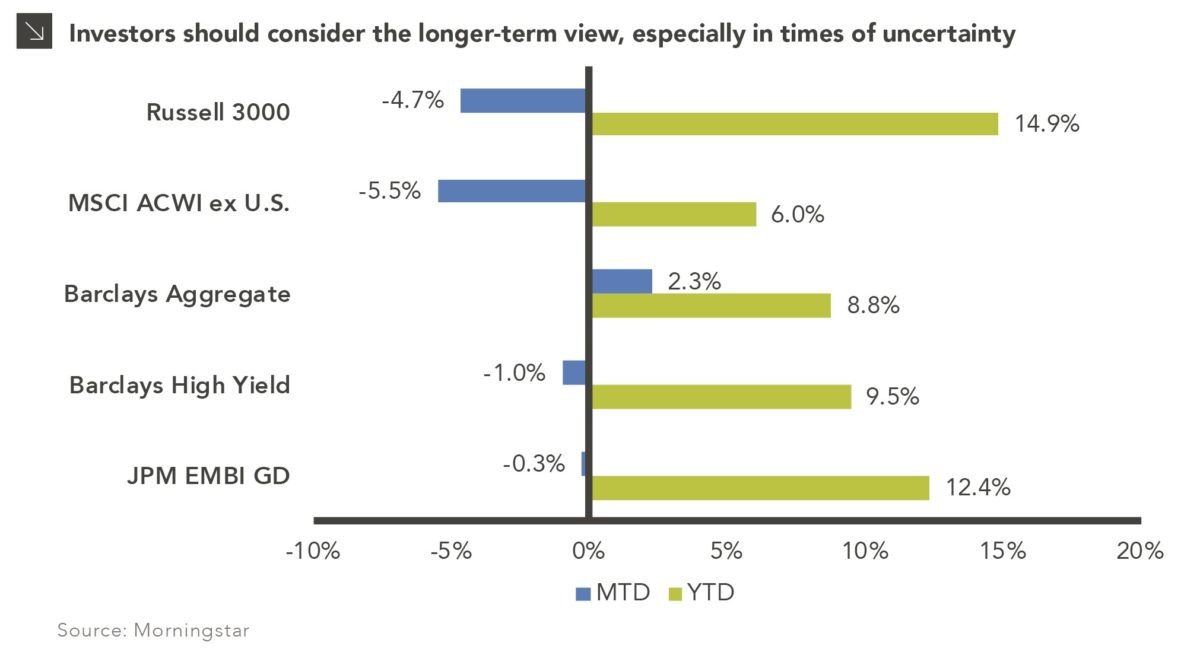
Given this week’s volatility driven by (brief) yield curve inversion, the ongoing U.S.-China trade dispute, disappointing economic data from Germany, and overall growing pessimism about future growth, investors’ growing concerns about portfolio returns are entirely justified. However, despite this week’s volatility and mostly negative news, almost all asset classes have delivered positive returns for the year, with the great majority of U.S. equity strategies up double digits. Furthermore, most fixed income strategies have profited from falling interest rates, as shown by positive returns from investment grade as well as below investment grade sectors. And for all the negative news out of the Eurozone and China, international equities — as represented by the ACWI ex-US index — are still up more than 6% through August 15th. While the rest of the year is likely to feature elevated volatility and lower returns, barring a major market correction most portfolios should remain in positive territory, despite what has transpired the first half of August. If nothing else, we encourage investors to take a long-term view of the markets and not overreact in times of market stress, as stepping back and taking a longer-term view of the markets indicates that 2019 has been a profitable year to date.

Print PDF > All is Not Lost for 2019

The opinions expressed herein are those of Marquette Associates, Inc. (“Marquette”), and are subject to change without notice. This material is not financial advice or an offer to purchase or sell any product. Marquette reserves the right to modify its current investment strategies and techniques based on changing market dynamics or client needs.
The Yield Curve Inverts: Time to Hunker Down?

This morning, the key range of the U.S. Treasury yield curve that is viewed as the bellwether of recessions — the 2-year versus the 10-year — inverted. The 10-year yield fell to 1.61%, below the 2-year’s 1.62%, as of the time of writing. The yield curve serves as a key indicator of market sentiment on future interest rates and therefore the future state of our economy. An upward sloping curve signifies a growing economy, while an inverted curve portends a contracting economy.

This newsletter details what investors should be aware of in light of the inversion, including the possibility of a recession, effects on the equity market, and other current events that may contribute to uncertainty and volatility.

Read > The Yield Curve Inverts: Time to Hunker Down?

The opinions expressed herein are those of Marquette Associates, Inc. (“Marquette”), and are subject to change without notice. This material is not financial advice or an offer to purchase or sell any product. Marquette reserves the right to modify its current investment strategies and techniques based on changing market dynamics or client needs.

Lower for Longer, or Negative Forever?

With Trump’s surprise announcement of additional tariffs at the beginning of this month — a day after the Fed’s rate cut — the yield curve continued its free fall and flattening that began in earnest at the beginning of 4Q18’s dislocation and the gradual heating-up of the tariff war. Sunday’s Argentine Presidential primary election surprise, where pro-free markets incumbent Macri lost to populist duo Fernandez/Kirchner by a wider than expected margin, further exacerbated that trend.

In this newsletter, we examine the driving forces behind this persistent yield curve decline and flattening and potential remedies to the “lower for longer” norm.

Read > Lower for Longer, or Negative Forever?

The opinions expressed herein are those of Marquette Associates, Inc. (“Marquette”), and are subject to change without notice. This material is not financial advice or an offer to purchase or sell any product. Marquette reserves the right to modify its current investment strategies and techniques based on changing market dynamics or client needs.

The Fed’s First Post-Recession Economic Stimulus

The Federal Reserve’s two central aims are to keep unemployment below a 5% threshold and inflation near a 2% constant. This week’s chart looks at how the Federal Reserve addressed these aims as they cut interest rates on Wednesday, July 31st, 2019, for the first time since the 2008 Financial Crisis from a fed funds target rate of 2.25%–2.5% to 2.0%–2.25%. This well-telegraphed and long-expected 25 basis point cut signals a shift in the Fed’s monetary policy towards one of dovish1 stimulus after a period of hawkishness from 2015 to 2018 that saw the Fed raise the fed funds target rate nine times from 0–0.25% to 2.25%–2.5%. In conjunction with this rate cut, the Fed also halted the run-off of their balance sheet by restarting their reinvestment in government bonds, effectively infusing more cash into the economy to provide further support.

As shown in the chart, this latest interest rate cut occurs with unemployment well below their 5% threshold — which by itself shows that stimulus is not necessary, while inflation is lower than their 2% target — which by itself shows that some stimulus would not hurt. The reasons for the Fed’s cut include a persistently slow global economy, weak business earnings environment, high U.S. rates relative to low and negative rates2 set by other central banks, the fact that low unemployment has not been driving inflation higher, and potential threats to global growth including Brexit and the tariff escalation between the U.S. and several countries, such as China.

For more information, please reference our full newsletter on the topic.

Print > The Fed’s First Post-Recession Economic Stimulus

1 Dovishness is a term used to describe central banks and central bankers who want to provide economic stimulus to keep unemployment low by reducing interest rates, which makes it easier for businesses to borrow and therefore hire people because of greater economic activity. This is in contrast with hawkishness, which describes central banks and central bankers who want to slow the economy down in order to contain inflation by raising interest rates, which makes it tougher for businesses to borrow and therefore restrains prices because of less economic activity.
2 Negative interest rates have recently become more prevalent among German and Japanese short term bonds as those economies continue to languish and their governments continue to provide more stimulus.

The opinions expressed herein are those of Marquette Associates, Inc. (“Marquette”), and are subject to change without notice. This material is not financial advice or an offer to purchase or sell any product. Marquette reserves the right to modify its current investment strategies and techniques based on changing market dynamics or client needs.

Stoking the Fire: The First Post-Recession Rate Cut

On July 31, 2019, the Federal Reserve cut interest rates for the first time since the 2008 Financial Crisis from a fed funds target rate of 2.25%–2.5% to 2%–2.25%. This well-telegraphed and long-expected 25 basis point cut, roughly 11 years after their last cut in December of 2008, signals a shift in the Fed’s monetary policy towards one of dovish stimulus after a period of hawkishness from 2015 to 2018 that saw the Fed raise the fed funds target rate nine times from 0–0.25% to 2.25%–2.5%.

This newsletter examines the reasons behind and the initial and potential reactions to the latest interest rate cut, including a look at unemployment, inflation, and the yield curve.

Read > Stoking the Fire: The First Post-Recession Rate Cut

The opinions expressed herein are those of Marquette Associates, Inc. (“Marquette”), and are subject to change without notice. This material is not financial advice or an offer to purchase or sell any product. Marquette reserves the right to modify its current investment strategies and techniques based on changing market dynamics or client needs.