2014 Market Preview

January 2014

Similar to previous years, we present our annual market preview newsletter. Each year presents new challenges to our clients, and 2014 is no different: We are coming off a banner year for U.S. equities, low interest rates continue to stymie fixed income investors, and while developed market equities enjoyed a strong 2013, emerging market stocks sputtered. In the alternative space, real estate and hedge funds proved accretive to portfolio returns, while growing dry powder in the private equity space is starting to raise a few eyebrows.

Download PDF

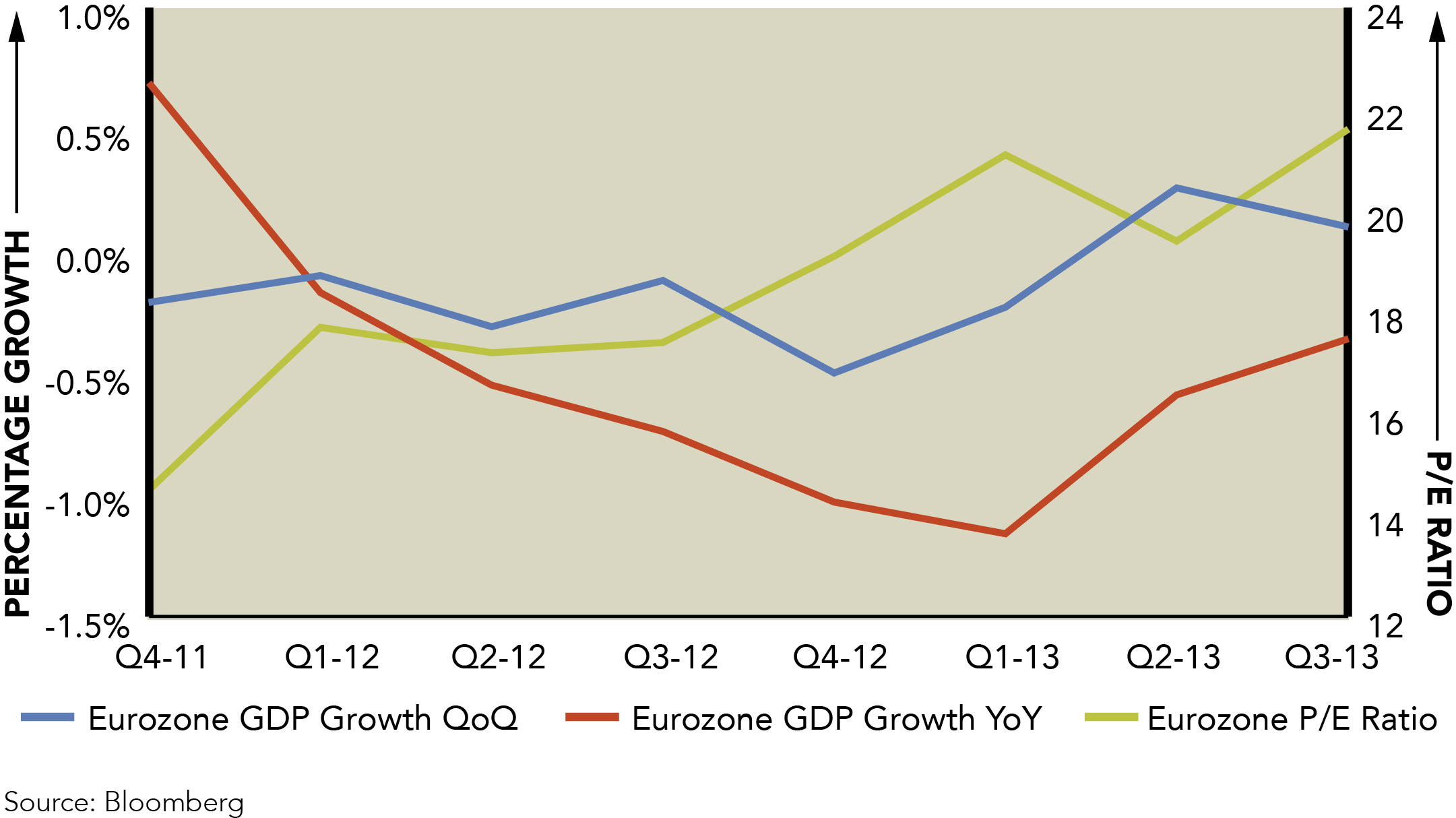
Eurozone Valuations Outpace GDP Growth

This week’s Chart of the Week examines GDP growth and valuation levels in the eurozone. The chart above depicts eurozone quarterly GDP growth compared to both the prior quarter and year. As the chart shows, eurozone GDP growth is at very low or even negative levels.

This week’s Chart of the Week examines GDP growth and valuation levels in the eurozone. The chart above depicts eurozone quarterly GDP growth compared to both the prior quarter and year. As the chart shows, eurozone GDP growth is at very low or even negative levels. Growth versus the prior year has been negative since the first quarter of 2012, while growth versus the prior quarter only recently turned positive (albeit very slow at .26%) in the second quarter of 2013.

The eurozone GDP growth or lack thereof does not seem to accurately correspond to eurozone valuation levels. As seen in the chart, the eurozone’s P/E ratio has continued to increase over the past 8 quarters despite little to no growth. The P/E ratio was 14.5 at the end of the fourth quarter of 2011. Since then, the P/E ratio has climbed to 21.6 on speculation that Europe will experience a strong recovery. However, despite continued investor optimism, the main question still remains: will the European recovery truly come to fruition?

Examining International Market Returns for U.S. Investors

This week’s COW looks at the year-to-date returns of the major international markets (Europe, Japan, and Emerging Markets) through September 25, 2013. This chart disaggregates the returns that U.S. investors have realized so far this year between the currency return and the local stock market performance

This week’s COW looks at the year-to-date returns of the major international markets (Europe, Japan, and Emerging Markets) through September 25, 2013. This chart disaggregates the returns that U.S. investors have realized so far this year between the currency return and the local stock market performance. While the depreciation of the Yen has helped drive the Japanese stock market to levels not seen since the late 1980’s, U.S. investors have only partially benefitted from the strong Japanese equity returns because of the fall in the Yen relative to the U.S. dollar. Interestingly, weak emerging market currencies were a theme for most of 2013, but with the Fed’s recent decision not to start tapering their quantitative easing (QE) program in September, emerging market currencies and equities have rallied significantly, pulling the year-to-date U.S. investor return close to even.

The Current Yield Environment

The S&P 500 returned -3.1% excluding dividends for the month of August. As the bull market seems to be losing steam, institutional investors will likely see lower returns from equity markets. Further compounding future portfolio returns is that bond prices are likely to be hampered by the threat of rising interest rates.

The S&P 500 returned -3.1% excluding dividends for the month of August. As the bull market seems to be losing steam, institutional investors will likely see lower returns from equity markets. Further compounding future portfolio returns is that bond prices are likely to be hampered by the threat of rising interest rates. Looking forward, a larger portion of investors’ returns may rely on receiving income in the form of interest and dividends rather than price appreciation.

With that in mind, we focus this week’s chart on asset class yields. Although the 10-year Treasury yield rose sharply in the 2nd quarter, this rise did not represent a parallel shift of the yield curve: yields on the shorter end of the curve remain low. Consequently, traditional bond portfolios with lower duration are still faced with the challenge of low yields, and the yields-to-maturity of the U.S. and Global Aggregate Bond Indexes remain compressed at 2.48% and 2.14%, respectively. Looking purely at yield, we see that senior secured loans (as measured by the CSFB Leveraged Loan Index), real estate (NCREIF Property Index), emerging markets debt, and high yield bonds are all yielding more than double the core bond market. Additionally, senior secured loans and real estate, in particular, offer lower interest rate risk. As such, these asset classes continue to offer compelling diversification benefits as components of an institutional portfolio.

The Wage Gap Between the U.S. and China Continues to Narrow

This week’s Chart of the Week examines the differences in average wages in the United States and China. As China has experienced substantial economic growth, it has also seen its average yearly wage for employed people in urban units rise from ¥9,333 in 2000 to ¥41,799 in 2011.

This week’s Chart of the Week examines the difference in average wages in the United States and China. As China has experienced substantial economic growth, it has also seen its average yearly wage for employed people in urban units rise from ¥9,333 in 2000 to ¥41,799 in 2011 (most recently available data). When converted and normalized into 2011 U.S. dollars, this is an increase from $1,472 to $6,468, which constitutes a 14.6% compounded annual growth rate in real dollars. On the other hand the U.S., like most other developed countries, has experienced stagnant real wage growth, fluctuating between $41K and $44K over the past decade.

A significant difference between the two wage levels remains with the average wage in the U.S. almost seven times higher than the average Chinese wage. However, many of the largest sectors of the Chinese economy are far more labor intensive and better represented by the U.S. minimum wage. The current minimum wage in the U.S. is $7.25/hr or $14,500 annually. Assuming there is no change in the U.S. real minimum wage, the Chinese average wage is on pace to surpass this in 2017.

While China has often been a cheap source of labor for businesses, wage increases could hurt the competitiveness of firms located in China. If Chinese wage growth continues on the current trend companies may decide that it is no longer optimal to produce in China. The effect this would have is twofold. As businesses leave China, the growth in the Chinese economy could slow. Secondly, this could lead to more jobs returning to the U.S., lowering unemployment and increasing wages.

Do Longer-Term Metrics Make European Stocks More Attractive?

This week’s Chart of the Week shows CAPEs for market stock indices of 47 countries including the United States. The U.S. comes in at the middle of the pack, with a CAPE of 19.6.

Most investors are familiar with the PE ratio as a metric of valuation. This metric divides the current stock price by trailing twelve month earnings. In effect, it measures how much an investor pays compared to the amount of earnings a company or index provides. As a measure of valuation, PE can be heavily influenced by the cyclical nature of earnings. To smooth out fluctuations due to cyclicality, one approach, popularized by Robert Shiller, is to divide equity index prices by ten-year average earnings. The measure, known as the Cyclically Adjusted PE (CAPE), can provide an indication of when markets are exceptionally over or undervalued.

This week’s Chart of the Week shows CAPEs for market stock indices of 47 countries including the United States. The U.S. comes in at the middle of the pack, with a CAPE of 19.6. This is much higher than the trailing 12-month PE of 13-14, due to the large declines in earnings suffered over the last ten years. Perhaps unsurprisingly, the countries with the lowest CAPEs reside in peripheral Europe. Greece, with a CAPE of 3.0, looks extremely undervalued by this measure. Spain and Italy, which are both home to large multinational corporations, have CAPEs just below 10. The Netherlands, which is a net lender in the Eurozone, has a CAPE below 10.

Of course, while low valuations have tended to precede strong long-term performance, this is by no means guaranteed. Additionally, given the ongoing nature of the Eurozone crisis, short-term performance of European equity markets is likely to be choppy at best. The Athens Stock Index, for example, is down 49% over the last year alone. Still, on a relative valuation basis, European equity markets look attractive compared to other countries for long-term investors.

Global Growth Trending Downward

On Monday, the IMF lowered its 2012 forecast for global growth to 3.5% down from an estimate of 3.6% made earlier this year. The growth forecast for 2013 was also lowered to 3.9% from 4.1% as growth around the world continues to stagnate.

On Monday, the IMF lowered its 2012 forecast for global growth to 3.5% down from an estimate of 3.6% made earlier this year. The growth forecast for 2013 was also lowered to 3.9% from 4.1% as growth around the world continues to stagnate. Emerging economies – a primary driver of future growth – have seen growth rates drop from 7.5% in 2010 to a projected 5.6% in 2012. The most notable member of the emerging economies, China, has begun to pursue expansionary monetary policy in hopes of reversing its slowing economic growth. Another significant headwind for global growth is the European Union, which is expected to be flat in 2012, as Spain, its third largest contributor, continues to be mired in a national debt crisis. In the U.S., growth is expected to remain well below trend as the economic recovery, now in its fourth year, struggles to gain momentum. Collectively, the struggles of these countries will make it difficult to achieve global growth north of 4% over the next few years.

U.S. Manufacturing: Headwinds but Hope

Despite the crisis in Europe, global stock markets have generally been buoyed by strong earnings growth from the globe’s two largest economies, the US and China. However, evidence of a slowdown in China has fueled debate over whether the US will be able to continue growing in the face of European and Chinese weakness.

Much focus has already been directed to the economic slowdown in the Eurozone with Italy, Spain, Portugal, and Greece already in recession. Despite the crisis in Europe, global stock markets have generally been buoyed by strong earnings growth from the globe’s two largest economies, the US and China. However, evidence of a slowdown in China has fueled debate over whether the US will be able to continue growing in the face of European and Chinese weakness. While still growing rapidly relative to mature economies, China’s GDP growth dropped to 8.1% in the 1st quarter and is projected to fall to 7.4% in the 2nd quarter. The decrease in GDP growth prompted the Chinese Central Bank to cut interest rates in June for the first time in three years.

Monday’s release of the ISM Manufacturing PMI is raising alarms that the impact of a global slowdown is beginning to be felt in the US. In the month of June, the Purchasing Managers Index fell 7.1% from 53.5 to 49.7, signaling a general softening in US manufacturing activity. More troubling was that the ISM Manufacturing New Orders sub-index fell from 60.1 to 47.8 over the month. While this data did not shake the stock market, investors should be wary of a potential backlash if the Fed does not provide the additional monetary stimulus that some seem to be anticipating. However, the recent slowdown in inflation (CPI) indicates that there may be room for the Fed to act.

Despite the global growth headwinds, there is reason to remain optimistic about the profitability of US manufacturers. The ISM Manufacturing Prices sub-index fell drastically in June from 47.5 to 37.0. That means that the cost of US manufacturers’ production inputs is at the lowest since early 2009. The combination of a strong US Dollar and less demand from China for raw materials such as steel, copper, and fuel is providing input cost relief to many US companies.

Currency Challenges for the BRICs

Given the volatility of the global markets in recent years, foreign currencies have become a substantial factor to consider when investing in non-U.S. securities. The BRICs (Brazil, Russia, India, and China), generally known as the most influential emerging markets, are experiencing various situations that have had a negative effect on their respective currencies.

Given the volatility of the global markets in recent years, foreign currencies have become a substantial factor to consider when investing in non-U.S. securities. The BRICs (Brazil, Russia, India, and China), generally known as the most influential emerging markets, are experiencing various situations that have had a negative effect on their respective currencies. Brazil has seen a resurgence in its consumer default rate as previous bad loans are manifesting themselves. Many analysts believe that this is similar to the recent subprime loan collapse in the United States, as the consumer debt default rate reached 7.6% in April. India is in danger of losing its investment grade rating due to trade and budget deficits. Russia’s main export of crude oil has suffered a 26% drop in price this quarter alone, driving investors to more stable nations. China has avoided the major drops that other currencies have versus the dollar, and the economic policies have thus far kept the currency value at a secure value, though it dropped over 1% in the second quarter. Furthermore, home prices fell in 54 of 70 cities tracked in China during the month of May. China has also reduced its annual growth target to 7.5% from 8.0% due to the slowing of demand for its exports as consumer demand in other nations has been sluggish.

The weakening currencies could present an opportunity for investors looking to enter emerging markets, as it may increase the competitiveness of the emerging markets countries affected, and hurt corporations based in developed countries with strong presence in the BRICs. For example, analysts believe the currency effect in Brazil will be a significant headwind this quarter for Coca-Cola Co., which has been investing heavily in South America and has experienced substantial growth in the region.

Trends in Tax Revenues

This week’s chart shows trends in tax revenues, indexed to 2007, for a group of ten selected countries (based on rolling twelve month averages for each). Taxes are the main source of government revenues and a crucial factor for the fiscal stability and economic growth of countries.

This week’s chart shows trends in tax revenues, indexed to 2007, for a group of ten selected countries (based on rolling twelve month averages for each). Taxes are the main source of government revenues and a crucial factor for the fiscal stability and economic growth of countries. Tax revenues are appropriated for public works, interest payments, financial assistance, education, infrastructure, growth incentives, and counter cyclical measures.

As the chart illustrates, there has been a divergence of tax revenues between developed and emerging market countries. Since 2007, most emerging market governments’ tax revenues have increased while the majority of developed countries’ tax revenues have either decreased or slightly increased.1 Many developed countries across the world continue to face revenue headwinds as they de-lever and recover from the 2008 financial crisis and subsequent economic slow-down, all of which have lowered tax revenues.

Going forward, this chart suggests a much more favorable backdrop for emerging market countries compared to developed countries. An increasing trend in tax revenues should allow emerging market countries to allocate money to public services as well as investment in infrastructure, education, research and development, and other important factors that contribute to countries’ long-term success and prosperity. Developed countries are struggling to maintain public services and programs with limited revenues and are being forced to borrow money; the U.S. has over $15 trillion in debt outstanding and is projected to run a deficit of approximately $1.2 trillion in 2012.2 As this occurs, investment in infrastructure, education, and other important growth platforms is placed on hold as more money is allocated towards debt and interest payments.

___________________________________________________________________________________

1 Bank of Korea, Bank of Italy, Federal Reserve, Bank of Thailand, UK Office for National Statistics, Bank of Greece, National Bank of Poland, Bank of Japan, Bank of Spain, Bank of the Republic of Columbia

2 Congressional Budget Office as of 03/31/2012