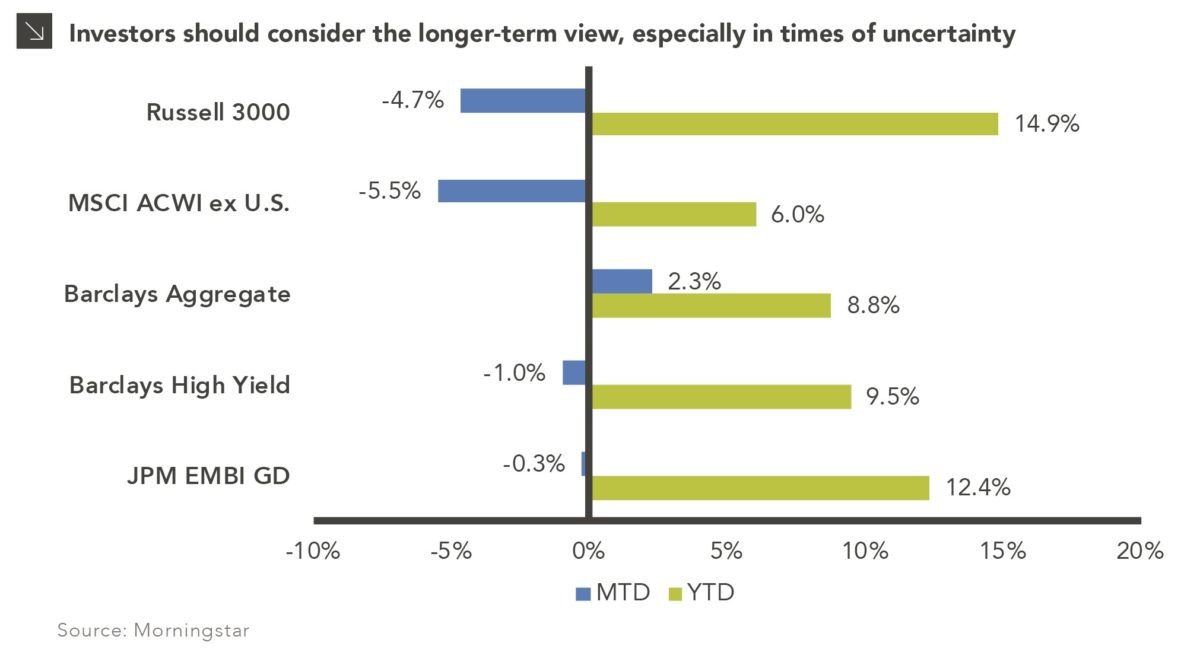
Sell in May and Go Away?

Global equity markets declined in May on a flurry of geopolitical news. As tensions persist, stocks are grasping to sustain their former rocket-like pace.

This newsletter details the recent trade and tariff announcements, their impact on the markets, and a look at what to expect in the remaining months of 2019.

Read > Sell in May and Go Away?

The opinions expressed herein are those of Marquette Associates, Inc. (“Marquette”), and are subject to change without notice. This material is not financial advice or an offer to purchase or sell any product. Marquette reserves the right to modify its current investment strategies and techniques based on changing market dynamics or client needs.

First Quarter Review of Asset Allocation

Heading into 2019, the primary risks facing financial markets were the trade war with China, the U.S. government shutdown, Brexit uncertainty, and further Fed rate hikes. However, in the first quarter the majority of these worries subsided.

In this newsletter, we analyze the current market environment with a review of recent performance and future expectations for each major asset class. As always, we caution investors to stay diversified and rebalance as appropriate. There are always potential disruptors to the financial markets and the most powerful tend to be largely unexpected. We will continue to monitor markets and developments as they occur to guide our clients to the most optimal portfolio decisions given the backdrop of program goals and risk tolerance.

Read > First Quarter Review of Asset Allocation

The opinions expressed herein are those of Marquette Associates, Inc. (“Marquette”), and are subject to change without notice. This material is not financial advice or an offer to purchase or sell any product. Marquette reserves the right to modify its current investment strategies and techniques based on changing market dynamics or client needs.

MSCI Plans to Increase China A-Share Exposure

After several years of consideration, in May 2018 MSCI added a small portion of the China A-share market to its Emerging Markets Equity Index using a 5% inclusion factor. After additional consultation following that successful implementation, MSCI recently announced plans to further increase the inclusion factor to 20% in three steps, with the final step occurring in November 2019.

This newsletter explains MSCI’s considerations in increasing the inclusion factor and the process the index will undergo in the next nine months to implement the increase, as well as an explanation of what an A-share is and what their future may hold for investors.

Read> MSCI Plans to Increase China A-Share Exposure

For further coverage on A-shares, reference our video from 2018’s Investment Symposium, “Getting “A” Share of the Chinese Market“, or two previous charts of the week linked above.


The opinions expressed herein are those of Marquette Associates, Inc. (“Marquette”), and are subject to change without notice. This material is not financial advice or an offer to purchase or sell any product. Marquette reserves the right to modify its current investment strategies and techniques based on changing market dynamics or client needs.

2019 Market Preview

Coming off a difficult 2018, investors face a litany of questions going into this year, whose potential answers will undoubtedly have an impact on the capital markets. The following set of newsletters examines the primary asset classes we cover for our clients, with in-depth analysis of last year’s performance and more importantly, trends, themes, and projections to watch for in 2019. We hope these materials can assist you and your committees as you plan for the coming year, and please feel free to reach out to any of us should you have further questions about the articles or wish to review the 2019 Market Preview Webinar recording. Here’s to a better year from the capital markets in 2019!

U.S. Economy: The View from the Top?
by Jeffrey Hoffmeyer, CFA, Lead Analyst, Asset Allocation

Fixed Income: Kicking Off the Year with Moderate Valuations, a Less-Hawkish Fed and Growing Global Tariffs
by Ben Mohr, CFA, Senior Research Analyst, Fixed Income

U.S. Equities: The Pro-Growth Narrative Fizzles Out
by Samantha T. Grant, CFA, CAIA, Senior Research Analyst, U.S. Equities
and Rob Britenbach, CIPM, Research Analyst, U.S. Equities

Non-U.S. Equities: Can They Get Back on Track?
by David Hernandez, CFA, Senior Research Analyst, International Equities
and Nicole Johnson-Barnes, Research Analyst

Real Estate: Navigating Through a Late Market Cycle
by Jeremy Zirin, CAIA, Senior Research Analyst, Real Assets

Infrastructure: Stable Cash Flows in an Uncertain Market Environment and the Evolving Landscape
by Jeremy Zirin, CAIA, Senior Research Analyst, Real Assets

Hedge Funds: Is Market Volatility Here to Stay?
by Joe McGuane, CFA, Senior Research Analyst, Alternatives

Private Equity: Poised for Robust Deployment
by Derek Schmidt, CFA, CAIA, Senior Research Analyst, Private Equity


The opinions expressed herein are those of Marquette Associates, Inc. (“Marquette”), and are subject to change without notice. This material is not financial advice or an offer to purchase or sell any product. Marquette reserves the right to modify its current investment strategies and techniques based on changing market dynamics or client needs.

What Happened to International Small-Cap Equities This Year?

This year’s non-U.S. equity returns have been disappointing, particularly for developed small-cap, with the MSCI EAFE small-cap index down 17.6% through December 18th. The following is a high-level review of why the asset class has struggled so much this year.

Download PDF >

The opinions expressed herein are those of Marquette Associates, Inc. (“Marquette”), and are subject to change without notice. This material is not financial advice or an offer to purchase or sell any product. Marquette reserves the right to modify its current investment strategies and techniques based on changing market dynamics or client needs.

A Shining Light for China?

On September 25, MSCI, Inc. — a leading global provider of research-based indices and analytics — announced its plans to consult on a further weight increase to China A-shares in the MSCI Global Investable Market Indexes. The changes under consideration include quadrupling the weighting of Chinese A-share large companies in its global benchmarks, adding mid-cap names, and including ChiNext as an eligible stock exchange segment. This consultation follows the successful implementation of an initial 5% inclusion of China A-shares in the MSCI China and related composite indices (such as the MSCI Emerging Markets Index) in May and August 2018.

Let’s unpack the full proposal, piece by piece. The first change would be an increase to the inclusion factor of China A-share large cap securities from 5% to 20% over two phases. Specifically, MSCI would target a 7.5% increase coinciding with their May 2019 semi-annual index review and another 7.5% bump up with their August 2019 quarterly index review. Second, MSCI would increase the list of eligible Chinese stock exchange segments by adding the ChiNext board of the Shenzhen Stock Exchange during the May 2019 review. The ChiNext board, where most technology firms make their debut, represents 20% of the total China A-shares opportunity set and has a larger free-float adjusted market capitalization than Shenzhen main and SME boards. Lastly, China A-share mid cap securities would be included with a 20% inclusion factor as part of the May 2020 semi-annual index review.

MSCI’s rationale for the suggested expansion of A-share inclusion is largely driven by the incremental improvements in market accessibility implemented by China. Since the announcement of MSCI China A shares inclusions in July 2017, the daily trading limit and number of new accounts opened has significantly increased within the Stock Connect program, which is an investment channel between Hong Kong, Shanghai, and Shenzhen that allows international and mainland Chinese investors to trade securities in each other’s markets. There has also been a considerable drop in the number of trading suspensions. For example, the number of large cap trade suspensions in the MSCI China A International IMI Index has decreased from 16 to zero over the past 15 months.

The above chart depicts the pro-forma country weights should these changes be implemented. As indicated, Chinese A-shares’ portion of the index would increase from 0.7% to 3.4%. The anticipated net effect would be a slight increase in China’s overall representation in the MSCI Emerging Markets index by 1.0%.

While MSCI’s consultation may or may not lead to changes in the MSCI indices, this proposal indicates growing confidence in market liberalization within China. And, if implemented, these moves will increase foreign investor inflows into China’s $7 trillion stock market. Chinese markets have been able to handle increased trading volumes. This reaffirms our view that institutional investors will increasingly have exposure to China’s local markets over medium to long term.

Print PDF

The opinions expressed herein are those of Marquette Associates, Inc. (“Marquette”), and are subject to change without notice. This material is not financial advice or an offer to purchase or sell any product. Marquette reserves the right to modify its current investment strategies and techniques based on changing market dynamics or client needs.

A “Halftime” Review of Asset Allocation for 2018

As of June 30th, the Russell 3000 index was up only 3.2%, a far cry from its 10-year annualized return of almost 9%; the MSCI ACWI ex-U.S. ­— a broad proxy for international stocks — has been even more disappointing, down 3.8% compared to its 2017 return of 27%. Furthermore, most bond strategies are negative for the year, thus dispelling the notion of diversification. However, the year is only halfway complete and as we have seen repeatedly in the capital markets, fortunes can change rapidly and unpredictably. In an effort to formulate explanations and expectations, the following newsletter investigates the disappointing performance from the first half of the year, as well as potential outcomes for the remainder of 2018.

Download PDF >

The opinions expressed herein are those of Marquette Associates, Inc. (“Marquette”), and are subject to change without notice. This material is not financial advice or an offer to purchase or sell any product. Marquette reserves the right to modify its current investment strategies and techniques based on changing market dynamics or client needs.

The ECB Ends QE

Late last week the European Central bank (ECB) announced an end to its quantitative easing (QE) program. Over the last three years the ECB purchased 2.4 trillion euros in bonds to help boost the region’s economy. In October of this year the monthly bond purchases will be halved to 15B euro and move to zero at the end of the year. The ECB balanced this hawkish move with a commitment to keep interest rates at current levels at least through the summer of 2019. In addition, the ECB will continue to reinvest its proceeds from current bond holdings for “an extended period of time.”

The ECB’s actions signal confidence in the economic recovery and provide a timeline for markets to adjust. Despite the end of QE, policies remain accommodative and low borrowing costs should persist into the near future. The central bank remains ready to step in should the region’s economy need further support, but has taken the first steps towards a more normal monetary policy.

Print PDF

The opinions expressed herein are those of Marquette Associates, Inc. (“Marquette”), and are subject to change without notice. This material is not financial advice or an offer to purchase or sell any product. Marquette reserves the right to modify its current investment strategies and techniques based on changing market dynamics or client needs.

Italian Elections and a Possible EU Exit

With Italy’s general election set for March 4th, this week’s chart examines the probability of a Euro break-up. This time last year European political risks were at the forefront of investors’ minds. The Netherlands, France, and Germany all held elections in 2017, with investors particularly concerned about France, where the anti-EU Marine Le Pen was polling well headed into elections. Ultimately, each country avoided anti-euro leadership and markets welcomed the results.

Now Italy will hold elections and there are several parties and political factions jockeying for leadership. Based on polling, experts expect no clear winner thus leading to negotiations to form a coalition government. Despite this uncertainty, the Sentix Euro Break-up Index has fallen to an all time low. Over the last two years the European economy has improved dramatically with a falling unemployment rate and rising consumer and business confidence readings. With a rosier outlook on the horizon, the idea of leaving the Euro has become less appealing to citizens. In fact, support for the EU has reached a 10-year high according to the most recent European Commission study. All of this means that an Italy EU exit event, or as we like to call it, Quitaly, is unlikely to occur.

Print PDF

The opinions expressed herein are those of Marquette Associates, Inc. (“Marquette”), and are subject to change without notice. This material is not financial advice or an offer to purchase or sell any product. Marquette reserves the right to modify its current investment strategies and techniques based on changing market dynamics or client needs.

Value Underperformance in the Current Market Cycle

With the value premium seemingly in decline, value investors have had a lot to complain about over the past ten years. Growth stocks continue to soar despite rich valuations and increasingly lofty expectations. However, we are most likely closer to the end than the beginning of this “pro-growth” trend.

Download PDF


The opinions expressed herein are those of Marquette Associates, Inc. (“Marquette”), and are subject to change without notice. This material is not financial advice nor an offer to purchase or sell any product. Marquette reserves the right to modify its current investment strategies and techniques based on changing market dynamics or client needs.