Coronavirus Roils the Equity Markets

U.S. equities recently experienced a sharp three-day sell-off as the market digested the potential for short-term disruptions to economic growth and company earnings due to the Coronavirus (COVID-19). With new health figures coming out daily, it is easy to become alarmed. However, as our Chart of the Week from February 13th highlighted, prior health crises have been proven to be non-events longer-term for equity markets. Similar outbreaks in the past caused short-term sell-offs in equity markets but longer-term saw positive market performance.

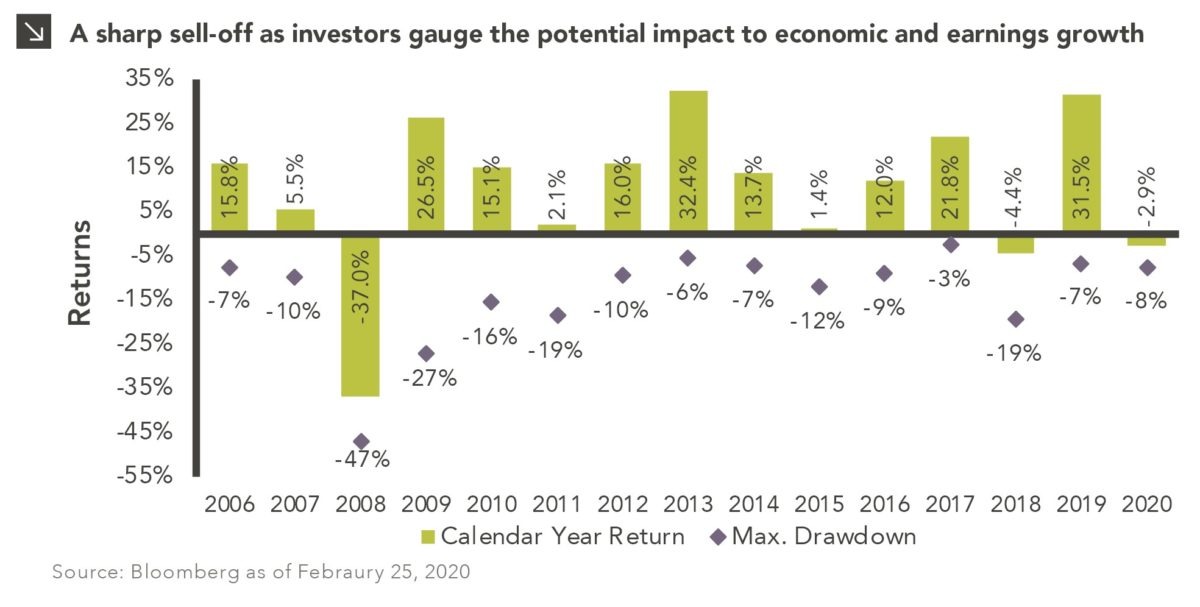
This week’s chart shows calendar year returns for the S&P 500 along with the max drawdown that occurred in each respective year. As of February 25, 2020, the S&P 500 has recorded a year-to-date drawdown of 7.6%. The current pullback is undeniably sharp in nature, but it is important to maintain perspective during turbulent times. Over the past 15 years, the average annual max drawdown was 14%. Many years experienced drawdowns near this level, yet still yielded a positive return for the year. On average, equities see a 5% pullback four times per year, a 10% pullback once per year, and a 20% correction once every five years.

While no one knows the full impact that the current outbreak will have to supply chains, trade, or travel, we recommend taking a long-term view to investing. The market had been looking past this current health crisis until the last few days, so a repricing of risk was inevitable. As this is an evolving situation, there is risk that the economic impact could increase and add further pressure to equities. However, the current pullback remains in-line with historical trends.

Print PDF > Coronavirus Roils the Equity Markets


The opinions expressed herein are those of Marquette Associates, Inc. (“Marquette”), and are subject to change without notice. This material is not financial advice or an offer to purchase or sell any product. Marquette reserves the right to modify its current investment strategies and techniques based on changing market dynamics or client needs.

Coronavirus and the U.S. Economy: Assessing the Impact

Over the last month, the world has been gripped by fears of the coronavirus and its eventual toll on the global economy. Most economists expect global economic growth to reaccelerate in the second half of the year after the virus peaks. We agree that most of the negative effects will most likely be felt in the first half of 2020.

Since January and February Chinese economic data will not be released for a few weeks, we thought it would make sense to review the current state of the economy in the United States. The table above shows leading indicators for the U.S. economy. Green denotes a healthy measure and red denotes a deteriorating measure. Some of the more stable measures over the past few years have been the 50-year low unemployment rate and inflation, which has been stable at 2%. The more volatile measures have been stock market valuations, the purchasing manufacturer’s index (“PMI”; a gauge of domestic manufacturing activity), and corporate earnings growth. Let’s start with PMI first since stock market valuation and earnings growth are more intertwined. PMIs have been under pressure since the start of the U.S.-China trade war in 2018. In January 2020, PMIs traced their way back into expansionary territory (i.e., above 50), but the coronavirus fallout may cast a cloud over manufacturing in the coming months.

What about the U.S. equity market? Last year, corporate earnings growth was virtually flat in an expensive stock market. Since then, stock market valuations¹ have come off their 2019 high but are still above the 10-year historical average of 16 times forward earnings. We believe meaningfully positive corporate earnings growth will be needed to support such an above-average market valuation. The most obvious way to ensure that is to have a strong U.S. consumer. Consumer confidence has steadily increased throughout this business cycle and right now consumers are as confident as they have ever been. Since the U.S. consumer drives two-thirds of the economy, we will be closely monitoring the consumer for weakening sentiment through measures like retail sales, revolving debt defaults, overall debt level, and other telling data. While we expect some metrics to potentially soften due to the coronavirus, we expect most to be positive by year-end. Ultimately, much like SARS and MERS, the virus’s bark will be much worse than its bite on the U.S. economy and equity market.

Print PDF > Coronavirus and the U.S. Economy: Assessing the Impact

¹ As measured by forward P/E
² FactSet Expected Earnings Growth for 2020


The opinions expressed herein are those of Marquette Associates, Inc. (“Marquette”), and are subject to change without notice. This material is not financial advice or an offer to purchase or sell any product. Marquette reserves the right to modify its current investment strategies and techniques based on changing market dynamics or client needs.

2020 Market Preview

2019 was certainly a profitable year for investors as traditional and alternative asset classes delivered positive returns.  As we enter 2020, there are a litany of questions facing global markets ranging from the U.S. election to trade disputes to global monetary policy, all of which will undoubtedly influence investment returns. The following newsletters examine the primary asset classes we cover for our clients, with in-depth analysis of last year’s performance and more importantly, trends, themes, and projections to watch for in 2020.

We hope these materials can assist you and your committees as you plan for the coming year, and please feel free to reach out to any of us should you have further questions about the articles. We have also produced a 2020 Market Preview video if you would like to hear a high-level summary of the market previews. Here’s to another positive year from the markets in 2020!

U.S. Economy: Signs of Slowing?
by Greg Leonberger, FSA, EA, MAAA, Partner, Director of Research

Fixed Income: The New Roaring Twenties — Will It Be Different This Time?
by Ben Mohr, CFA, Director of Fixed Income

U.S. Equities: Climbing the Wall of Worry
by Robert Britenbach, CFA, CIPM Research Analyst, U.S. Equities

Non-U.S. Equities: Big Expectations, Little Wiggle Room
by David Hernandez, CFA, Senior Research Analyst, Non-U.S. Equities
and Nicole Johnson-Barnes, CFA, Research Analyst

Real Estate: What Will Happen Next?
by Jeremy Zirin, CAIA, Senior Research Analyst, Real Assets

Infrastructure: The Energy Revolution Is Driving the Future of Infrastructure
by Jeremy Zirin, CAIA, Senior Research Analyst, Real Assets

Hedge Funds: Rising Geopolitical Risks and a U.S. Election Could Lead to Tempered Expectations
by Joe McGuane, CFA, Senior Research Analyst, Alternatives

Private Equity: As Asset Class Grows, Continues to Deliver for Investors
by Derek Schmidt, CFA, CAIA, Director of Private Equity

Private Credit: An Asset Class Coming Into Its Own
by Brett Graffy, CAIA, Research Analyst

To read the above files in one combined document > 2020 Market Preview


The opinions expressed herein are those of Marquette Associates, Inc. (“Marquette”), and are subject to change without notice. This material is not financial advice or an offer to purchase or sell any product. Marquette reserves the right to modify its current investment strategies and techniques based on changing market dynamics or client needs.

2020 Market Preview Video

This video coincides with our annual Market Preview newsletters and includes a recap of 2019’s performance and what investors can expect heading into 2020. 2019 was certainly a profitable year for investors as traditional and alternative asset classes delivered positive returns. As we enter 2020, there are a litany of questions facing global markets ranging from the U.S. election to trade disputes to global monetary policy, all of which will undoubtedly influence investment returns.

This video is part of our Market Insights series, a quarterly presentation designed to brief clients on the market as soon as possible after quarterly market data becomes available. Members of our research team discuss the overall U.S. economy, along with fixed income, U.S. and non-U.S. equity, hedge funds, private equity, real estate, and infrastructure.

For more information, questions, or feedback, please send us an email.

Despite Political Tensions, 2020 off to a Great Start

This week’s chart shows the cumulative S&P 500 return and 10-year Treasury yields through January 21st. The S&P 500 is up over 3% year-to-date despite impeachment proceedings and geopolitical tensions with Iran. We investigate why equity markets have remained strong through a seemingly difficult start to an election year.

Impeachment proceedings allege that Trump interfered in the coming 2020 election by holding back millions of dollars of military aid to Ukraine in exchange for them launching an investigation into Joe Biden. The market seems relatively unphased, however, as Republicans control a majority in the Senate of 53 to 47. A two-thirds majority (67 senators) is required to convict Trump and remove him from office. This seems unlikely as evidence remains thin and he retains backing from the Republican party.

Iran has been another point of conflict early this year as the U.S. killed Qassem Soleimani as a result of his alleged targeting of U.S. embassies. Iran then responded by firing missiles at U.S. targets in Iraq. It is widely viewed that Iran is looking to avoid a head-on conflict with the U.S. as economic sanctions are harming the Iranian economy. As the direct conflict seems to have abated and Iran’s economy is struggling, the market seems to view this as a non-event.

Rates have remained low and the economy is growing. Though there seems to have been a few bumps in the road, the S&P 500 continues to march higher. Uncertainties remain, however, as a surprise verdict from the impeachment trials or newly discovered coronavirus could upset the markets moving forward. Going forward, investors will look for positive earnings and economic growth — both domestically and abroad — to support further equity market gains in 2020.

Print PDF > Despite Political Tensions, 2020 off to a Great Start


The opinions expressed herein are those of Marquette Associates, Inc. (“Marquette”), and are subject to change without notice. This material is not financial advice or an offer to purchase or sell any product. Marquette reserves the right to modify its current investment strategies and techniques based on changing market dynamics or client needs.

Will the Good News Continue for U.S. Equities?

Domestic equity returns have surprised investors to the upside this year. The S&P 500 is up ~24% and the S&P has posted 26 new highs in 2019. Over the past 10 years, the S&P has recorded 233 new highs and a 481% cumulative return. The chart shows that many of the market highs were backloaded into the second half of the current recovery as economic growth and investor confidence increased. The S&P 500 did not reach its post-recession peak until 2013: four years after the financial crisis. During those four years, market volatility was elevated, but steadily decreasing.

2019’s market environment has been very different from 2009. The first contrast is valuations. In March 2009, the S&P 500 traded at 11.2 times forward earnings and today it trades at 19.2 times forward earnings, higher than its 10-year average of 16 times. Second, while market volatility on average has decreased by 50% since 2009, volatility (measured by the VIX index) ­— as shown by the orange diamond — remains elevated since 2017’s lows. Lastly, geopolitical risk has predominantly shifted from Europe and its sovereign debt crisis to the U.S.-China trade war, the latter of which is still not resolved. Luckily, U.S. businesses and especially U.S. consumers have proved resilient through these stressors. If the status quo continues into 2020, we can only hope for more of the same: positive equity returns albeit with higher market volatility and geopolitical risks.

Print PDF > Will the Good News Continue for U.S. Equities?


The opinions expressed herein are those of Marquette Associates, Inc. (“Marquette”), and are subject to change without notice. This material is not financial advice or an offer to purchase or sell any product. Marquette reserves the right to modify its current investment strategies and techniques based on changing market dynamics or client needs.

What Does an Election Year Mean for Equity Investors?

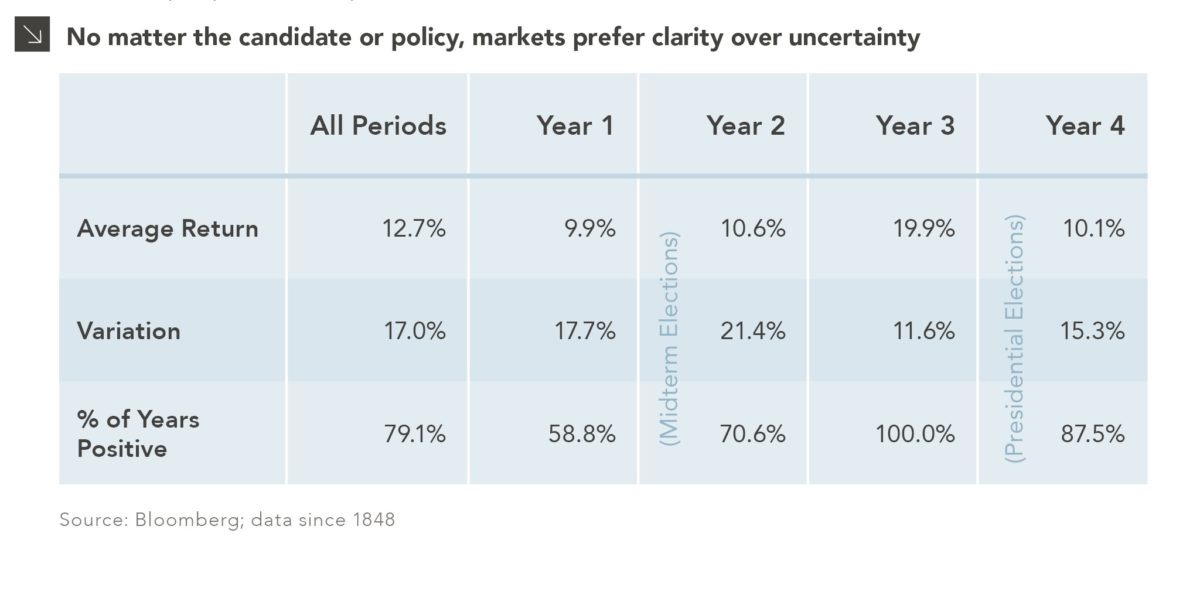
Prior to each presidential election, there is inevitable talk about market reactions to candidates and how policy changes could impact investors. As shown in the table, election years tend to exhibit more muted returns (as measured by the S&P 500 index) and greater volatility compared to the years leading into the presidential election. Year-to-date, 2019 has continued the Year 3 trend of strong performance, but if history is any indication, the 2020 outlook is less optimistic.

When it comes to Republicans vs. Democrats, political pundits often try to show one is better than the other for equity market returns. The reality, however, is that there isn’t enough of a sample size to draw any meaningful conclusions about parties, given the number of combinations of who controls the Presidency, Senate, and House of Representatives. Even in the case of 2016 with Trump’s unexpected win, markets initially sold off but quickly rebounded to their previous levels. No matter the candidate or the policy, markets care most about clarity and dislike uncertainty. As a result, we are expecting greater volatility over the next 12 months as we head into the 2020 presidential election. While the election will certainly not be the sole driver of market volatility, it will undoubtedly contribute to further uncertainty over the coming months.

Print PDF > What Does an Election Year Mean for Equity Investors?


The opinions expressed herein are those of Marquette Associates, Inc. (“Marquette”), and are subject to change without notice. This material is not financial advice or an offer to purchase or sell any product. Marquette reserves the right to modify its current investment strategies and techniques based on changing market dynamics or client needs.

Should Investors Worry About the Growing Deficit?

Americans have seen tax cuts and strong historical returns across asset classes since the Global Financial Crisis. However, though the general populace has been flourishing, the decrease in revenue flowing to the government and an increase in defense spending have contributed to the deficit increasing each year since 2016. Is the increased deficit a systemic risk or simply a side effect of a low rate environment?

This week’s chart of the week shows the United States’ deficit since 2007 in absolute terms as well as a percentage of GDP. The deficit spiked during the financial crisis at $1.4 trillion dollars as the administration took action to provide stimulus to the nation while in a recession. Shortly after, the deficit began decreasing as the economy moved towards recovery. More recently, the deficit has been increasing and is projected to reach $1.1 trillion dollars in 2020, an amount not seen since 2012. On an absolute basis, the deficit has been moving upward, but has this been offset by an increase in GDP? The blue line on the graph shows the deficit as a percentage of GDP. This metric has also been steadily increasing since 2016, though it is still much lower than during the Great Recession.

One area of potential concern is that during past expansions the deficit was decreasing or low, while now the deficit is moving in the opposite direction. If a recession were to occur, the government would have to borrow even more to stimulate the economy, pushing the debt level even higher and possibly raising concerns about the U.S. financial system. On the other hand, a theory of economic thought called Modern Monetary Theory (“MMT”) has gained traction due to the proposal of large increases in government spending by left-wing presidential candidates. MMT states that a country that prints its own currency does not have to worry much about debt as it can pay it off simply by adding to the monetary supply. Thus, the thought is that the only target for central banks should be inflation.

In all, deficit spending is a crucial means of financing public programs and stimulating the economy, no matter which economic viewpoint is applied. The U.S. deficit has ebbed and flowed over time and will continue to be a point of political contention for years to come.

Print PDF > Should Investors Worry About the Growing Deficit?

The opinions expressed herein are those of Marquette Associates, Inc. (“Marquette”), and are subject to change without notice. This material is not financial advice or an offer to purchase or sell any product. Marquette reserves the right to modify its current investment strategies and techniques based on changing market dynamics or client needs.

Live Videos: 2019 Investment Symposium Presentations

The six flash talks by our research team at Marquette’s 2019 Investment Symposium on October 4th are now available to view on our YouTube channel.

View each talk in the player above — use the upper-right list icon to access a specific presentation.

  • The Investment Case Behind ESG Investing and Implementation in Practice
    Nat Kellogg, CFA, Director of Manager Search
  • Beyond Traditional Real Estate: Exploring Opportunities in Non-Core Real Estate
    Jeremy Zirin, CAIA, Senior Research Analyst, Real Assets
  • So Many Risks, So Little Time: What’s Next in Global Risk?
    Nicole Johnson-Barnes, Research Analyst
  • U.S. Against the World: Should Investors Still Own International Stocks?
    David Hernandez, CFA, Senior Research Analyst, Non-U.S. Equities
    Samantha T. Grant, CFA, CAIA, Senior Research Analyst, U.S. Equities
  • Machine Learning for Investing: How is Artificial Intelligence Being Used in Asset Management?
    Ben Mohr, CFA, Director of Fixed Income
  • Pick Your Portfolio Poison: Recession or Inflation?
    Greg Leonberger, FSA, EA, MAAA, Director of Research

Marquette encourages open dialogue with our consultants and research team. For more information, questions, or feedback, please send us an email.

A Prism of Capital Market Views: Portfolio Manager Panel

Marquette’s 2019 Investment Symposium opened with a portfolio manager panel hosted by Marquette’s director of research, Greg Leonberger, FSA, EA, MAAA, and featuring:

  • John W. Rogers, Jr., Chairman, Co-CEO & Chief Investment Officer at Ariel Investments
  • Olga Bitel, Partner and Global Strategist at William Blair
  • Matthew J. Eagan, CFA, Executive Vice President and Portfolio Manager at Loomis, Sayles & Company