This legislative update covers the SECURE Act 2.0, summarizes requirements in the SECURE Act for defined contribution plans to provide participants with lifetime income illustrations, addresses the Department of Labor’s recent guidance regarding cryptocurrencies in retirement plans, and reviews plan features and enhancements employers are considering to improve employee retention amidst the “Great Resignation.”
The opinions expressed herein are those of Marquette Associates, Inc. (“Marquette”), and are subject to change without notice. This material is not financial advice or an offer to purchase or sell any product. Marquette reserves the right to modify its current investment strategies and techniques based on changing market dynamics or client needs.
Electric vehicle (EV) sales have seen significant growth over the past several years. Recently, elevated demand has contributed to a rampant increase in lithium prices, a primary input to the batteries that power EVs. As the global transition to a clean energy economy continues, the demand for lithium is expected to rise exponentially, to the point of creating a supply shortage in the coming years. While the metal itself is not in short supply, there are limitations to the extraction process and investment in the space has yet to catch up with the rise in demand.
In the last two years, lithium prices have soared more than 700% as sales of EVs have hit record-breaking numbers. Demand for lithium, according to McKinsey & Co., is expected to increase more than sixfold to 3.3 million metric tons in 2030 from 0.54 million metric tons in 2021. Supply is currently projected to reach 2.7 million metric tons by 2030, leaving 0.64 million in demand unaccounted for. The lithium mining industry today resembles an oligopoly, with only a handful of companies responsible for the majority of global supply. Going forward, this could change as further investment is made into the space, which could in turn help normalize price levels. While mining is often thought of as the polar opposite of sustainability, lithium mining actually helps further green energy initiatives, and lithium-related investments may serve ESG-focused investors well over time.
The opinions expressed herein are those of Marquette Associates, Inc. (“Marquette”), and are subject to change without notice. This material is not financial advice or an offer to purchase or sell any product. Marquette reserves the right to modify its current investment strategies and techniques based on changing market dynamics or client needs.
U.S. consumer sentiment has become increasingly pessimistic in 2022 as a plethora of macro headwinds have created uncertainty. The University of Michigan Consumer Sentiment Index, a key proxy for consumer confidence, fell to 58.4 in May, the lowest reading since August 2011. The survey aggregates consumer views across a range of questions including personal finances, general business conditions, housing market conditions, spending expectations, and outlook. The overall level of the index and the relative change from prior readings provide an indication as to how consumers feel about the current and future U.S. economy. Since its inception in 1978, the survey has posted a reading below 60 in only three other distinct periods: the late stages of the stagflationary environment in 1980, the Global Financial Crisis in 2008–2009, and a brief period in 2011 when S&P Global Ratings downgraded U.S. Treasury debt.
Despite consumer spending comprising the majority of GDP, extremely bearish consumer sentiment has historically been a poor predictor of recession. Survey readings below 60 have coincided with a recession only 33% of the time (two out of six recessions) since 1978. Consumer sentiment surveys seem to be far more indicative of the current consumer experience than the longer-term economic outlook. As seen in this week’s chart, the University of Michigan Consumer Sentiment Index has shown a strong correlation to gasoline prices — a very visible component of inflation for most consumers — especially during periods of rising gas prices. While current sentiment can have a very real impact on economic growth via consumer spending, it is important to consider this metric alongside other economic measures, many of which still show consumer strength. With the market laser-focused on the health of the U.S. consumer and the risk of recession, we will continue to monitor various economic indicators and advise our clients accordingly.
The opinions expressed herein are those of Marquette Associates, Inc. (“Marquette”), and are subject to change without notice. This material is not financial advice or an offer to purchase or sell any product. Marquette reserves the right to modify its current investment strategies and techniques based on changing market dynamics or client needs.
Equity markets have experienced heightened levels of volatility throughout 2022 with the S&P 500 down nearly 20% from its high in January. A host of macroeconomic factors — 40-year high inflation, supply chain disruptions, the war in Ukraine, and hawkish central bank policy — are stoking uncertainty in the markets and driving stocks lower. With the consumer at the center of the biggest unknown — whether the U.S. will dip into recession — the growing connection between individuals and the equity market is an increasingly important dynamic.
It’s generally accepted that the stock market is not the economy, though today the lines are more blurred. The portion of household financial assets held in equities has been steadily increasing, reaching an all-time high of 41.2% at the end of 2021. Individuals have an increasing stake in equity performance, with fluctuations in the stock market directly impacting consumer balance sheets and spending potential, and thus economic growth. This dynamic further complicates the job of the Federal Reserve as it looks to raise rates enough to combat heightened inflation without extinguishing growth. While no one has a crystal ball, continued market volatility seems likely. That said, for long-term investors, history has shown that markets are resilient and staying invested leads to the best outcomes; we encourage investors to remain disciplined.
The opinions expressed herein are those of Marquette Associates, Inc. (“Marquette”), and are subject to change without notice. This material is not financial advice or an offer to purchase or sell any product. Marquette reserves the right to modify its current investment strategies and techniques based on changing market dynamics or client needs.
Quite simply, this has been the worst start to a year since the 1930s:
One of only 19 quarters since 1976 when both bonds and stocks posted negative returns;
One of only six of those quarters when bonds have underperformed stocks;
The worst four-month return for the S&P 500 since 1939.
2022 to date has featured a myriad of macroeconomic factors coming to a head: inflation at its highest level since the 1980s, the Federal Reserve responding with aggressive rate hikes, and increasing concerns about the health of the consumer leading to a possible recession. An evolving pandemic, a war in Eastern Europe, and draconian lockdown policies in the world’s second-largest economy and largest manufacturing hub have further added to the problem and complicated the solution. With these macro headwinds and uncertainties driving markets year-to-date, Marquette’s fixed income, U.S. equities, and non-U.S. equities teams discuss the impacts on their asset classes and weigh in on the outlook from here.
The opinions expressed herein are those of Marquette Associates, Inc. (“Marquette”), and are subject to change without notice. This material is not financial advice or an offer to purchase or sell any product. Marquette reserves the right to modify its current investment strategies and techniques based on changing market dynamics or client needs.
On April 26th, 2022, Fidelity Investments announced plans to offer bitcoin for 401(k) plans. For Fidelity, this plan is a natural next step. As shown in Exhibit 1, Fidelity began exploring digital assets in 2014. Soon after, bitcoin-centric custody solutions began to emerge, followed by a private fund and spot-based ETF. While Fidelity’s embrace of bitcoin could be seen simply as bandwagon hopping, the trend below suggests that bitcoin may be part of a broader long-term digital asset strategy.
In this edition of DC Perspectives, we cover the implications of Fidelity’s announcement for bitcoin and digital assets broadly, for the investment industry, and for defined contribution plan sponsors.
The opinions expressed herein are those of Marquette Associates, Inc. (“Marquette”), and are subject to change without notice. This material is not financial advice or an offer to purchase or sell any product. Marquette reserves the right to modify its current investment strategies and techniques based on changing market dynamics or client needs.
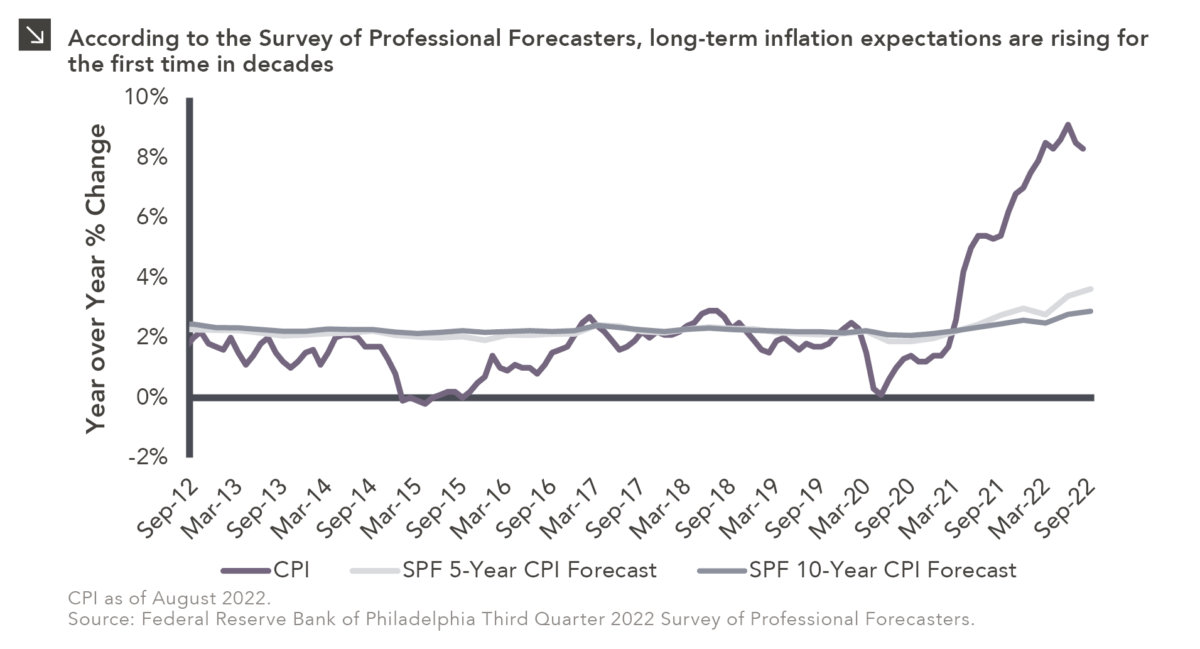
Uncertainty remains at the forefront for the U.S. consumer, with decades-high inflation exacerbated by supply chain bottlenecks and geopolitical conflicts triggering a sharp change in monetary policy. April CPI rose 8.3% year-over-year, down slightly from March’s 8.5% but still well above the Fed’s 2% target and the second highest print since 1982. Supply side dynamics, with consumers facing shortages from baby formula to custom kitchen deliveries, complicate the job of the Fed, whose tools only impact the demand side.
Despite increases in nominal earnings in line with long-term trends, inflation has outpaced wage growth, resulting in a downtrend in real weekly earnings since early 2021. With job openings still far exceeding the number of unemployed workers, many sectors across the economy are looking to fill vacancies. While higher wages are one way to attract workers, the decline in real wages is unlikely to abate until inflationary pressures can be contained. Wage growth can be a double-edged sword, with higher wages helping the consumer but contributing to sustained inflation. As the Fed looks to engineer a soft landing, reining in inflation without tipping the economy into recession, health of the U.S. consumer will be key. So far, the U.S. consumer and the labor market remain strong, but there are many moving pieces and there is much more to be done to stabilize prices.
The opinions expressed herein are those of Marquette Associates, Inc. (“Marquette”), and are subject to change without notice. This material is not financial advice or an offer to purchase or sell any product. Marquette reserves the right to modify its current investment strategies and techniques based on changing market dynamics or client needs.
This video is a recording of a live webinar by Director of Research Greg Leonberger, FSA, EA, MAAA, and Research Associate Nic Solecki covering cryptocurrency and other digital assets. While not an endorsement of cryptocurrency, Greg and Nic approach the topic from several angles, beginning by addressing common misconceptions, how blockchains work and why they require cryptocurrency, the evolution of digital assets as a potential asset class, sectors and subsectors within digital assets, and technology and concepts that have arisen alongside cryptocurrency, including smart contracts and decentralized finance (DeFi). They then examine adoption across the globe — from consumer to commercial to institutional investors — and provide an overview of performance and investment characteristics for digital assets, including risk/return profiles, liquidity, volatility, performance during drawdowns, and correlations to traditional asset classes. Finally, they address the market risks and most important considerations for investors. The webinar finished with a Q&A, which we have also included in this recording.
Marquette’s In Context series brings our latest research to your screen, with discussion led by the authors behind Marquette’s publications. From current events and trends to portfolio strategy and the broader economic landscape, we explore the questions investors are asking with consideration and the context you need to know.
Sign up for research alerts to be notified when we publish new videos here.
For more information, questions, or feedback, please send us an email.
The opinions expressed herein are those of Marquette Associates, Inc. (“Marquette”), and are subject to change without notice. This material is not financial advice or an offer to purchase or sell any product. Marquette reserves the right to modify its current investment strategies and techniques based on changing market dynamics or client needs. Marquette is an independent investment adviser registered under the Investment Advisers Act of 1940, as amended. Registration does not imply a certain level of skill or training. More information about Marquette including our investment strategies, fees, and objectives can be found in our ADV Part 2, which is available upon request.
All eyes are on rates this week as the Federal Open Market Committee (FOMC) convenes for the third time this year. In the seven weeks since the March meeting when the Committee raised rates an initial 25 basis points, continued inflationary pressures and an increasingly hawkish tone from Chairman Powell and other FOMC members have driven up market expectations for future hikes. The futures market has gone from pricing in a total of six 25 basis point increases and a year-end federal funds rate of 1.94% to ten hikes, including three consecutive 50 basis point increases, and a year-end rate of 2.81%. If market expectations prove correct, it would be the steepest pace of increases since the 1980s.
For a central bank that never quite normalized policy after the GFC, cooling decades-high inflation without tipping the economy into recession amid strained supply chains, a war in Europe, and COVID lockdowns in the world’s second-largest economy will be no easy task. Recent market volatility and sentiment reflect this uncertainty, with both equities and bonds down sharply year to date. While first quarter U.S. GDP “growth” of -1.4% missed expectations, the contraction was driven by trade and inventories as opposed to a consumer slowdown. The U.S. consumer is still strong, but the path forward is uncertain, with the yield on the 10-year Treasury — a key reference point for borrowing costs — briefly surpassing 3% yesterday for the first time since 2018. The Fed has to consider many moving pieces as it plans its path from here, and we look forward to hearing more about that process at Chairman Powell’s press conference tomorrow.
The opinions expressed herein are those of Marquette Associates, Inc. (“Marquette”), and are subject to change without notice. This material is not financial advice or an offer to purchase or sell any product. Marquette reserves the right to modify its current investment strategies and techniques based on changing market dynamics or client needs.
Here in Chicago, it has been a harsh spring. Below-average temperatures. Unrelenting rain. Snow flurries. Incessant clouds. Not the spring anyone was hoping for.
Investors would tell you the same thing, for different reasons. Stock market down 10% year to date.¹ Inflation at 8.5%, the highest in over 30 years. Bonds — the safe haven play in times of market volatility — down 9.5% year to date.² The ongoing conflict in Ukraine increasingly looks like a grinding war of attrition. Temporary yield curve inversion. Fed policy designed to slow inflation, though potentially at the expense of growth; either way, interest rates have more room to run. Not a lot of sunshine, indeed.
However, as April turns to May… hope springs eternal. Not all is lost for the year, and while most would agree that equity markets have not fully re-priced yet, there are hints — not unlike perennials sprouting each spring — that the worst of the market drop is behind us. Over time, markets have proven resilient and while the exact timing of market reversal is impossible to precisely call, one can look for signs of optimism. Here are some of the most compelling hints that we see.
Watch our Q1 2022 Market Insights Video for an in-depth analysis of the first quarter’s performance by Marquette’s research team.
The opinions expressed herein are those of Marquette Associates, Inc. (“Marquette”), and are subject to change without notice. This material is not financial advice or an offer to purchase or sell any product. Marquette reserves the right to modify its current investment strategies and techniques based on changing market dynamics or client needs.
Research alerts keep you updated on our latest research publications. Simply enter your contact information, choose the research alerts you would like to receive and click Subscribe. Alerts will be sent as research is published.
We respect your privacy. We will never share or sell your information.
Thank You
We appreciate your interest in Marquette Associates.
If you have questions or need further information, please contact us directly and we will respond to your inquiry within 24 hours.