Equities: Slow Down to Yield

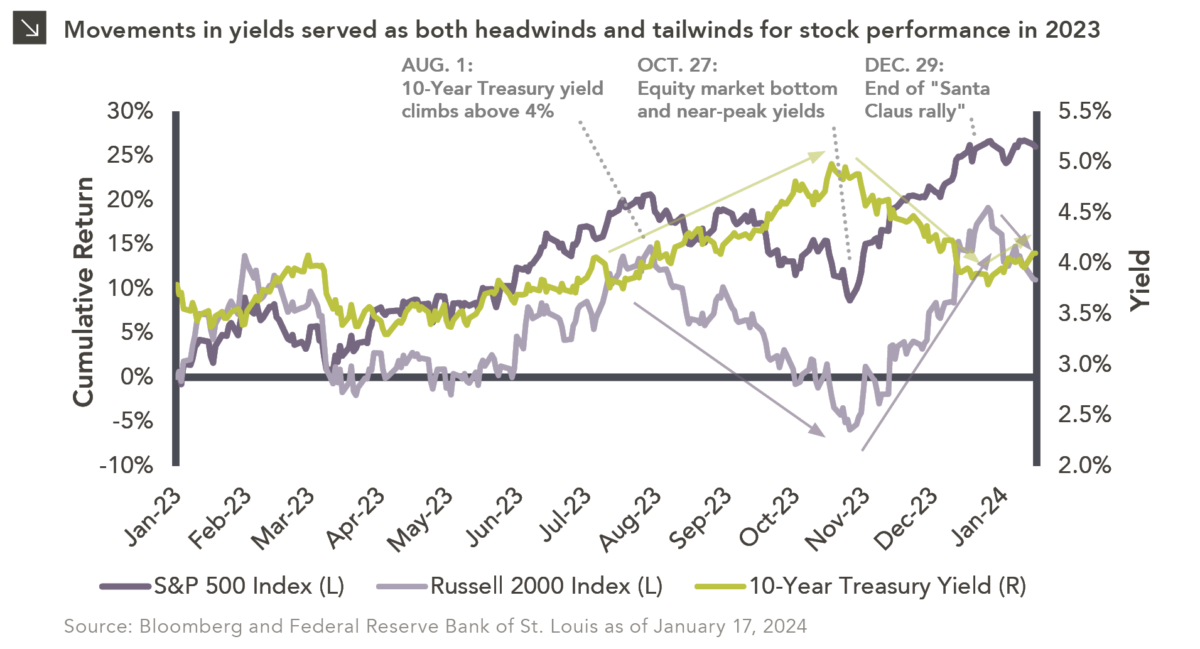
While robust equity market performance in 2023 was certainly in part spurred by the strength of mega-cap technology stocks, economic data and the movement of interest rates also played a critical role. To that point, a decline in Treasury yields to start last year helped fuel a low-quality rally in equity markets, though yields moderated over the next few months following the regional banking chaos that unfolded in February and March. Dynamics shifted in July, however, when yields began to surge as the U.S. Treasury announced new debt issuance to help fund a growing budget deficit. As the year progressed, the continued strength of the domestic economy, including a robust labor market and a resilient consumer, combined with hawkish Fed rhetoric caused yields to climb even further. The 10-Year Treasury yield notably rose to nearly 5% by mid-October, its highest level in over 15 years. Equity markets largely sold off in tandem with this spike in yields, with the Russell 2000 Index reaching an intra-year low on October 27, 2023. Market dynamics once again shifted in the final weeks of 2023, as cooling inflation data led to a more dovish tone from the Fed and widespread investor anticipation of near-term interest rate cuts. This changing sentiment supported a reversal in the 10-Year Treasury yield in late October. As a result of renewed optimism, equity markets exhibited a sustained rally to close the year, with the S&P 500 Index approaching all-time highs in late December. Small-cap equities, which were shunned by investors for much of 2023 amid an environment of higher rates, climbed nearly 25% from their October lows through year-end. Though this rally saw the reemergence of market breadth, as both cyclicals and growth-oriented equities notched strong returns, actively managed strategies struggled due to the outperformance of lower-quality stocks.

This “Santa Claus rally” that ended last year has ultimately tapered off, with equity markets declining to start 2024 amid slightly higher yields. While this trend could foreshadow further challenges for equities in 2024, it may also be a necessary correction. Specifically, given the sharp rise in stocks to close last year, investors may have priced in an overly optimistic probability of interest rate cuts and are just now beginning to consider the possibility that the Fed will not be as accommodative as expected in 2024. This recent correction may also provide some valuation support in the event of any missteps during this quarter’s earnings season, which is slated to kick off in the coming days. As 2024 progresses, policy decisions by the Federal Reserve and the movements in Treasury yields will likely continue to impact investor sentiment and market performance.

Great Expectations

After ending 2023 with a steep market rally, 2024 began on a more muted note, with Fed-pivot exuberance giving way to the details of execution. Of the many opportunities and risks facing markets this year, one of the most scrutinized will likely be how the Fed’s interest rate cuts compare to market expectations.

This newsletter analyzes current expectations for interest rate movements this year and potential scenarios that could influence the Fed’s policy decisions.

We’re Not So Different, High Yield Bonds and Leveraged Loans

Late last year we authored an article detailing the growing differences between the high yield and leveraged loan markets, particularly the overall quality in the high yield market versus that of leveraged loans. Today, some of those most pronounced differences appear to be abating, which should translate to a more convergent outlook for the two markets as it relates to security, structure, recovery, covenants, and ultimately, performance. With the Fed poised to begin cutting rates in 2024, we felt it was important to address these emerging trends before the start of the new year.

Realizing the Impact of Unrealized Losses

Earlier this year, the regional banking crisis and eventual collapses of Silicon Valley Bank, Signature Bank, First Republic Bank, and Silvergate Bank highlighted issues related to bank assets (e.g., U.S. Treasuries and mortgage-backed securities) sharply losing value due to higher interest rates. In many of these cases, uninsured depositors learned of growing unrealized losses at the institutions in question and feared the worst (i.e., that banks would become insolvent and pull deposits). Unfortunately, the story of declining bank asset values is relevant not only to uninsured regional banks, but to FDIC-insured depository institutions as well. To that point, the most recently published FDIC Quarterly Banking Profile highlighted growing unrealized losses across these institutions. Specifically, unrealized losses on securities totaled $558.4 billion in the second quarter of 2023, which represents an increase of $42.9 billion from the previous period. Rate hikes have certainly exacerbated these figures, as current losses are more than two standard deviations removed from the average levels exhibited since the Global Financial Crisis. An understanding of the implications of increased losses across different security types (e.g., available-for-sale vs. held-to-maturity) can be particularly useful. Notably, while held-to-maturity securities are reported as noncurrent assets on a company’s financial statements and earned interest income appears on a company’s income statement, changes in the prices of these securities are not reflected on the income statement if the securities have maturities longer than one year. As a result, some financial metrics (e.g., earnings) of certain banks may be somewhat overstated at present.

Even today, interest rates continue to chip away at the value of bank assets, and additional upward pressure on rates may strain bank profitability as held-to-maturity securities approach maturity. Banks will be hoping that the end of the current rate hiking cycle comes before these losses make their way to the income statement, which could cause many to question the health of various institutions. On a positive note, the FOMC announced during its most recent meeting that it would be holding its policy rate at a constant level, which may assuage some investor concerns related to this topic. Marquette will continue to monitor the impact of interest rates on the banking sector and the overall economy.

The Chart for Red October

U.S. equities declined for the third consecutive month in October amid an environment of higher yields and underwhelming earnings reports for many key index constituents. The S&P 500 Index, while still positive on a year-to-date basis, dropped by more than 2.0% during the month and is now more than 8.0% off its July peak. The Nasdaq-100 Index, which skews more heavily to growth-oriented segments of the market like Information Technology, also saw a decline of more than 2.0% in October. Finally, the Russell 2000 Index, which tracks the U.S. small-cap market, returned roughly -6.8% during the month and is now negative on a year-to-date basis.

As stated above, elevated yields have weighed on equity indices in recent time. The yield on the 10-year Treasury, for instance, recently eclipsed 5% for the first time in over 15 years, while most short-end rates remain at levels not seen since the Tech Bubble of the early 2000s. Higher yields have the effect of applying pressure to equity price multiples and enticing investors to allocate away from stocks and toward bonds. Smaller companies are often disproportionately impacted by higher rates because of the large debt burdens typically associated with those businesses, which helps to explain the underperformance of the Russell 2000 Index relative to the broad market over the last several months. Additionally, optimism surrounding some of the mega-cap technology companies that have exhibited robust returns this year, commonly referred to as the “Magnificent Seven,” appears to be waning. For example, Alphabet (the parent company of Google), saw its shares decline by roughly 10% the day after it reported a smaller-than-expected profit in its cloud computing segment. Amazon, Meta, and Tesla have also seen their shares trade lower in recent weeks due to investor concerns about future sales and margins. While it is important to note that none of these companies reported overly problematic earnings data for the third quarter, lofty valuations and investor exuberance have left their share prices vulnerable to pullbacks when results are even slightly disappointing.

While recent performance of equity indices has surely been challenged, there are several reasons for investors to stay the course. For instance, the Federal Reserve is likely nearing the end of its hiking cycle, meaning the pressure being applied to stock prices by higher yields may soon abate. It is also important to remember that markets often exhibit mean-reverting patterns of performance, meaning strong equity returns typically follow periods of stress. Marquette will continue to monitor dynamics within stock markets and provide guidance to clients accordingly, while also emphasizing the need for prudence and a long-term approach as it relates to equity investing.

3Q 2023 Market Insights Video

This video is a recording of a live webinar held on October 26 by Marquette’s research team, featuring in-depth analysis of the third quarter and themes we’ll be monitoring for the remainder of the year.

Our Market Insights series examines the primary asset classes we cover for clients including the U.S. economy, fixed income, U.S. and non-U.S. equities, hedge funds, real estate, infrastructure, private equity, and private credit, with presentations by our research analysts and directors.

Sign up for research alerts to be invited to future webinars and notified when we publish new videos. 
For more information, questions, or feedback, please send us an email.

Portfolio Trick or Treat

Coming into 2023, investors were cautiously optimistic about 2023 market returns; cautious considering the broad losses across asset classes during 2022 but optimistic about more attractive valuations and the inherent upside potential stemming from these price points. Nine months into the year, which of these opportunities have been “treats” for investors, and which have been “tricks”?

In this edition:

  • The biggest trick of them all: Investment grade fixed income
  • But not all of fixed income has been a trick…
  • Tricks come in all sizes: U.S. small-cap equities
  • Trick, treat, or both? U.S. growth stocks
  • Currency movements still tricky
  • More treat than trick: Emerging markets
  • If you’re not surprised, it’s not a trick: Commercial real estate

Temperatures Drop but Hiring Heats Up

A few weeks ago, the Bureau of Labor Statistics reported that total nonfarm payrolls rose by 336,000 during the month of September. This figure was roughly double that of the Dow Jones consensus estimate and more than 100,000 higher than the job gains posted during the previous month of August. These increases occurred across a variety of industries, including leisure and hospitality (96,000 job adds), health care (41,000 job adds), and professional, scientific, and technical services (29,000 job adds). Government employment also increased by 73,000 during the month. Additionally, the unemployment rate remained constant at 3.8% in September, and both of these data points can be observed in this week’s chart.

The robust job gains notched in September beg the natural question: How will a strong domestic labor market impact upcoming decisions of the Federal Reserve as it relates to the path of interest rates? Clearly, labor market data is supportive of “higher for longer” messaging, especially since inflation remains above the central bank’s long-run target of 2%. Based on futures markets, most forecasters believe that it is not until the middle of 2024 that the Fed’s policy rate will ultimately come down. In the more immediate term, futures markets indicate the likelihood of a pause at the next FOMC meeting, however, any decisions after that will depend on additional inflation and labor market data. Marquette will continue to monitor dynamics within the domestic labor market, assess current and future Fed policy, and provide guidance to clients accordingly.

Pause for Effect

With higher rates dragging on performance, investment grade fixed income securities experienced a challenging third quarter. While September CPI data may lead to a final rate increase by the Federal Reserve before the end of the year, a tactical pause by the central bank in the months following the next FOMC meeting appears likely. Based on prior pause cycles, investors may have reasons for optimism as it relates to the trajectory of investment grade fixed income in the near future.

The chart above highlights policy rate pause cycles overlayed with 1-year trailing returns of the Bloomberg U.S. Aggregate Bond Index and the upper bound of the federal funds rate over the last 45 years. For this analysis, a pause cycle was defined as a period immediately following a rate hike during which the policy rate was maintained at a single level for more than two consecutive FOMC meetings. As rate policy is dictated by economic data, looking beyond two FOMC meetings helps to distinguish pause cycles from stair-step rate increases. Based on this framework, there have been 13 such cycles since 1980, which have lasted roughly six months on average.

In Marquette’s most recent Quarterly Letter from the Director of Research, Halftime Adjustments, it was suggested that the overall yield environment, coupled with fewer Fed rate hikes going forward, could generally serve to benefit the fixed income space. This optimism is supported in part by the relatively strong bond market performance observed during 12 of the 13 pause cycles detailed above, with the lone exception coming in 1983 and 1984. This pattern aligns well with intuition, as a flat rate environment allows investors to collect coupon payments from bond holdings while prices hold steady, which leads to positive returns. Investors should remember, however, that the differences between past environments and current realities must be considered when assessing the return potential of all asset classes, including fixed income. While past performance does not guarantee future returns, Marquette will be watching closely to see if trends similar to those outlined above unfold over the coming months.

U.S. Equities: Surprising Strength Gives Way to Macro Risks

Equity market strength through the third quarter continues to challenge the common expectation going into the year. Cumulatively through September 30, the slowdown many investors anticipated has been averted thus far as the strength in certain segments of the market has more than offset the weakness in others. Following the strength of value equities — with Energy the lone positive sector in 2022 — markets experienced a shift in leadership to begin 2023. Companies that were challenged by supply chain issues and wage pressures rebounded to begin the year, primarily within growth-oriented sectors including Communication Services, Information Technology, and Consumer Discretionary. Overall, markets were strong through the first nine months of the year, as the S&P 500 rose 13.1%. However, September — historically the worst month of the year for equity markets — saw a somewhat unsurprising pullback. As we enter the final quarter of the year, we feel it is important to examine the underlying market dynamics driving performance and highlight the risks of a narrow market as well as the opportunities available on the sidelines.