Coronavirus Roils the Equity Markets

U.S. equities recently experienced a sharp three-day sell-off as the market digested the potential for short-term disruptions to economic growth and company earnings due to the Coronavirus (COVID-19). With new health figures coming out daily, it is easy to become alarmed. However, as our Chart of the Week from February 13th highlighted, prior health crises have been proven to be non-events longer-term for equity markets. Similar outbreaks in the past caused short-term sell-offs in equity markets but longer-term saw positive market performance.

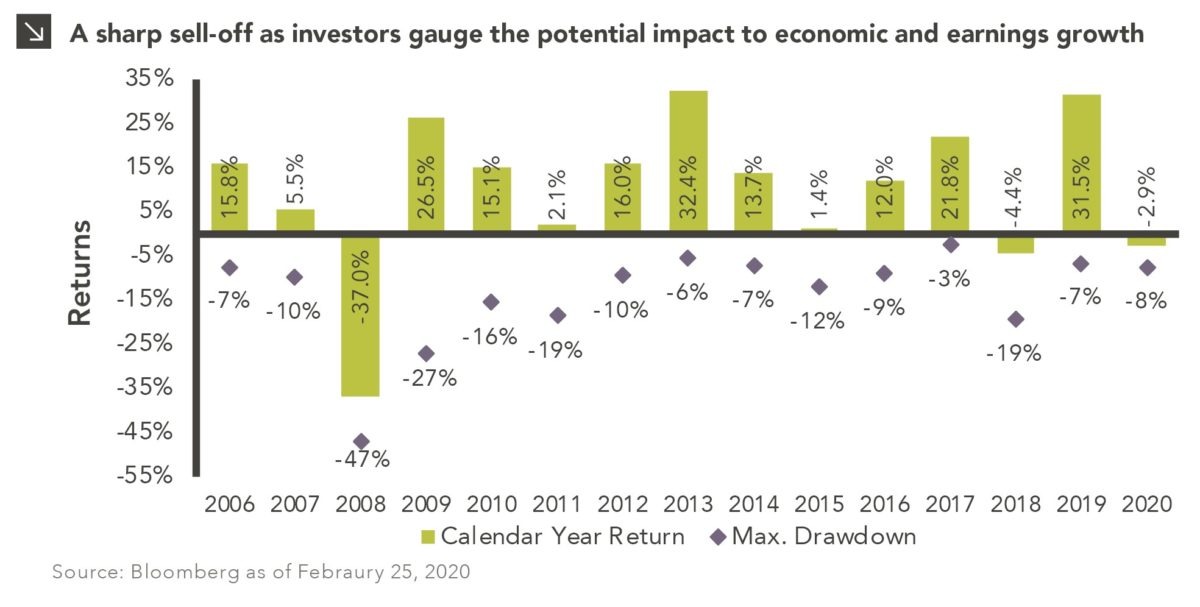
This week’s chart shows calendar year returns for the S&P 500 along with the max drawdown that occurred in each respective year. As of February 25, 2020, the S&P 500 has recorded a year-to-date drawdown of 7.6%. The current pullback is undeniably sharp in nature, but it is important to maintain perspective during turbulent times. Over the past 15 years, the average annual max drawdown was 14%. Many years experienced drawdowns near this level, yet still yielded a positive return for the year. On average, equities see a 5% pullback four times per year, a 10% pullback once per year, and a 20% correction once every five years.

While no one knows the full impact that the current outbreak will have to supply chains, trade, or travel, we recommend taking a long-term view to investing. The market had been looking past this current health crisis until the last few days, so a repricing of risk was inevitable. As this is an evolving situation, there is risk that the economic impact could increase and add further pressure to equities. However, the current pullback remains in-line with historical trends.

Print PDF > Coronavirus Roils the Equity Markets


The opinions expressed herein are those of Marquette Associates, Inc. (“Marquette”), and are subject to change without notice. This material is not financial advice or an offer to purchase or sell any product. Marquette reserves the right to modify its current investment strategies and techniques based on changing market dynamics or client needs.

Coronavirus and the U.S. Economy: Assessing the Impact

Over the last month, the world has been gripped by fears of the coronavirus and its eventual toll on the global economy. Most economists expect global economic growth to reaccelerate in the second half of the year after the virus peaks. We agree that most of the negative effects will most likely be felt in the first half of 2020.

Since January and February Chinese economic data will not be released for a few weeks, we thought it would make sense to review the current state of the economy in the United States. The table above shows leading indicators for the U.S. economy. Green denotes a healthy measure and red denotes a deteriorating measure. Some of the more stable measures over the past few years have been the 50-year low unemployment rate and inflation, which has been stable at 2%. The more volatile measures have been stock market valuations, the purchasing manufacturer’s index (“PMI”; a gauge of domestic manufacturing activity), and corporate earnings growth. Let’s start with PMI first since stock market valuation and earnings growth are more intertwined. PMIs have been under pressure since the start of the U.S.-China trade war in 2018. In January 2020, PMIs traced their way back into expansionary territory (i.e., above 50), but the coronavirus fallout may cast a cloud over manufacturing in the coming months.

What about the U.S. equity market? Last year, corporate earnings growth was virtually flat in an expensive stock market. Since then, stock market valuations¹ have come off their 2019 high but are still above the 10-year historical average of 16 times forward earnings. We believe meaningfully positive corporate earnings growth will be needed to support such an above-average market valuation. The most obvious way to ensure that is to have a strong U.S. consumer. Consumer confidence has steadily increased throughout this business cycle and right now consumers are as confident as they have ever been. Since the U.S. consumer drives two-thirds of the economy, we will be closely monitoring the consumer for weakening sentiment through measures like retail sales, revolving debt defaults, overall debt level, and other telling data. While we expect some metrics to potentially soften due to the coronavirus, we expect most to be positive by year-end. Ultimately, much like SARS and MERS, the virus’s bark will be much worse than its bite on the U.S. economy and equity market.

Print PDF > Coronavirus and the U.S. Economy: Assessing the Impact

¹ As measured by forward P/E
² FactSet Expected Earnings Growth for 2020


The opinions expressed herein are those of Marquette Associates, Inc. (“Marquette”), and are subject to change without notice. This material is not financial advice or an offer to purchase or sell any product. Marquette reserves the right to modify its current investment strategies and techniques based on changing market dynamics or client needs.

Much Ado About Corona?

By now, you have all read the headlines and watched various news commentators detail the perils of the latest pneumonia outbreak, 2019 Novel Coronavirus (“nCov”), impacting China, nearby countries, and a few of their western trade partners. As of February 13th, confirmed cases in mainland China had reached over 60,000 patients, and as was broadcast on February 11th, the death total has surpassed 1,000. Even though these health figures are alarming, we have experienced similar outbreaks in the past and can take some comfort in knowing that eventual containment — and a vaccine — are in the works.

From a financial market’s standpoint, one common theme we are hearing from economists and portfolio managers is that, similar to the SARS outbreak of 2002–2003, the recent sharp, nCoV-driven market sell-off is temporary and the overall market impact will be minimal over the long-term. This chart of the week shows the short-term returns of the broader market — using the MSCI All Country World Index as the guidepost — during the SARS outbreak, as well as the current coronavirus. As shown in the chart, during the first three months of the SARS outbreak the MSCI ACWI posted a -2.9% return. However, six months after the initial SARS patient, the MSCI ACWI return was back in positive territory, up 2.8%.

While comparing SARS and nCoV makes sense from a regional and virus strain commonality, one must also consider the economic circumstances surrounding each outbreak. The supply chain connectivity between China and the broader world has advanced in leaps and bounds since 2003. The potential knock-on effects of an extended drop in Chinese factory productivity could slow, for instance, the technology supply chains for Apple, LG, Google, and more. Hence, economists are probably spot on that the market will rebound, but the details of the true impact on global growth are yet to be defined.

Print PDF > Much Ado About Corona?

The opinions expressed herein are those of Marquette Associates, Inc. (“Marquette”), and are subject to change without notice. This material is not financial advice or an offer to purchase or sell any product. Marquette reserves the right to modify its current investment strategies and techniques based on changing market dynamics or client needs.

Is Manufacturing on the Rebound?

The ISM PMI index is a survey of manufacturers and measures the overall strength of the manufacturing sector. A measure over 50 indicates the sector is growing while over 43 suggests the economy overall is expanding. Over the last five months of 2019 this measure fell below 50, leading analysts and investors to wonder if we were in a manufacturing recession, driven by the U.S.-China trade dispute and slowing global growth. However, January’s reading came in at 50.9, beating expectations of 48.5 and recovering from an almost four year low. January’s surprise gain was met positively by stocks, bond yields, and dollar gains. The PMI had recently been held back by weak export markets and the trade war and it seems that news of the Phase One trade agreement between the U.S. and China supported manufacturing health; however, effects of the coronavirus nearly freezing parts of China’s economy and Boeing’s halted production straining producers will likely impact February’s number. So, while January’s reading was certainly a welcomed surprise, economists are now in “wait and see” mode to see how these risks play out in February.

Print PDF > Is Manufacturing on the Rebound?


The opinions expressed herein are those of Marquette Associates, Inc. (“Marquette”), and are subject to change without notice. This material is not financial advice or an offer to purchase or sell any product. Marquette reserves the right to modify its current investment strategies and techniques based on changing market dynamics or client needs.

Will the Spread of Coronavirus Drive a Risk-Off Market?

Global markets have come under pressure as the number of coronavirus cases grows. Through January 27th, the S&P 500 is down 3% from its mid-January peak when the U.S.-China phase one trade deal was signed. The 10-year Treasury yield has fallen from 1.85% to 1.61% over this same period, as bond spreads widened and the dollar strengthened.

This newsletter summarizes recent market activity and potential implications of the spread of coronavirus, which originated in Wuhan, China. For long-term investors, this outbreak is likely nothing but noise; however, future news about the coronavirus could impact markets in the short-term.

Download PDF > Will the Spread of Coronavirus Drive a Risk-Off Market?


The opinions expressed herein are those of Marquette Associates, Inc. (“Marquette”), and are subject to change without notice. This material is not financial advice or an offer to purchase or sell any product. Marquette reserves the right to modify its current investment strategies and techniques based on changing market dynamics or client needs.

2020 Market Preview

2019 was certainly a profitable year for investors as traditional and alternative asset classes delivered positive returns.  As we enter 2020, there are a litany of questions facing global markets ranging from the U.S. election to trade disputes to global monetary policy, all of which will undoubtedly influence investment returns. The following newsletters examine the primary asset classes we cover for our clients, with in-depth analysis of last year’s performance and more importantly, trends, themes, and projections to watch for in 2020.

We hope these materials can assist you and your committees as you plan for the coming year, and please feel free to reach out to any of us should you have further questions about the articles. We have also produced a 2020 Market Preview video if you would like to hear a high-level summary of the market previews. Here’s to another positive year from the markets in 2020!

U.S. Economy: Signs of Slowing?
by Greg Leonberger, FSA, EA, MAAA, Partner, Director of Research

Fixed Income: The New Roaring Twenties — Will It Be Different This Time?
by Ben Mohr, CFA, Director of Fixed Income

U.S. Equities: Climbing the Wall of Worry
by Robert Britenbach, CFA, CIPM Research Analyst, U.S. Equities

Non-U.S. Equities: Big Expectations, Little Wiggle Room
by David Hernandez, CFA, Senior Research Analyst, Non-U.S. Equities
and Nicole Johnson-Barnes, CFA, Research Analyst

Real Estate: What Will Happen Next?
by Jeremy Zirin, CAIA, Senior Research Analyst, Real Assets

Infrastructure: The Energy Revolution Is Driving the Future of Infrastructure
by Jeremy Zirin, CAIA, Senior Research Analyst, Real Assets

Hedge Funds: Rising Geopolitical Risks and a U.S. Election Could Lead to Tempered Expectations
by Joe McGuane, CFA, Senior Research Analyst, Alternatives

Private Equity: As Asset Class Grows, Continues to Deliver for Investors
by Derek Schmidt, CFA, CAIA, Director of Private Equity

Private Credit: An Asset Class Coming Into Its Own
by Brett Graffy, CAIA, Research Analyst

To read the above files in one combined document > 2020 Market Preview


The opinions expressed herein are those of Marquette Associates, Inc. (“Marquette”), and are subject to change without notice. This material is not financial advice or an offer to purchase or sell any product. Marquette reserves the right to modify its current investment strategies and techniques based on changing market dynamics or client needs.

2020 Market Preview Video

This video coincides with our annual Market Preview newsletters and includes a recap of 2019’s performance and what investors can expect heading into 2020. 2019 was certainly a profitable year for investors as traditional and alternative asset classes delivered positive returns. As we enter 2020, there are a litany of questions facing global markets ranging from the U.S. election to trade disputes to global monetary policy, all of which will undoubtedly influence investment returns.

This video is part of our Market Insights series, a quarterly presentation designed to brief clients on the market as soon as possible after quarterly market data becomes available. Members of our research team discuss the overall U.S. economy, along with fixed income, U.S. and non-U.S. equity, hedge funds, private equity, real estate, and infrastructure.

For more information, questions, or feedback, please send us an email.

Will 2020 Earnings Expectations Hold Up?

Despite poor earnings growth in 2019, global equities had a strong year, generating double-digit returns. The MSCI World Index, a developed global equity benchmark, and the MSCI Emerging Markets (EM) Index returned 28.4% and 18.4%, respectively. Paradoxically, however, earnings growth was negative for both indices in 2019. Why were equity returns so strong while earnings growth was so weak? One key reason was investor reaction to central bank activity.

Throughout most of the world, central banks took accommodative actions in response to slowed economic growth. The developed markets central bank policy rate dropped from 1.96% to 1.39% between 2018 and 2019. Emerging countries also acted as China, Brazil, Indonesia, Mexico, Russia, Turkey, and the Philippines all deployed interest rate cuts. This central bank activity boosted investor optimism leading to strong returns in anticipation of better economic and earnings data in the year ahead.

Looking forward, 2020 earnings growth estimates range from 8% to 14%. In a typical year, estimates are revised downward as analysts begin the year with a more optimistic view. In fact, at this time last year, 2019 estimates ranged between 5% and 8%. Will the 2020 expectations hold up as we move through the year? We think markets are betting that they will and that a significant miss, similar to 2019, is likely to lead to disappointing returns in the year ahead.

Print PDF > Will 2020 Earnings Expectations Hold Up?


The opinions expressed herein are those of Marquette Associates, Inc. (“Marquette”), and are subject to change without notice. This material is not financial advice or an offer to purchase or sell any product. Marquette reserves the right to modify its current investment strategies and techniques based on changing market dynamics or client needs.

U.K. Domestic Banks Spike After Tory Triumph

In what has been called a landmark victory, Prime Minister Boris Johnson and the Conservatives handily defeated their Labour party opposition in the Thursday, December 12th U.K. general election, winning 364 of the 650 Parliament seats. This landslide gain locks in a Tory government majority, which should enable Johnson to fulfill his campaign pledge to “Get Brexit Done.” The win also provides the broader market with greater certainty about the direction of Brexit, as Johnson will now have the votes necessary to complete the steps needed to make the existing divorce deal law and to take Britain out of the European Union by the end of 2020.

Brexit has been a major overhang on U.K. stocks, as evidenced by the FTSE 100 being the worst performing European Index year-to-date. In this chart of the week, we show the London stock market response to the election results. The FTSE 100 Index rallied on both the Friday and Monday after last week’s election, up 1.1% and 2.3% respectively based on closing price. In intraday trading on Monday, December 16th, the U.K. blue-chip index surged to its highest level in four months, up nearly 2.7%. Of note, those businesses acutely impacted by the domestic U.K. economy saw a meaningful boost. British financial service firms were among the major climbers during the rally, with Hargreaves Lansdown, Barclays, and Lloyds Banking Group (shown in the chart) up over 4%.

Print PDF > U.K. Domestic Banks Spike After Tory Triumph


The opinions expressed herein are those of Marquette Associates, Inc. (“Marquette”), and are subject to change without notice. This material is not financial advice or an offer to purchase or sell any product. Marquette reserves the right to modify its current investment strategies and techniques based on changing market dynamics or client needs.

Will Argentina’s New President Drive Losses for Hedge Funds?

When Argentina President Mauricio Macri was elected in 2015, he brought along a pro-business agenda, which reopened the country’s financial markets bringing investors ­— including hedge funds — back into the country. As hedge funds returned, their investments in both debt and equity were on the presumption that Argentina would not default on its debt, and economic growth would strengthen. Unfortunately, those bets were hit hard following a disappointing showing for Macri in August’s primary election. Bonds across the Argentina complex sold off to distressed levels as investors expressed concerns that Alberto Fernández, the Peronist candidate, would return the Peronist movement back to power. Investors feared market overhauls made by Macri would be undone by Fernández and the Peronist party.

On October 27th, the Peronist movement was voted back into power when Fernández received 48% of the vote. Despite the election result, hedge funds remain invested across the Argentina debt complex with the view that Fernández will not allow Argentina’s bonds to default. It remains to be seen if that will happen, but hedge funds remain long on this distressed credit despite taking a large haircut to their positions in August. These managers have quite the hole to climb out of and only time will tell if they are on the right side of this trade; for those with exposure, all eyes will be on Fernandez and any new policies that arise from his regime that could impact these investments.

Print PDF > Will Argentina’s New President Drive Losses for Hedge Funds?


The opinions expressed herein are those of Marquette Associates, Inc. (“Marquette”), and are subject to change without notice. This material is not financial advice or an offer to purchase or sell any product. Marquette reserves the right to modify its current investment strategies and techniques based on changing market dynamics or client needs.