Live Videos: 2019 Investment Symposium Presentations

The six flash talks by our research team at Marquette’s 2019 Investment Symposium on October 4th are now available to view on our YouTube channel.

View each talk in the player above — use the upper-right list icon to access a specific presentation.

  • The Investment Case Behind ESG Investing and Implementation in Practice
    Nat Kellogg, CFA, Director of Manager Search
  • Beyond Traditional Real Estate: Exploring Opportunities in Non-Core Real Estate
    Jeremy Zirin, CAIA, Senior Research Analyst, Real Assets
  • So Many Risks, So Little Time: What’s Next in Global Risk?
    Nicole Johnson-Barnes, Research Analyst
  • U.S. Against the World: Should Investors Still Own International Stocks?
    David Hernandez, CFA, Senior Research Analyst, Non-U.S. Equities
    Samantha T. Grant, CFA, CAIA, Senior Research Analyst, U.S. Equities
  • Machine Learning for Investing: How is Artificial Intelligence Being Used in Asset Management?
    Ben Mohr, CFA, Director of Fixed Income
  • Pick Your Portfolio Poison: Recession or Inflation?
    Greg Leonberger, FSA, EA, MAAA, Director of Research

Marquette encourages open dialogue with our consultants and research team. For more information, questions, or feedback, please send us an email.

Luncheon Keynote with Mohamed El-Erian


Excerpts from Mohamed El-Erian’s Keynote Presentation at Marquette’s 2019 Investment Symposium

Mohamed El-Erian is Chief Economic Advisor at Allianz, Chair of President Obama’s Global Development Council, author of two New York Times bestsellers, and former CEO and co-CIO of PIMCO.

Please contact your consultant or send our marketing team an email for the password to view the excerpts.

A Prism of Capital Market Views: Portfolio Manager Panel

Marquette’s 2019 Investment Symposium opened with a portfolio manager panel hosted by Marquette’s director of research, Greg Leonberger, FSA, EA, MAAA, and featuring:

  • John W. Rogers, Jr., Chairman, Co-CEO & Chief Investment Officer at Ariel Investments
  • Olga Bitel, Partner and Global Strategist at William Blair
  • Matthew J. Eagan, CFA, Executive Vice President and Portfolio Manager at Loomis, Sayles & Company

Third Quarter Review of Asset Allocation: Risks and Opportunities

The third quarter saw mixed results for financial markets. Economic fundamentals generally remain strong but signs of deterioration are starting to emerge. Unemployment currently hovers around 3.5%, and inflation is near the Fed’s target of 2%. However, 3Q GDP growth was under 2% (though the 1.9% figure exceeded the 1.7% estimate), and the PMI index has been below 50 since August (a reading under 50 is indicative of contraction in the manufacturing sector). Overall, the most important global trends we see are the following:

  • The U.S.-China trade conflict continues to weigh heavily on both countries as talks remain ongoing;
  • The Federal Reserve (“Fed”) reversed course by cutting interest rates and further cuts are still possible;
  • The U.S. Treasury yield curve inverted briefly, which historically has signaled a recession over the subsequent 12–24 months;
  • Brexit negotiations were extended to January 31, 2020, therefore further perpetuating the uncertainty around the UK’s exit from the EU;
  • Negative interest rates continue to grow in prevalence around the world.

The impact of these shifting dynamics is explored further in this newsletter as we review third quarter performance and expectations going forward for each of the major asset classes.

Read > Third Quarter Review of Asset Allocation: Risks and Opportunities


The opinions expressed herein are those of Marquette Associates, Inc. (“Marquette”), and are subject to change without notice. This material is not financial advice or an offer to purchase or sell any product. Marquette reserves the right to modify its current investment strategies and techniques based on changing market dynamics or client needs.

Central Banks Fight the Threat of Recession

On September 12th, the European Central Bank (“ECB”) — headed by departing President Mario Draghi — passed a major stimulus package fueled by a key interest rate cut and a large bond repurchase program. The ECB deposit facility rate, which is used by banks to make overnight deposits, was lowered 10 basis points to -0.5%, a new record low. The newly approved quantitative easing program is set to begin on November 1st. It will involve the ECB buying over 20 billion euros worth of Eurozone government bonds on a monthly basis with the intention of increasing the money supply, thereby lowering interest rates and encouraging growth.

Though this move by the ECB did not receive unanimous approval by voting members, it was implemented with the hopes of stemming an increased slowdown in Europe and fighting against the threat of recession. One indicator of the Eurozone slowdown has been PMI numbers, which dropped again in September, remaining in contraction territory. This trend began at the start of 2018 with the crossover into negative growth occurring early this year.

Similar though slightly better numbers have been seen in the United States over the past few months, and it is widely expected that the Fed will continue monetary easing by cutting rates one more time in 2019, either at the end of this month or the end of the year. As trade tensions and market uncertainties persist, the ECB, Federal Reserve, and central banks across the world are fighting to maintain growth and avoid a global recession.

Print PDF > Central Banks Fight the Threat of Recession

The opinions expressed herein are those of Marquette Associates, Inc. (“Marquette”), and are subject to change without notice. This material is not financial advice or an offer to purchase or sell any product. Marquette reserves the right to modify its current investment strategies and techniques based on changing market dynamics or client needs.

The Root Cause of Negative Rates

At our annual investment symposium last Friday, we worked through a thought-experiment with keynote speaker Mohamed El-Erian on two points central to the state of our global economy today. The first is that with the furtherance of negative rates in Germany and Japan driven by the global growth slowdown, foreign investors’ continued buying of U.S. Treasuries may eventually cause U.S. rates to go negative. In turn, this could lead to a shift from bonds to stocks and thereby drive up P/E ratios to higher and higher norms. The second is that the global slowdown appears to be very much driven by an aging of the overall population, which includes mounting retirements out of the workforce.

This week’s chart is actually two charts; the first on the left shows the number of people aged 65+ per 100 people of working age, which has grown in leaps and bounds for all developed countries between 1980 and 2015. Japan is especially notable, with 13 people aged 65+ per 100 people of working age in 1980, skyrocketing to 43 people aged 65+ per 100 people of working age in 2015. While data from China and emerging economies are not readily available, we can expect them to follow a similar trend. The second chart on the right shows the share of the U.S. population aged 65+ growing from only 5% in 1910 to 15% today and expected — based on actual birth rates — to reach 20% and 25% in the next few decades.

Certainly, this evolution of workforces will be a focus point going forward, and as more baby boomers exit the workforce, their productivity will need to be replaced to maintain current economic growth rates. Whether that comes from technological innovation or simply an influx of workers bears watching and will no doubt help shape the economic growth narrative in the future.

Print PDF > The Root Cause of Negative Rates

The opinions expressed herein are those of Marquette Associates, Inc. (“Marquette”), and are subject to change without notice. This material is not financial advice or an offer to purchase or sell any product. Marquette reserves the right to modify its current investment strategies and techniques based on changing market dynamics or client needs.

3Q 2019 Market Briefing

Live Webinar – Thursday, October 24, 2019 – 1:00-2:00 PM CT


Please join Marquette’s asset class analysts for a live webinar based on our 3Q 2019 Market Environment. This webinar series is designed to brief clients on the market as soon as possible after quarterly market data becomes available.

The overall U.S. economy will be discussed, along with fixed income, U.S./non-U.S. equity, hedge funds, private equity, real estate and infrastructure.

Featuring:
Greg Leonberger, FSA, EA, MAAA, Partner, Director of Research
Jeffrey Hoffmeyer, CFA, Lead Analyst, Asset Allocation
Ben Mohr, CFA, Director of Fixed Income
Samantha Grant, CFA, CAIA, Senior Research Analyst, U.S. Equities
David Hernandez, CFA, Senior Research Analyst, Non-U.S. Equities
Joe McGuane, CFA, Senior Research Analyst, Alternatives
Jeremy Zirin, CAIA, Senior Research Analyst, Real Assets
Brett Graffy, CAIA, Research Analyst

Who should attend: Institutional investment stewards, private clients, investment managers

Live webinar attendees will be able to submit questions to the presenters and vote in audience polls during the event. Questions will be answered during the final 15 minutes of the webinar, as time allows.

If you are unable to attend the webinar live, you can also view it afterward on demand. Registrants will automatically receive a follow-up email shortly after the end of the webinar to notify them of webinar recording availability

Attack on Saudi Oil and Market Implications

Over the weekend, half of Saudi Arabia’s oil production stopped due to a drone attack on the country’s major Saudi Aramco oil infrastructure which includes processing centers and oil fields. While a Yemeni militant group — the Houthi rebels — claimed responsibility for the attack, U.S. intelligence suspects Iran as the culprit.

This newsletter details the immediate developments and market implications of the attack, including a look at oil pricing and current supply, expectations for recovery, and potential effects on demand and geopolitical uncertainties.

Read > Attack on Saudi Oil and Market Implications

The opinions expressed herein are those of Marquette Associates, Inc. (“Marquette”), and are subject to change without notice. This material is not financial advice or an offer to purchase or sell any product. Marquette reserves the right to modify its current investment strategies and techniques based on changing market dynamics or client needs.


Plummeting Pound Rebounds as PM Johnson is Thwarted

There has been a flurry of updates on the Brexit saga over the last three weeks, starting with the leak of the Yellowhammer doomsday report on August 18th to Wednesday’s stunning news of British Members of Parliament (MPs) successfully pressing forward on a measure to foil a no-deal Brexit. Throughout that time ­— and since the Referendum — the pound sterling has taken varying degrees of “pounding” based on these Brexit updates, and this week was no different.

In today’s chart, we show the intraday moves of the USD/GBP spot rate over the last three days. On Tuesday, September 3rd, MPs exerted their legislative muscle and debated the merits of a bill designed to prevent a no-deal Brexit on October 31st. In a sharp early sell-off that morning, the pound nosedived below the October 2016 “Flash Crash” dip and hit a 34-year low. The slump came amid growing fears that Britain could crash out of the European Union sans divorce agreement and the possibility of a snap general election. By that evening, however, MPs had voted 328 to 301 to seize control and presented a formal debate on the proposed legislation, delivering Prime Minister Johnson’s first legislative defeat in the House of Commons and causing the pound to rebound from the intraday low. And we saw the pound continue to rise in conjunction with PM Johnson’s second loss on the following day — MPs voted 329 to 300 in favor of the proposed legislative block on a no-deal Brexit. While it is unknown whether the pound will continue to climb, the MPs’ steps towards ensuring that the worst-case Brexit scenario would be avoided appeared to placate currency traders and the market.

Print PDF > Plummeting Pound Rebounds as PM Johnson is Thwarted

The opinions expressed herein are those of Marquette Associates, Inc. (“Marquette”), and are subject to change without notice. This material is not financial advice or an offer to purchase or sell any product. Marquette reserves the right to modify its current investment strategies and techniques based on changing market dynamics or client needs.

All is Not Lost for 2019

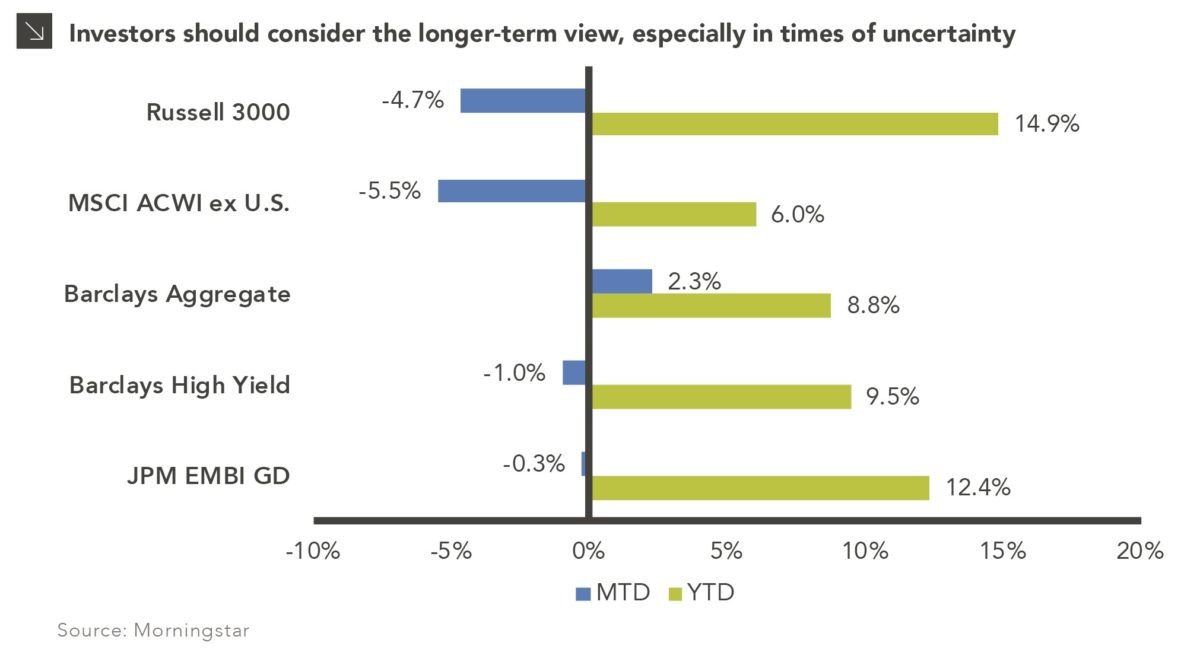
Given this week’s volatility driven by (brief) yield curve inversion, the ongoing U.S.-China trade dispute, disappointing economic data from Germany, and overall growing pessimism about future growth, investors’ growing concerns about portfolio returns are entirely justified. However, despite this week’s volatility and mostly negative news, almost all asset classes have delivered positive returns for the year, with the great majority of U.S. equity strategies up double digits. Furthermore, most fixed income strategies have profited from falling interest rates, as shown by positive returns from investment grade as well as below investment grade sectors. And for all the negative news out of the Eurozone and China, international equities — as represented by the ACWI ex-US index — are still up more than 6% through August 15th. While the rest of the year is likely to feature elevated volatility and lower returns, barring a major market correction most portfolios should remain in positive territory, despite what has transpired the first half of August. If nothing else, we encourage investors to take a long-term view of the markets and not overreact in times of market stress, as stepping back and taking a longer-term view of the markets indicates that 2019 has been a profitable year to date.

Print PDF > All is Not Lost for 2019

The opinions expressed herein are those of Marquette Associates, Inc. (“Marquette”), and are subject to change without notice. This material is not financial advice or an offer to purchase or sell any product. Marquette reserves the right to modify its current investment strategies and techniques based on changing market dynamics or client needs.