The Impact of Artificial Intelligence on Markets

Over the last several decades, artificial intelligence (“AI”) has evolved from a theoretical concept into a transformative force across a variety of industries. The 1940s saw the advent of the digital computer, which was followed years later by the first artificial neural network, a computational model inspired by the structure of the human brain that consists of algorithms that attempt to recognize relationships in data. In more recent years, researchers have developed “deep learning” systems (i.e., neural networks with many layers) capable of increasingly complex tasks including image recognition, reading comprehension, and predictive reasoning. Given the advances in the space, it should not come as a surprise that the use cases of artificial intelligence are now vast, with AI tools now implemented across fields including health care, retail, finance, and entertainment. Researchers and corporate executives are not the only ones to have noticed the remarkable potential of AI, however, as investors have flocked to the space in droves over the last several years.

This newsletter outlines the growth of AI as an investment theme, including performance, valuations, and earnings growth of AI-related companies and equities, other segments of the market that may stand to benefit from advances in AI, and potential risks for investors.

3 vs. 2000

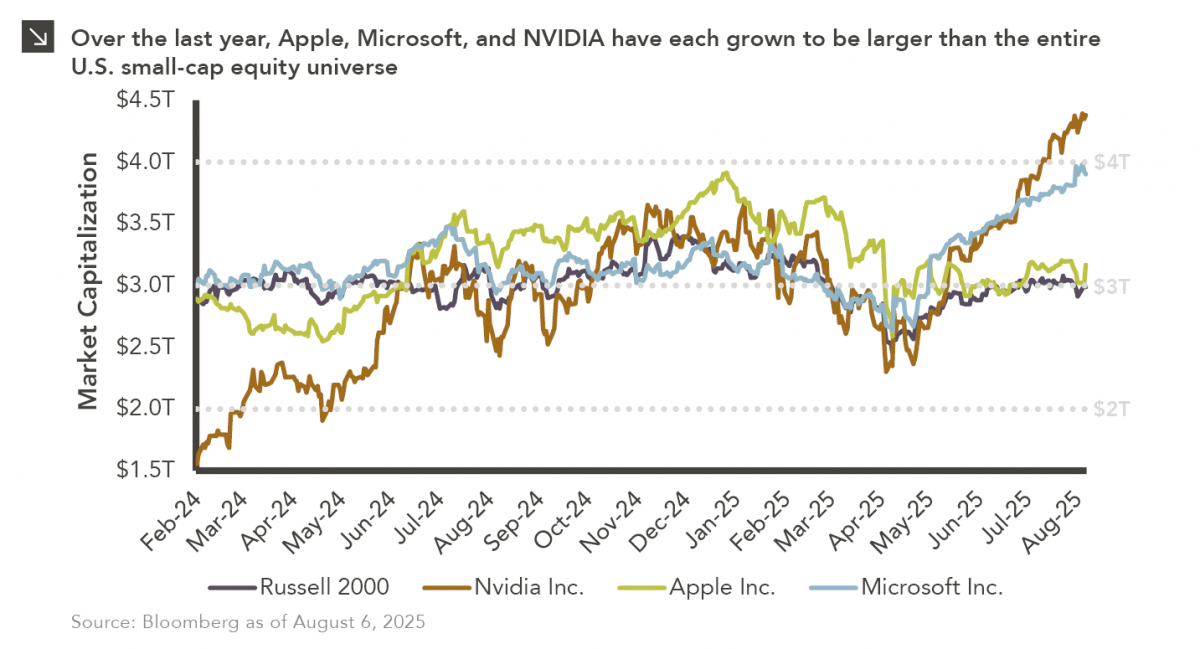
In last year’s “2 vs. 2000” Chart of the Week publication, we explored the emergence of trillion-dollar companies, noting that Microsoft and Apple had each exceeded the combined market capitalization of Russell 2000 Index constituents. Since then, another technology giant has crossed that threshold, with NVIDIA recently becoming the first company to reach a market capitalization of $4 trillion. While Microsoft currently hovers around this level thanks to robust earnings and demand for its cloud and enterprise solutions, Apple has experienced more turmoil in recent time. In the first three months of this year, Apple shed nearly $1.5 trillion from its market capitalization amid trade tensions and concerns about slowing growth. During this bout of volatility, the company briefly became smaller than the U.S. small-cap equity universe, but a rally sparked by its announcement to bring manufacturing back to the U.S. helped Apple regain its footing and once again surpass the Russell 2000 Index in terms of market capitalization.

The meteoric rise of Apple, Microsoft, and NVIDIA underscores ongoing investor preferences for large-cap, technology-focused companies. In contrast, the U.S. small-cap space, which is more tilted toward businesses in sectors like Financials and Industrials, has struggled in recent years for this same reason. The Russell 2000 Index has also been negatively impacted by the realization of smaller company growth within private markets, as outlined in a recent newsletter. Going forward, investors should be cognizant of the risks posed by both large and small companies and remain adequately diversified across the market capitalization spectrum.

Non-U.S. Stocks: Currency Leads, Earnings Lag

There was a striking reversal in equity performance trends during the first half of 2025, with non-U.S. stocks outperforming their U.S. peers by a significant margin. Specifically, the MSCI ACWI ex-U.S. and Russell 3000 indices returned 17.9% and 5.8%, respectively, on a year-to-date basis through June 30. While it is unclear whether this shift is a temporary phenomenon or the unraveling of a multidecade pattern, a deeper exploration of year-to-date returns for various equity benchmarks may provide some answers. Notably, currency movements, particularly the weakening of the U.S. dollar, have played an outsized role in the returns of non-U.S. stocks this year, adding 14% and 9% to the total year-to-date returns of the MSCI Europe ex-UK and MSCI Japan indices, respectively. Multiple factors have contributed to this bout of dollar weakness, including uncertainty regarding tariffs, concerns about the U.S. fiscal deficit, and a growing global interest in diversifying into non-U.S. assets. European and Asian equities have benefitted from these dynamics, with both regions experiencing strong capital flows in the first half of the year. This helps explain the second-largest return driver for international equities in 2025: multiple expansion. Indeed, improving investor sentiment and capital inflows have recently propelled international equity valuations above their long-term averages. Pledges for increased defense spending and infrastructure development in Europe (as described in a recent Chart of the Week) are especially stoking enthusiasm among investors, with fiscal stimulus measures and rate cuts serving as additional sentiment tailwinds.

While the factors detailed above warrant excitement about non-U.S. equities, it is prudent to address the risks facing the asset class as well. To that point, a third takeaway from the return decomposition detailed above is what is nearly absent from the total return of Europe and Japan: meaningful earnings growth. While certain sectors of the non-U.S. market, such as Financials and Information Technology, have strong growth projections, broad earnings expectations are mixed, with European companies expected to report a 0.3% drop in earnings for the second quarter. In conclusion, there is certainly a case for optimism related to the prospects of non-U.S. stocks going forward, but it is important to underscore the importance of earnings growth as the key driver of long-term returns.

2025 Halftime Market Insights

This video is a recording of a live webinar held July 17 by Marquette’s research team analyzing the first half of the year across the economy and various asset classes as well as themes we’ll be monitoring through the rest of 2025.


Our quarterly Market Insights series examines the primary asset classes we cover for clients including the U.S. economy, fixed income, U.S. and non-U.S. equities, hedge funds, real assets, and private markets, with commentary by our research analysts and directors.

Featuring:
Greg Leonberger, FSA, EA, MAAA, FCA, Partner, Director of Research
Frank Valle, CFA, CAIA, Associate Director of Fixed Income
James Torgerson, Senior Research Analyst
Catherine Hillier, Senior Research Analyst
David Hernandez, CFA, Director of Traditional Manager Search
Evan Frazier, CFA, CAIA, Senior Research Analyst
Dennis Yu, Research Analyst
Amy Miller, Associate Director of Private Equity
Chad Sheaffer, CFA, CAIA Senior Research Analyst

Sign up for research alerts to be invited to future webinars and notified when we publish new videos.

If you have any questions, please send our team an email.

Policy Uncertainty Blurs the Outlook

As we enter the second half of the year, Liberation Day-induced market volatility seems like a distant memory with the S&P hitting another all-time high on July 10th and non-U.S. stocks significantly outpacing their U.S. counterparts through June 30th. Meanwhile, the One Big Beautiful Bill was signed into law by President Trump on July 4th with varying expectations on its impact to growth but a consensus view that it will push the deficit higher.

In this edition:

  • Tariff and policy uncertainty
  • Risk factors and market indicators
  • Equity market drivers
  • Currency and regional trends
  • What to watch in the second half

Why Are Emerging Markets Investors Removing Their China Exposure?

Emerging markets (EM) equities have gone through cycles of performance throughout time, creating varied investor sentiment towards the asset class. Recently, discussions around excluding China from investment portfolios have become more common, spurring the growth of active EM ex-China strategies. This newsletter explores the current landscape of EM investing, examines the drivers of the EM ex-China trend, and analyzes the performance impact of removing China from an EM allocation.

Bring Out the Big Guns

NATO has decided to take the phrase “don’t bring a knife to a gun fight” quite literally. Last week at the NATO summit in The Hague, the 32 member countries pledged to increase their defense spending as a percentage of GDP from the current 2% target share to a new 5% target share. The pledge includes spending 3.5% on defense items such as troops and weapons and 1.5% on defense-related initiatives such as critical infrastructure, cybersecurity, and resilience measures. This change comes on the heels of criticism from President Trump regarding the underspending of member nations on security, as well as his ambivalent comments on the U.S. commitment to collective defense under Article 5. Additionally, commitments to the alliance have been reinvigorated given the ongoing war in Ukraine and a desire to combat an increasingly hostile Russia.

This new commitment follows a trend of increased defense spending by NATO member states, as there are now significantly more members achieving the 2% target than in previous years. In 2021, the year prior to Russia’s invasion of Ukraine, only six member states achieved the 2% target, compared to 23 member states last year. Some members of NATO even pledged to spend 3.5% of GDP on defense prior to the rollout of the new 5% target. That said, and as this week’s chart indicates, only one NATO country (Poland) currently spends at that 3.5% level.

While the higher spending guidelines are groundbreaking, there is still significant progress that must be made for members to achieve this new level. For example, simply to meet the previously planned target of at least 3.5% of GDP, Germany would have to spend an extra €689 billion on defense through 2035. Similarly, Italy and France would each need to spend more than €400 billion. This increase in spending may provide near-term tailwinds for European equities, particularly defense stocks as detailed in a previous Chart of the Week. However, higher defense spending could add to already ballooning fiscal deficits in many member states, meaning inflation may remain elevated across Europe. While it remains to be seen if NATO members will achieve the new spending target and what the ultimate impact on financial markets will be as a result of these dynamics, one thing is certain: NATO is no longer willing to not be armed and dangerous.

Oil Pares Gains After U.S. Strikes Iran

Last week, Marquette released a publication detailing the importance of the Strait of Hormuz within the context of the global oil trade given recent tensions in the Middle East. Over the weekend, these tensions escalated materially, with the United States carrying out a bombing campaign against multiple nuclear enrichment facilities in Iran. In response, Iranian officials launched a missile attack on a U.S. military installation in Qatar and have threatened to close the Strait of Hormuz, a measure that would need to be ratified by the country’s parliament and national security council. Experts agree that such an undertaking would be highly problematic for the global economy and China in particular, which accounts for roughly 90% of Iran’s oil exports (around 1.6 million barrels per day). Goldman Sachs estimates that a closure of the strait could push the price of oil to more than $100 per barrel.

Interestingly, despite these developments, oil prices have not moved significantly higher in recent time. Brent crude, the international oil benchmark, did climb above $81 per barrel immediately after the U.S. strikes, but has since dropped back to around $72 per barrel as of this writing. Interestingly, most of this decline occurred after the missile attack on the U.S. airbase in Qatar, which may have led investors to believe that oil flows will not be the primary target of the Iranian military going forward. The current figure of $72 per barrel, while still above the five-year average level for Brent crude oil, is largely in line with where the commodity has traded since 2021. Equity markets do not seem particularly phased by this weekend’s strikes either, with major global stock indices finishing Monday in positive territory. These positive dynamics amid a string of negative headlines likely stem from the fact that the Strait of Hormuz has yet to be officially closed, although analysts have reported a slowdown in shipping navigation through the strait since the U.S. strikes. Clearly, much uncertainty remains related to the situation in the Middle East, and asset prices could see increased volatility in the near term depending on the next moves by any of the countries involved.

Land of the Rising Yields

For many years, Japan experimented with ultra-loose monetary policy given long-term economic stagnation and persistent deflationary pressures that plagued the nation. Actions related to this policy included the Bank of Japan pushing interest rates lower, the implementation of yield curve control, and the purchase of more than 50% of all outstanding Japanese government bonds by the central bank. Roughly one year ago, however, the Bank of Japan ended both its yield curve control and negative interest rate policies after achieving sustained inflation and wage growth. Unfortunately, policymakers in Japan face an entirely new set of problems today.

As detailed in this week’s chart, yields on long-term Japanese government bonds have surged in recent days following a weak auction outcome, with the nation’s 30-year bond yield climbing to a record of 3.14%. There are many reasons for this spike, including new trade restrictions that pose a dual challenge to the Japanese economy. On one hand, tariffs diminish the likelihood of near-term interest rate increases by the Bank of Japan, thereby boosting demand for short-term debt. At the same time, trade tensions heighten inflation risks, which undermine investor confidence in long-term bonds. These dynamics present a dilemma for the Bank of Japan as it seeks to scale back its bond buying program and signal potential trouble for Japan’s heavily indebted government. To be clear, rising yields in Japan reflect a broader pattern, as long-term borrowing costs have climbed across major economies given investor concerns over the ability of governments to manage large fiscal deficits. Still, Japan finds itself on particularly precarious footing, and its central bank must now contend with inflationary pressures, weaker sentiment, and demographic headwinds.

The Soybean Shuffle

The most recent headlines related to tariffs have been positive, with the U.S. and China reaching a 90-day pause on May 12 and domestic equities surging in response to this news. Despite this reprieve, however, U.S. farmers may still have reason for concern. To that point, current duties on the second highest U.S. agricultural export, soybeans, remain almost as high as those from 2018, a year that saw U.S. soybeans become a major casualty of another trade conflict triggered by American tariffs on Chinese goods. The U.S. soybean industry was hit hard as a result, suffering an immediate loss of market presence in China. This trend can be observed in the chart above. During a recent hearing before the U.S. Senate Finance Committee, the president of the American Soybean Association expressed fears that current trade restrictions could lead to a loss in market share for U.S soybean farmers similar to that of 2018.

China accounts for roughly 60% of global soybean imports and around half of total U.S. soybean exports, meaning tariffs will almost certainly impact U.S. farmers negatively. Additionally, the Chinese government has endeavored to increase its partnership with Brazil, which is currently China’s largest soybean trading partner. Earlier this month, the leaders of both countries met in Beijing to emphasize the importance of the relationship and sign new trade agreements. Even before this summit, Chinese companies have worked to expand infrastructure within Brazil (e.g., building railroads and water ports) with the goal of bolstering the agriculture supply chain. Additionally, one the largest state-owned conglomerates in China, COFCO, is in the process of building an export terminal in the major Brazilian port city of Santos, which is expected to increase capacity from 5 million tons to 14 million tons. This port is key when it comes to the exporting of commodities such as corn, sugar, and soybeans. It remains to be seen how much stronger the trade relationship between China and Brazil will become in the coming years.

In conclusion, recent tariffs have both redefined international trade relationships and underscored the vulnerability of domestic farmers.  Readers should note that uncertainty surrounding the global macroeconomic landscape is likely to persist, and commodities like soybeans could exhibit elevated levels of volatility amid a reshaping of world trade.