2021 Market Preview Video

This video coincides with our 2021 Market Preview newsletters and provides a high-level summary of each, including analysis of last year’s performance as well as trends, themes, opportunities, and risks to watch for in 2021.

Our Market Insights series examines the primary asset classes we cover for clients including the U.S. economy, fixed income, U.S. and non-U.S. equities, hedge funds, real estate, infrastructure, private equity, and private credit, with presentations by our research analysts and directors.

Sign up for research alerts to be notified when we publish new videos here.
For more information, questions, or feedback, please send us an email.

Third Quarter Review of Asset Allocation: Risks and Opportunities

The third quarter of 2020 featured a major rebound in economic data amid an intense battle for the presidency and an uncertain future for COVID-19 cases as some states are seeing higher positivity rates. GDP growth for the quarter is expected to come in at +35.2% YoY, higher than analyst expectations, which helped to propel equity markets higher during the quarter. In addition, the unemployment rate dropped to 7.9% but is expected to remain elevated until additional clarity regarding COVID-19 becomes available. Below are some highlights from the quarter:

  • Biden is favored over Trump in the election race, as mail-in ballots and virtual town halls instead of debates have proven that this election will be unlike any before it.
  • The country has widely reopened, though concerns in some larger states of increased positivity rates have caused some rollbacks ahead of the winter season.
  • A vaccine is in the works and anticipated to be ready by April 2021, with widespread vaccinations likely around mid-2021.
  • Schools have moved to a hybrid model of in-person and online classes, causing logistical problems for parents as many balance jobs and at-home learning.

The election is sure to bring additional volatility through the end of the year. Biden and Trump have vastly different tax plans and a Democratic sweep could drive a sell-off in equity markets. Economic data is still pending through 3Q, though most forecasts show large rebounds in data as states reopened from COVID-19 closures. Big questions regarding vaccines and if the winter will see a resurgence in coronavirus cases remain. We analyze what all of this means for each asset class in the remainder of this newsletter.

Read > Third Quarter Review of Asset Allocation: Risks and Opportunities


The opinions expressed herein are those of Marquette Associates, Inc. (“Marquette”), and are subject to change without notice. This material is not financial advice or an offer to purchase or sell any product. Marquette reserves the right to modify its current investment strategies and techniques based on changing market dynamics or client needs.

Q3 2020 Market Insights Video

This video features an in-depth analysis of the third quarter’s performance, coinciding with our 3Q Asset Allocation Update newsletter reviewing risks and opportunities heading into the final quarter of the year.

Our Market Insights series examines the primary asset classes we cover for clients including the U.S. economy, fixed income, U.S. and non-U.S. equities, hedge funds, real estate, infrastructure, private equity, and private credit, with presentations by our research analysts and directors.

Sign up for research alerts to be notified when we publish new videos here.
For more information, questions, or feedback, please send us an email.

IPO Market Is Heating Up Again

The IPO market in 2019 generated a record amount of exit value for venture capital investors as large and anxiously awaited IPOs from Uber, Lyft, Slack, Peloton, Smile Direct, Chewy, Pinterest, and Beyond Meat drove the market and dominated the headlines. Entering 2020 — a presidential election year — the markets braced for another round of anticipated IPOs expected to come before the election. However, following the COVID outbreak in Q1 and the resulting global pandemic during Q2, the IPO market ground to a halt. This disruption resulted in a significant backlog of companies waiting to come to the public markets.

In this newsletter, we look at the recent reversal of this IPO backlog with companies coming public at a feverish pace during the third quarter and take a look at further expectations for the remainder of the year.

Read > IPO Market Is Heating Up Again


The opinions expressed herein are those of Marquette Associates, Inc. (“Marquette”), and are subject to change without notice. This material is not financial advice or an offer to purchase or sell any product. Marquette reserves the right to modify its current investment strategies and techniques based on changing market dynamics or client needs.

The Year of SPACs

If there is one corner of the financial market that has benefited from the pandemic, it is special purpose acquisition companies (SPACs). This atypical pathway to the public markets was once a niche strategy for small investment firms. Now, the strategy has become one of the hottest financial topics of 2020 after a massive uptick in the volume of these vehicles.

A record 82 special purpose acquisition corporations went public this year to raise a record $39 billion, far exceeding the $9.5 billion in gross proceeds for SPACs in 2019 or the $8.5 billion in 2018.

SPACs are vehicles that raise money in an IPO, and then place the funds in a trust while the sponsor searches for a business or multiple businesses to acquire. The companies then complete a merger and the target becomes a listed stock.

A private company going public via SPAC has a few advantages over a traditional IPO. Private companies can go public on a faster timeline and there is more certainty around a company’s valuation. Furthermore, the listing of a SPAC requires a much lower level of diligence than a similarly sized IPO since there are no financial statements to analyze. For a sponsor, raising a SPAC is similar to raising a closed-end fund, allowing for a shorter and more comfortable timeline during the fundraise. In addition, the reputation of SPACs has improved over the past decades as governance practices have been refined and made more shareholder-friendly.

The volatility and price declines earlier in 2020 made IPOs and direct listings impractical options for many private companies, which is where SPACs have stepped in. There has been a lot of talk particularly in the venture community not being satisfied with the IPO process. That has led to conversations about going the direct listing route, and now the SPAC route. There have been several companies that have gone the IPO route and set a price underwriters deemed reasonable, only to see the stock surge on the first day of trading, which ultimately results in money being left on the table. And with IPOs being inherently riskier, there was less incentive to take on more risk by going public during an election year and pandemic.

It is clear SPACs are here to stay, but it is uncertain whether they will continue at the same rapid pace as this year. While the population of companies that might combine with a SPAC is growing, it still represents a small subset of private companies, limiting the potential disruption of the traditional IPO process. While the momentum driving innovation around public listings is encouraging, SPACs will not provide a solution for every private business. That said, there is a two-year time period for a SPAC to acquire a business, guaranteeing they will remain around for at least the foreseeable future.

Print PDF > The Year of SPACs


The opinions expressed herein are those of Marquette Associates, Inc. (“Marquette”), and are subject to change without notice. This material is not financial advice or an offer to purchase or sell any product. Marquette reserves the right to modify its current investment strategies and techniques based on changing market dynamics or client needs.

2020 Halftime Market Insights Video

This video features an in-depth analysis of the second quarter’s performance and coincides with our 2Q Asset Allocation Update newsletter, reviewing risks and opportunities heading into the second half of the year.

Our Market Insights series examines the primary asset classes we cover for clients including the U.S. economy, fixed income, U.S. and non-U.S. equities, hedge funds, real estate, infrastructure, private equity, and private credit, with presentations by our research analysts and directors.

Sign up for research alerts to be notified when we publish new videos here. For more information, questions, or feedback, please send us an email.

Second Quarter Review of Asset Allocation: Risks and Opportunities

The second quarter of 2020 proved to be as eventful as the first, with slow economic results being largely ignored as markets rallied. GDP growth for the quarter is expected to come in at -35.5% YoY, though 3Q GDP projections indicate a significant rebound is expected as the country begins to reopen to “the new normal.” In addition, the unemployment rate came in at 11.1%, down from the April peak above 14%. Below are some highlights from the quarter:

  • Countries around the globe began reopening businesses amid fears of a second wave of COVID-19 infections.
  • Daily infections reached a new high in the United States at more than 50,000 per day, causing some states to roll back their reopening plans.
  • Weekly initial claims for unemployment insurance have continued to trend downwards.
  • Additional fiscal and monetary stimulus are expected in the second half of the year, bolstering markets.

COVID-19 has proven to be a potentially long-lasting concern as it remains to be seen whether we are in for a V-shaped or U-shaped recovery. Economic data is improving slowly, though markets have seemed to shrug off some of the negative news as the S&P 500 moved into positive territory over the one-year period. Though it may have fallen into the background due to COVID-19, 2020 is a presidential election year. Uncertainty surrounding the election will undoubtedly have an impact on forward-looking expectations. In this newsletter, we analyze what all of this means for each asset class.

Read > Second Quarter Review of Asset Allocation: Risks and Opportunities


The opinions expressed herein are those of Marquette Associates, Inc. (“Marquette”), and are subject to change without notice. This material is not financial advice or an offer to purchase or sell any product. Marquette reserves the right to modify its current investment strategies and techniques based on changing market dynamics or client needs.
Best Historical Performing Asset Class Is on Sale!

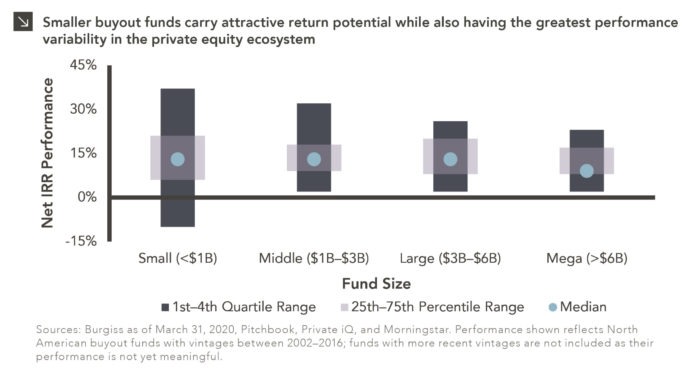
It is critical for institutional investors to understand the importance of both relative and absolute value when considering investment allocations. From a relative value perspective, private equity ­— which has been one of the most desired and consistently best performing asset classes over the last 20 years — is now on sale.

Following global investment volatility and panic from the COVID-19 crisis in March, the combination of government intervention along with public equity enthusiasm has driven public valuation multiples to near-record levels over the last three months with the Russell 3000 trading at 15x EV/EBITDA (S&P 500 at 23x EV/EBITDA), making the relative value trade even more compelling for private equity investments. Meanwhile, private equity multiples have been more stable, with May transactions occurring at 10x for middle market buyouts and 7.5x for small buyouts less than $100 million in enterprise value, providing investors a 35% or 50% relative discount respectively as compared to the Russell 3000. The current valuation spread provides the widest spread these markets have offered.

Private equity managers have mostly shown investment discipline, thinking longer-term and focused on absolute returns over a multi-year basis, which has resulted in a tighter range of valuations paid as compared to rising public equity multiples over the last decade. However, given the current market dynamics with the valuation spread growing, it is likely private market investors will benefit from the relative outperformance of private equity capital deployed in 2020.

This may be an opportune time for institutional investors to consider stepping back from elevated public market valuations and find ways to allocate more capital and raise their targeted allocations to private equity in order to maximize the absolute returns of their portfolios. We have seen clients increasing their annual deployment and focusing on more opportunistic strategies, including co-investment funds and secondary funds which have shorter investment periods thus allowing more capital to be deployed in 2020 and 2021.

Furthermore, private equity managers should increasingly be thinking about the relative value of the capital that has been committed to them. The last few years have provided for record-breaking fundraising for the private equity industry. This committed capital is currently sitting in dry powder and in most cases remains uncalled from investors sitting in public equity markets. Due to the current valuation spread, the relative value these private equity managers provide by finding opportunities present in the private market is great. Most importantly, more capital being put to work in private markets can expand the number of private equity-owned businesses and does not have to drive up the valuations paid, unlike in public markets where there are a fixed number of opportunities and where more capital being deployed in public equities pushes valuations higher.

Print PDF > Best Historical Performing Asset Class Is on Sale!


The opinions expressed herein are those of Marquette Associates, Inc. (“Marquette”), and are subject to change without notice. This material is not financial advice or an offer to purchase or sell any product. Marquette reserves the right to modify its current investment strategies and techniques based on changing market dynamics or client needs.

Private Equity in Times of Crisis

While there is still much uncertainty around the long-term economic ramifications of COVID-19, financial markets have been undergoing frequent massive swings as both investment managers and allocators evaluate the situation and what it might mean for their current and future investments. Given the illiquid and slow-moving nature of private equity investments, an outstanding question is: What will this mean for private market investors?

One principle which people took serious note of in the last crisis was something called the “denominator effect.” A decline in the value of one asset should result in other assets being sold to properly rebalance a portfolio, but many assets like venture capital (“VC”), private equity (“PE”), and others can be quite hard to sell in the short-to-medium term, leaving LPs overallocated to private markets. When the stock market falls dramatically, public market investments fall in value immediately; however, private market investments do not reflect the changing environment right away because they require a manual valuation process that is one to two quarters behind public markets.

In addition, LPs allocating to PE and VC can expect net cash flows to turn negative, a break from the norm of recent years when distributions outpaced contributions, which led to positive net cash flows. During a time of crisis, GPs dislike realizing investments at diminished valuations. Instead, they tend to further invest into existing portfolio companies, or at least hold those companies longer, which leads to reduced distributions. Furthermore, GPs also tend to call down capital more slowly during times of market crisis because deal-making slows substantially. It is forecasted that it will take months, possibly even until the end of the year for transaction volumes to rebound.

The exact repercussions the crisis will have on PE fund performance will remain unknown until we know how deeply the virus will affect global economies. However, we do believe private markets will fare well in the current market environment. Research indicates that while PE exhibits high correlation with public market performance over longer periods of time, in times of volatility it tends to drop less and subsequently outperform. Funds deploying cash through the crisis are in a favorable position to deliver elevated returns given the higher likelihood of finding a bargain in a crisis. Previous crisis funds, such as 2001 or 2009 vintages, posted top-tier metrics; the hope is that this pandemic is consistent with these previous patterns for private equity returns.

Print PDF > Private Equity in Times of Crisis


The opinions expressed herein are those of Marquette Associates, Inc. (“Marquette”), and are subject to change without notice. This material is not financial advice or an offer to purchase or sell any product. Marquette reserves the right to modify its current investment strategies and techniques based on changing market dynamics or client needs.

What Does the COVID-19 Pandemic Mean for Private Equity Investments?

Given the significant amount of volatility in the public markets and uncertainty surrounding the economic outlook as a result of the COVID-19 pandemic, this newsletter provides an update and outlook for private market investors.

This newsletter covers the valuation process used by private equity and debt funds, the expected impact on first quarter valuations for private market funds, how portfolios are positioned to handle the economic slowdown, what GPs are doing in this environment to protect and position their portfolio companies for the slowdown, and Marquette Associates’ outlook for the remainder of the year.

Read > What Does the COVID-19 Pandemic Mean for Private Equity Investments?


The opinions expressed herein are those of Marquette Associates, Inc. (“Marquette”), and are subject to change without notice. This material is not financial advice or an offer to purchase or sell any product. Marquette reserves the right to modify its current investment strategies and techniques based on changing market dynamics or client needs.