Back So Soon?

Over the past decade, U.S. private equity firms have returned to market sooner and sooner. The fundraising environment for these organizations remains attractive due in large part to strong performance and the persistent gap between private and public market valuations. Furthermore, the current robust dealmaking climate, both in terms of platform investments being made and potential add-on activity throughout the period during which portfolio companies are held, means that managers are both investing their funds more quickly and holding additional capital in reserve. These factors have resulted in more frequent fundraises.

This dynamic of accelerated capital deployment introduces incremental risks for private equity investors, including increased vintage year risk with the potential for greater return dispersion throughout an economic cycle. Moreover, more frequent fundraising could put stress on a private equity firm’s team, both with respect to the investment professionals leading deals and the operational resources executing value creation plans. Finally, more frequent fundraising, if not accompanied by shorter hold periods, will require private equity firms to return to the market more regularly with less realized performance, as potential gains stemming from recently deployed capital will be largely unrealized.

The trend of private equity firms deploying capital more quickly and returning to market sooner puts pressure on limited partners to continuously think strategically about portfolio construction. Thoughtful, consistent investment pacing that is supported by a robust go-forward pipeline of compelling fund opportunities will help to mitigate many of the aforementioned risks. Additionally, a deliberate approach will allow limited partners to prioritize opportunities in which they have the most conviction, gain access to those funds, and capture the outsized return potential of private equity investments.

Print PDF > Back So Soon?


The opinions expressed herein are those of Marquette Associates, Inc. (“Marquette”), and are subject to change without notice. This material is not financial advice or an offer to purchase or sell any product. Marquette reserves the right to modify its current investment strategies and techniques based on changing market dynamics or client needs.

Private Credit: Consistency is Key

We are all familiar with adages like “consistency is the key to success” and “excellence is mundane”. For private credit, consistent returns achieved in a straightforward way bring these statements to life. Recent data1 has shown that from 2004 to 2021, U.S. private credit has generated positive or flat performance throughout the economic cycle – from expansion, to late cycle cooling, through a recession and into a turnaround. The same cannot be said for U.S. high yield and leveraged loans, which have historically contracted during recessionary periods. Private credit has outperformed both high yield and leveraged loans during expansionary and late cycle stages, only underperforming in the turnaround phase when the ISM Manufacturing Index is less than 50 and rising. The straightforward, perhaps ordinary nature of these loans, loans to businesses from non-bank lenders, makes the asset class even more interesting in our opinion. Marquette advocates allocating to private credit in order to capture two premiums – yield premium and structure premium – which are especially compelling in today’s low interest rate environment. Moreover, the data shown in the chart above gives quantifiable evidence that the asset class is also a solid diversifier to a traditional fixed income allocation. We continue to find attractive managers and strategies in the market for investors who already have a dedicated private credit allocation and would be happy to further discuss with others interested in the space.

1https://am.jpmorgan.com/content/dam/jpm-am-aem/global/en/insights/market-insights/guide-to-alternatives/mi-guide-to-alternatives.pdf

Print PDF > Private Credit – Consistency is Key


The opinions expressed herein are those of Marquette Associates, Inc. (“Marquette”), and are subject to change without notice. This material is not financial advice or an offer to purchase or sell any product. Marquette reserves the right to modify its current investment strategies and techniques based on changing market dynamics or client needs.

Private Equity Staying Rational with Fund Sizes

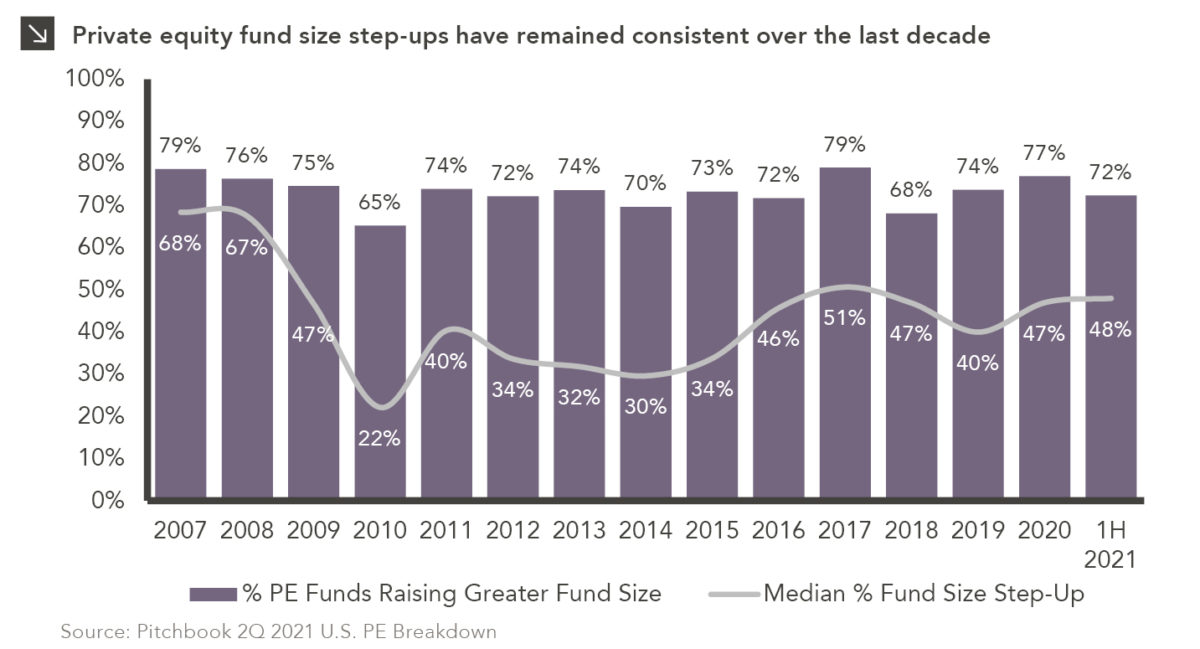
Despite strong fundraising numbers in recent years, private equity managers in the U.S. have stayed consistent with subsequent fund size step-ups. Through the first half of 2021, 72% of private equity managers launched funds with increased size targets, in line with the average over the last decade. The median fund size step-up in the first half of the year was 48%, modestly above the 40% average increase over the last decade, but in line with the industry average over the last five years.

Fund size is a critical factor for private equity investors to consider, as it can push a manager outside their strategy, require additional resources, require purchasing larger businesses that are more efficient, and/or take managers longer to deploy. That said, modest fund size growth is healthy for a private equity organization, allowing for internal growth, giving existing investors the ability to scale their allocations, and creating opportunities to bring new investors into the fund. Risks related to increased fund size can be mitigated by managers via scaled resources, targeting more portfolio companies, reducing the amount of co-investment offered, and/or reducing leverage — all things we look for in our due diligence process. We believe modest growth is healthy and to be encouraged if done responsibly, but we do carefully evaluate the magnitude of a fund size increase relative to our assessment of a manager’s capacity and strategy.

Print PDF > Private Equity Staying Rational with Fund Sizes


The opinions expressed herein are those of Marquette Associates, Inc. (“Marquette”), and are subject to change without notice. This material is not financial advice or an offer to purchase or sell any product. Marquette reserves the right to modify its current investment strategies and techniques based on changing market dynamics or client needs.

2021 Halftime Market Insights Video

This video features an in-depth analysis of the first half of 2021, reviewing general themes from the second quarter and risks and opportunities to monitor in the coming months.

Our Market Insights video series examines the primary asset classes we cover for clients including the U.S. economy, fixed income, U.S. and non-U.S. equities, hedge funds, real estate, infrastructure, private equity, and private credit, with presentations by our research analysts and directors.

Sign up for research alerts to be notified when we publish new videos here.
For more information, questions, or feedback, please send us an email.

PE Tapping Public Market Strength

Private equity exits are set to break record numbers in 2021. In 2020, there were 947 exits worth $367 billion, and in 2019 there were 1,111 for a total $323 billion. Already this year, in the first half of 2021, there have been 676 exits for $356 billion. At this pace, the year is on track to surpass both the previous highs of 1,328 exits in 2015 and $421 billion in exit value in 2018.

Along with the number of exits increasing overall, the percentage of exits via IPO has increased significantly this year. In 2019, the fear of a recession kept private companies from wanting to go public. Once a private company hits the market, PE sponsors keep their shares, now subject to public market dynamics, for an average of three years. Risk of a looming recession or lack of confidence in the public market can deter private company owners from pursuing this path. Alternatively, the increased use of public market exits year-to-date may represent private owners’ more bullish outlook on the market. We will continue to look to leading indicators like private market sentiment to help inform our own market expectations and client recommendations.

Print PDF > PE Tapping Public Market Strength


The opinions expressed herein are those of Marquette Associates, Inc. (“Marquette”), and are subject to change without notice. This material is not financial advice or an offer to purchase or sell any product. Marquette reserves the right to modify its current investment strategies and techniques based on changing market dynamics or client needs.

Can Private Equity Outperformance Persist?

North American private equity managers have consistently outperformed the Russell 3000 as well as other broad equity indices over the last 20 years.¹ Key value drivers that have contributed to this outperformance include information asymmetry, a longer-term strategic focus, use of leverage, improved management and governance, and effective value creation plans. But for private equity managers to continue to achieve these outsized returns, they must first find the right opportunities and then be able to effectively monetize their investments.

In the U.S. there are approximately 17,500 private companies with annual revenue greater than $100 million, compared to roughly 2,600 public companies above the same revenue threshold. For every one public opportunity at this level, there are almost seven private opportunities. There are also more than 340,000 private businesses with revenue between $5 and $100 million. As private markets continue to grow and evolve, private companies will be able to access capital with greater ease than they have historically. This, in addition to the disadvantages of going public, should extend the trend of companies staying private for longer. This sets the stage for private equity managers to continue to deliver attractive risk-adjusted returns, with a robust opportunity set and a number of unique investment advantages.

Print PDF > Can Private Equity Outperformance Persist?

¹Pitchbook as of Q320, latest data available.
Sources: Capital IQ, Forbes, and PitchBook


The opinions expressed herein are those of Marquette Associates, Inc. (“Marquette”), and are subject to change without notice. This material is not financial advice or an offer to purchase or sell any product. Marquette reserves the right to modify its current investment strategies and techniques based on changing market dynamics or client needs.

A Strong Decade for Private Markets, Led by Growth

While it has been a very strong decade for private market returns, not all private market strategies have provided the same level of risk-adjusted returns. Growth-oriented strategies like Growth, Private Equity, and Venture Capital have delivered the highest 15-year horizon IRRs and with lower standard deviation than other lower-returning strategies like Real Estate, Infrastructure, and Oil & Gas. We believe these growth areas are better positioned to generate higher IRRs within closed-ended funds given their large opportunity set, accelerated ability to deploy capital, opportunities to drive operational improvements, and ability to generate attractive exit opportunities.

Asset allocation mix is of increasing importance as investors seeking higher return potential within portfolios look to scale up their illiquid allocations. The last decade shows that not all private markets investments are equal. We believe Growth, Private Equity, and Venture Capital are likely to continue to be the most attractive strategies for investors looking to maximize the returns generated from their illiquid allocations. Manager selection also remains a critical investment decision within private markets strategies, where there is typically a wider range of performance dispersion than in more traditional public market asset classes.

Print PDF > A Strong Decade for Private Markets, Led by Growth


The opinions expressed herein are those of Marquette Associates, Inc. (“Marquette”), and are subject to change without notice. This material is not financial advice or an offer to purchase or sell any product. Marquette reserves the right to modify its current investment strategies and techniques based on changing market dynamics or client needs.

The SPAC Explained

The SPAC once again rose to prominence in 2020 and momentum has continued to build this year. By mid-March 2021, the number of SPACs raised had already eclipsed the total raised in 2020. SPACs, special-purpose acquisition companies, are shell companies set up to raise money to acquire another, existing company. SPAC vehicles have been around for decades but have recently risen in popularity as experienced investors and management teams have chosen this route to decrease the risks associated with a traditional initial public offering (IPO).

In this newsletter, we explain how SPACs work and are structured, typical attributes of SPAC sponsors, who benefits from the SPAC structure, why SPACs have seen such exponential growth recently, and how private equity interacts with and influences the SPAC industry.

Read > The SPAC Explained

For more Marquette coverage on SPACs, reference our recent research, What’s Next for SPACs? and The Year of SPACs.


The opinions expressed herein are those of Marquette Associates, Inc. (“Marquette”), and are subject to change without notice. This material is not financial advice or an offer to purchase or sell any product. Marquette reserves the right to modify its current investment strategies and techniques based on changing market dynamics or client needs.

What’s Next for SPACs?

The ferocious appetite for Special Purpose Acquisition Companies (SPACs) continued its momentum throughout the first quarter of 2021. Investors could not get enough of this asset class as a record amount of capital flowed into the space. Through March, 2021 has already seen more SPAC IPOs than all of 2020, with over 300 new deals coming to market. Similarly, gross proceeds thus far through April are already over $100B, well past the $83B that was raised throughout 2020. The space has gotten so hot that sports celebrities like Shaquille O’Neal, Colin Kaepernick, and Alex Rodriguez have all put their names on SPACs that have recently hit the market.

Can this momentum continue? The Securities and Exchange Commission (SEC) might have something to say about it. Earlier this month, the SEC issued new accounting guidance that would classify SPAC warrants as liabilities instead of as equity instruments, as they are currently classified. Warrants are given to capital providers like hedge funds that put up the capital for SPACs before an IPO, to offer the capital provider more upside once the company goes public. SPAC IPOs have since slowed, as affected SPACs would have to restate their financials if this becomes law. With this risk on the table, investors may begin to look elsewhere to put their capital to work, dampening this SPAC market frenzy.

Print PDF > What’s Next for SPACs?


The opinions expressed herein are those of Marquette Associates, Inc. (“Marquette”), and are subject to change without notice. This material is not financial advice or an offer to purchase or sell any product. Marquette reserves the right to modify its current investment strategies and techniques based on changing market dynamics or client needs.

One Year Later, What’s Next?

Welcome to our inaugural quarterly client newsletter! As a way of introduction, I am Greg Leonberger, Director of Research here at Marquette. I have had the privilege of meeting many of you over the years, and for those that I have not worked with previously, please accept this virtual introduction; my hope is to meet many more of you in person once in-person meetings resume. As I embark on this newsletter series, the goal each quarter is relatively simple: provide you with our views on capital markets, the economy, emerging risks as well as opportunities, and hopefully stitch in a few anecdotes to make for a more engaging connection with our readers.

Highlights from this edition:

  • One year anniversary of the equity market trough in 2020
  • COVID-19: lingering uncertainty, vaccine progress, economic recovery
  • Equities update: value and small-cap outperformance, valuations, TINA
  • Fixed income: reflation trade and interest rates, spreads
  • Alternatives: opportunities in real estate, hedge funds, and private markets
  • Inflation worries: money supply and commodity prices

Read > One Year Later, What’s Next?


The opinions expressed herein are those of Marquette Associates, Inc. (“Marquette”), and are subject to change without notice. This material is not financial advice or an offer to purchase or sell any product. Marquette reserves the right to modify its current investment strategies and techniques based on changing market dynamics or client needs.