2021 Market Preview Video

This video coincides with our 2021 Market Preview newsletters and provides a high-level summary of each, including analysis of last year’s performance as well as trends, themes, opportunities, and risks to watch for in 2021.

Our Market Insights series examines the primary asset classes we cover for clients including the U.S. economy, fixed income, U.S. and non-U.S. equities, hedge funds, real estate, infrastructure, private equity, and private credit, with presentations by our research analysts and directors.

Sign up for research alerts to be notified when we publish new videos here.
For more information, questions, or feedback, please send us an email.

Can TIPS Be an Effective Inflation Hedge for Portfolios?

With the COVID vaccine’s worldwide distribution and adoption starting last week, many investors are aiming to project an inflation outlook driven by the return of furloughed workers and impending economic recovery and adjust portfolios with inflation protection in mind.

In this newsletter, we examine how key asset classes in institutional portfolios behave in rising or declining inflation environments, and ultimately determine the best asset classes that serve as inflation hedges while also providing strong total return and efficiency ratios. In particular, we investigate if TIPS (Treasury Inflation-Protected Securities) offer superior inflation protection compared to other common portfolio constituents.

Read > Can TIPS Be an Effective Inflation Hedge for Portfolios?


The opinions expressed herein are those of Marquette Associates, Inc. (“Marquette”), and are subject to change without notice. This material is not financial advice or an offer to purchase or sell any product. Marquette reserves the right to modify its current investment strategies and techniques based on changing market dynamics or client needs.

Third Quarter Review of Asset Allocation: Risks and Opportunities

The third quarter of 2020 featured a major rebound in economic data amid an intense battle for the presidency and an uncertain future for COVID-19 cases as some states are seeing higher positivity rates. GDP growth for the quarter is expected to come in at +35.2% YoY, higher than analyst expectations, which helped to propel equity markets higher during the quarter. In addition, the unemployment rate dropped to 7.9% but is expected to remain elevated until additional clarity regarding COVID-19 becomes available. Below are some highlights from the quarter:

  • Biden is favored over Trump in the election race, as mail-in ballots and virtual town halls instead of debates have proven that this election will be unlike any before it.
  • The country has widely reopened, though concerns in some larger states of increased positivity rates have caused some rollbacks ahead of the winter season.
  • A vaccine is in the works and anticipated to be ready by April 2021, with widespread vaccinations likely around mid-2021.
  • Schools have moved to a hybrid model of in-person and online classes, causing logistical problems for parents as many balance jobs and at-home learning.

The election is sure to bring additional volatility through the end of the year. Biden and Trump have vastly different tax plans and a Democratic sweep could drive a sell-off in equity markets. Economic data is still pending through 3Q, though most forecasts show large rebounds in data as states reopened from COVID-19 closures. Big questions regarding vaccines and if the winter will see a resurgence in coronavirus cases remain. We analyze what all of this means for each asset class in the remainder of this newsletter.

Read > Third Quarter Review of Asset Allocation: Risks and Opportunities


The opinions expressed herein are those of Marquette Associates, Inc. (“Marquette”), and are subject to change without notice. This material is not financial advice or an offer to purchase or sell any product. Marquette reserves the right to modify its current investment strategies and techniques based on changing market dynamics or client needs.

Q3 2020 Market Insights Video

This video features an in-depth analysis of the third quarter’s performance, coinciding with our 3Q Asset Allocation Update newsletter reviewing risks and opportunities heading into the final quarter of the year.

Our Market Insights series examines the primary asset classes we cover for clients including the U.S. economy, fixed income, U.S. and non-U.S. equities, hedge funds, real estate, infrastructure, private equity, and private credit, with presentations by our research analysts and directors.

Sign up for research alerts to be notified when we publish new videos here.
For more information, questions, or feedback, please send us an email.

Can Real Assets Help Protect Portfolios from Inflation?

Against the current backdrop of unprecedented monetary stimulus, investors have become increasingly wary of future inflation and its potential degenerative effect on portfolio returns. While deflationary pressures appear more likely in the near term, the COVID-driven stimulus packages have created the potential for inflation once the pandemic has subsided. Predictably, investors are contemplating which asset classes can help hedge inflationary risk and real assets are a natural asset class to offset this risk.

During periods of upward price pressure, both real estate and infrastructure funds have at least some degree of pricing power, meaning they can boost rental income and revenue streams from their underlying holdings. In some cases, the embedded lease and contractual agreements of these holdings are linked to an inflation index, particularly for infrastructure. Therefore, the incomes of such holdings will rise as inflation rises and thus unlike fixed rate bonds, the real rate of return will not be eroded.

In order to examine this hypothesis, we compared traditional asset classes — stocks and bonds — to the real assets mentioned above: real estate and infrastructure. We compared cumulative returns during periods of above average inflation and during positive inflation surprises.¹ Although data is limited for real assets (particularly infrastructure), we analyzed cumulative returns for these four asset classes back to the earliest common date of index inception. Since the 2006 inception of the FTSE core infrastructure index, both real estate and infrastructure assets significantly outperformed U.S. equities and bonds during all periods when U.S. CPI rose above the period’s historical YOY average (1.9%). And during all quarters over the same period when developed world inflation experienced a material positive shock (“positive inflation surprises” defined previously), real assets also significantly outperformed both bonds and equities. Thus, while we have only experienced marginal inflationary pressure over the past 15 years, the data indicates that the inflation hedging mechanisms of real estate and infrastructure assets have been effective in protecting the purchasing power of portfolios. While it is difficult to forecast the ultimate timing, duration, and magnitude of inflation from this point forward, it is clear that real assets should offer a degree of insulation from the adverse effects of inflation.

Print PDF > Can Real Assets Help Protect Portfolios from Inflation?

¹ Surprises to developed world inflation are defined as periods where the expectations to the GDP weighted CPIs of the U.S., UK, and EU were below the actual CPI level by more than 10 bps.


The opinions expressed herein are those of Marquette Associates, Inc. (“Marquette”), and are subject to change without notice. This material is not financial advice or an offer to purchase or sell any product. Marquette reserves the right to modify its current investment strategies and techniques based on changing market dynamics or client needs.

2020 Halftime Market Insights Video

This video features an in-depth analysis of the second quarter’s performance and coincides with our 2Q Asset Allocation Update newsletter, reviewing risks and opportunities heading into the second half of the year.

Our Market Insights series examines the primary asset classes we cover for clients including the U.S. economy, fixed income, U.S. and non-U.S. equities, hedge funds, real estate, infrastructure, private equity, and private credit, with presentations by our research analysts and directors.

Sign up for research alerts to be notified when we publish new videos here. For more information, questions, or feedback, please send us an email.

Second Quarter Review of Asset Allocation: Risks and Opportunities

The second quarter of 2020 proved to be as eventful as the first, with slow economic results being largely ignored as markets rallied. GDP growth for the quarter is expected to come in at -35.5% YoY, though 3Q GDP projections indicate a significant rebound is expected as the country begins to reopen to “the new normal.” In addition, the unemployment rate came in at 11.1%, down from the April peak above 14%. Below are some highlights from the quarter:

  • Countries around the globe began reopening businesses amid fears of a second wave of COVID-19 infections.
  • Daily infections reached a new high in the United States at more than 50,000 per day, causing some states to roll back their reopening plans.
  • Weekly initial claims for unemployment insurance have continued to trend downwards.
  • Additional fiscal and monetary stimulus are expected in the second half of the year, bolstering markets.

COVID-19 has proven to be a potentially long-lasting concern as it remains to be seen whether we are in for a V-shaped or U-shaped recovery. Economic data is improving slowly, though markets have seemed to shrug off some of the negative news as the S&P 500 moved into positive territory over the one-year period. Though it may have fallen into the background due to COVID-19, 2020 is a presidential election year. Uncertainty surrounding the election will undoubtedly have an impact on forward-looking expectations. In this newsletter, we analyze what all of this means for each asset class.

Read > Second Quarter Review of Asset Allocation: Risks and Opportunities


The opinions expressed herein are those of Marquette Associates, Inc. (“Marquette”), and are subject to change without notice. This material is not financial advice or an offer to purchase or sell any product. Marquette reserves the right to modify its current investment strategies and techniques based on changing market dynamics or client needs.

Q1 2020 Market Insights Video

This video features an in-depth analysis of the first quarter’s performance with a special focus looking forward from the coronavirus pandemic and resulting economic and market impacts.

Our Market Insights series examines the primary asset classes we cover for clients including the U.S. economy, fixed income, U.S. and non-U.S. equities, hedge funds, real estate, infrastructure, private equity, and private credit, with presentations by our research analysts and directors. For more information, questions, or feedback, please send us an email.

How Will Private Real Estate Be Impacted by Coronavirus and the Market Downturn?

As we have seen in past market downturns, almost all risk assets feel some degree of pain as correlations trend towards one and returns drift downwards in seemingly perfect harmony. In the case of private real estate, headlines have been sparse to this point but it is only a matter of time until the repercussions are felt, particularly for the sectors hardest hit by the outbreak.

This newsletter details potential near-term and long-term effects of the coronavirus pandemic on private real estate, with a look at historical performance as well as some of the unique features of this particular downturn.

Read > How Will Private Real Estate Be Impacted by Coronavirus and the Market Downturn?


The opinions expressed herein are those of Marquette Associates, Inc. (“Marquette”), and are subject to change without notice. This material is not financial advice or an offer to purchase or sell any product. Marquette reserves the right to modify its current investment strategies and techniques based on changing market dynamics or client needs.


What Does the Coronavirus Pandemic Mean for Future Real Estate Returns?

This week’s chart examines forward-looking returns for private real estate based on historical spreads to the 10-Year Treasury Yield and the NCREIF-ODCE Index (proxy for core private real estate). Real estate valuations (spread-to-Treasuries) are currently above 300 bps as a result of COVID-19. Spreads of this magnitude have only been seen four times, each of which has been followed by strong 3- and 5-year returns. For example, during the Global Financial Crisis, real estate spreads-to-Treasuries surpassed 300 bps in the fourth quarter of 2009 which were followed by 12.2% and 12.4% returns for the NCREIF-ODCE Index in the subsequent 3 and 5-year periods, respectively.

Though the impacts from COVID-19 have not yet been fully felt in the private real estate market, it is clear that challenges lie ahead, particularly in the sectors that have been hit the hardest. For example, assets with short lease durations and heavier operating business components, such as hospitality (daily), and co-working office (monthly), as well as assets that rely on foot traffic, such as entertainment, food & beverage, and destination retail will be more affected by the pandemic. Further complicating matters, the lack of transaction volume, comparable sales, leases, and loan originations have made it nearly impossible for appraisers to adjust valuations at this point in time.

Beyond the aforementioned troubled sectors, the impacts from COVID-19 will ultimately vary by property type, geography, and risk profile. The following table highlights the potential near-term and long-term impacts of each property sector:
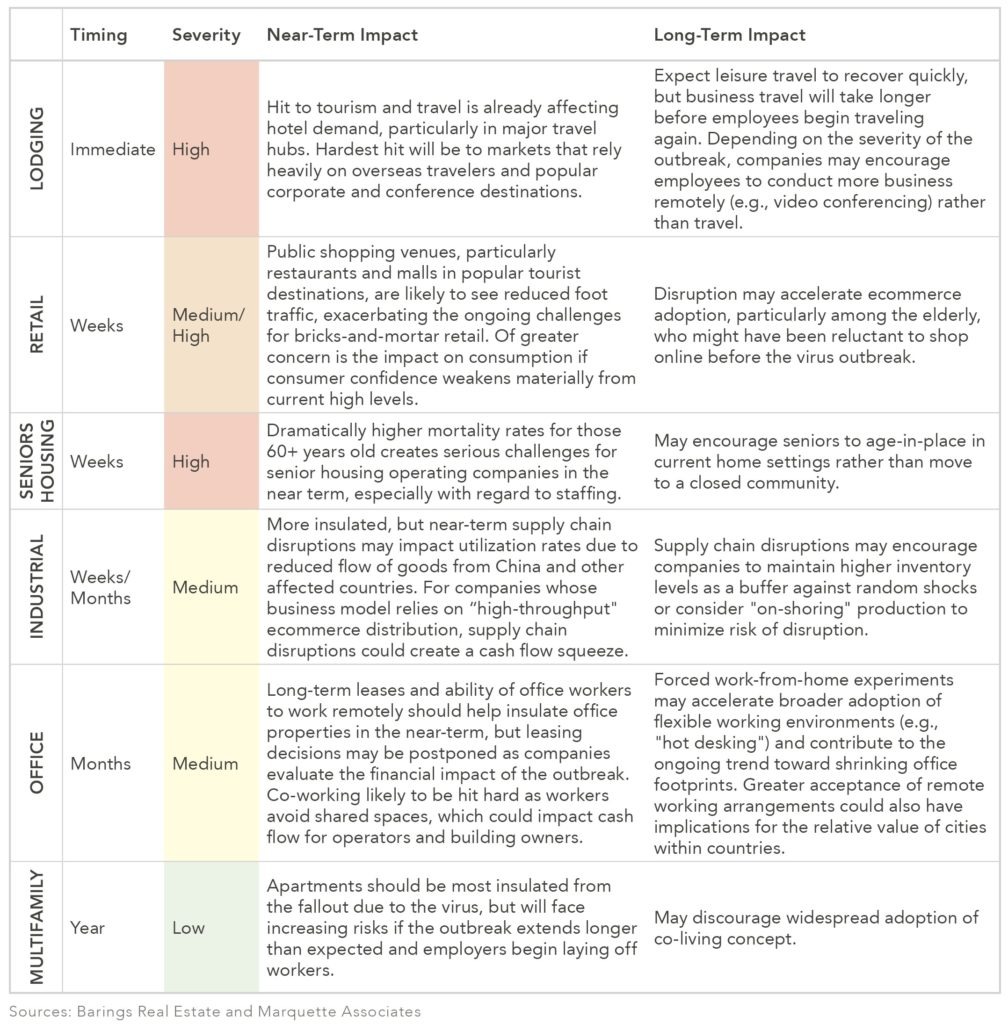
Impacts of Coronavirus Pandemic on Real Estate Property Sectors table

While global growth is being impacted in the near-term, we still expect a recovery to take hold once the disruption fades; we still maintain the view that the recovery is delayed, not derailed. However, the true impact of this on real estate returns will not be known for a while. Although longer-term forward-looking returns appear promising at this point, there is a relatively high degree of uncertainty because the ultimate impact on the aforementioned sectors (which should be the biggest headwind for real estate) will remain unknown until the coronavirus outbreak is contained and the economy begins to function at a normal level again.

Print PDF > What Does the Coronavirus Pandemic Mean for Future Real Estate Returns?


The opinions expressed herein are those of Marquette Associates, Inc. (“Marquette”), and are subject to change without notice. This material is not financial advice or an offer to purchase or sell any product. Marquette reserves the right to modify its current investment strategies and techniques based on changing market dynamics or client needs.