Second Quarter Review of Asset Allocation: Risks and Opportunities

The second quarter of 2020 proved to be as eventful as the first, with slow economic results being largely ignored as markets rallied. GDP growth for the quarter is expected to come in at -35.5% YoY, though 3Q GDP projections indicate a significant rebound is expected as the country begins to reopen to “the new normal.” In addition, the unemployment rate came in at 11.1%, down from the April peak above 14%. Below are some highlights from the quarter:

  • Countries around the globe began reopening businesses amid fears of a second wave of COVID-19 infections.
  • Daily infections reached a new high in the United States at more than 50,000 per day, causing some states to roll back their reopening plans.
  • Weekly initial claims for unemployment insurance have continued to trend downwards.
  • Additional fiscal and monetary stimulus are expected in the second half of the year, bolstering markets.

COVID-19 has proven to be a potentially long-lasting concern as it remains to be seen whether we are in for a V-shaped or U-shaped recovery. Economic data is improving slowly, though markets have seemed to shrug off some of the negative news as the S&P 500 moved into positive territory over the one-year period. Though it may have fallen into the background due to COVID-19, 2020 is a presidential election year. Uncertainty surrounding the election will undoubtedly have an impact on forward-looking expectations. In this newsletter, we analyze what all of this means for each asset class.

Read > Second Quarter Review of Asset Allocation: Risks and Opportunities


The opinions expressed herein are those of Marquette Associates, Inc. (“Marquette”), and are subject to change without notice. This material is not financial advice or an offer to purchase or sell any product. Marquette reserves the right to modify its current investment strategies and techniques based on changing market dynamics or client needs.

Q1 2020 Market Insights Video

This video features an in-depth analysis of the first quarter’s performance with a special focus looking forward from the coronavirus pandemic and resulting economic and market impacts.

Our Market Insights series examines the primary asset classes we cover for clients including the U.S. economy, fixed income, U.S. and non-U.S. equities, hedge funds, real estate, infrastructure, private equity, and private credit, with presentations by our research analysts and directors. For more information, questions, or feedback, please send us an email.

How Will Private Real Estate Be Impacted by Coronavirus and the Market Downturn?

As we have seen in past market downturns, almost all risk assets feel some degree of pain as correlations trend towards one and returns drift downwards in seemingly perfect harmony. In the case of private real estate, headlines have been sparse to this point but it is only a matter of time until the repercussions are felt, particularly for the sectors hardest hit by the outbreak.

This newsletter details potential near-term and long-term effects of the coronavirus pandemic on private real estate, with a look at historical performance as well as some of the unique features of this particular downturn.

Read > How Will Private Real Estate Be Impacted by Coronavirus and the Market Downturn?


The opinions expressed herein are those of Marquette Associates, Inc. (“Marquette”), and are subject to change without notice. This material is not financial advice or an offer to purchase or sell any product. Marquette reserves the right to modify its current investment strategies and techniques based on changing market dynamics or client needs.


What Does the Coronavirus Pandemic Mean for Future Real Estate Returns?

This week’s chart examines forward-looking returns for private real estate based on historical spreads to the 10-Year Treasury Yield and the NCREIF-ODCE Index (proxy for core private real estate). Real estate valuations (spread-to-Treasuries) are currently above 300 bps as a result of COVID-19. Spreads of this magnitude have only been seen four times, each of which has been followed by strong 3- and 5-year returns. For example, during the Global Financial Crisis, real estate spreads-to-Treasuries surpassed 300 bps in the fourth quarter of 2009 which were followed by 12.2% and 12.4% returns for the NCREIF-ODCE Index in the subsequent 3 and 5-year periods, respectively.

Though the impacts from COVID-19 have not yet been fully felt in the private real estate market, it is clear that challenges lie ahead, particularly in the sectors that have been hit the hardest. For example, assets with short lease durations and heavier operating business components, such as hospitality (daily), and co-working office (monthly), as well as assets that rely on foot traffic, such as entertainment, food & beverage, and destination retail will be more affected by the pandemic. Further complicating matters, the lack of transaction volume, comparable sales, leases, and loan originations have made it nearly impossible for appraisers to adjust valuations at this point in time.

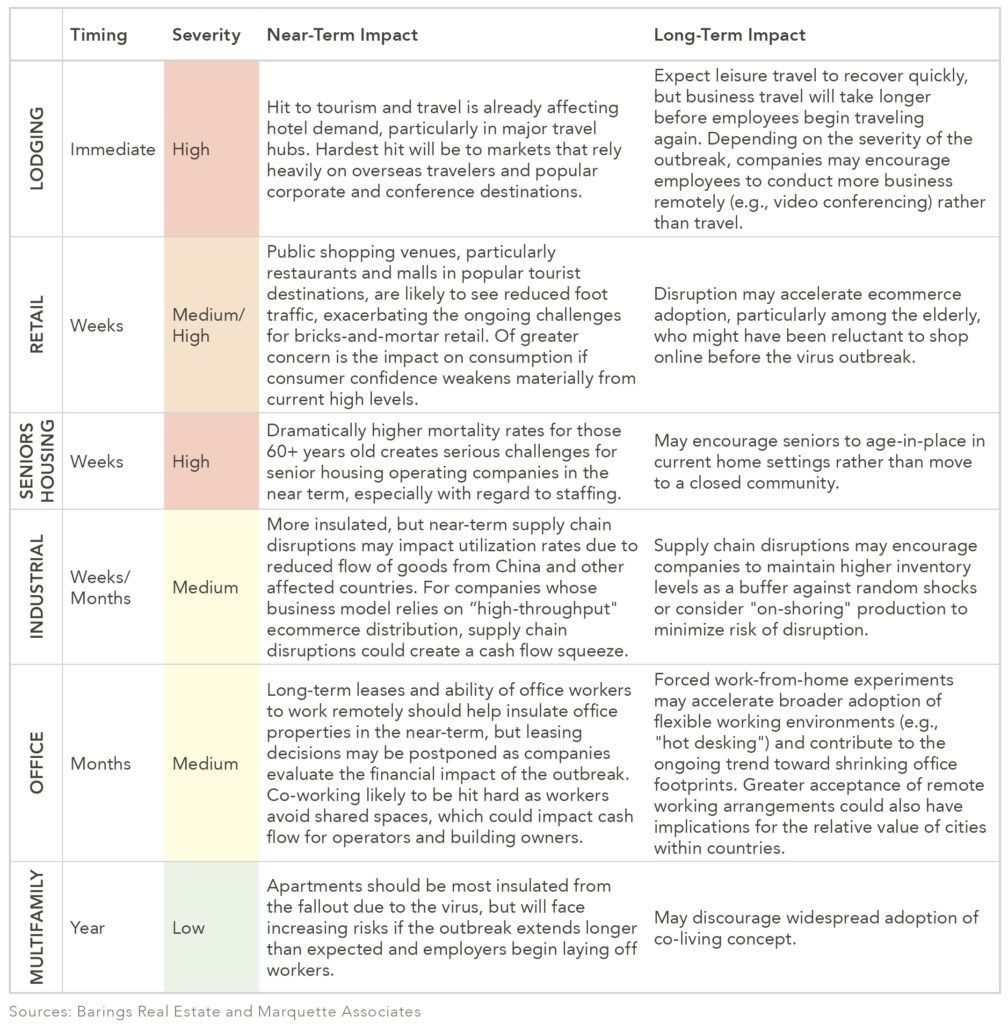
Beyond the aforementioned troubled sectors, the impacts from COVID-19 will ultimately vary by property type, geography, and risk profile. The following table highlights the potential near-term and long-term impacts of each property sector:

Impacts of Coronavirus Pandemic on Real Estate Property Sectors table

While global growth is being impacted in the near-term, we still expect a recovery to take hold once the disruption fades; we still maintain the view that the recovery is delayed, not derailed. However, the true impact of this on real estate returns will not be known for a while. Although longer-term forward-looking returns appear promising at this point, there is a relatively high degree of uncertainty because the ultimate impact on the aforementioned sectors (which should be the biggest headwind for real estate) will remain unknown until the coronavirus outbreak is contained and the economy begins to function at a normal level again.

Print PDF > What Does the Coronavirus Pandemic Mean for Future Real Estate Returns?


The opinions expressed herein are those of Marquette Associates, Inc. (“Marquette”), and are subject to change without notice. This material is not financial advice or an offer to purchase or sell any product. Marquette reserves the right to modify its current investment strategies and techniques based on changing market dynamics or client needs.

March 2: Coronavirus Update and Portfolio Guidance

Last week was a painful one for the equity markets as fears about the coronavirus drove investors out of stocks and markets into correction territory. The following newsletter summarizes last week’s developments and provides specific commentary on what to watch for across the major asset classes that constitute investor portfolios.

Read > March 2: Coronavirus Update and Portfolio Guidance

As always, please reach out to your consultant or our research team for more details about any of the information presented in this update. For more Marquette coverage on coronavirus, reference our previous newsletter (January 28) and Chart of the Week posts (February 13, February 21, February 26).


The opinions expressed herein are those of Marquette Associates, Inc. (“Marquette”), and are subject to change without notice. This material is not financial advice or an offer to purchase or sell any product. Marquette reserves the right to modify its current investment strategies and techniques based on changing market dynamics or client needs.

2020 Market Preview

2019 was certainly a profitable year for investors as traditional and alternative asset classes delivered positive returns.  As we enter 2020, there are a litany of questions facing global markets ranging from the U.S. election to trade disputes to global monetary policy, all of which will undoubtedly influence investment returns. The following newsletters examine the primary asset classes we cover for our clients, with in-depth analysis of last year’s performance and more importantly, trends, themes, and projections to watch for in 2020.

We hope these materials can assist you and your committees as you plan for the coming year, and please feel free to reach out to any of us should you have further questions about the articles. We have also produced a 2020 Market Preview video if you would like to hear a high-level summary of the market previews. Here’s to another positive year from the markets in 2020!

U.S. Economy: Signs of Slowing?
by Greg Leonberger, FSA, EA, MAAA, Partner, Director of Research

Fixed Income: The New Roaring Twenties — Will It Be Different This Time?
by Ben Mohr, CFA, Director of Fixed Income

U.S. Equities: Climbing the Wall of Worry
by Robert Britenbach, CFA, CIPM Research Analyst, U.S. Equities

Non-U.S. Equities: Big Expectations, Little Wiggle Room
by David Hernandez, CFA, Senior Research Analyst, Non-U.S. Equities
and Nicole Johnson-Barnes, CFA, Research Analyst

Real Estate: What Will Happen Next?
by Jeremy Zirin, CAIA, Senior Research Analyst, Real Assets

Infrastructure: The Energy Revolution Is Driving the Future of Infrastructure
by Jeremy Zirin, CAIA, Senior Research Analyst, Real Assets

Hedge Funds: Rising Geopolitical Risks and a U.S. Election Could Lead to Tempered Expectations
by Joe McGuane, CFA, Senior Research Analyst, Alternatives

Private Equity: As Asset Class Grows, Continues to Deliver for Investors
by Derek Schmidt, CFA, CAIA, Director of Private Equity

Private Credit: An Asset Class Coming Into Its Own
by Brett Graffy, CAIA, Research Analyst

To read the above files in one combined document > 2020 Market Preview


The opinions expressed herein are those of Marquette Associates, Inc. (“Marquette”), and are subject to change without notice. This material is not financial advice or an offer to purchase or sell any product. Marquette reserves the right to modify its current investment strategies and techniques based on changing market dynamics or client needs.

2020 Market Preview Video

This video coincides with our annual Market Preview newsletters and includes a recap of 2019’s performance and what investors can expect heading into 2020. 2019 was certainly a profitable year for investors as traditional and alternative asset classes delivered positive returns. As we enter 2020, there are a litany of questions facing global markets ranging from the U.S. election to trade disputes to global monetary policy, all of which will undoubtedly influence investment returns.

This video is part of our Market Insights series, a quarterly presentation designed to brief clients on the market as soon as possible after quarterly market data becomes available. Members of our research team discuss the overall U.S. economy, along with fixed income, U.S. and non-U.S. equity, hedge funds, private equity, real estate, and infrastructure.

For more information, questions, or feedback, please send us an email.

Alternatives 101 Video Series

Our Alternatives 101 video series covers each of the major alternatives asset classes, with guidance provided by several of Marquette’s research analysts and directors. In contrast to traditional investments, alternatives investing includes asset classes other than stocks, bonds, and cash (reference our Investing 101 series for more information about traditional investing concepts). This series aims to introduce trustees, staff, and other investors to the key terms and concepts they may encounter when investing in these typically less familiar asset classes.

The series covers:

View each talk in the player below— use the upper-right list icon to access a specific presentation.

For more information, questions, or feedback, please send us an email.

Live Videos: 2019 Investment Symposium Presentations

The six flash talks by our research team at Marquette’s 2019 Investment Symposium on October 4th are now available to view on our YouTube channel.

View each talk in the player above — use the upper-right list icon to access a specific presentation.

  • The Investment Case Behind ESG Investing and Implementation in Practice
    Nat Kellogg, CFA, Director of Manager Search
  • Beyond Traditional Real Estate: Exploring Opportunities in Non-Core Real Estate
    Jeremy Zirin, CAIA, Senior Research Analyst, Real Assets
  • So Many Risks, So Little Time: What’s Next in Global Risk?
    Nicole Johnson-Barnes, Research Analyst
  • U.S. Against the World: Should Investors Still Own International Stocks?
    David Hernandez, CFA, Senior Research Analyst, Non-U.S. Equities
    Samantha T. Grant, CFA, CAIA, Senior Research Analyst, U.S. Equities
  • Machine Learning for Investing: How is Artificial Intelligence Being Used in Asset Management?
    Ben Mohr, CFA, Director of Fixed Income
  • Pick Your Portfolio Poison: Recession or Inflation?
    Greg Leonberger, FSA, EA, MAAA, Director of Research

Marquette encourages open dialogue with our consultants and research team. For more information, questions, or feedback, please send us an email.

Third Quarter Review of Asset Allocation: Risks and Opportunities

The third quarter saw mixed results for financial markets. Economic fundamentals generally remain strong but signs of deterioration are starting to emerge. Unemployment currently hovers around 3.5%, and inflation is near the Fed’s target of 2%. However, 3Q GDP growth was under 2% (though the 1.9% figure exceeded the 1.7% estimate), and the PMI index has been below 50 since August (a reading under 50 is indicative of contraction in the manufacturing sector). Overall, the most important global trends we see are the following:

  • The U.S.-China trade conflict continues to weigh heavily on both countries as talks remain ongoing;
  • The Federal Reserve (“Fed”) reversed course by cutting interest rates and further cuts are still possible;
  • The U.S. Treasury yield curve inverted briefly, which historically has signaled a recession over the subsequent 12–24 months;
  • Brexit negotiations were extended to January 31, 2020, therefore further perpetuating the uncertainty around the UK’s exit from the EU;
  • Negative interest rates continue to grow in prevalence around the world.

The impact of these shifting dynamics is explored further in this newsletter as we review third quarter performance and expectations going forward for each of the major asset classes.

Read > Third Quarter Review of Asset Allocation: Risks and Opportunities
 

The opinions expressed herein are those of Marquette Associates, Inc. (“Marquette”), and are subject to change without notice. This material is not financial advice or an offer to purchase or sell any product. Marquette reserves the right to modify its current investment strategies and techniques based on changing market dynamics or client needs.