What Does the Biden Win Mean for Financial Markets?

On Saturday, November 7th, Joe Biden was declared the winner of the presidential election and will become the 46th president of the United States in January. Markets were surprisingly positive last week despite the uncertainty around results as multiple states were too close to call until all the votes had been tallied. While there is still pending litigation in certain states, it seems highly unlikely that these actions will reverse the election result. Thus, market participants have turned their attention to what the market can expect from a Biden-led White House coupled with a split Congress, while the coronavirus pandemic marches on.

In this newsletter, we tackle this question for each of the “traditional” asset classes: Fixed Income, U.S. Equities, and Non-U.S. Equities. The impact on alternative asset classes such as hedge funds, real assets, and private equity are more nuanced and will be covered in our 2021 market preview to be released in January.

Read > What Does the Biden Win Mean for Financial Markets?


The opinions expressed herein are those of Marquette Associates, Inc. (“Marquette”), and are subject to change without notice. This material is not financial advice or an offer to purchase or sell any product. Marquette reserves the right to modify its current investment strategies and techniques based on changing market dynamics or client needs.

Early Voter Turnout

Of the many reasons the 2020 election may make history, expected record voter turnout is perhaps the best. By October 22nd, early votes via mail-in ballots and early in-person voting had already surpassed all early voting done in the 2016 general election. Based on last night’s latest estimates, almost 100 million have already voted nationwide, more than 70% of 2016’s high water mark of almost 139 million. Key battleground states Texas, Florida, North Carolina, Georgia, and Nevada have already collected more than 90% of 2016’s total vote.

For states that compare ballots to a voter’s party registration, 45% of early voters have been Democrat and 31% Republican, with the remainder registered with a minor party or without party affiliation. Polls generally report that Republicans are more likely to vote in person on Election Day, so early takeaways are limited.

As we anxiously await election results tonight and over the following days (hopefully not weeks), we can at least be celebratory about how many citizens have performed their civic duty in this election.

Please follow Marquette Research for additional election updates in the coming days, including our take on impacts across asset classes.

Print PDF > Early Voter Turnout


The opinions expressed herein are those of Marquette Associates, Inc. (“Marquette”), and are subject to change without notice. This material is not financial advice or an offer to purchase or sell any product. Marquette reserves the right to modify its current investment strategies and techniques based on changing market dynamics or client needs.

Record Growth During Third Quarter, but Will It Continue?

In this week’s chart of the week, we look at the estimated growth of Gross Domestic Product (GDP) — the value of all goods and services produced across the economy — for the third quarter of 2020. GDP increased at a seasonally adjusted annual rate of 33.1% according to the “advance“ estimate released by the Bureau of Economic Analysis. This increase is the largest on record, following a record decline (-31.4%) in the second quarter as COVID-19 severely disrupted business activity across the country. The increase was driven by increases in personal consumption expenditures, private inventory investment, exports, nonresidential fixed investment, and residential fixed investment; detractors were decreases in federal, state, and local government spending. The actual quarter-on-quarter rate of expansion, without annualization, was 7.4%.

Economists expect the economy to expand throughout the fourth quarter though much more slowly compared to the third quarter. Rising COVID-19 cases across certain parts of the country could plunge the economy into turmoil again if states are forced to put tighter restrictions back in place, likely slowing consumption and ultimately, GDP growth. Mitigating factors to these trends are potential vaccine approval and distribution, as well as additional stimulus from the U.S. government. Fourth quarter GDP will undoubtedly hinge on how these themes play out and bear watching over the coming months.

Print PDF > Record Growth During Third Quarter, but Will It Continue?


The opinions expressed herein are those of Marquette Associates, Inc. (“Marquette”), and are subject to change without notice. This material is not financial advice or an offer to purchase or sell any product. Marquette reserves the right to modify its current investment strategies and techniques based on changing market dynamics or client needs.
Equities Falter Amid Uncertainty

October has been a tale of two months for equity market participants. While the first half of the month saw solid performance from risk assets, major equity indices have struggled in recent days as investors continue to grapple with political, economic, and public health uncertainty.

In this newsletter, we put the recent volatility and pullback into context, with an update on the resurgence of new coronavirus cases and global responses to the pandemic and a look at expectations for the coming months.

Read > Equities Falter Amid Uncertainty


The opinions expressed herein are those of Marquette Associates, Inc. (“Marquette”), and are subject to change without notice. This material is not financial advice or an offer to purchase or sell any product. Marquette reserves the right to modify its current investment strategies and techniques based on changing market dynamics or client needs.

Third Quarter Review of Asset Allocation: Risks and Opportunities

The third quarter of 2020 featured a major rebound in economic data amid an intense battle for the presidency and an uncertain future for COVID-19 cases as some states are seeing higher positivity rates. GDP growth for the quarter is expected to come in at +35.2% YoY, higher than analyst expectations, which helped to propel equity markets higher during the quarter. In addition, the unemployment rate dropped to 7.9% but is expected to remain elevated until additional clarity regarding COVID-19 becomes available. Below are some highlights from the quarter:

  • Biden is favored over Trump in the election race, as mail-in ballots and virtual town halls instead of debates have proven that this election will be unlike any before it.
  • The country has widely reopened, though concerns in some larger states of increased positivity rates have caused some rollbacks ahead of the winter season.
  • A vaccine is in the works and anticipated to be ready by April 2021, with widespread vaccinations likely around mid-2021.
  • Schools have moved to a hybrid model of in-person and online classes, causing logistical problems for parents as many balance jobs and at-home learning.

The election is sure to bring additional volatility through the end of the year. Biden and Trump have vastly different tax plans and a Democratic sweep could drive a sell-off in equity markets. Economic data is still pending through 3Q, though most forecasts show large rebounds in data as states reopened from COVID-19 closures. Big questions regarding vaccines and if the winter will see a resurgence in coronavirus cases remain. We analyze what all of this means for each asset class in the remainder of this newsletter.

Read > Third Quarter Review of Asset Allocation: Risks and Opportunities


The opinions expressed herein are those of Marquette Associates, Inc. (“Marquette”), and are subject to change without notice. This material is not financial advice or an offer to purchase or sell any product. Marquette reserves the right to modify its current investment strategies and techniques based on changing market dynamics or client needs.

Will a Vaccine Be the End of COVID-19?

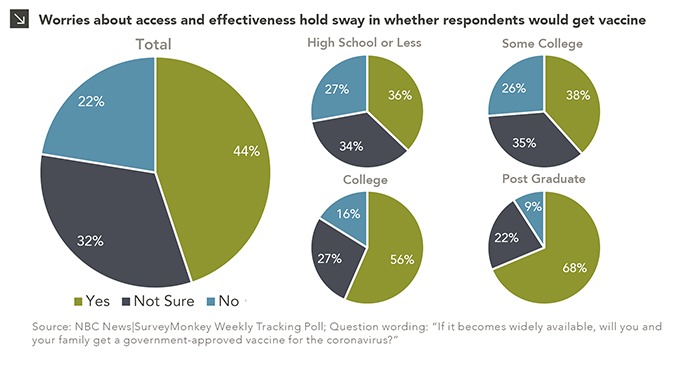
Simmering in the background of the presidential race and stimulus talks remains a crucial step towards fully re-opening the country: vaccine progress. Many experts view the development of a vaccine as the key to finally ending the battle against COVID-19. With a commercially available vaccine anticipated as early as April of 2021, it seemed that we were drawing nearer to the end of restrictions on large gatherings. People would be able to attend sporting events, weddings, and graduations again in a return to more normal life. However, in a startling recent poll of over 34,000 people regarding their interest in receiving a government-approved vaccine, over half said that they would not or are not sure that they would want to receive the vaccine.

The stark difference in responses seems to correlate with education level, as shown in the charts above. There is a significant increase in wanting to receive the vaccine on behalf of people whose education includes a college degree. For education levels below college, the results were much more mixed about receptivity to a vaccine. The most commonly cited reservations were accessibility (cost, wait time, proximity of distribution center/medical office) and effectiveness. Although this was just one poll, it appears that the release of a vaccine may not completely stem the pandemic unless there is a dramatic reversal in vaccine sentiment over the coming months.

Print PDF > Will a Vaccine Be the End of COVID-19?


The opinions expressed herein are those of Marquette Associates, Inc. (“Marquette”), and are subject to change without notice. This material is not financial advice or an offer to purchase or sell any product. Marquette reserves the right to modify its current investment strategies and techniques based on changing market dynamics or client needs.

Q3 2020 Market Insights Video

This video features an in-depth analysis of the third quarter’s performance, coinciding with our 3Q Asset Allocation Update newsletter reviewing risks and opportunities heading into the final quarter of the year.

Our Market Insights series examines the primary asset classes we cover for clients including the U.S. economy, fixed income, U.S. and non-U.S. equities, hedge funds, real estate, infrastructure, private equity, and private credit, with presentations by our research analysts and directors.

Sign up for research alerts to be notified when we publish new videos here.
For more information, questions, or feedback, please send us an email.

ESG AUM Continues to Grow

Over the past five years, there has been a substantial increase in assets under management (“AUM”) for ESG (environmental, social, and corporate governance) mandated funds, as investors are placing greater emphasis on environmental and social issues while realizing that performance is not a tradeoff for sustainable investments. Since 2015, there has been a 147.5% increase in AUM for ESG-mandated funds, specifically looking at U.S. Equity, U.S. Fixed Income, Global Equity, and Global Fixed Income.

Going forward, we expect to see a larger increase in ESG investing as the COVID crisis further unfolds against the backdrop of other significant environmental and social issues. The recent inflows into ESG funds are a combination of new funds and the restructuring of old non-ESG funds. During the first half of 2020, over 20 new ESG funds have been launched in the U.S., making it the sixth consecutive year of 20+ new launches, and the U.S. is expected to set a new record by the end of the year. Clearly this is a trend that is gaining momentum across the investment universe and bears watching in future years. For more information on sustainable investing, reference our Sustainable Investing Video Series.

Print PDF > ESG AUM Continues to Grow


The opinions expressed herein are those of Marquette Associates, Inc. (“Marquette”), and are subject to change without notice. This material is not financial advice or an offer to purchase or sell any product. Marquette reserves the right to modify its current investment strategies and techniques based on changing market dynamics or client needs.

Distressed Investing: Missed Opportunity?

As the calendar flipped to 2020, many market prognosticators agreed that one of the longest economic expansions on record would continue throughout the year. Unemployment rates were near record lows across most major economies and many were expecting a record year for corporate earnings. The signing of the Phase One U.S-China trade deal helped drive markets to all-time highs in the early part of February. Nobody saw the rapid escalation of a global pandemic that pushed the global economy into recession and global markets into a tailspin.

This newsletter covers the shift in distressed investing this year amid the uncertainty surrounding the length and economic impacts of the pandemic, including a look back at the previous expansion that led to exponential growth of leveraged credit markets. Historically, distressed hedge funds have performed well after a crash, and as companies across many sectors face immense pressure, this current cycle is likely to create a robust opportunity set.

Read > Distressed Investing: Missed Opportunity?


The opinions expressed herein are those of Marquette Associates, Inc. (“Marquette”), and are subject to change without notice. This material is not financial advice or an offer to purchase or sell any product. Marquette reserves the right to modify its current investment strategies and techniques based on changing market dynamics or client needs.

Can Real Assets Help Protect Portfolios from Inflation?

Against the current backdrop of unprecedented monetary stimulus, investors have become increasingly wary of future inflation and its potential degenerative effect on portfolio returns. While deflationary pressures appear more likely in the near term, the COVID-driven stimulus packages have created the potential for inflation once the pandemic has subsided. Predictably, investors are contemplating which asset classes can help hedge inflationary risk and real assets are a natural asset class to offset this risk.

During periods of upward price pressure, both real estate and infrastructure funds have at least some degree of pricing power, meaning they can boost rental income and revenue streams from their underlying holdings. In some cases, the embedded lease and contractual agreements of these holdings are linked to an inflation index, particularly for infrastructure. Therefore, the incomes of such holdings will rise as inflation rises and thus unlike fixed rate bonds, the real rate of return will not be eroded.

In order to examine this hypothesis, we compared traditional asset classes — stocks and bonds — to the real assets mentioned above: real estate and infrastructure. We compared cumulative returns during periods of above average inflation and during positive inflation surprises.¹ Although data is limited for real assets (particularly infrastructure), we analyzed cumulative returns for these four asset classes back to the earliest common date of index inception. Since the 2006 inception of the FTSE core infrastructure index, both real estate and infrastructure assets significantly outperformed U.S. equities and bonds during all periods when U.S. CPI rose above the period’s historical YOY average (1.9%). And during all quarters over the same period when developed world inflation experienced a material positive shock (“positive inflation surprises” defined previously), real assets also significantly outperformed both bonds and equities. Thus, while we have only experienced marginal inflationary pressure over the past 15 years, the data indicates that the inflation hedging mechanisms of real estate and infrastructure assets have been effective in protecting the purchasing power of portfolios. While it is difficult to forecast the ultimate timing, duration, and magnitude of inflation from this point forward, it is clear that real assets should offer a degree of insulation from the adverse effects of inflation.

Print PDF > Can Real Assets Help Protect Portfolios from Inflation?

¹ Surprises to developed world inflation are defined as periods where the expectations to the GDP weighted CPIs of the U.S., UK, and EU were below the actual CPI level by more than 10 bps.


The opinions expressed herein are those of Marquette Associates, Inc. (“Marquette”), and are subject to change without notice. This material is not financial advice or an offer to purchase or sell any product. Marquette reserves the right to modify its current investment strategies and techniques based on changing market dynamics or client needs.