A Moving Picture of U.S. Household Debt

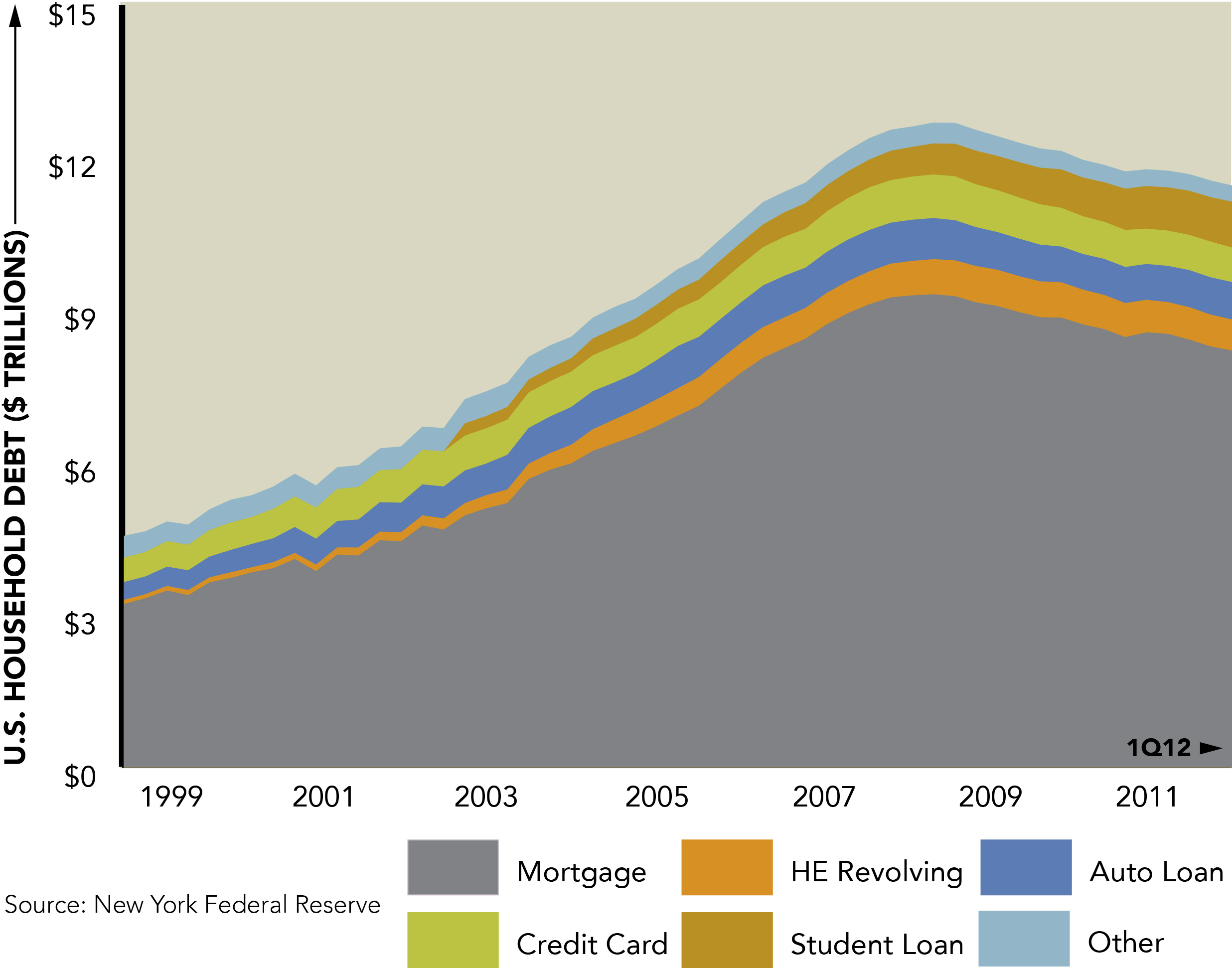
This week’s chart shows the components and level of U.S. household debt from March 1999 through March 2012. Categories of U.S. household debt include Mortgage, Home Equity Revolving, Auto Loan, Credit Card, Student Loan (which the Fed began tracking as an independent category in the first quarter of 2003), and Other which includes consumer finance and retail loans.

This week’s chart shows the components and level of U.S. household debt from March 1999 through March 2012. Categories of U.S. household debt include Mortgage, Home Equity Revolving, Auto Loan, Credit Card, Student Loan (which the Fed began tracking as an independent category in the first quarter of 2003), and Other which includes consumer finance and retail loans.

In its Quarterly Report on Household Debt and Credit, the Federal Reserve Bank of New York announced that total household indebtedness was $11.44 trillion as of the first quarter of 2012. The effects of U.S. household balance sheet repair since the 2008 recession can be seen in the above chart: after household debt peaked at $12.68 trillion in the third quarter of 2008, U.S. households have reduced total debt levels by $1.24 trillion (10.8%). In addition to a reduction in consumer spending, total debt levels were reduced due to banks exercising greater caution when issuing credit cards and mortgages. All categories of household debt decreased during this time with the exception of student loans which grew by 47.9%. During this time, college tuition costs continued to rise and households took on greater amounts of student loans in hopes of improved employment prospects. Student loans are now the second largest component of U.S. household debt behind mortgages.

As households continue to de-lever and focus on balance sheet repair, their consumption will not be as large of a driver to total GDP as it has been historically, therefore creating another headwind for robust economic growth.

New Jobs… Familiar Feeling

On Friday, the U.S. Department of Labor announced that 115,000 jobs were created in April and the national unemployment rate fell from 8.2% to 8.1%. Though these data points showed improvement, their release prompted an immediate equity market selloff.

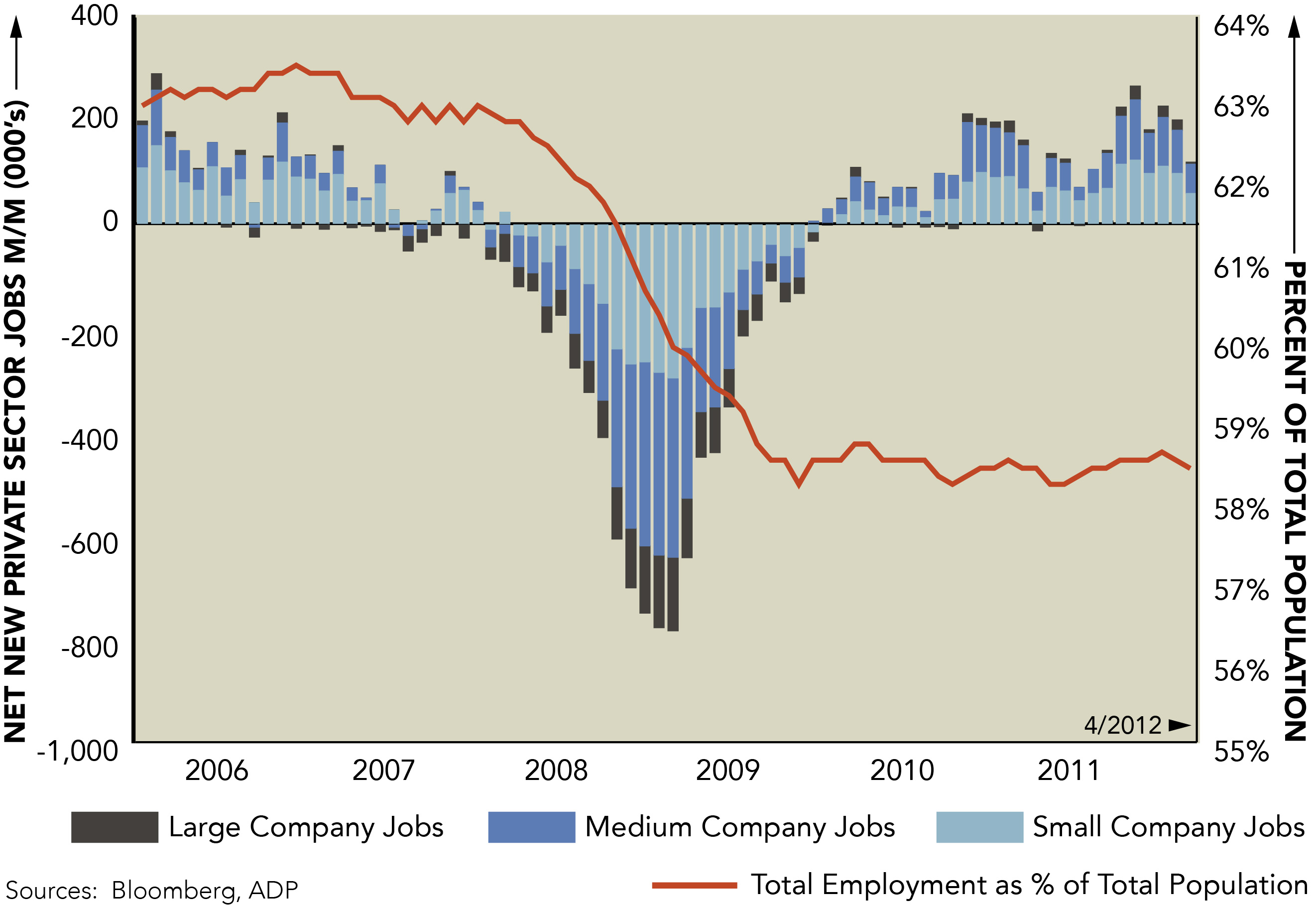
On Friday, the U.S. Department of Labor announced that 115,000 jobs were created in April and the national unemployment rate fell from 8.2% to 8.1%. Though these data points showed improvement, their release prompted an immediate equity market selloff. So what gives? In this Chart of the Week, we consider an expanded view of the labor market to explain Friday’s reaction.

At the beginning of 2006, the U.S. private sector labor market was close to full employment, and more jobs were being created every month. Comparing today’s total number of private sector jobs to those pre-recession levels, the private sector has only 2% less total jobs. The chart above illustrates why the true situation is not as healthy as the headline unemployment numbers suggest: although the private sector has been adding jobs for a little over two years now, the job growth has been almost exclusively from small and medium sized companies. A recovery in job creation by larger companies and public sector jobs which, on average, pay higher wages has yet to take hold.

Despite the fact that we have seen job creation over the last two years, the total number of Americans employed as a percentage of the population has been stagnant: the new jobs that have been created are only enough to keep pace with population growth. The unemployment rate is falling mainly because the percentage of Americans who have given up seeking work (and are therefore not included in that calculation) remains elevated.

This challenge is no more evident than with young Americans. During the 90’s, an average of 77.2% of 20-24 year olds and 52.3% of 16-19 year olds participated in the labor markets. Today, those percentages stand at 70.6% and 33.8%, respectively. As long as the labor market continues to force young people to start careers later, start saving later, and start raising families later, the outlook for full recovery and long-term economic growth remains challenged. Friday’s negative reaction to sustained slow job growth shows that small improvements are no longer enough to satisfy investors’ concerns which are becoming increasingly forward-looking.

U.S. Income Inequality

Income inequality in the United States has emerged as a popular topic in the media as well as the upcoming presidential election. The upcoming presidential debates are certain to feature a fair amount of political rhetoric in an attempt to address the issue of income inequality.

Income inequality in the United States has emerged as a popular topic in the media as well as the upcoming presidential election. The Occupy Movement has garnered a great deal of media attention in the past six months, with its premise of protesting economic and social inequality. The upcoming presidential debates are certain to feature a fair amount of political rhetoric in an attempt to address the issue of income inequality.

The chart above depicts the percentage of total income1 that the top 10% of earners (in 2010, families with a market income above $108k) are responsible for. As seen in the chart, the line forms a “U” shape where the top 10% accounted for approximately 45% of total income prior to WWII, declined to the low/mid 30’s until the late 1970’s and has risen to approximately 45% today.

In addition, we can use the GINI ratio (index of income concentration) to further scrutinize income disparity. The GINI ratio is a statistical measure of income equality ranging from 0-1. A measure of 1 indicates perfect inequality; i.e. one person has all the income and the rest have none. A measure of 0 indicates perfect equality; i.e. all people have equal shares of income. As also seen in the chart, the GINI ratio has also risen precipitously since its inception in 1967. Currently the GINI index stands at 0.47, which stands out as one of the highest when compared to other developed economies:


Germany 0.27
France 0.32
Italy 0.32
Canada 0.32
Japan 0.38
Uruguay 0.45
Russia 0.42
Singapore 0.47

There are many theories as to why we have seen such growth in income inequality since the late 1970’s. Potential explanations include:

  • Immigration of unskilled workers has put downward wage pressure on native born workers.
  • Advances in computers and automation may have replaced moderate to low skilled workers, thereby decreasing demand for these types of employees.
  • Decline of private sector labor unions and their ability to maximize incomes of their members.
  • Tax policy – corporate and individuals.
  • Relatively small increases in the minimum wage.
  • Corporate deregulation (in particular financials – 10% of corporate profits in 1970’s, 40% today – increase in executive compensation, prevalence of lobbyists).
  • Education gap between rich and poor has grown substantially. Cost of tuition is prohibitive for low income families. This has led to a shortage of highly skilled workers; therefore, demand (compensation) goes up for these types of workers.

The upcoming presidential debates will surely contain a healthy dose of discussion regarding income inequality, with a bulk focusing on tax policy and education reform. It will be interesting to see how each candidate plans to address these issues and the effect these policies will have on the financial markets. Is income inequality a detriment to the greater economy, or an essential part of capitalism?

_________________________________________________________________________________________________________

1 Income is defined as the sum of all income components reported on tax returns (wages and salaries, pensions received, profits from businesses, capital income such as dividends, interest, or rents, and realized capital gains) before individual income taxes. Government transfers such as Social Security retirement benefits or unemployment compensation benefits are excluded from the income definition. Non-taxable fringe benefits such as employer provided health insurance is also excluded from the income definition. Therefore, the income measure is defined as cash market income before individual income taxes.

Trends in Personal Savings Rates

This week’s chart shows the personal savings rate from January 1959 to February 2012. The average for that time period is represented, along with averages over the last 30, 20, and 10 years.

This week’s chart shows the personal savings rate from January 1959 to February 2012. The average for that time period is represented, along with averages over the last 30, 20, and 10 years. Averages are plotted according to their respective time periods.

The chart shows a noticeable decline in the personal savings rate over the 53 year period. The 53 year average is 7% compared to a 30 year average of 5.2%, a 20 yr average of 4.1%, and a 10 year average of 3.8%. Since consumers are saving less, they are spending more. This phenomenon has driven growth in consumer expenditures which in turn has contributed to growth in GDP. In the mid 1960s, consumer expenditures accounted for 61% of nominal GDP. By the early 80s it increased to 65.7% and in 2008 to 70.5%. The health of the economy has become more dependent on consumer spending.

During recessions the personal savings rate tends to spike up as consumers become more conservative. We saw this occur in the most recent recession with the savings rate climbing as high as 8.3%. As the economy has rebounded fear has subsided and consumers are spending more. In addition, with interest rates so low, consumers have less incentive to save. This has led to a personal savings rate of 3.7% in February 2012, which is below the 10 year average.

The Changing Composition of Consumption

While traditional “active” consumer spending undoubtedly makes up a large percentage of G.D.P., increased spending on health care (through Medicare and Medicaid) over time has likely overstated this popular statistic.

It is common to hear that consumption contributes 65 to 70% of total GDP, hence its importance to economic growth. More insightful, though, is to understand the underlying components of consumption and how accurately it truly reflects consumption on behalf of consumers. To do this, we use the Personal Consumption Expenditures (PCE) data which is the source of that 65 – 70% number. Critically, one must understand the elements of PCE data: in addition to the traditional consumption items (clothing, electronics, food and drink, housing, transportation, etc.), non-profit spending and expenditures made “on behalf” of consumers, such as Medicare and Medicaid, are also included. While traditional “active” consumer spending undoubtedly makes up a large percentage of G.D.P., increased spending on health care (through Medicare and Medicaid) over time has likely overstated this popular statistic.

Indeed, this is reflected in the historical data: in 1959, over 73% of consumer spending was spent in four main traditional consumer spending categories: housing, transportation, food and drink, and personal care/clothing. Over the last 50 years, the percentage spent on these four categories decreased to just over 50% of all spending in 2011. The biggest reason for the change is increased spending on healthcare – it accounted for less than 6% of overall PCE in 1959, while today it accounts for nearly 20%. This massive increase has certainly decreased the percentage of total PCE that is attributable to traditional, active consumer spending choices.

PCE is not a great indicator of average consumer expenditures, because the “spending” on Medicare and Medicaid is not distributed evenly among consumers, nor is it an “elected” expenditure in that consumers freely choose to spend or not spend on the two items. So if consumers aren’t actually spending 20% of their expenditures on healthcare, what are they buying? To get a sense for what consumers are actually spending their money on, the Bureau of Labor Statistics performs a survey called the Consumer Expenditure Survey that attempts to collect data on the spending habits of American consumers. Based on these results, healthcare accounts for less than 7% of annual spending for the average consumer.

Category % of Avg. Annual Expenditures
Food 12.7%
Housing 34.4%
Apparel and services 3.5%
Transportation 16.0%
Healthcare 6.6%
Entertainment 5.2%
Cash contributions 3.4%
Personal insurance and pensions 11.2%
Other 7.0%


Delinquency Rates

This week’s Chart of the Week examines four types of loans and their delinquency rates over the past twenty years. A loan is considered to be delinquent if it is past due by thirty or more days. The delinquency rate is the percentage of loans that are considered to be delinquent.

This week’s Chart of the Week examines four types of loans and their delinquency rates over the past twenty years. A loan is considered to be delinquent if it is past due by thirty or more days. The delinquency rate is the percentage of loans that are considered to be delinquent.

The chart shows all four delinquency rates are on a noticeable decline from their peaks as the economy has made some improvements over the last two years. In fact, three of the four rates have fallen below their respective twenty year averages. Business loan delinquency rates have followed the pattern of the business cycle therefore it is not surprising to see the rates go down as we emerge from recession. Consumer and credit card delinquency rate declines are due in large part to commercial banks writing off bad debt, a tightening of lending standards, and consumers deleveraging. More individuals are no longer paying their mortgages, thus freeing up money to pay off other debts.

The delinquency rate for single family mortgages remains considerably higher than its twenty year average. Many homes are now valued significantly lower than their loan balances. This fact, coupled with a challenging job market, has contributed to the high delinquency rate. The potential that these delinquent properties will eventually end up in foreclosure make it an even more challenging environment for residential real estate. Foreclosures will increase the supply in an already oversupplied market and exacerbate the downward pressure on home prices. As discussed in our 2012 Market Preview, this environment has led to a boom for owners of rental units: the apartment sector has benefitted because individuals are now turning to rentals rather than purchasing homes.

Unemployment in Context

In the most recent November employment survey, the unemployment rate fell significantly further than expected, to 8.6%. This seeming improvement, however, masks continued weakness in economic growth. Calls for a U.S. recession now seem premature, but, so too do calls for a return to robust growth.

In the most recent November employment survey, the unemployment rate fell significantly further than expected, to 8.6%. This seeming improvement, however, masks continued weakness in economic growth. Calls for a U.S. recession now seem premature, but, so too do calls for a return to robust growth. In November, the economy added an estimated 120,000 jobs. This is roughly the number of jobs that must be added each month to simply keep pace with population growth. Thus, the majority of the improvement in the unemployment rate came from a decline in labor force participation, shown in the Labor Force Participation chart.

The labor force participation rate measures the number of people who are employed or seeking employment as a percentage of the total population. Notably, the participation rate has increased over time as more women have joined the workforce. Currently, the labor participation is at the same level as during the double dip recession of the 1980’s. Improvements in the unemployment rate due to a decline in the participation rate imply little relative improvement in a country’s economic condition. Ultimately, either participation stays low, which permanently lowers output potential, or participation increases as the economy improves, which increases the unemployment rate.

Due to the long duration of unemployment after the most recent recession, more workers may continue to drop out of the labor force. This makes the unemployment rate a less relevant measure of the output gap between the economy’s current and potential output. Ideally, for robust growth to take hold, the number of jobs created would have to be in excess of those needed to keep up with population growth. In this scenario, there may or may not be a decrease in the unemployment rate, depending on how the participation rate changes. However, there would be an improvement in the employment to population ratio. This measure, in the Employment to Population Ratio chart, has languished at depressed levels since collapsing during the most recent recession.

Post-Recession Employment Growth

This week’s chart analyzes job growth after the last four recessions by examining employment levels 60 months after the start of each recession. The data focuses on private employment, not government employment. Ellipses on the chart represent the end point of each recession, whereas squares represent the beginning of job growth.

This week’s chart analyzes job growth after the last four recessions by examining employment levels 60 months after the start of each recession. The data focuses on private employment, not government employment. Ellipses on the chart represent the end point of each recession, whereas squares represent the beginning of job growth.

The 1982 recession lasted seventeen months. After its cessation, it took only nine months for employee growth to emerge. While the 1990 recession lasted nine months, it endured an additional 26 until job growth began. The length of the 2001 recession was again brief lasting only nine months, but it withstood 30 months until growth mode. The most recent recession began in December of 2007 and lasted nineteen months. At 27 months and counting, we are still waiting for job growth to commence.

Five years after the ’82, ’90, and the ’01 recessions, private sector job levels were well ahead of their pre-recessions levels. Unfortunately, it is difficult to paint a happy picture on the current status of employment: while there has been progress in recovering lost jobs, substantial headwinds remain, as 6.3 million more jobs are needed to return to pre-recession levels.

Recessions and Income Declines

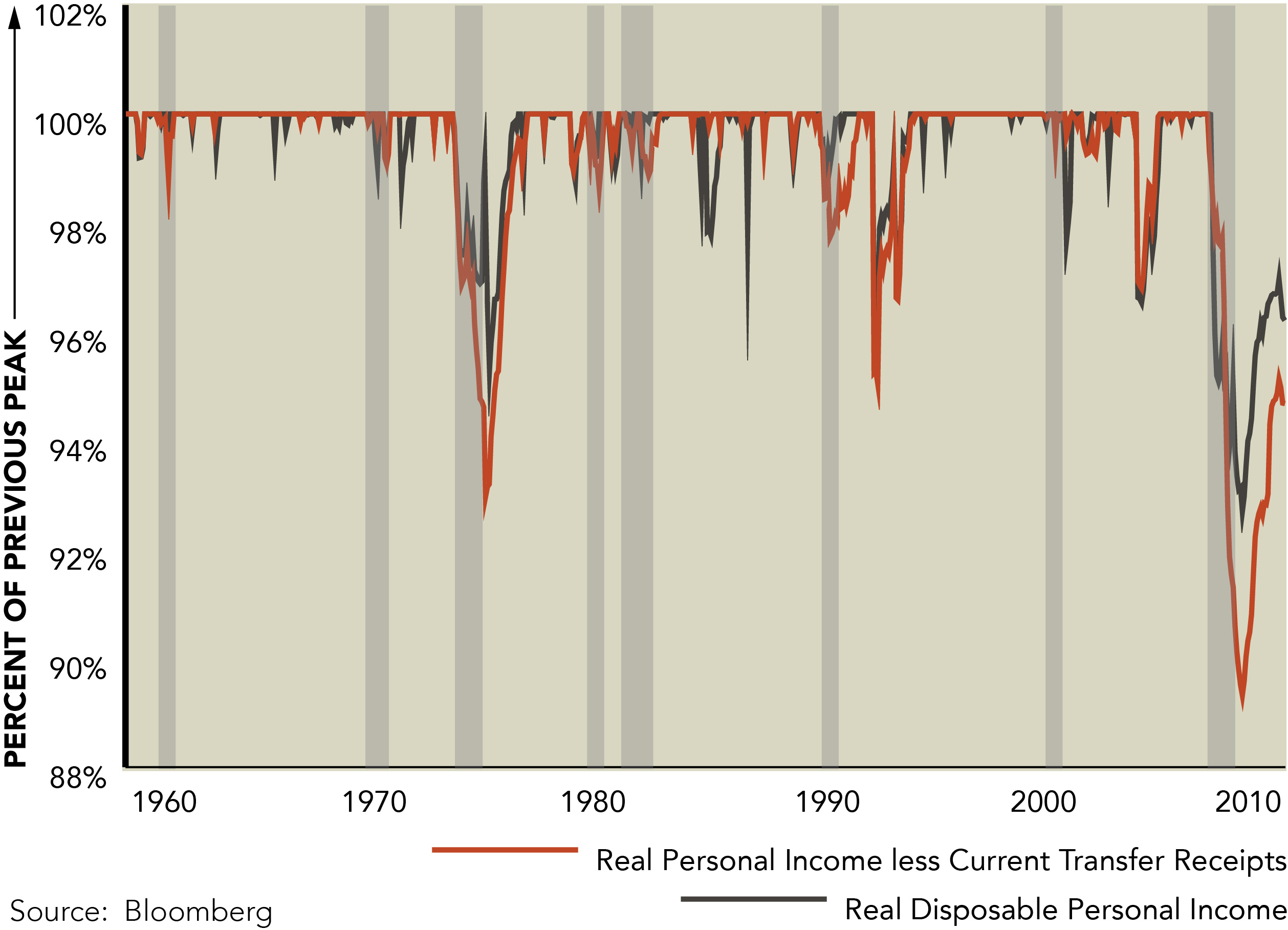
This chart looks at the drop and recovery in real personal income during recessions over the last 50 years (personal income is shown as a percentage of the previous peak to look at prior recessions on an apples-to-apples basis).

This chart looks at the drop and recovery in real personal income during recessions over the last 50 years (personal income is shown as a percentage of the previous peak to look at prior recessions on an apples-to-apples basis). The red line (Real Personal Income less Current Transfer Receipts) shows inflation adjusted after-tax disposable income not including government support (i.e. net social security receipts, unemployment insurance, etc.). The gray line (Real Disposable Income) shows inflation adjusted after-tax disposable income including government support.

A few things stand out. First is the depth of the 2008 – 2010 recession, which was far worse than any prior drop in U.S. incomes. Second, this chart shows the role of government support during recessions, as the drop in real disposable income is far less than would otherwise be expected, due to government support. Thirdly, the drop in real disposable incomes over the last three months is a worrying trend. This is especially true given the growing talk in Washington over reducing government support of disposable income through higher taxes and/or lower spending.

Falling real incomes and less government support does not bode well for U.S. economic growth over the coming quarters.

The State of U.S. Manufacturing

Generally speaking, the new orders component serves as an indicator of future demand, while the inventories component serves as an indicator of current supply. Comparing new orders to inventories helps to illustrate the supply/demand dynamic within the manufacturing sector, which in turn can help provide insight into future economic activity. When demand (i.e. new orders) is greater than supply (i.e. inventories), it’s a sign of future economic growth. When demand is less than supply, it’s a sign of future economic weakness.

The Institute for Supply Management (ISM) Manufacturing Index (also referred to as the ISM Purchasing Managers’ Index, or PMI) is the most commonly used leading indicator of economic activity within the United States manufacturing sector. It is a monthly index based on a survey of more than 300 manufacturing firms across the country. The ISM Manufacturing Index is composed of five equally weighted subcomponents: new orders, production, employment, supplier deliveries, and inventories. The index is an important leading indicator insomuch as it serves as a snapshot of the overall trend in manufacturing. Readings above 50 indicate that manufacturing is generally expanding, while readings below 50 indicate that manufacturing is generally declining.

In the September ISM report, the Manufacturing Index posted a reading of 51.6 (up from 50.6 in August). This was the 26th consecutive month the index posted a reading above 50, indicating that manufacturing in the U.S. has been expanding for more than two years. However, a deeper look at some of its subcomponents (specifically new orders and inventories) paints a different picture.

Generally speaking, the new orders component serves as an indicator of future demand, while the inventories component serves as an indicator of current supply. Comparing new orders to inventories helps to illustrate the supply/demand dynamic within the manufacturing sector, which in turn can help provide insight into future economic activity. When demand (i.e. new orders) is greater than supply (i.e. inventories), it’s a sign of future economic growth. When demand is less than supply, it’s a sign of future economic weakness.

In the September ISM report, the difference between the new orders component and the inventories component (New Orders Minus Inventories Index in the chart above) posted a reading of -2.4. This was the fourth consecutive month when the difference between new orders and inventories has been negative (a negative value in this index indicates that inventories are greater than new orders). As the chart indicates, since 1970, any time there has been a negative reading in the New Orders Minus Inventories Index for at least three consecutive months, the economy was either about to enter a recession or was in the midst of a recession. Although the current string of negative readings may be a temporary phenomenon caused in part by supply chain disruptions due to the earthquake in Japan, it is certainly not a sign of a strengthening economy.