The Business Cycle Diaries

Even the casual observer of market dynamics is likely aware that the world economy appears to be on uneven footing. Elevated price levels, increasingly restrictive monetary policy, and geopolitical turmoil have plagued securities markets during the first half of the year and are now dampening expectations for global GDP growth going forward. Given this myriad of macroeconomic challenges, many investors are now assessing the possibility of a prolonged slowdown in economic activity for both the United States and the rest of the world.

The aim of this newsletter is to gauge the extent to which the global economy is at risk of such a downturn by examining the state of the current domestic business cycle, inferring its likely next stage, and reviewing which asset classes and investing styles tend to be the most attractive during each phase of the cycle.

Read > The Business Cycle Diaries


The opinions expressed herein are those of Marquette Associates, Inc. (“Marquette”), and are subject to change without notice. This material is not financial advice or an offer to purchase or sell any product. Marquette reserves the right to modify its current investment strategies and techniques based on changing market dynamics or client needs.

Active Managers: The Mid-Year Report Card

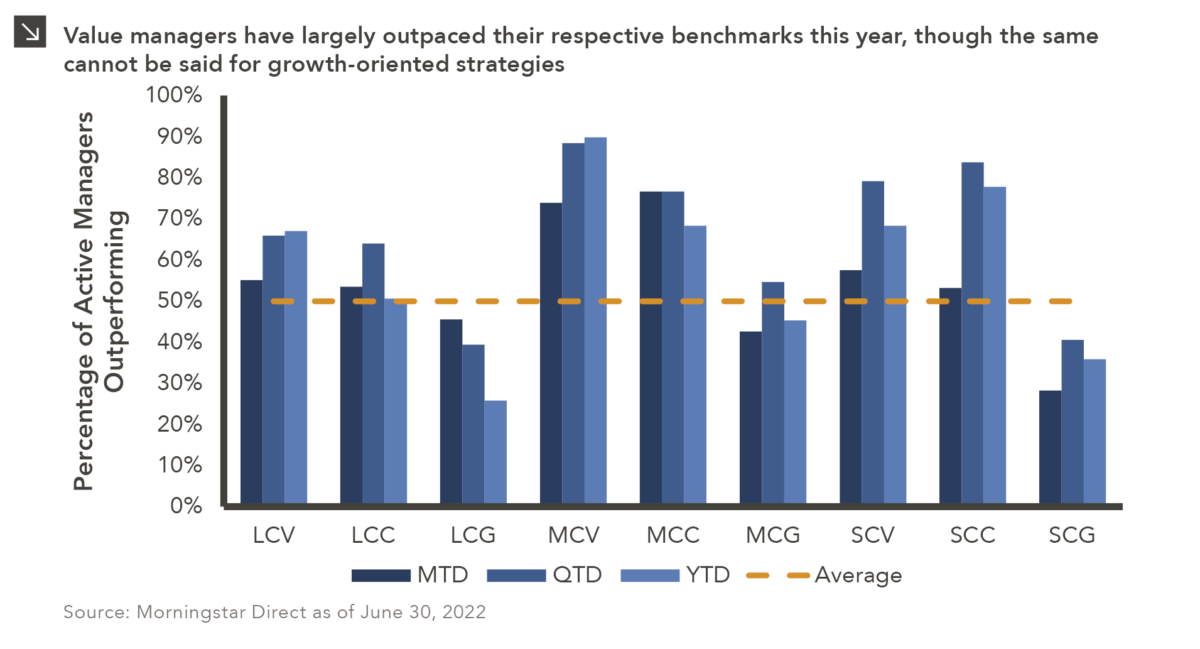
Domestic equity indices suffered significant pullbacks in the first half of 2022 amid increasing investor concerns of a prolonged economic slowdown. Growth benchmarks were hit hardest given the recent focus on rising rates, although core and value indices across the market capitalization spectrum also notched negative returns during the period. These types of broad-based pullbacks are often conducive to active manager outperformance because, in theory, one of the main benefits of active strategies is protection during down markets. Fund managers are usually able to deliver on this proposition by avoiding speculative stocks with uncertain future cash flows that tend to drop precipitously amid corrections, instead gearing toward high-quality business with pricing power and robust earnings that are able to withstand market swoons. That said, the extent to which managers have been successful in notching returns in excess of their respective benchmarks this year has largely depended on investment style.

In the first six months of 2022, most value-oriented active strategies have done a good job protecting capital. Roughly 67% of managers in the large-cap value space have outperformed their relevant benchmarks, while 90% and 78% have done the same in the mid- and small-cap value spaces, respectively. Core strategies have had similar success. Just over half of large-cap core managers have recorded positive relative returns for the year, while 68% of mid-cap core and 78% of small-cap core managers have outperformed their respective benchmarks. The story is different on the growth side, however, where just 26% of active large-cap, 45% of mid-cap, and 36% of small-cap managers have been able to keep pace with or exceed relevant benchmarks. At a high level, performance of growth indices in 2022 has largely been driven by multiple compression rather than changes in earnings growth or company fundamentals, and active managers are more likely to lag in periods when valuation is the primary driver of market returns.

Marquette recommends allocating between active and passive management based on the efficiency of the underlying market. At the top of the market capitalization spectrum, outperformance has been notoriously difficult in recent history, with roughly two-thirds of all active U.S. large-cap managers trailing the S&P 500 on a trailing 10-year basis regardless of investment style. Mid- and small-cap strategies have had more success generating alpha over longer periods of time given the less efficient nature of those segments of the market, with the majority of managers outperforming their respective indices over the last decade. While even the most capable managers experience periods of underperformance, the case for active management within the U.S. equity space is certainly stronger further down the cap spectrum. Marquette will continue to source best-in-class strategies across all asset classes and recommend these strategies for inclusion in client portfolios where appropriate.

Print PDF > Active Managers: The Mid-Year Report Card


The opinions expressed herein are those of Marquette Associates, Inc. (“Marquette”), and are subject to change without notice. This material is not financial advice or an offer to purchase or sell any product. Marquette reserves the right to modify its current investment strategies and techniques based on changing market dynamics or client needs.
Global Equities Still Well Above COVID Lows

Just over two years ago, on March 23rd, 2020, global equities hit their COVID-19-induced bottom. At their lows, the S&P 500, MSCI Emerging Markets Index, and MSCI EAFE Index were down 30%, 32%, and 33%, respectively, year-to-date. Over the next seven quarters, global equities produced mostly positive returns, with the S&P 500 leading the way. From the 2020 trough, the large-cap U.S. index was up an astounding 119% through the end of 2021.

This year, markets have faced several geopolitical and macroeconomic concerns that have squashed that positive momentum. Russia’s invasion of Ukraine in February and China’s rise in COVID-19 cases combined with its zero-COVID policy have worsened supply chain issues, exacerbated global inflation, and added to mounting economic pressures. To combat inflation, central banks have aggressively raised interest rates, which will likely further dampen economic activity. As a result of these headwinds, the S&P 500, MSCI EM, and MSCI EAFE benchmarks are all down roughly 17–19% year-to-date.¹ Despite these losses, global equities remain well above the COVID-19 trough, with non-U.S. equities still roughly 40+% higher and the S&P 500 77% higher. Looking forward, we expect global equities — particularly in developed countries — to face continued volatility in the second half of the year as central banks continue their fight against inflation, likely at the expense of economic growth.

Print PDF > Global Equities Still Well Above COVID Lows

¹As of June 29, 2022


The opinions expressed herein are those of Marquette Associates, Inc. (“Marquette”), and are subject to change without notice. This material is not financial advice or an offer to purchase or sell any product. Marquette reserves the right to modify its current investment strategies and techniques based on changing market dynamics or client needs.

When Apple Becomes the Forbidden Fruit

For much of the last two years, big name tech stocks had been tantalizing fruit for investors willing to pay up for growth. Enter 2022. After peaking on January 4th, the S&P 500 has taken a nosedive, led by those same tech stocks. Since 2018, the Information Technology sector has grown from a 20.1% weight in the S&P 500 to 26.8%, setting it up to now have an outsized impact as equities correct. The largest detractors year-to-date, regardless of GICS sector classification, have business models and value propositions rooted in technological advancement and innovation. The top eight detractors this year are Apple, Microsoft, Amazon, Alphabet, Meta, Tesla, NVIDIA, and Netflix. These eight stocks have cost the index more than 800 basis points year-to-date, almost half of the S&P 500’s -17.6% return.¹

Behind the outsized correction in technology stocks are macro headwinds and rising rates. The instability caused by the Russia/Ukraine war, COVID-related shutdowns in China, ongoing supply chain disruptions, and heightened inflation has led to shifts out of longer-duration growth stocks towards the perceived safety of assets like gold and value stocks. Rising rates are weighing on growth stock multiples and increasing recessionary concerns are reducing confidence in outyear earnings projections. Uncertainty is high and sentiment is weak, and while risks certainly remain, that may eventually help support a market bottom. Up or down, large tech stocks will continue to have a meaningful impact on broader market returns.

Print PDF > When Apple Becomes the Forbidden Fruit

¹As of June 10, 2022


The opinions expressed herein are those of Marquette Associates, Inc. (“Marquette”), and are subject to change without notice. This material is not financial advice or an offer to purchase or sell any product. Marquette reserves the right to modify its current investment strategies and techniques based on changing market dynamics or client needs.

Our Growing Stake in the Stock Market

Equity markets have experienced heightened levels of volatility throughout 2022 with the S&P 500 down nearly 20% from its high in January. A host of macroeconomic factors — 40-year high inflation, supply chain disruptions, the war in Ukraine, and hawkish central bank policy — are stoking uncertainty in the markets and driving stocks lower. With the consumer at the center of the biggest unknown — whether the U.S. will dip into recession — the growing connection between individuals and the equity market is an increasingly important dynamic.

It’s generally accepted that the stock market is not the economy, though today the lines are more blurred. The portion of household financial assets held in equities has been steadily increasing, reaching an all-time high of 41.2% at the end of 2021. Individuals have an increasing stake in equity performance, with fluctuations in the stock market directly impacting consumer balance sheets and spending potential, and thus economic growth. This dynamic further complicates the job of the Federal Reserve as it looks to raise rates enough to combat heightened inflation without extinguishing growth. While no one has a crystal ball, continued market volatility seems likely. That said, for long-term investors, history has shown that markets are resilient and staying invested leads to the best outcomes; we encourage investors to remain disciplined.

Print PDF > Our Growing Stake in the Stock Market


The opinions expressed herein are those of Marquette Associates, Inc. (“Marquette”), and are subject to change without notice. This material is not financial advice or an offer to purchase or sell any product. Marquette reserves the right to modify its current investment strategies and techniques based on changing market dynamics or client needs.

Flirting With a Bear Market: How Did We Get Here, and What Comes Next?

Quite simply, this has been the worst start to a year since the 1930s:

  • One of only 19 quarters since 1976 when both bonds and stocks posted negative returns;
  • One of only six of those quarters when bonds have underperformed stocks;
  • The worst four-month return for the S&P 500 since 1939.

2022 to date has featured a myriad of macroeconomic factors coming to a head: inflation at its highest level since the 1980s, the Federal Reserve responding with aggressive rate hikes, and increasing concerns about the health of the consumer leading to a possible recession. An evolving pandemic, a war in Eastern Europe, and draconian lockdown policies in the world’s second-largest economy and largest manufacturing hub have further added to the problem and complicated the solution. With these macro headwinds and uncertainties driving markets year-to-date, Marquette’s fixed income, U.S. equities, and non-U.S. equities teams discuss the impacts on their asset classes and weigh in on the outlook from here.

Read > Flirting With a Bear Market: How Did We Get Here and What Comes Next?


The opinions expressed herein are those of Marquette Associates, Inc. (“Marquette”), and are subject to change without notice. This material is not financial advice or an offer to purchase or sell any product. Marquette reserves the right to modify its current investment strategies and techniques based on changing market dynamics or client needs.

Looking for Sunshine

Here in Chicago, it has been a harsh spring. Below-average temperatures. Unrelenting rain. Snow flurries. Incessant clouds. Not the spring anyone was hoping for.

Investors would tell you the same thing, for different reasons. Stock market down 10% year to date.¹ Inflation at 8.5%, the highest in over 30 years. Bonds — the safe haven play in times of market volatility — down 9.5% year to date.² The ongoing conflict in Ukraine increasingly looks like a grinding war of attrition. Temporary yield curve inversion. Fed policy designed to slow inflation, though potentially at the expense of growth; either way, interest rates have more room to run. Not a lot of sunshine, indeed.

However, as April turns to May… hope springs eternal. Not all is lost for the year, and while most would agree that equity markets have not fully re-priced yet, there are hints — not unlike perennials sprouting each spring — that the worst of the market drop is behind us. Over time, markets have proven resilient and while the exact timing of market reversal is impossible to precisely call, one can look for signs of optimism. Here are some of the most compelling hints that we see.

In this edition:

  • Inflation
  • Yield curve inversion
  • War-driven market volatility
  • Earnings estimates
  • Opportunities for active managers

Read > Looking for Sunshine

Watch our Q1 2022 Market Insights Video for an in-depth analysis of the first quarter’s performance by Marquette’s research team.


The opinions expressed herein are those of Marquette Associates, Inc. (“Marquette”), and are subject to change without notice. This material is not financial advice or an offer to purchase or sell any product. Marquette reserves the right to modify its current investment strategies and techniques based on changing market dynamics or client needs.

Q1 2022 Market Insights Video

This video features an in-depth analysis of the first quarter’s performance by Marquette’s research team, reviewing general themes from the quarter and risks and opportunities to monitor in the coming months.

 Our Market Insights series examines the primary asset classes we cover for clients including the U.S. economy, fixed income, U.S. and non-U.S. equities, hedge funds, real estate, infrastructure, private equity, and private credit, with presentations by our research analysts and directors.

Sign up for research alerts to be notified when we publish new videos here.
For more information, questions, or feedback, please send us an email.

Low Volatility: Factor or Fad?

The beginning of 2022 represented a change of pace for equity investors, as increased geopolitical and macroeconomic uncertainty drove the S&P 500 to its first negative quarter in two years. In light of recent performance trends and the potential for continued asset price fluctuation, market participants may be interested in assessing the viability of strategies with lower risk profiles that still offer the potential for long-term gains similar to those of the S&P 500. One such strategy is low volatility equity investing. Though it has fallen somewhat out of favor in recent years, low volatility is a generally accepted risk premia factor (akin to value, size, quality, etc.), meaning investors can theoretically expect to earn excess returns by allocating to lower volatility equities over the long run. This newsletter seeks to understand the rationale and evidence for this premium, explain recent performance of low volatility stocks, and examine the prospects of the style going forward.

Read > Low Volatility: Factor or Fad?


The opinions expressed herein are those of Marquette Associates, Inc. (“Marquette”), and are subject to change without notice. This material is not financial advice or an offer to purchase or sell any product. Marquette reserves the right to modify its current investment strategies and techniques based on changing market dynamics or client needs.

The Rising Possibility of Recession

Over the last several weeks, the risk of an economic downturn in the United States has increased with inflation continuing higher, Russia’s invasion of Ukraine triggering unprecedented sanctions, and the Fed beginning its rate hiking cycle. While inflation and the anticipation of rising rates have been driving markets for several months, the invasion of Ukraine in February and the resultant economic sanctions on Russia have added a new dynamic to the equation, driving up commodity inflation and making the Fed’s job of controlling pricing pressures without triggering an economic slowdown even trickier. With many U.S. stock indices dipping into correction territory this year, every new data point and indicator will be heavily scrutinized.

In this newsletter we examine these dynamics and try to provide perspective as it relates to the current market environment.

Read > The Rising Possibility of a Recession


The opinions expressed herein are those of Marquette Associates, Inc. (“Marquette”), and are subject to change without notice. This material is not financial advice or an offer to purchase or sell any product. Marquette reserves the right to modify its current investment strategies and techniques based on changing market dynamics or client needs.