An Investor’s Holiday Wish List

Hopefully not another year of coal
In the spirit of holiday fun — and an effort to put 2022 investment returns behind us — we have put together our investor wish list for 2023. We have broken the wish list into two categories: the “must-haves,” which carry the most weight and are most observable, and the “stocking stuffers,” which may not be headline grabbers but are nonetheless impactful across economies and markets. Predictably, the “must-have” items focus on a reversal of the major trends that drove the markets this year; we “must have” a better outlook across at least some of these topics. The “stocking stuffers” category is a variety of topics that either directly impact the major trends from 2022 or are more targeted with their impact on specific asset classes. And while we recognize this is not an exhaustive list, we feel strongly that if these wishes come true we can all feel better about market returns in 2023.

This year’s must-haves:

  • Lower inflation
  • Less aggressive Fed policy leads to fewer interest rate hikes in 2023
  • Avoid a deep recession
  • Resolution of geopolitical conflicts

And stocking stuffers:

  • Broad-based earnings in the U.S. stock market
  • A weaker U.S. dollar
  • Credit defaults start to flatline
  • Slowdowns in hiring and wage growth
  • Favorable news out of China
  • History repeats itself

Read > An Investor’s Holiday Wish List


The opinions expressed herein are those of Marquette Associates, Inc. (“Marquette”), and are subject to change without notice. This material is not financial advice or an offer to purchase or sell any product. Marquette reserves the right to modify its current investment strategies and techniques based on changing market dynamics or client needs.

International Equities: Waitin’ on a Sunny Day

In recent years, international stocks have underperformed their domestic counterparts by a significant margin. Specifically, the MSCI ACWI ex-US index has compounded annual returns at just 3.3% over the last decade through the end of October, compared to an annualized return of 12.8% for the S&P 500 index. This current stretch marks the longest period of relative outperformance on a trailing 5-year basis for either index since the early 2000s.

This newsletter examines a host of factors that have contributed to this pattern of performance, including differences in composition between U.S. and international equity indices, currency movements, and geopolitics and analyzes the diversification benefits of international equity allocations within portfolios despite performance challenges.

Read > International Equities: Waitin’ on a Sunny Day


The opinions expressed herein are those of Marquette Associates, Inc. (“Marquette”), and are subject to change without notice. This material is not financial advice or an offer to purchase or sell any product. Marquette reserves the right to modify its current investment strategies and techniques based on changing market dynamics or client needs.

Keeping the Lights On

While overall fundamentals for U.S. equity benchmarks have remained mostly resilient this year amid a painful repricing of risk assets, earnings growth has actually been concentrated in just a few areas of the market. The blended year-over-year earnings growth rate for the S&P 500 index during the third quarter of 2022 is 2.2% (with roughly half of companies reporting at the time of this writing), though only four sectors of the index have reported growth in earnings for the period. The Energy space stands out especially among these sectors, with its earnings up a massive 134% year-over-year amid strong demand for natural resources and continued commodity price inflation. Were the sector to be excluded from the S&P 500 index, earnings for the benchmark would be down 5.1% on a year-over-year basis, despite the fact that Energy accounts for less than 6.0% of the index. This trend is expected to continue into the fourth quarter, during which total earnings growth for the index is expected to be roughly 0.5%, with a decline of 3.5% excluding the Energy sector. For the full calendar year, S&P 500 index earnings are expected to grow 6.1% and decline 0.6% without Energy stocks.

Examining data below the index level is always important when assessing the health of equity markets and company fundamentals. To that point, simply looking at earnings figures for the S&P 500 index in aggregate obscures the fact that growth-oriented spaces of the benchmark like Communication Services and Information Technology, which are expected to post year-over-year earnings declines of 22.2% and 2.1% in the third quarter, respectively, are experiencing significant headwinds amid ongoing interest rate and inflationary pressures. These trends, however, are expected to reverse beginning in the second quarter of next year when, against tough compares, the Energy space is projected to become a detractor to overall earnings growth for the S&P 500 index while the rest of the benchmark grows earnings at a positive rate. With all of this in mind, investors should continue to employ a prudent approach to diversification across asset classes, geographies, and economic sectors, which will help position portfolios for success as market leadership rotates.

Print PDF > Keeping the Lights On


The opinions expressed herein are those of Marquette Associates, Inc. (“Marquette”), and are subject to change without notice. This material is not financial advice or an offer to purchase or sell any product. Marquette reserves the right to modify its current investment strategies and techniques based on changing market dynamics or client needs.

Q3 2022 Market Insights Video

This video is a recording of a live webinar held October 27th by Marquette’s research team, featuring in-depth analysis of the third quarter of 2022 and risks and opportunities to monitor in the coming months.

Our Market Insights series examines the primary asset classes we cover for clients including the U.S. economy, fixed income, U.S. and non-U.S. equities, hedge funds, real estate, infrastructure, private equity, and private credit, with presentations by our research analysts and directors.

Sign up for research alerts to be invited to future webinars and notified when we publish new videos.
For more information, questions, or feedback, please send us an email.

It’s Always Darkest Before the Dawn

Diversification has been said to be the only free lunch in investments. Since the inception of the Lehman/Barclays/Bloomberg Aggregate index,¹ there have been only 18 of 187 quarters (9.6% frequency) with negative returns in both the bond and equity markets, as measured by the Aggregate and S&P 500 indices, respectively. Comparable results are seen in the monthly data: Of 561 months, only 83 times did both the fixed income and equity markets deliver a negative total return (15.2% frequency). Over the last 45+ years, there has never been a calendar year that recorded negative returns in both indices, though that looks likely to change this year.

This newsletter analyzes 2022’s equity and bond market performance and the importance of diversification and discipline amid such negative momentum.

Read > It’s Always Darkest Before the Dawn

¹Actual data goes back to 1986; backfilled data back to 1976


The opinions expressed herein are those of Marquette Associates, Inc. (“Marquette”), and are subject to change without notice. This material is not financial advice or an offer to purchase or sell any product. Marquette reserves the right to modify its current investment strategies and techniques based on changing market dynamics or client needs.

Livestream Videos: 2022 Investment Symposium

The presentations by our research team from Marquette’s 2022 Investment Symposium livestream on September 23rd are now available. Please feel free to reach out to any of the presenters should you have any questions.

View each talk in the player above — use the upper-right list icon to access a specific presentation.


The opinions expressed herein are those of Marquette Associates, Inc. (“Marquette”), and are subject to change without notice. This material is not financial advice or an offer to purchase or sell any product. Marquette reserves the right to modify its current investment strategies and techniques based on changing market dynamics or client needs. Past performance is not indicative of future results. For full disclosure information, please refer to the end of each presentation. Marquette is an independent investment adviser registered under the Investment Advisers Act of 1940, as amended. Registration does not imply a certain level of skill or training. More information about Marquette including our investment strategies, fees and objectives can be found in our ADV Part 2, which is available upon request.
Midterm Madness

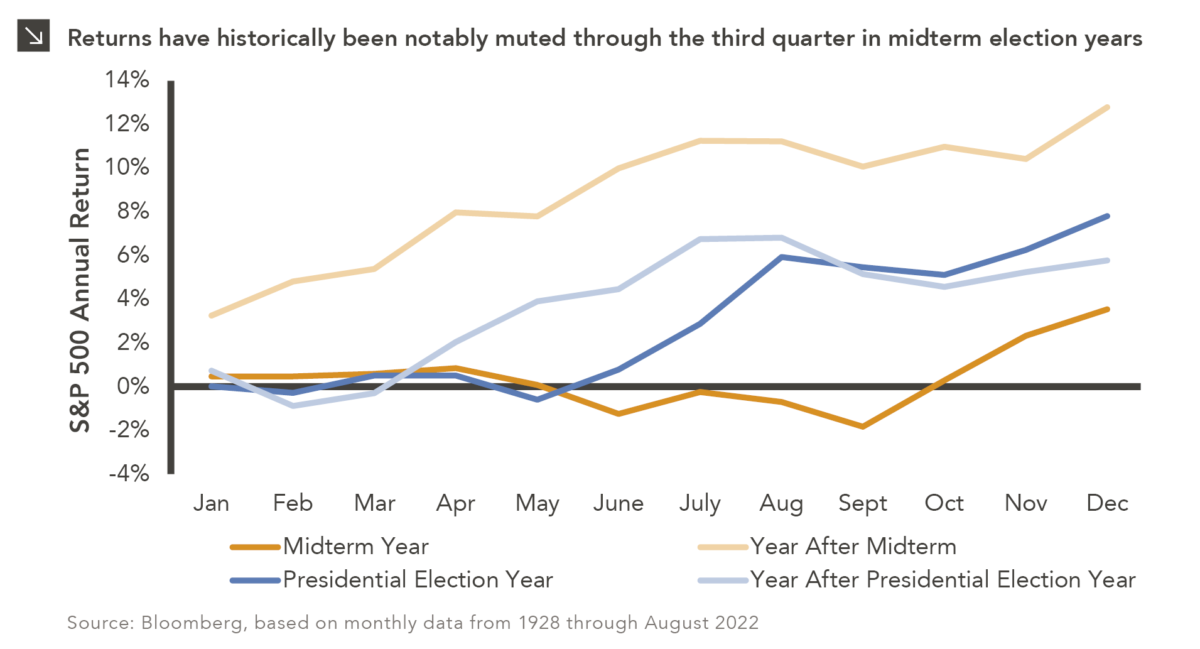
If inflation, rising rates, and a war in Europe were not enough to keep markets interesting this year, 2022 is also a midterm election year. Based on data over the last nine decades, midterm election years — while only marginally more volatile than non-election years overall — tend to exhibit a distinct performance pattern throughout the year. On average, returns during midterm years tend to be flat to slightly negative through the first three quarters as investor confidence is dampened by uncertainty around the outcome of the election. Historically, returns start to pick up as November draws near and tend to finish strongly, with fourth quarter returns in midterm years significantly stronger than non-midterm years. This holds true regardless of which party wins the House and Senate and whether or not there is a change of control, suggesting investors value predictability more so than a specific party controlling Congress. While each year is unique, and this analysis does not consider the deluge of other macroeconomics issues plaguing 2022, it is interesting historical context. Come November 6, there may be one less source of uncertainty in markets.

Print PDF > Midterm Madness


The opinions expressed herein are those of Marquette Associates, Inc. (“Marquette”), and are subject to change without notice. This material is not financial advice or an offer to purchase or sell any product. Marquette reserves the right to modify its current investment strategies and techniques based on changing market dynamics or client needs.

Halftime Market Outlook: A Mixed Bag

Last week, we hosted our “Halftime” Market Insights Webinar. As the host, my job was to introduce the analyst for each section and then summarize his or her comments before moving to the next speaker. After the fourth section, I found myself using the term “mixed bag” for the third time; it was at that moment that I knew I had my title for this letter!

Of course, “mixed bag” is an overused and unoriginal cliché to describe a perspective that features both positive and negative elements. If we focus solely on the first half of the year, it is hard to find much good news at all between negative economic growth, historically high inflation, and hefty losses in both the equity and bond markets. Even the good news is rooted in how bad things are…after all, how much longer can inflation stay above 9%? Could the equity market REALLY drop another 20% the second half of the year? Alas, our “mixed bag” descriptor admittedly relies on the assumption that conditions should improve at least somewhat for the remainder of the year, though likely not enough to reverse the damage inflicted during the first half. On an absolute and relative basis, growth and return figures should be better, but it is naïve to think that all of the bad news is behind us.

In this edition:

  • Inflation expectations
  • Consumer and business sentiment
  • The S&P 500’s worst six-month start to a year since 1970
  • Recession probability
  • The Agg’s worst start to a year ever
  • Bonds go back to being bonds

Read > Halftime Market Outlook: A Mixed Bag


The opinions expressed herein are those of Marquette Associates, Inc. (“Marquette”), and are subject to change without notice. This material is not financial advice or an offer to purchase or sell any product. Marquette reserves the right to modify its current investment strategies and techniques based on changing market dynamics or client needs.

2022 Halftime Market Insights Video

This video is a recording of a live webinar held July 20th by Marquette’s research team, featuring in-depth analysis of the first half of 2022 and risks and opportunities to monitor in the coming months.

Our Market Insights series examines the primary asset classes we cover for clients including the U.S. economy, fixed income, U.S. and non-U.S. equities, hedge funds, real estate, infrastructure, private equity, and private credit, with presentations by our research analysts and directors.

Sign up for research alerts to be notified when we publish new videos and invited to future webinars.
For more information, questions, or feedback, please send us an email.

Sustainability Briefing – 3Q 2022

Sustainable investing is not new to Marquette. Ranging from mission-driven screening to minority-owned investment manager utilization, Marquette has been partnering with clients for over thirty years to implement investment strategies that address a myriad of environmental, social, and governance (ESG) themes. But something has shifted over the last few years, bringing ESG to the forefront of client discussions and manager presentation decks. To help clients navigate this evolving space, we will be sharing quarterly briefings that highlight trending topics surrounding sustainable investing.

In this edition:

  • Greenwashing and increased regulatory scrutiny by the SEC
  • ESG and sustainability-themed ETF flows
  • The SEC’s recent proposed rule, File No. S7-10-22: The Enhancement and Standardization of Climate-Related Disclosures for Investors
  • Business impact of increasing interest and attention to ESG themes:
    • Electric vehicle adoption
    • Unionization efforts
    • ESG disclosures by corporate issuers

Read > 3Q22 Sustainability Briefing


The opinions expressed herein are those of Marquette Associates, Inc. (“Marquette”), and are subject to change without notice. This material is not financial advice or an offer to purchase or sell any product. Marquette reserves the right to modify its current investment strategies and techniques based on changing market dynamics or client needs.