2024 Market Preview: A 40 Degree Day

A former colleague once described his brother-in-law to me as a “40 degree day.” The puzzled look on my face revealed my unfamiliarity with the term, so he went on to ask me: “When does anyone get upset about a 40 degree day?” I laughed and shook my head — it was genius, the perfect way to describe something more forgettable than memorable…not especially good or bad, just average.

Given what markets have been through over the last four years — COVID, outsized returns both good and bad, record inflation, sky-rocketing interest rates, geopolitical conflict, and elevated volatility — I know I’m not alone in hoping that 2024 market returns will resemble a 40 degree day. Indeed, an “average” year of returns across markets will equate to positive portfolio performance for most asset allocations and allow investors to satisfy their risk and return goals.

Of course, there are potential stumbling blocks to a “normal” year. In particular, we will closely watch the Fed pivot and the disparity between expected and actual rate cuts, geopolitical conflicts, and the U.S. presidential election.

With that as background, we offer our annual outlook across asset classes, highlighting trends and themes for the year ahead. Happy reading and here’s to a year of normalcy!

Equities: Slow Down to Yield

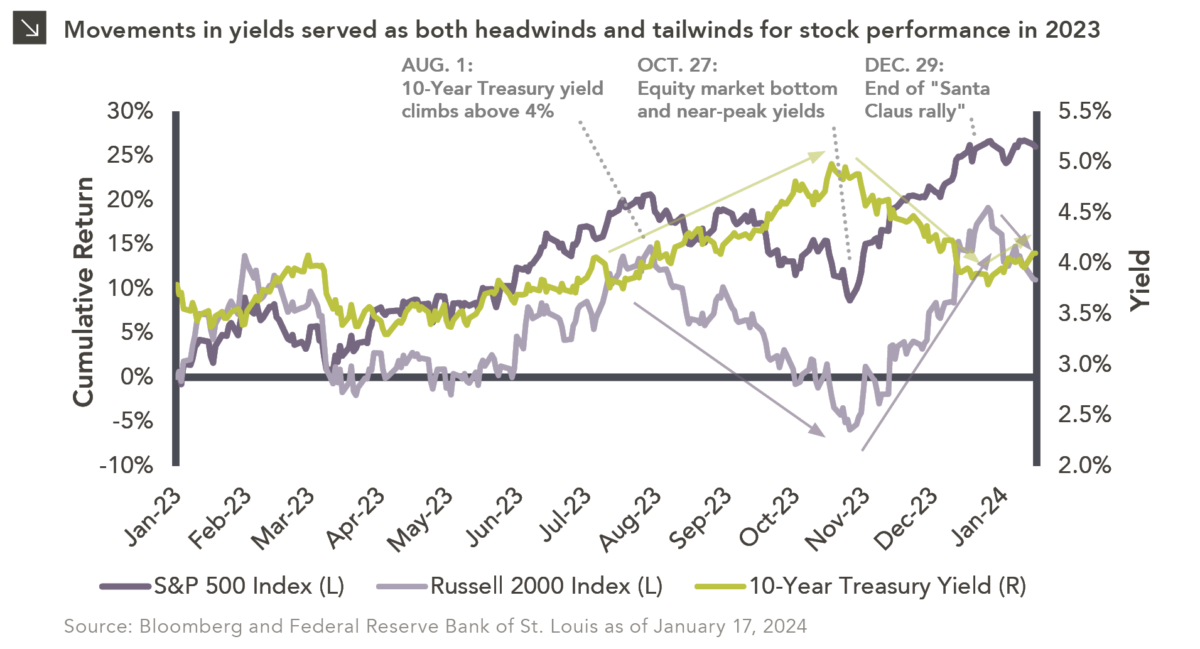
While robust equity market performance in 2023 was certainly in part spurred by the strength of mega-cap technology stocks, economic data and the movement of interest rates also played a critical role. To that point, a decline in Treasury yields to start last year helped fuel a low-quality rally in equity markets, though yields moderated over the next few months following the regional banking chaos that unfolded in February and March. Dynamics shifted in July, however, when yields began to surge as the U.S. Treasury announced new debt issuance to help fund a growing budget deficit. As the year progressed, the continued strength of the domestic economy, including a robust labor market and a resilient consumer, combined with hawkish Fed rhetoric caused yields to climb even further. The 10-Year Treasury yield notably rose to nearly 5% by mid-October, its highest level in over 15 years. Equity markets largely sold off in tandem with this spike in yields, with the Russell 2000 Index reaching an intra-year low on October 27, 2023. Market dynamics once again shifted in the final weeks of 2023, as cooling inflation data led to a more dovish tone from the Fed and widespread investor anticipation of near-term interest rate cuts. This changing sentiment supported a reversal in the 10-Year Treasury yield in late October. As a result of renewed optimism, equity markets exhibited a sustained rally to close the year, with the S&P 500 Index approaching all-time highs in late December. Small-cap equities, which were shunned by investors for much of 2023 amid an environment of higher rates, climbed nearly 25% from their October lows through year-end. Though this rally saw the reemergence of market breadth, as both cyclicals and growth-oriented equities notched strong returns, actively managed strategies struggled due to the outperformance of lower-quality stocks.

This “Santa Claus rally” that ended last year has ultimately tapered off, with equity markets declining to start 2024 amid slightly higher yields. While this trend could foreshadow further challenges for equities in 2024, it may also be a necessary correction. Specifically, given the sharp rise in stocks to close last year, investors may have priced in an overly optimistic probability of interest rate cuts and are just now beginning to consider the possibility that the Fed will not be as accommodative as expected in 2024. This recent correction may also provide some valuation support in the event of any missteps during this quarter’s earnings season, which is slated to kick off in the coming days. As 2024 progresses, policy decisions by the Federal Reserve and the movements in Treasury yields will likely continue to impact investor sentiment and market performance.

A Case of Bad Breadth

The new year presents an opportunity for a fresh investment outlook. As investors hypothesize about where markets may be headed in 2024, a look back at performance during 2023 may prove beneficial. To that point, one of the major narratives over the last year was the dominance of U.S. equities relative to many other asset classes, as the S&P 500 Index returned approximately 26.3% in 2023. As many readers are no doubt aware, the “Magnificent Seven” companies (Amazon, Apple, Alphabet, Meta, Microsoft, Nvidia, and Tesla), which represent nearly one-third of the index, accounted for roughly two-thirds of the calendar year return for the benchmark. While the S&P 500 Index is often considered a proxy for the overall U.S. stock market, it is worthwhile to investigate the extent to which the 2023 return of the benchmark is indicative of broader strength across the equity spectrum, given the fact that just a handful of companies drove the majority of index performance. One way to do this is to assess the returns of equal weight indices and compare them to those of the more traditional, market capitalization weight benchmarks, since equal weight indices eliminate the outsized influence of mega-cap companies like the Magnificent Seven.

For the full calendar year of 2023, the S&P 500 Equal Weight Index returned approximately 13.9%, significantly underperforming its market capitalization weight peer. The S&P 500 Equal Weighted Index also underperformed its international counterpart, the MSCI EAFE Equal Weight Index (+16.9%), meaning the average developed large-cap international stock outperformed the average domestic large-cap stock last year. This comparison suggests that, due to greater breadth of returns, international equity exposure may serve as an attractive complement to domestic stock exposure at the overall portfolio level, given the performance concentration currently exhibited by the U.S. equity market. It is also important to remember that the S&P 500 Equal Weight Index has outgained the S&P 500 Index in 6 of the last 12 calendar years, as these figures speak to the mean-reverting nature of performance over time. Dynamics related to performance breadth and concentration will be important to watch in the year ahead, especially as investors monitor how companies such as the Magnificent Seven navigate the prevailing environment of higher interest rates and slower global growth. Above all else, both recent and longer-term market trends underscore the importance of portfolio diversification, as investors seek to reap potential future benefits of the mega-cap exposure, while also accounting for the risks of index concentration and the opportunities that exist elsewhere.

Many Happy Returns: A Look Back at 2023

After a challenging 2022, during which significant drawdowns were exhibited by equity and fixed income indices alike, last year saw resurgent performance from most areas of the public market landscape. U.S. stocks were higher in 2023, with the S&P 500 and Russell 2000 indices posting returns of 26.3% and 16.9%, respectively, during the year. Key themes within domestic equity markets in 2023 included increased investor interest in GLP-1 obesity drugs, which led to strong performance from large-cap healthcare companies like Eli Lilly, as well as advances within the field of artificial intelligence. These advances resulted in narrow market leadership for much of 2023 and helped fuel a strong 42.7% calendar year return for the Russell 1000 Growth Index, which is home to each of the “Magnificent Seven” companies (Amazon, Apple, Alphabet, Meta, Microsoft, Nvidia, and Tesla) that were ultimately some of the largest beneficiaries of AI-related fervor. Some may have expressed skepticism that U.S. equity markets would exhibit such robust calendar year returns in March of 2023, which saw a banking crisis that led to the shuttering of Silicon Valley Bank, Signature Bank, and First Republic Bank amid an aggressive monetary tightening campaign by the Federal Reserve and widespread runs on deposits. Fortunately, concerns about broader contagion were allayed when the Fed announced plans to protect uninsured deposits at the affected institutions, though performance of mid- and small-cap indices did suffer due to these events.

Non-U.S. equities posted gains in 2023 as well, with the MSCI EAFE and EAFE Small-Cap indices, which track developed market stocks, returning 18.2% and 13.2%, respectively. UK stocks, while still positive for the year, lagged the broad market due to economic stagnation and higher borrowing costs. Japanese equities, on the other hand, served as a bright spot within the developed market space given recent shareholder-friendly corporate governance reforms and monetary policy that continues to be accommodative. The MSCI Emerging Markets Index was positive for the year as well, notching a return of 9.8%. Companies domiciled in Latin American countries like Brazil and Mexico were some of the largest gainers within non-U.S. markets during the year, as many have benefited from a reconfiguration of global supply chains and favorable population demographics. Additionally, the Taiwanese company TSMC, which is the largest constituent of the MSCI EM Index, exhibited strong performance in 2023 thanks to the enthusiasm surrounding AI advances detailed above. Despite these positive outcomes, the 2023 return of the EM benchmark was hampered due to continued challenges faced by China, which was among the worst performing countries during the period. Indeed, a slump in its property sector, ongoing geopolitical issues, a weak job market, and widespread debt stress in the corporate space have spelled trouble for China’s economy in recent time, however, many believe the nation’s slowdown has bottomed.

Fixed income indices were also positive in 2023 after a dismal 2022, with falling inflation, a resilient economy, and expectations of interest rate cuts on the horizon leading to a bond market rally to end the year. To that point, the yield on the 10-year Treasury, which sat above 5.0% less than three months ago, has now dropped to below 3.9%. Thanks in part to these dynamics, the Bloomberg Aggregate Index notched a return of 5.5% in 2023, while high yield bonds (+13.4%) and bank loans (+13.0%) posted their best calendar year performance figures since 2019 and 2009, respectively.

It is important to note that private markets asset classes, including private equity and real estate, report performance on a lagged basis, meaning full calendar year returns for these spaces will not be available for some time. In the coming weeks, Marquette will be providing more detailed analysis related to both public and private market performance in 2023, as well as what investors might reasonably expect in the new year. We encourage clients, in tandem with their consultants, to review these analyses, as well as existing investment exposures and policy targets, to ensure the appropriate positioning of portfolios in 2024 and beyond. Finally, as it relates to the new year, we wish all readers many happy returns!


Benchmarks:
Core Bond: Bloomberg Aggregate Index
High Yield: Bloomberg High Yield Index
Bank Loans: CS Leverage Loan Index
Broad U.S. Equities: Russell 3000 Index
Large Cap: S&P 500 Index
Mid Cap: Russell Mid Cap Index
Small Cap: Russell 2000 Index
Broad Intl Equities: MSCI ACWI ex-USA Index
Intl Large Cap: MSCI EAFE Index
Intl Small Cap: MSCI EAFE Small Cap Index
Emerging Markets: MSCI Emerging Markets Index
Commodities: S&P GSCI

Small-Cap Healthcare: The Biggest Loser

Innovations in the field of weight loss are nothing new, as the first generation of products designed to provide individuals with slimmer waistlines were first developed nearly 100 years ago. These products primarily consisted of stimulants, such as dinitrophenol and methamphetamine. The healthcare industry has since moved on from such stimulants as other products have come to market in recent time, including Saxenda by Novo Nordisk. Saxenda, which was approved by the U.S. Food and Drug Administration (FDA) in 2014, represents the first GLP-1 product designed for weight loss management. A second Novo Nordisk product, Wegovy, was approved by the FDA in 2021. Indeed, these and other GLP-1s have been on the market for several years now, however, investors took particular note of these products in 2023, which led to notable impacts across the healthcare space in terms of equity performance.

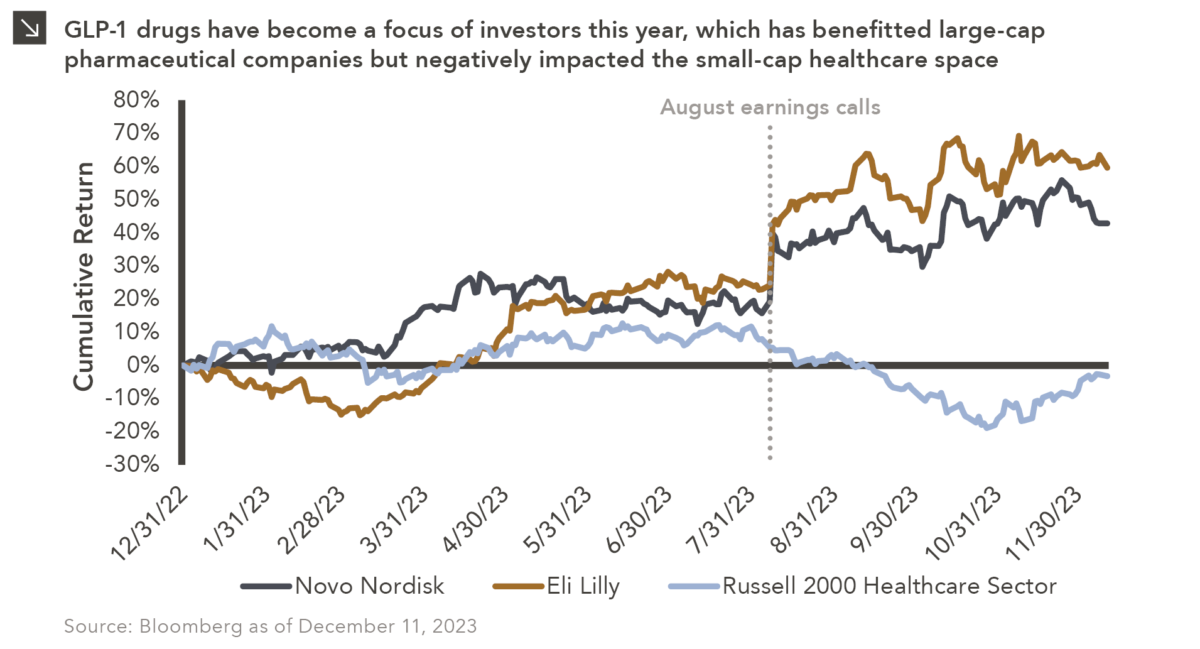
On the positive side, many large-cap pharmaceutical companies, including Novo Nordisk and Eli Lilly, have benefitted from increased investor focus on GLP-1s this year. In August, new guidance related to these drugs was issued during the earnings calls for both businesses, fueling upticks in their respective share prices as shown in this week’s chart. Specifically, Novo Nordisk reported sales growth of 157% for its obesity-related drugs, with North American operations growing sales for these products by a staggering 207%. Elli Lilly also shared positive news on its August earnings call with investors, including robust sales growth of Mounjaro, the company’s diabetes drug. This growth led to investor optimism related to the potential of Elli Lilly’s weight loss management drug Zepbound, which was ultimately approved by the FDA in November. As of the time of this writing, the share prices of Novo Nordisk and Eli Lilly are up roughly 42.8% and 59.6%, respectively, on a year-to-date basis. Negative impacts stemming from increased investor focus on GLP-1s were primarily observed within the small-cap space, specifically the healthcare sector of the Russell 2000 Index. To that point, the weight loss products detailed above caused some investors to question the extent to which other healthcare products and services, including orthopedic surgeries and sleep apnea machines, would be utilized by new and existing patients going forward. This uncertainly led to a decline of the healthcare sector of the Russell 2000 Index of roughly 25% in the three months leading into November, though the space has recovered some of those losses within the last several weeks.

Even though GLP-1 drugs have been available in the market for some time, their adoption for weight loss management remains nascent and has investors excited for the future of the healthcare space. Time will tell how successful and disruptive these products will ultimately prove, and Marquette will continue to monitor the impact of these drugs on equity markets, both broadly and at the sector level.

The Chart for Red October

U.S. equities declined for the third consecutive month in October amid an environment of higher yields and underwhelming earnings reports for many key index constituents. The S&P 500 Index, while still positive on a year-to-date basis, dropped by more than 2.0% during the month and is now more than 8.0% off its July peak. The Nasdaq-100 Index, which skews more heavily to growth-oriented segments of the market like Information Technology, also saw a decline of more than 2.0% in October. Finally, the Russell 2000 Index, which tracks the U.S. small-cap market, returned roughly -6.8% during the month and is now negative on a year-to-date basis.

As stated above, elevated yields have weighed on equity indices in recent time. The yield on the 10-year Treasury, for instance, recently eclipsed 5% for the first time in over 15 years, while most short-end rates remain at levels not seen since the Tech Bubble of the early 2000s. Higher yields have the effect of applying pressure to equity price multiples and enticing investors to allocate away from stocks and toward bonds. Smaller companies are often disproportionately impacted by higher rates because of the large debt burdens typically associated with those businesses, which helps to explain the underperformance of the Russell 2000 Index relative to the broad market over the last several months. Additionally, optimism surrounding some of the mega-cap technology companies that have exhibited robust returns this year, commonly referred to as the “Magnificent Seven,” appears to be waning. For example, Alphabet (the parent company of Google), saw its shares decline by roughly 10% the day after it reported a smaller-than-expected profit in its cloud computing segment. Amazon, Meta, and Tesla have also seen their shares trade lower in recent weeks due to investor concerns about future sales and margins. While it is important to note that none of these companies reported overly problematic earnings data for the third quarter, lofty valuations and investor exuberance have left their share prices vulnerable to pullbacks when results are even slightly disappointing.

While recent performance of equity indices has surely been challenged, there are several reasons for investors to stay the course. For instance, the Federal Reserve is likely nearing the end of its hiking cycle, meaning the pressure being applied to stock prices by higher yields may soon abate. It is also important to remember that markets often exhibit mean-reverting patterns of performance, meaning strong equity returns typically follow periods of stress. Marquette will continue to monitor dynamics within stock markets and provide guidance to clients accordingly, while also emphasizing the need for prudence and a long-term approach as it relates to equity investing.

3Q 2023 Market Insights Video

This video is a recording of a live webinar held on October 26 by Marquette’s research team, featuring in-depth analysis of the third quarter and themes we’ll be monitoring for the remainder of the year.

Our Market Insights series examines the primary asset classes we cover for clients including the U.S. economy, fixed income, U.S. and non-U.S. equities, hedge funds, real estate, infrastructure, private equity, and private credit, with presentations by our research analysts and directors.

Sign up for research alerts to be invited to future webinars and notified when we publish new videos. 
For more information, questions, or feedback, please send us an email.

Portfolio Trick or Treat

Coming into 2023, investors were cautiously optimistic about 2023 market returns; cautious considering the broad losses across asset classes during 2022 but optimistic about more attractive valuations and the inherent upside potential stemming from these price points. Nine months into the year, which of these opportunities have been “treats” for investors, and which have been “tricks”?

In this edition:

  • The biggest trick of them all: Investment grade fixed income
  • But not all of fixed income has been a trick…
  • Tricks come in all sizes: U.S. small-cap equities
  • Trick, treat, or both? U.S. growth stocks
  • Currency movements still tricky
  • More treat than trick: Emerging markets
  • If you’re not surprised, it’s not a trick: Commercial real estate

U.S. Equities: Surprising Strength Gives Way to Macro Risks

Equity market strength through the third quarter continues to challenge the common expectation going into the year. Cumulatively through September 30, the slowdown many investors anticipated has been averted thus far as the strength in certain segments of the market has more than offset the weakness in others. Following the strength of value equities — with Energy the lone positive sector in 2022 — markets experienced a shift in leadership to begin 2023. Companies that were challenged by supply chain issues and wage pressures rebounded to begin the year, primarily within growth-oriented sectors including Communication Services, Information Technology, and Consumer Discretionary. Overall, markets were strong through the first nine months of the year, as the S&P 500 rose 13.1%. However, September — historically the worst month of the year for equity markets — saw a somewhat unsurprising pullback. As we enter the final quarter of the year, we feel it is important to examine the underlying market dynamics driving performance and highlight the risks of a narrow market as well as the opportunities available on the sidelines.

Selling Insurance: An Option for Diversification

The Aflac Duck, the LiMu Emu, and the GEICO Gecko may be fictional insurance salespeople (or sales-animals, perhaps), however, the market participants involved in the selling of financial insurance are all too real. Put options are a popular form of such insurance, as these instruments afford the option holder the right to sell an underlying security at a given level, effectively insulating the holder against significant drops in the price of the underlying security. That said, much like bundling your home and auto with Jake from State Farm, this insurance comes at a cost based on implied volatility. For those who choose to purchase options contacts on the broad-based S&P 500 Index as a means of insuring portfolios against losses, this implied volatility is measured by the VIX Index, which uses at-the-money S&P 500 Index options to assess expectations of near-term market fluctuations. Over the long term, these expected volatility levels tend to be higher than what is actually exhibited. Specifically, since the start of 1990, implied volatility of the S&P 500 Index was greater than what was subsequently realized in roughly 87% of daily observations, and the difference between the two was roughly 4.5% on average over the same time period. This phenomenon leads to the systematic over-pricing of put option contacts and is highlighted in the top half of this week’s chart.

The data points noted above demonstrate the fact that selling insurance contracts on the U.S. equity market has generally been a profitable endeavor over the last several decades. To that point, the CBOE S&P 500 PutWrite Index, which is comprised of short positions in at-the-money put options on the S&P 500 Index and short-term Treasury bills which serve to collateralize the option positions, is an effective tool for measuring exactly how beneficial this activity can be for investors. On a trailing 10-year basis as of September 30, the PutWrite index notched an annualized return of 6.7%. While this is significantly lower than the 13.1% figure for the S&P 500 over the same period, the PutWrite benchmark has notably delivered that performance with a lower annualized standard deviation — 9.7% vs. 15.0% for the S&P 500. Performance of the PutWrite benchmark during down markets has been particularly compelling, with the index outperforming the S&P 500 in six of the last seven calendar years during which the S&P 500 was negative. This performance pattern can be observed in the bottom half of this week’s chart. It is important to note that active managers within the space can provide additional value over the PutWrite index by selling the most attractive options, diversifying the portfolio of options across different strike prices and tenors, and optimizing the pool of cash with which the options are collateralized.

Readers should be aware of the fact that options selling is not without risk. Performance typically lags during strong, upward-trending markets, and a relatively high equity beta means that these types of strategies will be more correlated to stock market movements than other diversifying alternatives. That said, options-based strategies could present attractive opportunities for many investors due to the systematic processes with which they are implemented, the lower fees and better liquidity terms associated with them relative to other alternatives, and the likelihood that the volatility risk premium will persist into the future. Marquette will continue to monitor the persistence of this premium, conduct due diligence on investment managers in the options space, and provide education and recommendations to clients accordingly.