What Does Elevated Index Concentration Mean for Active U.S. Equity Managers?

Indexing has risen in popularity over the last decade, particularly for U.S. equity investors. The fees are lower and indexing is perceived as less risky, with investors primarily seeking beta exposure to the market. However, these indices have evolved against an ever-changing economic and financial market backdrop. As a result, several unintended structural issues have emerged, particularly related to concentration risk. Understanding this evolution and how it could alter the overall exposures within a broader portfolio is critical, as these indices are not static. Notably, the composition of some indices alongside the increase in passive capital has created headwinds for active managers and helps to explain recent performance challenges.

This newsletter examines the progression of passive management, how and why U.S. equity index concentration has increased in recent years, and the effects and risks investors need be aware of across the market capitalization spectrum.

Disappointments to the Downside

Many readers likely know that when it comes to investor sentiment and market performance, economic results relative to forecasts can be just as important as the results themselves. To that point, the Bloomberg U.S. Economic Surprise Index currently sits at roughly -0.6, which represents its lowest level in nearly a decade. According to Bloomberg, this index is an objective and quantitative measure that aggregates the differences between actual economic data and the median forecast from surveys of economists. Said another way, the index measures the degree to which U.S. economic data releases surprise to the upside or downside relative to market expectations. The index compiles various U.S. economic indicators, including employment numbers, GDP growth, inflation rates, and consumer confidence, then each economic data release is compared to the consensus estimate and the difference is standardized. A positive index reading indicates that economic data have, on average, been better than expected, while a negative reading indicates that data have been worse than expected.

Recent data releases that have driven the Bloomberg Economic Surprise Index lower include U.S. manufacturing activity, which contracted for a third consecutive month in June as measured by the ISM Manufacturing PMI. Many economists expected this gauge to increase from the 48.7 figure exhibited in May to 49.1, but it instead fell to 48.5. Additionally, the U.S. ISM Services PMI, which measures the economic condition and performance of service-based companies, dipped to 48.8 in June. This represents the sharpest contraction for that index in more than four years, meaning forecasters who were expecting the June figure to be closer to 52.5 after a 53.8 reading in May were far off the mark.

Interestingly, equity markets seem to be largely unphased by these disappointments to the downside, as the S&P 500 Index has returned nearly 12% since the Bloomberg Economic Surprise Index fell into negative territory roughly 10 weeks ago. This is likely in part due to the fact that readings of inflation, perhaps the economic metric investors are currently watching most intently, have actually come in below consensus expectations over the last three months (as measured by CPI). That said, continued downside surprises could spell trouble for equities, as major stock indices have tended to display a material degree of correlation to the Bloomberg Economic Surprise Index over the last several decades. In the months ahead, investors should consider both the absolute levels of indicators, as well as releases relative to forecasts, in order to properly assess the impact of economic data on market performance.

“Renew” Your Opinion on Policy Bets

During election season, investors are often tempted to position their portfolios based on expectations related to potential changes in government policy. That said, market dynamics in the wake of various political events can be confounding and notoriously difficult to forecast. There is perhaps no better example to support this statement than performance of the energy space over the last seven years.

When Donald Trump assumed the presidency in 2017, his administration sought to rescind many environmental regulations and attain energy independence via the use of fossil fuels. His term saw the approval of multiple controversial oil pipelines, a large expansion of oil and gas leasing, and support for energy development on federal land. Since coming to office in 2021, however, Joe Biden has aimed to reverse many of the energy policies of his predecessor, as well as promote an agenda focused on the reduction of greenhouse gas emissions and the development of renewable energy sources. Based on this information, many readers might have expected robust performance of traditional energy companies during the Trump presidency, as well as more challenged returns for clean energy stocks. The policies of the Biden administration, on the other hand, might have been expected to lead to a reversal of these dynamics. Readers may be surprised to learn, however, that the Energy sector of the S&P 500 Index returned -29.6% during Trump’s term in office, compared to 136.1% since Biden assumed office. Conversely, the S&P Global Clean Energy Index returned 305.9% in the four years of Trump’s presidency but has notched a -54.0% gain during the Biden term.

There are many factors that can help explain these and other surprising performance trends. First, markets tend to be forward-looking in nature, meaning current prices of financial assets usually reflect investor expectations of what is to come in the (sometimes distant) future. Additionally, exogenous shocks can roil securities markets and lead to dynamics that would have otherwise been unexpected based on prevailing conditions and the agendas of those in political office. For instance, the COVID-19 pandemic upended supply chains and the 2022 Russian invasion of Ukraine led to increases in the prices of certain commodities, and these developments were largely conducive to positive performance from traditional energy companies despite a renewables-focused U.S. president. Finally, there is the question of natural business and economic cycles, which have tended to ebb and flow regardless of which party controls the White House. All of this is to say that market timing around an election or any other major political event can be a most difficult exercise. Given the upcoming presidential election in the U.S., investors should remain diversified across the asset class spectrum in order to capture market gains and insulate their portfolios against losses, both of the expected and unexpected kind.

Airline Stocks: Just Plane Challenged

Although travelers have happily bid farewell to pandemic-related restrictions and returned to the skies en masse, airline stocks seem to have missed the memo on bouncing back to pre-COVID levels. To that point, the Dow Jones U.S. Airlines Index has returned roughly -35% since the start of the pandemic. This cumulative performance figure is despite a surge in the index in the wake of vaccine announcements in late 2020, as well as the fact that that this summer may be the busiest travel season the U.S. has ever seen. These dynamics can be observed in this week’s chart.

The dichotomy between booming travel numbers and lackluster airline stock performance can be attributed to several challenges facing the industry. Specifically, while increased passenger volumes boost revenues for major airlines, these businesses continue to grapple with profit margin pressures stemming from soaring operational costs. For instance, higher oil prices (now $80 per barrel compared to roughly $55 before the pandemic) have proved to be a significant headwind for airlines. Additionally, ongoing issues including pilot and crew shortages, escalating wages, operational inefficiencies, and higher maintenance expenses have further constrained airline profitability in recent time. Spending on corporate travel has also been somewhat tepid over the last few years as well, which has presented problems for airlines that offer premium upgrades such as business class seating.

In conclusion, the challenges faced by airlines will likely persist into the near future, though robust passenger volumes are certainly a cause for optimism. As it relates to investor exposure to these types of stocks in general, four major airlines (American, Delta, Southwest, and United) are constituents of the S&P 500 Index, and these carriers comprise roughly 0.2% of the benchmark. In other words, adequate diversification should mitigate the impacts of the headwinds described above at the portfolio level.

The Capital Structure Shuffle

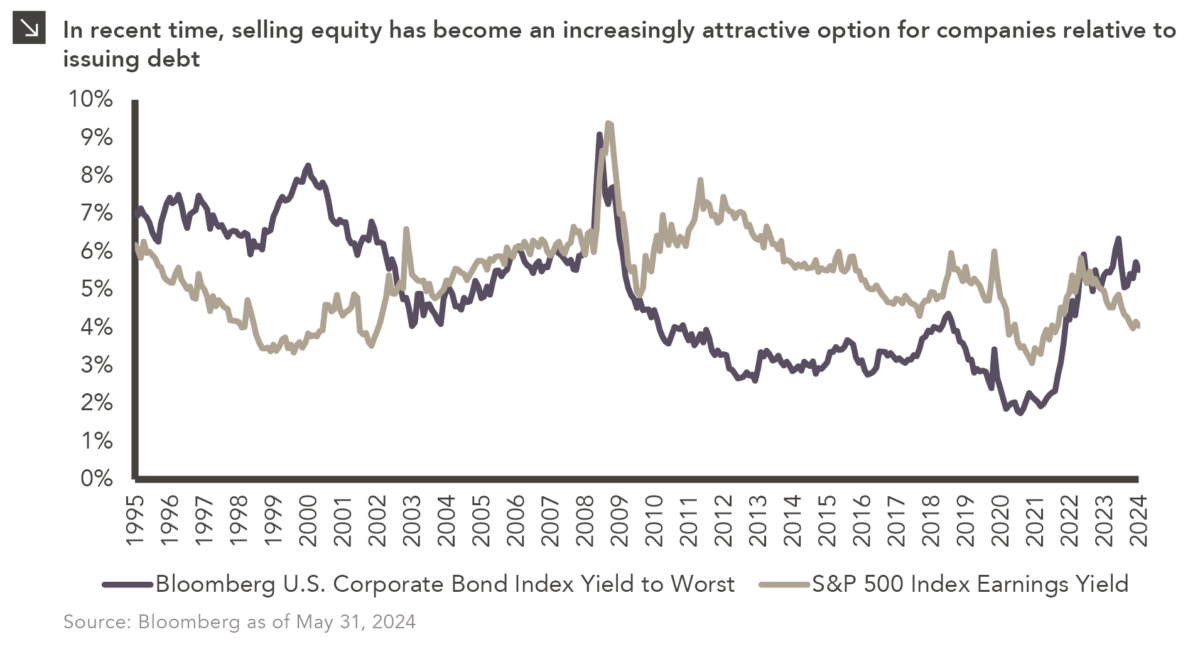
In the years following the Global Financial Crisis, issuing new debt was an easy decision for companies looking to raise capital given an environment of historically low interest rates. That said, decisions related to the composition of corporate capital structures are now less straightforward due to seismic shifts in monetary policy that have taken place in recent time. To that point, this week’s chart compares the yield-to-worst of the Bloomberg U.S. Corporate Bond Index, a proxy for the cost of debt, to the earnings yield of the S&P 500 Index. The earnings yield is calculated by dividing earnings-per-share by the price of the index and is used as a proxy to determine the costs companies face when it comes to new equity share issuance (i.e., the lower the earnings yield, the cheaper it is to sell shares and vice versa). As readers can observe in the chart above, this yield now sits below the yield-to-worst of the fixed income index.

Companies generally prefer issuing debt over equity due to the tax shield associated with this financing (i.e., interest expenses are typically tax-deductible), which still renders debt the more cost-efficient option for many companies in the current environment. Further, equity issuance is often viewed negatively by market participants due to the dilution of per-share earnings that arises as a result.  There are, of course, additional factors beyond the costs of debt and equity that CFOs must consider when making decisions related to capital structure dynamics. That said, in light of the trends outlined above, many companies may begin to view equity issuance as a more attractive option when it comes to raising capital.

1Q 2024 Market Insights Video

This video is a recording of a live webinar held April 25 by Marquette’s research team analyzing the first quarter of 2024 across the economy and various asset classes and themes we’ll be monitoring in the coming months.

Our quarterly Market Insights series examines the primary asset classes we cover for clients including the U.S. economy, fixed income, U.S. and non-U.S. equities, hedge funds, real assets, and private markets, with commentary by our research analysts and directors.

Sign up for research alerts to be invited to future webinars and notified when we publish new videos. If you have any questions, please send us an email.

Mind the Gap

Any ride on the London Tube reminds riders to mind the gap: Beware the space between train car and platform as you board and depart the train. A recent trip to London brought this phrase back to me and it seemed like a perfect description of how to look at financial markets this year, with the “gap” serving as the difference between expectations and reality, most particularly in terms of interest rate cuts.

In our market preview, we identified the Fed pivot as a primary driver of financial markets this year, most especially how expectations of cuts would line up with actual Fed policy. Going into the year, the market had priced in at least five cuts, which helped fuel a furious fourth quarter rally and investor optimism for 2024. One quarter in, however, those expectations have been turned on their head. Hotter than expected inflation and jobs reports in March have created a “higher for longer” narrative with the market expecting no more than two cuts during the second half of the year. Some economists have taken an even more bearish stance, suggesting there will not be any cuts. Overall, rates rose across the curve during the quarter as current U.S. debt levels sustained the long end of the curve while the short end was relatively unmoved.

Intuitively, many investors would expect such a big change in rate expectations to weigh heavily on markets, both equities and bonds. In that sense, equity performance was surprising during the first quarter, as the upward trend from 2023 continued. Predictably, bonds suffered as rates rose, but below investment grade sectors were profitable. To be fair, though, it should be noted that equities have endured a difficult start to this month, down 4.6% through April 22 as the higher for longer narrative has gained momentum.¹

Going forward, what should we watch for from asset classes as we venture into a market environment that looks much different than what we were expecting only three months ago?

Assessing the Likelihood of a Recession and Understanding the Impact on Portfolios

Is a recession coming to the U.S.? It’s a question that has been asked since 2022, as the Fed’s rapid rate hikes sparked concern that higher interest rates would lead to demand destruction and ultimately economic contraction. Nonetheless, here we are in the first quarter of 2024 and although the growth rate of gross domestic product has fallen, it is still positive. Unemployment remains at historic lows and inflation is falling. However, with the Fed unlikely to cut rates during the first half of the year and the full effect of the higher rate environment not yet settled, the recession threat still looms over the economy and markets. Given this background, the following paper presents three reasons for each side as to whether the U.S. may enter or avoid a recession in 2024, as well as recessionary implications across asset classes.

The Dynamic Duo

In 2023, investors were stunned by the robust performance of seven prominent mega-cap stocks deemed the “Magnificent Seven.” Largely beneficiaries of the AI craze, these seven companies comprised almost 28% of the S&P 500 at the end of 2023. This narrow breadth and concentration within the market posed challenges for active large-cap managers who struggled to keep pace with benchmarks without matching the weight of this group in their portfolios. While market breadth has started to improve among large caps, a similar trend is now emerging in the small-cap universe with just two stocks, Super Micro Computers and MicroStrategy — now the two largest companies and weights in the Russell 2000, spearheading the majority of the index’s returns this year.

Since the onset of 2023, Super Micro and MicroStrategy have posted remarkable returns of 1,093% and 936%, respectively, driving up their weights in the Russell 2000 to 1.94% and 0.85%. For perspective, prior to this year, the index’s most substantial single weight since 1985 was 1.45%, at the peak of the dot-com bubble. Like the Magnificent Seven, these two firms have profited from the proliferation of AI. MicroStrategy has also capitalized on the recent cryptocurrency surge over the past six months.

While the performance of these stocks captivates attention, they have become a pain point for active small-cap managers trying to outperform the Russell 2000. Leaving aside fundamental underwriting, many small-cap managers are constrained by prudent limits on market capitalization for the companies they can invest in, and these two outsized outperformers fall far beyond those. As of March 18, Super Micro had a market cap of $55.5 billion and MicroStrategy stood at $25.3 billion, both in large-cap territory. While the Russell 2000 maintains a $6 billion market capitalization threshold for small-cap stocks, the index is only reconstituted once annually, and both companies fell within the limit in April 2023 when FTSE Russell last evaluated index characteristics. Despite their stellar performance, many managers will be unable to allocate to these companies due to their size. Though managers with prior allocations may be able to hold their positions, it could prompt scrutiny regarding the discipline of their investment approach. This predicament mimics the struggles seen in the large-cap space last year, where a select few companies drove much of the market’s performance and active manager relative weights dictated attribution. With the next Russell reconstitution not slated until June 28 of this year, active small-cap managers may have to get creative in order to navigate these challenges.

2024 Market Preview Video

This video is a recording of a live webinar held January 25 by Marquette’s research team analyzing 2023 across the economy and various asset classes as well as what trends and themes we’ll be monitoring in the year ahead.

Our quarterly Market Insights series examines the primary asset classes we cover for clients including the U.S. economy, fixed income, U.S. and non-U.S. equities, hedge funds, real assets, and private markets, with commentary by our research analysts and directors.

Sign up for research alerts to be invited to future webinars and notified when we publish new videos. If you have any questions, please send us an email.